You picked up the iPad and the Safari compass icon is simply gone, or it is greyed out and won’t open, and you need a browser now. Outside the EU, Safari can’t be deleted from an iPad, so it is either hidden from the Home Screen (search for it in the App Library) or blocked in Screen Time (turn it back on under Settings > Screen Time > Content & Privacy Restrictions).
Find Safari if It’s Only Hidden
Start here, because it takes ten seconds. An iPad keeps every installed app in the App Library, even apps that have been removed from the Home Screen. Apple’s App Library guide for iPad explains how to find and move them.
- Swipe left past your last Home Screen page to open the App Library. You can also tap the App Library button at the right end of the Dock.
- Tap the search field at the top and type Safari.
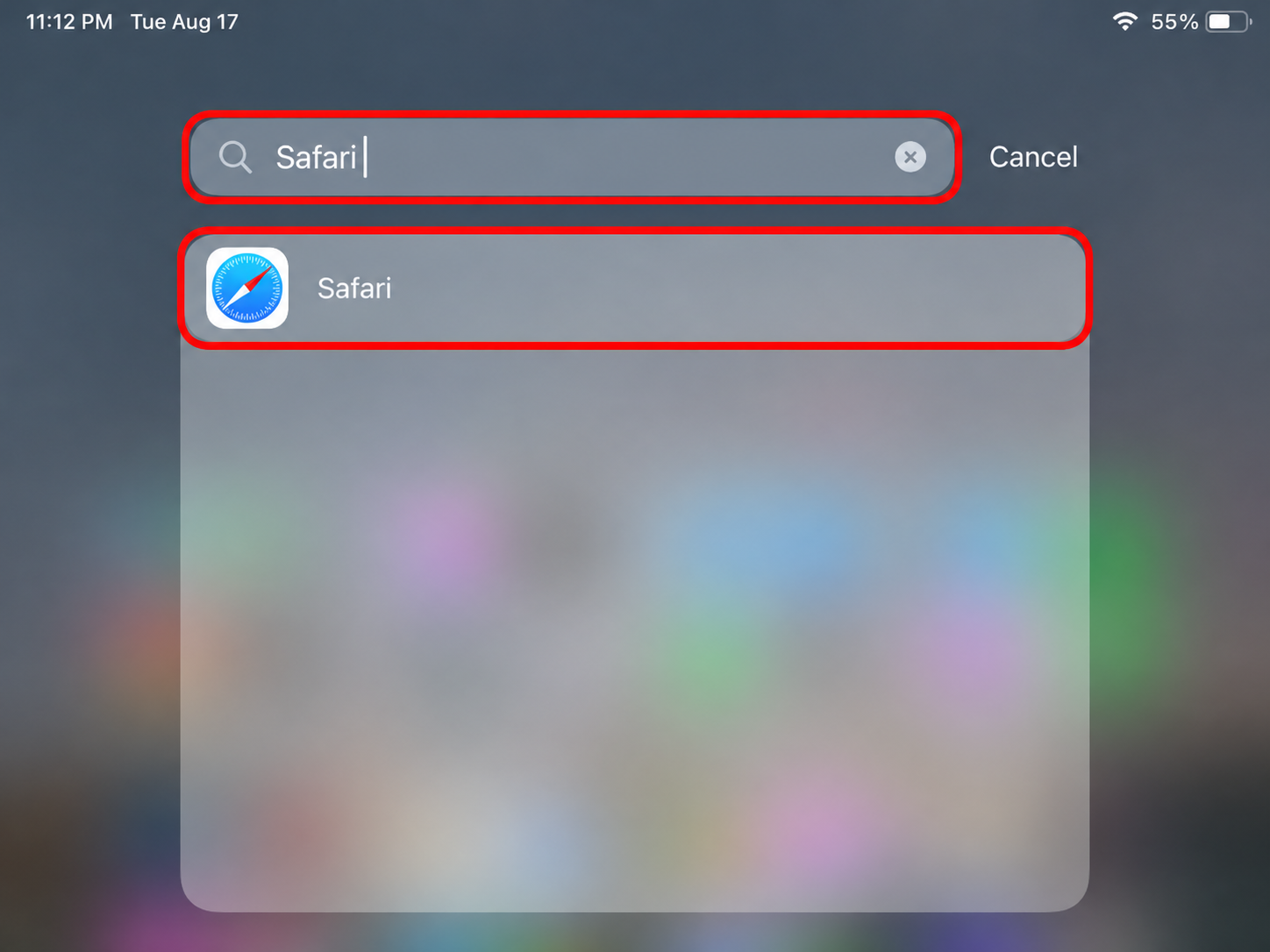
- If Safari appears, tap it to open it right away.
- To put it back on the Home Screen, touch and hold the Safari icon in the App Library until the icons jiggle and it jumps to the Home Screen, then lift your finger. You can then drag it into the Dock.
If Safari doesn’t show up in the App Library search at all, it is almost certainly blocked by Screen Time or by a school or work administrator. Skip to the Screen Time section below.
Check for a Hidden Home Screen Page
Sometimes Safari is still on a Home Screen page, but that whole page has been hidden. To show hidden pages, touch and hold an empty part of the wallpaper until the icons jiggle, tap the dots near the bottom of the screen, and put a checkmark under any page you want to show. Tap Done.
New apps follow the choice in Settings > Home Screen & App Library, where you can pick Add to Home Screen or App Library Only. That setting doesn’t move Safari, but it explains why other new apps might not show up on your Home Screen either.
If Safari opens only after Face ID, Touch ID or the passcode, it has been locked. Touch and hold the icon, tap Don’t Require Face ID (or Touch ID or Passcode), and authenticate. Apple’s guide to locking or hiding an app notes that apps that come installed, like Safari, can’t be hidden, so they won’t be in the App Library’s Hidden folder.
Can Safari Be Deleted From an iPad?
Not in most countries. Safari isn’t on Apple’s list of built-in apps you can delete. In the European Union, Apple lets you delete Safari once another browser is set as the default; if that happened, redownload Safari from the App Store, as Apple’s article on deleting built-in apps in certain countries or regions explains. When you touch and hold the Safari icon, you can remove it from the Home Screen, which only moves it to the App Library. That is why searching for it in the App Library works, and why, outside the EU, there is no Safari to redownload from the App Store. If someone tells you to “reinstall Safari,” they are thinking of a different app.
Turn Safari Back On in Screen Time
Screen Time can switch off built-in apps, and Apple’s iPadOS 26 guide to blocking apps with Content & Privacy Restrictions says an app turned off this way isn’t deleted: it is temporarily hidden from the Home Screen until you turn it back on. Turning it back on is the whole fix. You’ll need the Screen Time passcode if one was set, which is often a different code from the one that opens the iPad.
On Your Own iPad (iPadOS 26)
- Open Settings and tap Screen Time.
- Tap Content & Privacy Restrictions and enter the Screen Time passcode if asked.
- Tap Allowed Apps & Features.
- Turn on the switch next to Safari.

- Go back to the Home Screen or App Library. Safari should be back where it was.
If you want restrictions gone entirely, you can turn off Content & Privacy Restrictions at the top of that screen instead, but that also lifts every other limit, such as purchase and content ratings.
On iPadOS 27
Apple reorganized Screen Time in iPadOS 27. Its current Screen Time guide places controls for built-in features under Settings > Screen Time > Content & Privacy Restrictions > Other Features, where you allow or block items such as AirDrop and Camera. Look for Safari there first. If you don’t see it, check the screen named Allowed Apps & Features or a similar label on your version, because Apple’s page doesn’t list Safari by name.
On a Child’s iPad Managed With Family Sharing
If a parent manages the iPad through Family Sharing, the block is usually set from the parent’s device, and changing it on the child’s iPad may be locked. Apple’s parental controls article describes the route on iPadOS 27 and iOS 27: on the parent’s iPhone or iPad, go to Settings > Family, tap the child’s name, then Apps & Websites, enter the Screen Time passcode, select the app and unblock it; Apple notes you can unblock an app at any time. Apple notes that a blocked app isn’t deleted; it appears dimmed on the Home Screen, which matches the “greyed out” Safari many people see. On iPadOS 26, the parent opens Settings > Screen Time, taps the child’s name, then Content & Privacy Restrictions > Allowed Apps & Features.
For example, if Maya’s son finds Safari dimmed on his iPad, Maya opens Settings > Family on her own iPhone, picks his name, and allows Safari in Apps & Websites. His iPad picks up the change without anyone touching it. For more on setting these limits, see how to change age restrictions on an iPad.
If You Forgot the Screen Time Passcode
The Screen Time passcode is separate from the passcode that opens the iPad. Apple’s Screen Time passcode article describes how to reset it on iPadOS 27:
- Open Settings > Screen Time.
- Tap Passcode & Management.
- Tap Change Screen Time Passcode, then tap it again.
- Confirm with Face ID, Touch ID or the passcode that opens the iPad. If asked, enter the Apple Account email and password used to set up Screen Time Passcode Recovery.
- Enter a new Screen Time passcode twice.
On iPadOS 26 there is no Passcode & Management screen: scroll down on the Screen Time screen to find Change Screen Time Passcode and follow the prompts.
If the iPad belongs to a child in Family Sharing, the parent or family organizer resets the child’s passcode from their own device. If you can’t reset it, Apple says you need the same Apple Account that was used when the passcode was created.
If the iPad Belongs to a School or Employer
School and work iPads are often managed with a device management profile, which can restrict apps without any Screen Time setting showing it. To check, open Settings > General > VPN & Device Management. Apple’s list of device management restrictions includes one that makes Safari unavailable and removes its icon. If you see a profile from your school or company there, the Safari block probably comes from the administrator, and only they can lift it.
Don’t delete that profile to get Safari back. Apple’s guide to reviewing configuration profiles notes that removing a profile also removes its settings, apps and data, and that you should check with the administrator first on a school or business device. Ask IT whether Safari can be allowed, or whether they want you to use a different browser.
If Safari Opens but Pages Won’t Load
A Safari that opens and then shows blank pages or errors is a different problem from a missing icon. Apple’s troubleshooting article for Safari not loading websites suggests working through these in order:
- Try another network: switch to a different Wi-Fi network, or to cellular on a cellular iPad, and reload the page.
- If you use a VPN, check its settings, since a VPN can block or change connections.
- Restart the iPad.
- Clear website data in Settings > Apps > Safari > Clear History and Website Data, then tap Clear History. Expect to sign back in to websites afterward. More detail on this is in how to clear the cache on iPhone and iPad.
- Make sure JavaScript is on (next section).
- If you use iCloud Private Relay, turn it off temporarily in your iCloud settings and test the page again.
If only one website fails while others work, Apple suggests contacting that site’s developer. And if your open tabs vanished after a crash or restart, see how to restore tabs on an iPad. A page that says the site is restricted comes from Screen Time, and unblocking a website on iPad covers that case.
Turn On Cookies and JavaScript in Safari
Some people searching for “enable Safari” really mean that a site says to enable cookies or JavaScript. Both switches live in the Settings app, not inside Safari.
- Open Settings > Apps > Safari.
- Tap Advanced.
- To allow cookies, turn off Block All Cookies, as Apple’s iPad cookies instructions describe.

- To allow JavaScript, turn on JavaScript on the same screen.
- Close and reopen the website.
Blocking all cookies keeps many sites from signing you in or remembering your cart, so leave it off unless you have a specific reason.
Safari on iPad Questions
Why is Safari greyed out on my iPad?
A dimmed icon usually means the app is blocked through Screen Time, often by a parent using Family Sharing. Allow it again from the device that manages Screen Time.
Will turning Safari back on change my bookmarks or other apps?
No. Because a blocked app is only hidden, your bookmarks and Safari settings stay in place, and other apps aren’t affected.
Is the fix different on an iPhone?
The causes are the same, but the screens differ slightly. See how to get Safari back on an iPhone for that version.
Can I use a different browser while I sort this out?
Yes, if downloads from the App Store aren’t restricted too. A parent who blocked Safari on purpose may also have limited app downloads, so ask before working around the block.
Once Safari is back, drag it into the Dock so it is harder to lose next time.

Matthew Burleigh is the founder, head writer, and editor of Solve Your Tech, which he launched in 2012. He has written technology tutorials since 2008 and worked in IT since 2003, including small-business support, IT management, and consulting. He holds Bachelor’s and Master’s degrees in Computer Science from Arizona State University.
Matthew writes practical guides for Windows, iPhone and iPad, Microsoft Office, Outlook, Google apps, and Android. Solve Your Tech’s guides are checked step by step against the device or app maker’s own documentation and tested on his own devices whenever he has the hardware or software, with clear steps, sources, and update dates.
Read more about Matthew and how Solve Your Tech writes and updates its guides, or report a correction.