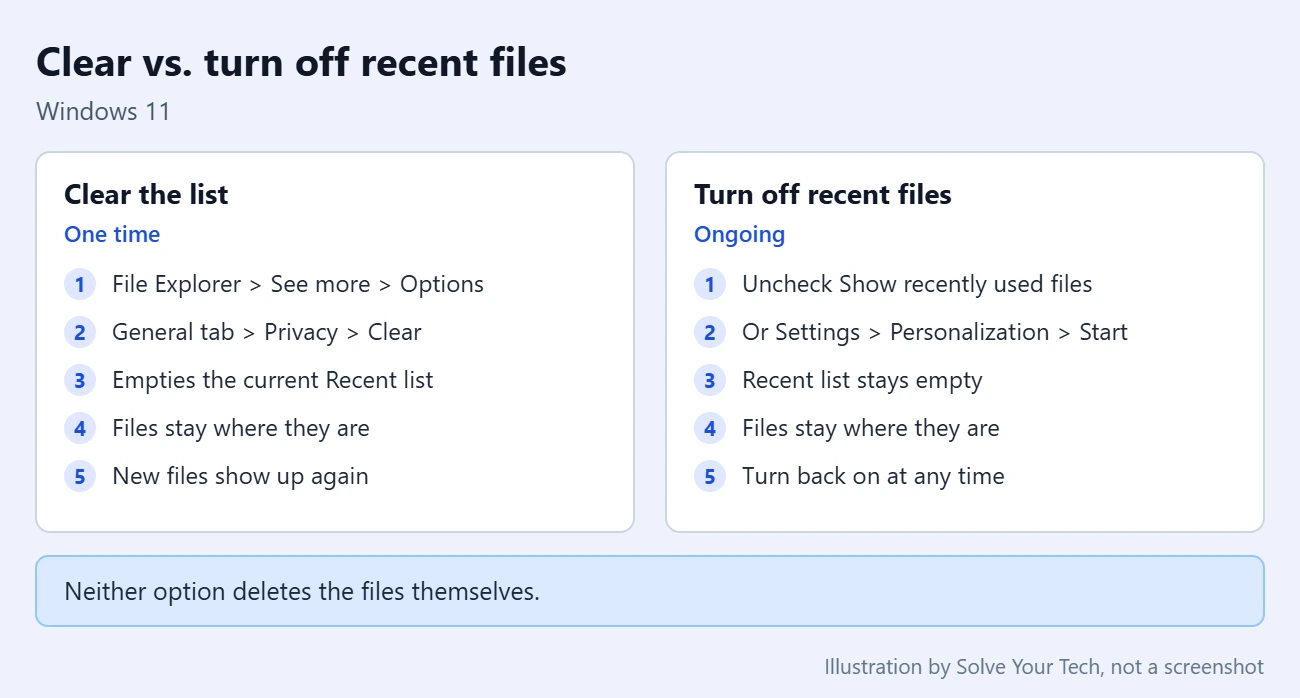
To clear recent files in Windows 11, open File Explorer, click the three-dot See more button, and choose Options. On the General tab, click Clear next to “Clear File Explorer history,” then click OK.
This empties the list of recent files on File Explorer’s Home page. It does not delete the files themselves, and it does not stop Windows from listing new files as you open them. If you want the list to stay empty, turn the feature off as well. Both jobs are covered below, along with the Start menu, taskbar Jump Lists, and apps that keep their own lists.
What You Need to Know First
- Version: These steps are for Windows 11. Microsoft renamed Quick access to Home in version 22H2, so on a current PC the recent files appear on the Home page of File Explorer.
- Per user: The settings here apply to the Windows account you are signed in to. Other accounts on the same PC keep their own lists.
- No admin rights needed: Clearing the list and changing these options are ordinary user settings. On a work or school PC, your organization may lock some of them.
- Nothing is deleted: A recent files list is a set of shortcuts. Clearing it removes the shortcuts, not the documents, photos, or other files they point to.
How to Clear Recent Files in File Explorer

This is the quickest way to wipe the whole list in one go. There is no undo, so if you still need to find a file from the list, note where it is saved first.
- Open File Explorer. Click its folder icon on the taskbar or press Windows + E.
- Click the three-dot See more button in the toolbar at the top of the window.
- Click Options. The Folder Options window opens.
- Stay on the General tab and look at the Privacy section near the bottom.
- Click Clear next to “Clear File Explorer history.”
- Click OK to close the window.
To confirm it worked, click Home in the left pane of File Explorer. The Recent section should be empty. Folders you pinned to Quick access stay pinned, because pins are not part of the history.
If you cannot find the three-dot button, click Start, type File Explorer Options, and open the result. It is the same window. Our guide on how to use File Explorer in Windows 11 explains the rest of the toolbar.
Clear Recent Files in Windows 10
Press Windows + E, select the View tab, and choose Options (or Options > Change folder and search options). On General, select Clear beside Clear File Explorer history. To stop new recent-file and frequent-folder entries, clear the two Privacy checkboxes, then select Apply and OK. Reopen Quick access and check the list. This removes history entries, rather than the underlying documents.
Microsoft’s Windows 10 File Explorer instructions describe the View > Options route and Privacy checkboxes. For Start and taskbar Jump Lists, use Settings > Personalization > Start and turn off Show recently opened items in Jump Lists on Start or the taskbar. An application’s own recent list remains a separate setting.
How to Remove One File From the Recent List
You do not have to clear everything to hide a single file.
- Open File Explorer and click Home.
- Find the file under Recent. To pick several, hold Ctrl while you click each one.
- Right-click the selection and choose Remove from Recent. On some Windows 11 versions the command is worded Remove from list.
Only the entry disappears. The file stays in its folder, and it can show up in the list again the next time you open it.
How to Stop Windows 11 From Showing Recent Files
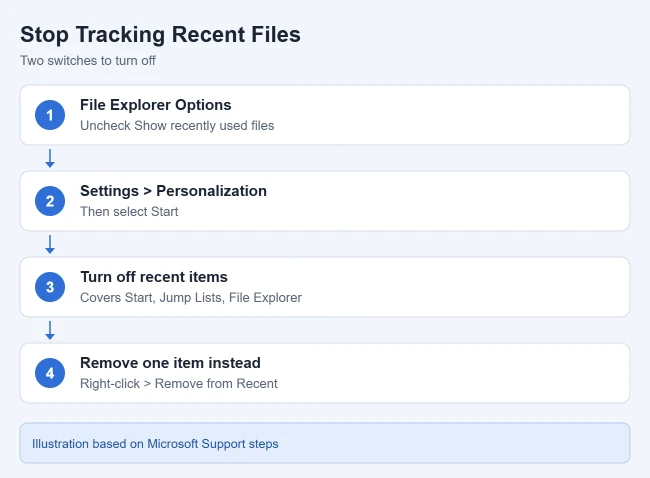
Clearing is a one-time cleanup. To keep the list empty, turn recent files off. You can do that in two places, and you can use either one or both.
In File Explorer
- Open File Explorer, click See more, then Options.
- On the General tab, under Privacy, uncheck Show recently used files.
- Optionally uncheck Show frequently used folders so Windows stops adding folders to Quick access by itself.
- Click OK.
This only changes File Explorer. Recent items can still appear in the Start menu and in Jump Lists unless you also change the setting below.
In Settings
A Jump List is the menu that opens when you right-click an app on the taskbar; it can list files you opened recently in that app. One switch in Settings controls recent items there, in Start, and in File Explorer. Microsoft’s steps are:
- Click Start > Settings > Personalization > Start.
- Turn off Show recommended files in Start, recent files in File Explorer, and items in Jump Lists. On early Windows 11 versions, the same switch is called Show recently opened items in Start, Jump Lists, and File Explorer.
After you turn it off, right-click an app on the taskbar that used to list files, such as a Microsoft 365 app. The recent entries should be gone. Items you pinned to a Jump List yourself are separate and can remain.
To undo either change, go back to the same place and check the box or turn the switch on again. Windows starts building the list from that point; do not expect the old entries to return. Here is how to see recent files in Windows 11 once it is back on.
How to Clear the Recent Items Folder
Windows also keeps shortcuts to recently opened files in a Recent Items folder inside your user profile. Some older programs read this folder directly.
- Press Windows + R to open the Run box.
- Type
shell:recentand press Enter. A File Explorer window opens showing a list of shortcuts. - Press Ctrl + A to select them all, then press Delete.
Check that the address bar shows the Recent Items folder before you press Delete, so you do not remove real files from another folder by mistake. The items here are only shortcuts. On current Windows 11 versions, emptying this folder may not change what File Explorer’s Home page shows, so use the Clear button as well.
If a folder elsewhere refuses to delete because a file is open or access is denied, see how to force delete a folder in Windows 11.
Recent Files in Office and Other Apps
Apps such as Word, Excel, Photoshop, and Notepad keep their own recent lists. Clearing File Explorer history does not empty those.
In Microsoft 365 apps such as Word and Excel, click File > Open, right-click a file, and choose Remove from list. Be careful to pick that command and not Delete file, which removes the actual file. To clear everything that is not pinned, right-click any file in the list, choose Clear unpinned Documents, and click Yes. Microsoft documents these options in Customize the list of recently used files in Office apps.
For other programs, look in the app’s File menu or its settings for a recent files option.
Troubleshooting
The list fills up again
That is expected after a clear. Windows keeps adding files you open until you turn off Show recently used files or the Settings switch.
Files from OneDrive or Office.com still appear
Microsoft says File Explorer Home can show your recent and favorited Office.com files when you are signed in with a Microsoft account. Those entries come from your account, not only from this PC, so they can reappear. Look in the same Privacy section of Folder Options for an option that mentions files from Office.com and uncheck it if your version has one.
The Settings switch is missing or grayed out
The label differs by version, so read each switch on the Start page of Personalization. If a switch is grayed out on a work or school PC, an administrator has probably set it by policy and you will need to ask them.
You manage the PC and want the history cleared automatically
Windows includes two Group Policy settings under User Configuration > Administrative Templates > Start Menu and Taskbar: Do not keep history of recently opened documents and Clear history of recently opened documents on exit. Microsoft describes both in its Start policy settings reference. You need an edition of Windows that includes the Local Group Policy Editor, and this is not necessary for a typical home PC.
Frequently Asked Questions
Does clearing recent files delete my files?
No. Clearing recent files in Windows 11 only removes the list of shortcuts shown in File Explorer, Start, and Jump Lists. Your documents and photos stay in their folders.
Can I get the recent files list back after clearing it?
No. There is no undo for the Clear button. The files are still on your PC, so you can find them in their folders or with search, and the list fills again as you open files.
Does clearing File Explorer history remove my pinned folders?
No. Folders you pinned to Quick access stay pinned. To remove one, right-click it and choose Unpin from Quick access. Our Quick access guide has more detail.
Will clearing recent files make my PC faster?
No. The list is a small set of shortcuts, so clearing it is about privacy and tidiness, not speed or storage space.
What else can I clear for privacy?
You can also clear your clipboard and delete junk files.
Next Step
If you share your PC, clear the list once with the Clear button, then turn off Show recently used files so it stays empty.

Matthew Burleigh is the founder, head writer, and editor of Solve Your Tech, which he launched in 2012. He has written technology tutorials since 2008 and worked in IT since 2003, including small-business support, IT management, and consulting. He holds Bachelor’s and Master’s degrees in Computer Science from Arizona State University.
Matthew writes practical guides for Windows, iPhone and iPad, Microsoft Office, Outlook, Google apps, and Android. Solve Your Tech’s guides are checked step by step against the device or app maker’s own documentation and tested on his own devices whenever he has the hardware or software, with clear steps, sources, and update dates.
Read more about Matthew and how Solve Your Tech writes and updates its guides, or report a correction.