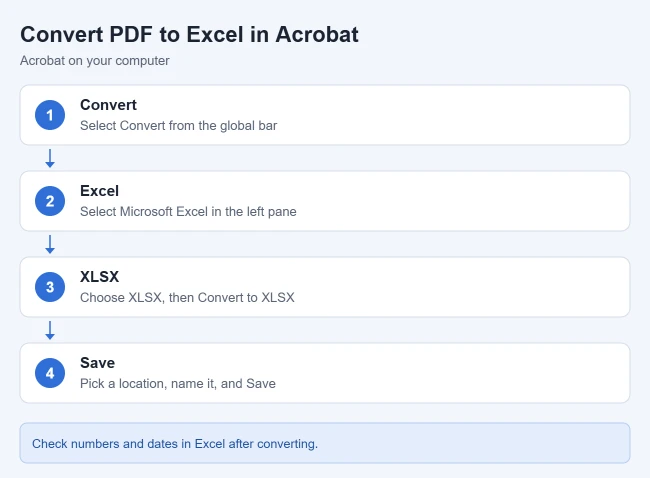
To convert a PDF to Excel with Adobe Acrobat, open the PDF, select Convert from the bar at the top, choose Microsoft Excel on the left, pick XLSX, and select Convert to XLSX. Then choose where to save the new spreadsheet, type a name, and select Save.
That is the route Adobe documents for the current Acrobat desktop app in its Convert PDFs to Microsoft Excel formats help article. The rest of this guide covers what you need before you start, the older Export PDF layout, Acrobat Reader, Adobe’s online converter, scanned PDFs, converting only part of a file, and what to do when the spreadsheet does not look right.
What You Need Before You Start
- The Acrobat desktop app. The main steps below are for Adobe Acrobat on a Windows PC or a Mac. Acrobat is the paid PDF editor. It is not the same as the free Acrobat Reader, which has its own section below.
- A PDF you are allowed to open. If the PDF is protected with a password, Adobe says you need to unlock it with that password before it can be converted.
- A program that opens Excel files. The result is an XLSX file, the standard Excel workbook format. If you do not have Excel, see our guide on how to open an XLSX file.
- Realistic expectations. A PDF stores the look of a page, not a grid of cells. Acrobat rebuilds rows and columns from what it sees, so plan to check the result.
Converting does not change the PDF. Acrobat saves the spreadsheet as a separate new file, so there is nothing to undo. If you do not like the result, delete the new file and convert again with different settings.
How to Convert a PDF to Excel in Acrobat
These steps use the labels in Adobe’s current help for Acrobat on desktop.
- Open the PDF in Adobe Acrobat on your computer.
- Select Convert from the global bar. The global bar is the row of options across the top of the Acrobat window.
- Select Microsoft Excel in the left pane. A dropdown menu appears next to it.
- Choose XLSX from the dropdown menu.
- Select Convert to XLSX. A save dialog box opens.
- Pick a folder, type a file name, and select Save.
Acrobat creates an Excel workbook in the folder you chose. Open that folder and double-click the file to open it in Excel.
If you see an Export PDF tool instead
Older versions of Acrobat use a different layout. Adobe’s How to convert a PDF to Excel page describes it this way:
- Open the PDF in Acrobat.
- Click the Export PDF tool in the right pane.
- Choose Spreadsheet as the export format, then select Microsoft Excel Workbook.
- Click Export.
- Name the new Excel file and click Save.
Adobe’s current help also mentions a third way in: open the All tools menu and select Export a PDF. It leads to the same list of formats as the Convert button.
Change the Conversion Settings
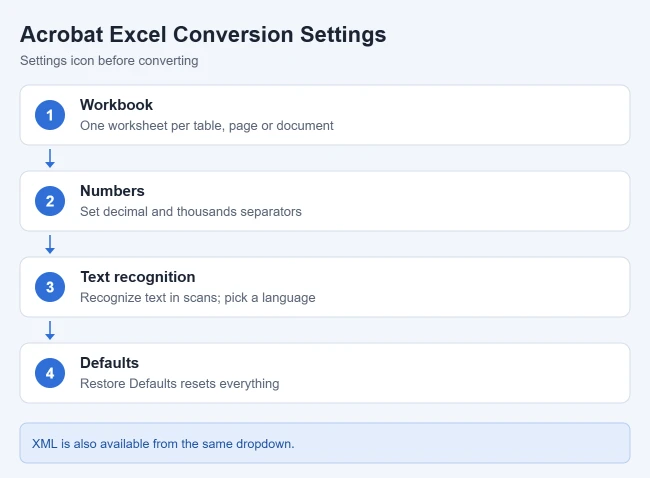
The default settings work for many files. If the workbook comes out with the wrong sheet layout or the numbers look wrong, change the settings and convert again.
- Select Convert from the global bar.
- Select Microsoft Excel, then choose XLSX or XML from the dropdown menu.
- Select Settings.
- Adjust the options described below, then select OK.
| Setting | What Adobe says it does | When to change it |
|---|---|---|
| Excel Workbook Settings | Creates a worksheet for each table, each page, or the entire document | A long report lands on one crowded sheet, or one table is split across many sheets |
| Numeric Settings | Sets the decimal and thousands separators for numeric data | The PDF uses a different number style than your copy of Excel, such as 1.234,56 |
| Text Recognition Settings | Recognizes text in images if needed and sets the language | The PDF is a scan, or it is in a language other than the default |
| Restore Defaults | Applies the default conversion settings | You want to start over |
Convert Only Part of a PDF
You do not have to convert a 40-page report to get one table out of it. Adobe documents an Export Selection As command in its export selections help article.
- Use the Select tool to mark the content you want, such as the rows of one table.
- Right-click the selected text and choose Export Selection As.
- Select a format from the Save As Type list. Adobe lists XLSX and CSV among the choices. CSV is a plain text file with commas between values, which Excel can also open.
- Select Save.
If the pages you need are easy to separate, another option is to pull them into their own PDF first. Our guide on saving individual pages from a PDF in Acrobat shows how.
Converting Scanned PDFs
A scanned PDF is a picture of a page. Adobe explains that a scan contains only image data, not text you can select. Acrobat has to read the picture with optical character recognition (OCR), which is software that turns pictures of letters and numbers into real text.
You have two ways to handle a scan:
- During the conversion. Open the conversion Settings described above and use Text Recognition Settings to recognize text and set the correct language. In the older Export PDF layout, Adobe says Acrobat runs text recognition automatically when the PDF contains scanned text.
- Before the conversion. Adobe’s Recognize text in scanned documents article gives this path: open the scan, select All tools > Scan & OCR, select In this file, choose the page range and language, and select Recognize Text. Then convert the PDF to Excel as usual.
Adobe recommends saving a backup copy of the original scan first, because recognizing text changes the PDF. It also advises reviewing the document afterward, since OCR can misread characters. With a spreadsheet, one wrong digit matters, so compare the totals against the original.
Convert to XML Instead
The same Microsoft Excel dropdown offers XML. Choose it, select Convert to XML, then name and save the file. XML is a text-based data format that Excel and many other programs can read. Most people should pick XLSX. Choose XML only if another program or a coworker specifically asks for it.
Can Acrobat Reader Convert a PDF to Excel?
Not for free. Acrobat Reader is the free viewer, and Adobe’s Export PDFs article for Reader says you need a paid subscription to the Adobe Acrobat Export PDF service to convert PDFs to Word, Excel, or RTF documents.
If you have that subscription, Adobe gives these steps:
- Open the PDF in Acrobat Reader and select Sign In in the upper-right corner. Sign in with your own Adobe account.
- Select All Tools > Export a PDF. The open file is selected by default.
- Choose the Excel format from the Export PDF To list.
- Select the Convert to button for that format.
- Choose a location in the Save as dialog box and select Save.
For a scanned document, Adobe says to check that the Document Language matches the language of the text. Select Change to pick a different one.
Use Adobe’s Online Converter
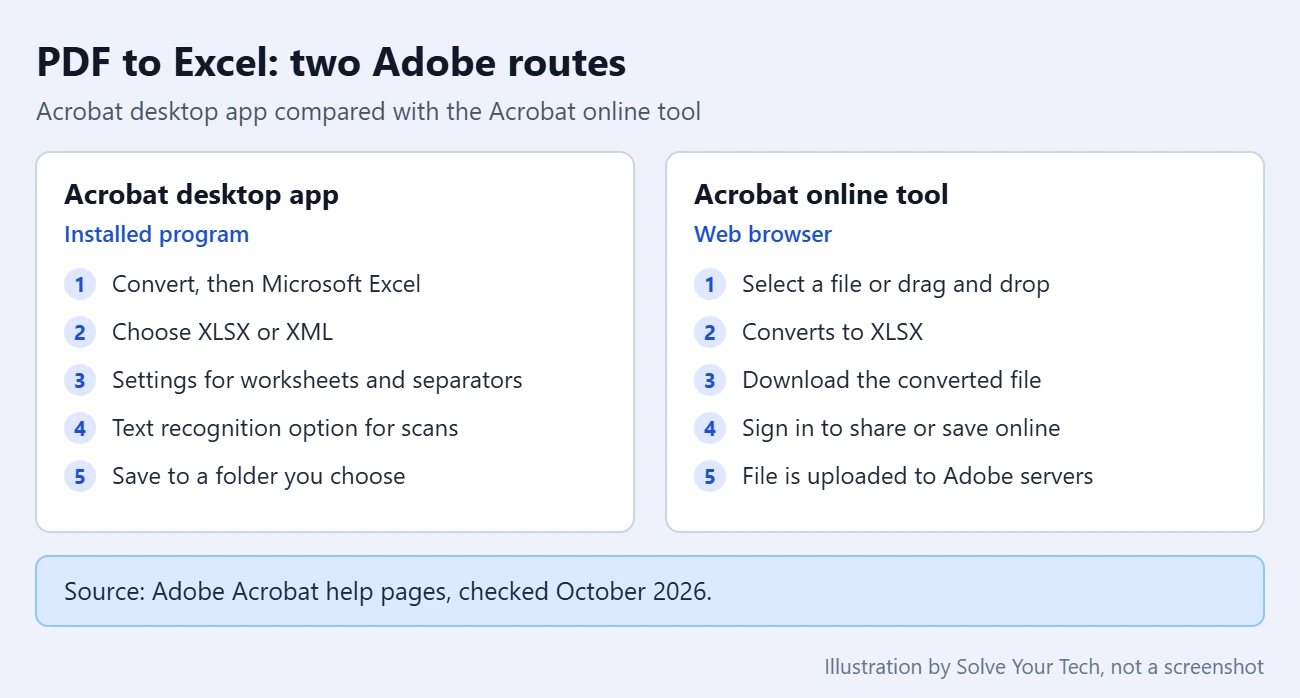
Adobe also runs an online PDF to Excel converter that works in a web browser, so you do not need the desktop app installed.
- Open the converter page in your browser.
- Click Select a file, or drag and drop a PDF into the drop zone.
- Wait while Acrobat converts the PDF to an XLSX file.
- Download the converted file, or sign in to share it.
Before you upload: the online tool sends your file to Adobe. The page says the file is handled by Adobe servers and deleted unless you sign in to save it. For a bank statement, payroll report, or anything confidential, check your employer’s or your own rules first, or use the desktop app, which saves the result to a folder you choose.
Adobe’s separate Acrobat on the web service has a similar tool. From its home page, select Convert > Export a PDF, pick the file, choose Microsoft Excel, convert, and then select Download file.
Import the PDF From Inside Excel
If you have a recent desktop version of Excel for Windows, you can skip Acrobat and pull tables straight out of a PDF. Microsoft documents this in Import data from data sources (Power Query).
- In Excel, select Data > Get Data > From File > From PDF.
- Select your PDF file, then click Open.
- The Navigator dialog box lists the tables Excel found. Select the tables you want.
- Select Load to place the data in a worksheet, or Transform Data to clean it up in Power Query first. Power Query is Excel’s built-in tool for importing and reshaping data.
Microsoft notes that the PDF connector needs .NET Framework 4.5 or higher on the computer. If Excel says the connector requires additional components, that is the missing piece. If you do not see From PDF in the menu, your version of Excel may not include it.
Check the Spreadsheet After Converting
No converter is perfect, so spend two minutes checking the workbook before you rely on it.
- Count the rows. Compare the last row of each table with the PDF to confirm nothing was dropped.
- Test the numbers. Click a cell that should hold a number and add a simple
=SUM()formula below the column. If the total is zero or too small, some values came through as text. - Look at dates and long numbers. Excel may reformat dates, account numbers, and values with leading zeros when it opens them.
- Check headings. Titles that spanned several columns in the PDF often end up in one cell or as merged cells.
- Look at every sheet tab. Depending on the workbook setting, each table or page can be on its own worksheet.
Troubleshooting
There is no Convert button
You may be using an older version of Acrobat. Look for the Export PDF tool in the right pane, or open All tools and select Export a PDF. If you are in the free Acrobat Reader, converting requires the paid Export PDF subscription described above.
All the data is in one column, or the sheet is blank
This usually points to a scanned or image-based PDF. Try to select a word in the PDF with your mouse. If you cannot, run Scan & OCR first or turn on text recognition in the conversion settings, then convert again.
Numbers have the wrong decimal point
Open the conversion Settings and set the decimal and thousands separators under Numeric Settings to match the PDF. Then convert the file again.
Everything is on one sheet, or spread across too many
Change Excel Workbook Settings so Acrobat creates a worksheet for each table, for each page, or for the entire document, whichever fits your file.
Acrobat will not convert a protected PDF
Adobe says a password-protected PDF has to be unlocked with its password before it can be converted. If you do not have the password, ask the person who created the file for it or for an unprotected copy.
Frequently Asked Questions
Does converting a PDF to Excel keep the formulas?
Do not count on it. A PDF normally shows the results of calculations, not the formulas behind them, so expect plain values in the converted workbook and rebuild any formulas you need. Adobe’s pages describe carrying over tables, rows, columns, and formatting.
What is the difference between XLS and XLSX?
Both are Excel file types. Adobe explains that XLS is the older format used by Excel 2003 and earlier, and XLSX is the newer format introduced with Excel 2007. The current Acrobat desktop steps produce XLSX files.
Is Adobe’s online PDF to Excel converter free?
Adobe describes the online converter as free. Its page says you can download the converted file or sign in to share it, and you may be asked to sign in before downloading. Adobe’s subscription help pages describe limits on how many conversions some plans allow, so heavy use may require a paid plan.
Can I convert a PDF to Excel on a phone?
Adobe says the online converter works in any web browser, including on iOS and Android, and that an Export PDF subscription can also be used through the Acrobat Reader mobile app. The step-by-step instructions in this guide are for a computer.
Does converting change or delete my original PDF?
No. The conversion saves a new Excel file under the name and location you pick. The PDF stays where it was. The one exception is running Scan & OCR on a scan first, which adds a text layer to the PDF itself, so keep a backup copy as Adobe suggests.
More Excel and PDF Guides
Once your data is in Excel, these guides cover related jobs:
- How to copy a Word table into Excel
- How to open CSV files with Excel by default
- How to combine PDF files with Adobe Acrobat

Matthew Burleigh is the founder, head writer, and editor of Solve Your Tech, which he launched in 2012. He has written technology tutorials since 2008 and worked in IT since 2003, including small-business support, IT management, and consulting. He holds Bachelor’s and Master’s degrees in Computer Science from Arizona State University.
Matthew writes practical guides for Windows, iPhone and iPad, Microsoft Office, Outlook, Google apps, and Android. Solve Your Tech’s guides are tested on current devices or checked against official product documentation, with clear steps, sources, and update dates.
Read more about Matthew and how Solve Your Tech writes and updates its guides, or report a correction.