Yes, you can BCC someone from your AOL account. In AOL Mail, click Compose, click BCC at the right side of the To field, and type the address you want to copy privately. The people in To and CC get the email without seeing the BCC address.
These steps are for AOL Mail in a desktop web browser such as Chrome, Edge, Firefox, or Safari. There are also short sections for the AOL app on a phone and for AOL Desktop Gold, the separate paid AOL program.
What Is BCC?
BCC stands for blind carbon copy. Like CC (carbon copy), it sends someone a copy of your email. The difference is privacy: BCC addresses are hidden. People in To and CC can’t see who was BCC’d, and BCC recipients can’t see each other.
| Field | Who gets the email | Who can see the address |
|---|---|---|
| To | The main people you’re writing to | Everyone on the email |
| CC | People copied for their information | Everyone on the email |
| BCC | People copied privately | Only you, the sender |
BCC recipients can still see the To and CC addresses, because those are shown to everyone. Only the BCC list itself is kept private.
When to use BCC (and when not to)
BCC fits these situations:
- Group announcements to people who don’t know each other, like a club, a class’s parents, or a neighborhood list. It keeps their addresses private and stops a flood of reply-all messages.
- Leaving a long thread politely. Move the group to BCC in your reply, say you’ve done so, and you won’t get the follow-up messages.
- Introductions. After you introduce two people, reply with yourself moved to BCC so they can continue without you.
Skip BCC when the hidden person is part of a disagreement or a private matter the others would expect to know about. A BCC that comes to light, often through a reply-all, can damage trust. If someone needs to be in the loop, put them in CC.
How to BCC From AOL Mail
- Sign in to AOL Mail at mail.aol.com. Trouble getting in? Here’s how to sign in to AOL Mail.
- From the inbox, click Compose at the top left. A new message opens.
- Click BCC at the right side of the To field. A BCC line appears below To.
- Type the address you want to blind copy in the BCC field. To add more people, type each address and press Enter or type a comma between them.
- Add your main recipient in To, then type a subject and your message.
- Click Send.
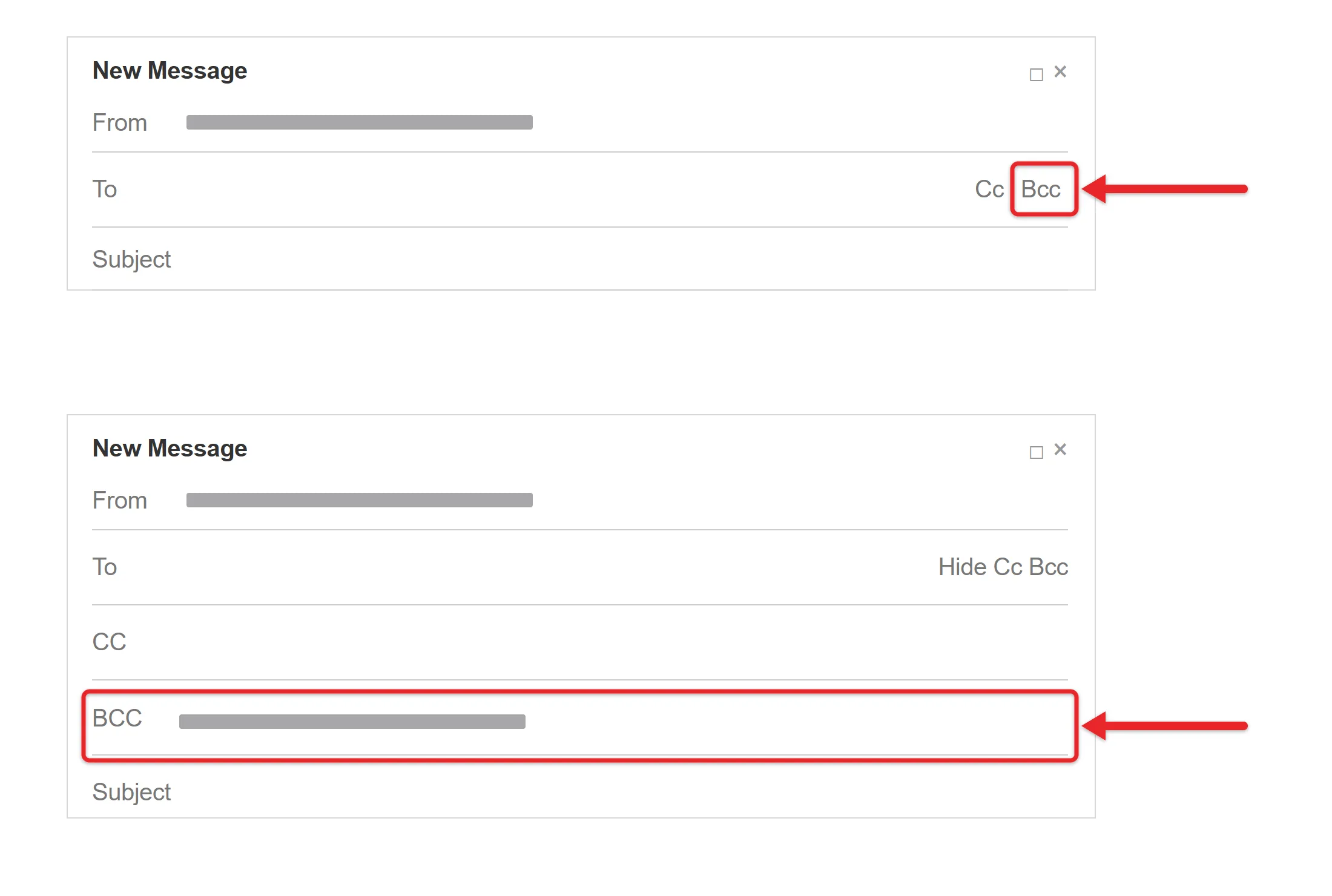
The BCC recipient gets the email, but their address doesn’t appear for anyone else. The basic compose steps (To, Subject, message, Send) match AOL’s Compose and send emails in AOL Mail help page. AOL’s page doesn’t describe the BCC link itself, so the BCC steps above are based on the AOL Mail compose screen shown in the screenshot.
If AOL keeps showing you news before you can get to Compose, here’s how to open AOL Mail straight to your inbox.
Check that it worked
To test BCC before you use it for something important, send a message to a friend in To and put a second address of your own in BCC. Open the copy that arrives at your second address and look at the recipients. Then ask your friend whether your second address shows up on their copy. It shouldn’t.
You can’t take a BCC back once you click Send, so look over the To, CC, and BCC lines before you send.
How to Email a Group Without Sharing Everyone’s Address
BCC is the simplest way to send one message to many people without showing everyone’s address.
- Click Compose.
- Type your own AOL address in To. That gives the email a visible recipient and puts a copy in your inbox.
- Click BCC and add everyone else’s addresses there.
- Write your subject and message, then click Send.

Each person sees only your address in the To line. If anyone replies, the reply comes only to you instead of going to the whole group.
A tip for group messages: start the email with a line such as “I’ve BCC’d everyone to keep your addresses private.” People who notice their address is missing from To won’t wonder why.
Save time with an AOL contact list
If you email the same group often, AOL lets you create a distribution list. AOL’s manage distribution lists help page describes the steps: click the Contacts icon, click the Lists tab, click + Create list, name the list, add your contacts, and click Save. You can then send to the group by typing the list’s name in the To field. If you want the members hidden from each other, type the list name in the BCC field instead and put your own address in To.
How Many People Can You BCC?
AOL doesn’t publish a number. Its limits on sending bulk mail page says AOL doesn’t disclose how many recipients or emails you can send at one time, to protect people from spam. If you hit the limit, AOL shows a notice and you have to wait a set time, usually stated in the notice, before you can send more.
Every address in To, CC, and BCC counts as a recipient. For a very large group, split the list and send it in a few smaller batches. Some spam filters also treat big BCC mailings with suspicion, so a message to hundreds of people may land in some recipients’ junk folders. For a regular newsletter, an email newsletter service is a better fit than a personal AOL account.
BCC in the AOL App on a Phone
- Open the AOL app and go to Mail.
- Tap the compose button.
- Tap the Cc/Bcc line below the To field to show the Bcc field.
- Type the address in Bcc, add your main recipient in To, and write your message.
- Tap Send.
The app’s layout can change with updates. If you don’t see a Cc/Bcc line, tap the To row or look for a small arrow next to it.
BCC in AOL Desktop Gold
AOL Desktop Gold is a separate program from AOL Mail on the web, with its own compose window. AOL has a help page for adding Cc and Bcc recipients in AOL Desktop Gold, so follow that if you use the desktop software.
If You Don’t See the BCC Link
- You don’t see the BCC link: make sure you’re in a new message or reply, not just reading an email. If the compose window is small, click the Expand email icon at the top of the message to open it full screen.
- The email won’t send: check each BCC address for typos, such as a missing @ or a space. Fix or remove any address that looks wrong, then try again.
- You get a sending limit notice: wait the time AOL gives in the notice, then send to the rest of the group in smaller batches.
- A recipient says the email went to spam: ask them to add your AOL address to their contacts or safe senders list.
- You put the group in To or CC by mistake: the addresses are already visible to everyone. Send a short follow-up asking people not to reply all, and use BCC next time.
AOL BCC Questions
Can BCC recipients see each other?
No. BCC addresses are hidden from all other recipients, including the other people in BCC.
Does the BCC recipient know they were BCC’d?
Usually they can tell. Their address isn’t in the To or CC lines of the message they receive, which normally means they were BCC’d. Some email services also label the message as a BCC for that person.
What happens if a BCC recipient clicks Reply All?
Their reply goes to you and to everyone in To and CC, and their address appears on it. That reveals they got a copy. When To or CC recipients click Reply All, BCC recipients don’t get those replies.
Can I BCC myself?
Yes. Type your own address in BCC to get a copy in your inbox. AOL also keeps a copy of every message you send in your Sent folder.
Can I send an email with only BCC recipients?
Putting your own address in To is the reliable way to do it. It gives the message a visible recipient and keeps everyone else hidden in BCC.
If you need to check where a message came from, here’s how to view the full headers of an AOL email. To protect yourself from risky messages, see the current options for disabling links from unknown senders in AOL Mail.

Matthew Burleigh is the founder, head writer, and editor of Solve Your Tech, which he launched in 2012. He has written technology tutorials since 2008 and worked in IT since 2003, including small-business support, IT management, and consulting. He holds Bachelor’s and Master’s degrees in Computer Science from Arizona State University.
Matthew writes practical guides for Windows, iPhone and iPad, Microsoft Office, Outlook, Google apps, and Android. Solve Your Tech’s guides are checked step by step against the device or app maker’s own documentation and tested on his own devices whenever he has the hardware or software, with clear steps, sources, and update dates.
Read more about Matthew and how Solve Your Tech writes and updates its guides, or report a correction.