You can make a barcode for free by typing your data into a free online barcode generator, picking a barcode type such as Code 128 or QR Code, and downloading the image. If you’d rather work offline, Word for Windows has a hidden barcode field, and free barcode fonts work in both Word and Excel.
This guide covers three free methods: the TEC-IT online generator in any web browser, the DisplayBarcode field in Word for Microsoft 365, Word 2024, 2021, 2019 and 2016 on Windows, and the free Libre Barcode fonts from Google Fonts. Making the image is free. If you need a UPC for a product you’ll sell in stores or online marketplaces, read the section on retail barcodes first, because the number itself has to come from GS1.
Pick the Right Barcode Type
A barcode is a picture of data. A scanner reads the bars (or squares) and turns them back into the numbers or letters you typed. The pattern rules are called a symbology, and a scanner has to support the symbology you choose.
| Barcode type | What it holds | Good for |
|---|---|---|
| Code 128 | Letters, numbers, and symbols | Inventory tags, asset labels, shipping labels |
| Code 39 | Uppercase letters, numbers, space, and – . $ / + % | Older scanners, ID badges, simple labels |
| UPC-A | 12 digits | Retail products sold in the US |
| EAN-13 | 13 digits | Retail products sold outside the US, and books (ISBN) |
| QR Code | Web links, text, contact details | Anything people will scan with a phone camera |
If you’re adding labels to an existing system, such as a store’s point-of-sale software or a library catalog, ask whoever manages it which type it expects. If you’re starting from scratch and only need to track your own items, Code 128 is a safe default because it holds letters and numbers and nearly every handheld scanner reads it.
Make a Barcode With a Free Online Generator
The TEC-IT Online Barcode Generator is free, runs in any browser, and supports dozens of types. These steps work on a Windows PC, a Mac, or a Chromebook.
- Open your web browser and go to barcode.tec-it.com. The generator opens with a list of barcode categories on one side and a preview area.
- Choose a category such as Linear Codes, EAN / UPC, or 2D Codes, then select the specific type, for example Code-128. The preview changes to a sample barcode of that type.
- Click in the Data box, delete the sample text, and type your own value. The preview redraws with your data. If it doesn’t, click Refresh Barcode.
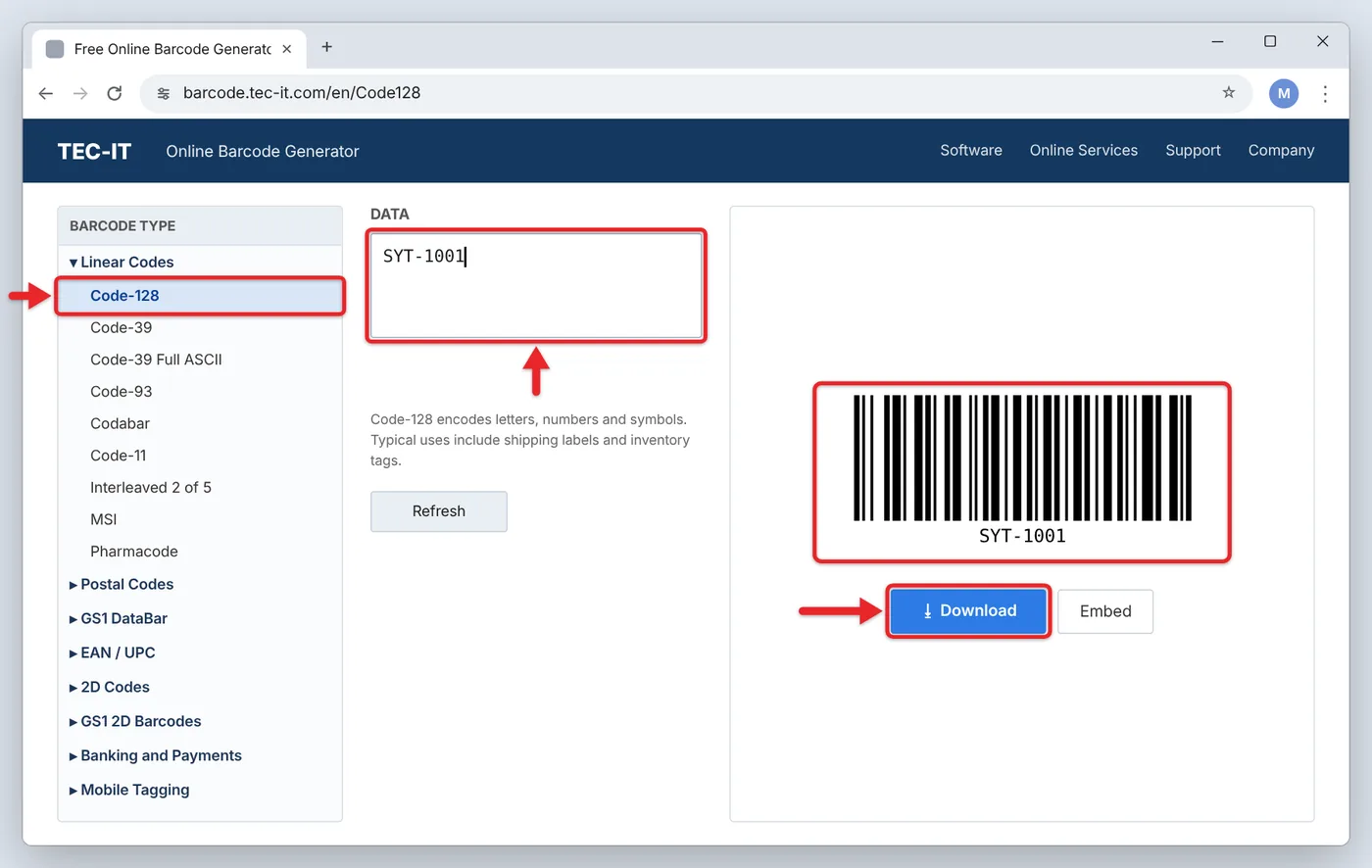
- Check for an error message under the preview. If you typed a character the type doesn’t allow, such as a letter in a UPC, the generator tells you instead of drawing a bad barcode.
- Open the image settings if you want a different file type or a sharper image. You can switch the format from GIF to PNG or JPG and raise the resolution (DPI). PNG at 300 DPI is a good choice for printing.
- Click Download. The image saves to your Downloads folder, ready to insert into a document or label template.
To make a numbered series, such as ASSET-001 through ASSET-010, use the generator’s sequence option. It fills in a prefix, a start value, and an end value for you. Free users can create up to 10 barcodes per sequence.
One limit to know: TEC-IT’s terms say the free generator and its output are for non-commercial or private use, and business use needs written approval or a paid subscription. For a small business, the Word and font methods below are better choices, since both are free for commercial work.
Make a Barcode in Microsoft Word
Word for Windows can draw a barcode with a field code named DisplayBarcode. There’s no ribbon button for it, but it takes less than a minute once you know the pattern. Microsoft’s DisplayBarcode field code reference lists every option. This field isn’t available in Word for Mac or Word for the web.
- Click in your document where you want the barcode.
- Press Ctrl + F9. A pair of gray curly braces appears. You must use this shortcut; typing the braces on the keyboard doesn’t work.
- Inside the braces, type the field name, your data in quotation marks, and the barcode type. For example:
DisplayBarcode "SYT-10452" CODE128 \t - Right-click the field and choose Toggle Field Codes. The code is replaced by the barcode image. The
\tpart adds the readable text under the bars.
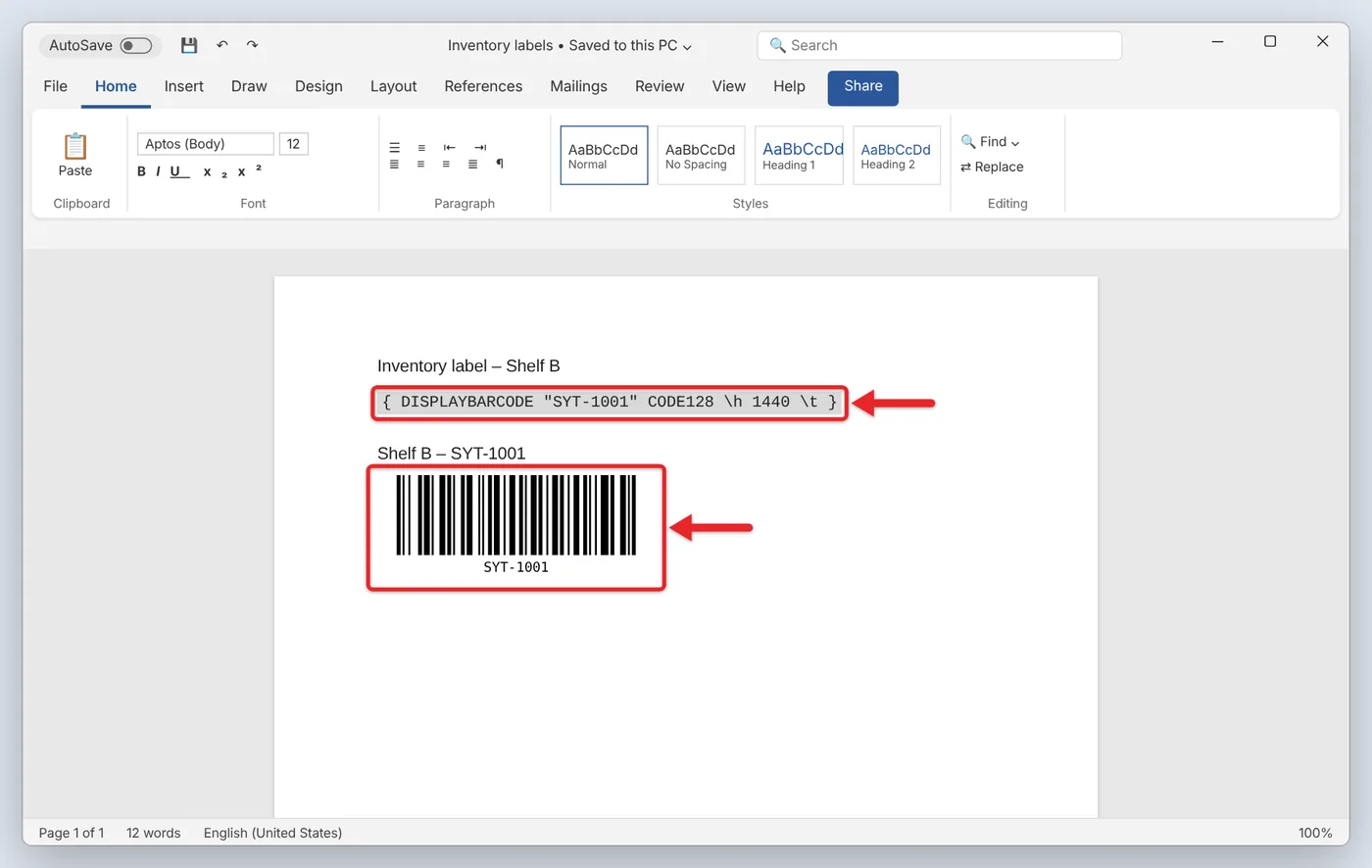
Word supports QR, CODE128, CODE39, EAN13, EAN8, UPCA, UPCE, ITF14, NW7 (Codabar), and JPPOST. A few more examples:
DisplayBarcode "https://www.solveyourtech.com" QR \q 3makes a QR code with the highest level of error correction.DisplayBarcode "012345678905" UPCA \tmakes a UPC-A barcode with its digits underneath.DisplayBarcode "012345678900" UPCA \t \xmakes a UPC-A and has Word correct the last digit (the check digit) if it’s wrong.DisplayBarcode "PART42" CODE39 \d \tmakes a Code 39 barcode with the start and stop characters added.
To make the barcode bigger, add \s 200 to double its size (the scale range is 10 to 1000 percent). To edit the data later, right-click the barcode, choose Toggle Field Codes again, change the text, and toggle it back.
If you need the same barcode on a sheet of labels, set it up in a single label first, then follow the steps for printing labels from Word.
Use a Free Barcode Font in Word or Excel
Excel doesn’t have a barcode feature, and neither do Google Docs or Sheets. A barcode font fills that gap: you type text, change its font, and the characters turn into bars. The Libre Barcode fonts are free on Google Fonts and released under the SIL Open Font License, which allows commercial use.
Code 39 is the easiest to use because it doesn’t need any math. You only wrap your data in asterisks.
- Go to Google Fonts, search for Libre Barcode 39 Text, open it, and click Get font, then Download all. The Text version prints readable characters under the bars.
- Unzip the download and install the font. On Windows, right-click the .ttf file and choose Install. For other ways, read about installing fonts on Windows 11. On a Mac, double-click the file and click Install.
- Restart Excel or Word so the new font appears in the font list.
- In Excel, put your item codes in column A, starting in A2. In B2, type
="*"&A2&"*"and fill the formula down. Each cell now shows your code with an asterisk on each side. - Select column B and change the font to Libre Barcode 39 Text. The text turns into barcodes.
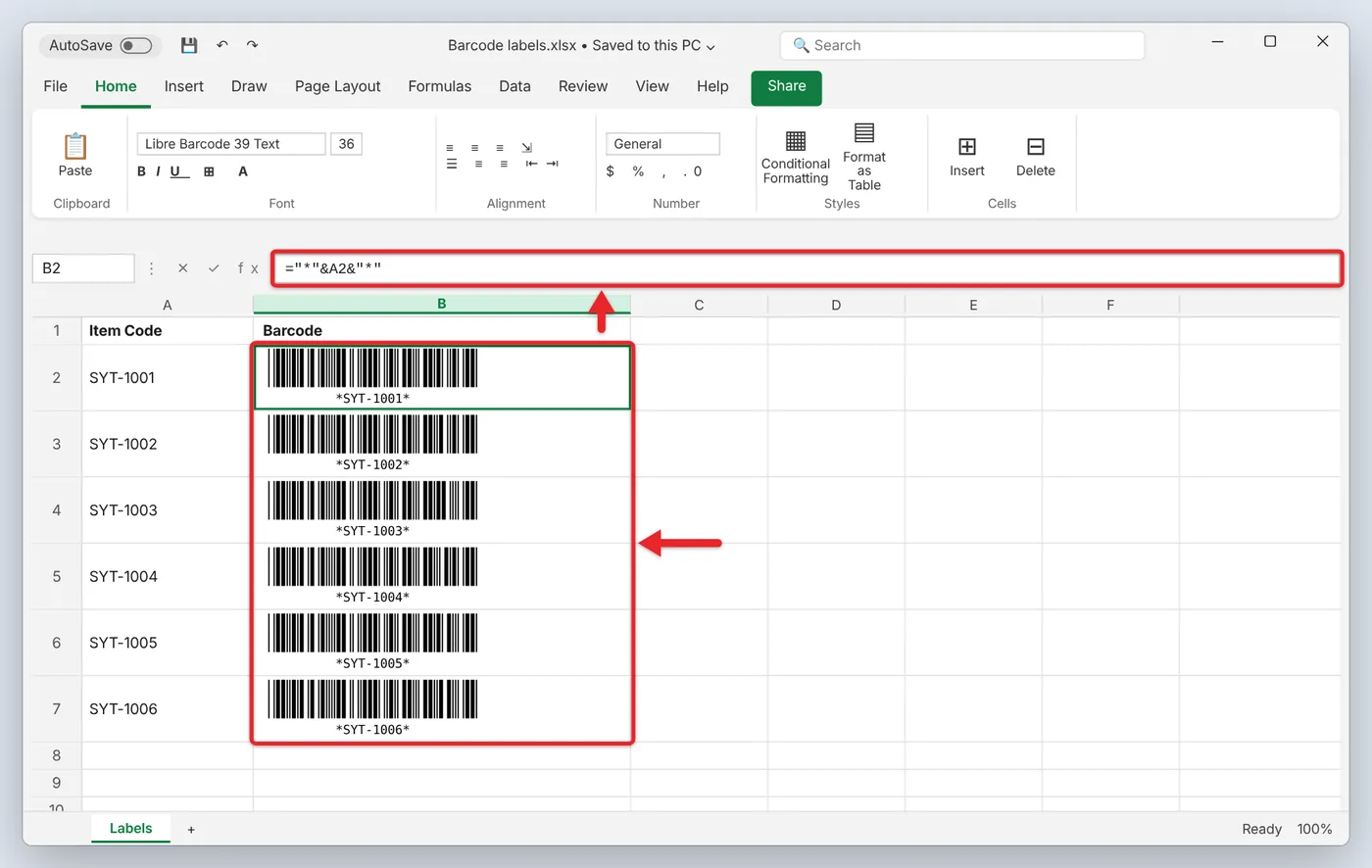
- Raise the font size to at least 36 points and widen the column so no barcode is cut off. Print a test page and scan it.
In Word, type the asterisks yourself (for example, *PART42*), select the text, and apply the font.
If you send the Word file to someone who doesn’t have the barcode font, embed the font in the document first.
Code 39 accepts only uppercase letters, numbers, space, and a few symbols. If you need lowercase letters or longer codes in less space, use Libre Barcode 128 instead. Code 128 includes a calculated check character, so you can’t just type plain text in that font. Paste your text into the Libre Barcode Code 128 encoder, copy the encoded result, and paste that into your document before applying the font.
Barcodes for Retail Products (UPC and EAN)
Any generator can draw a UPC, but it can’t give you a valid UPC number. Those numbers are licensed so that each product has a unique code tied to the company that owns the brand. In the US, the licensing body is GS1 US. If you sell to retailers or on large marketplaces, buyers will expect GS1-issued numbers, and a made-up or resold number can match someone else’s product.
According to GS1 US’s UPC barcode pricing page, the current options are:
- A single GS1 US GTIN: $30, one time, with no annual renewal. It’s a good fit if you only sell one or two products.
- A GS1 Company Prefix: starts at $250 plus $50 a year for 10 product numbers, with higher tiers for 100, 1,000, or more products. A prefix lets you number future products yourself.
Once you have your number, any of the methods above can turn it into the barcode image. Use UPC-A in Word, or the EAN / UPC category in an online generator, and print it at full size with blank space on both sides.
You don’t need GS1 numbers for internal uses such as inventory tags, library books, or event tickets. Code 128 or QR codes with your own numbering work fine there.
If Your Barcode Won’t Scan
- The scanner doesn’t support that type. Many basic scanners read Code 128, Code 39, and UPC/EAN but not QR codes. Check the scanner’s manual for its supported types.
- There’s no blank margin. Barcodes need a clear “quiet zone” on the left and right. Don’t let text, borders, or the label edge touch the bars.
- The barcode was shrunk or stretched. Resize images by dragging a corner so the proportions stay the same. Downloading at a higher DPI helps if bars look blurry.
- The Code 39 asterisks are missing. Without them, the font draws bars that no scanner accepts.
- Code 128 font text wasn’t encoded. Run it through the encoder first.
- The check digit is wrong. UPC and EAN numbers end in a calculated digit. Add
\xin Word, or let the online generator flag the error. - Colors are low contrast. Dark bars on a white background scan best. Red bars often fail because many laser scanners use red light.
You can test a barcode before printing a batch by scanning it from the screen with a phone. On Android, Google Lens can read barcodes and QR codes. For the steps, read about scanning a QR code on Android.
Frequently Asked Questions
Is it legal to make my own barcodes?
Yes. Barcode symbologies are open standards, and you can draw them with any tool. The rules apply to UPC and EAN numbers for retail products, which should come from GS1 so they don’t clash with another company’s items.
Does Excel have a built-in barcode generator?
No. Excel has no barcode function or ribbon command. Use a barcode font such as Libre Barcode 39, or make the barcodes in Word with the DisplayBarcode field and copy them over.
What’s the difference between a barcode and a QR code?
A traditional barcode stores a short string of data in one row of bars. A QR code is a two-dimensional square that holds much more, such as a full web address, and almost any phone camera can read it. QR is technically a type of barcode, and the methods in this guide can make both.
Can I use a free barcode generator for my business?
It depends on the tool. TEC-IT’s free generator is limited to non-commercial use. The Word DisplayBarcode field and the Libre Barcode fonts have no such limit, and Zint, an open-source barcode generator, is another option for offline batch work.
What size should a printed barcode be?
There’s no single size for internal labels, so print a test and make sure your scanner reads it from a normal distance. Retail UPC barcodes have specific size rules from GS1, so avoid shrinking them to fit a small package without checking those rules.

Matthew Burleigh is the founder, head writer, and editor of Solve Your Tech, which he launched in 2012. He has written technology tutorials since 2008 and worked in IT since 2003, including small-business support, IT management, and consulting. He holds Bachelor’s and Master’s degrees in Computer Science from Arizona State University.
Matthew writes practical guides for Windows, iPhone and iPad, Microsoft Office, Outlook, Google apps, and Android. Solve Your Tech’s guides are checked step by step against the device or app maker’s own documentation and tested on his own devices whenever he has the hardware or software, with clear steps, sources, and update dates.
Read more about Matthew and how Solve Your Tech writes and updates its guides, or report a correction.