If your Android phone says the SIM card is out of service, or shows No service, open the Wi-Fi calling setting and look at the calling preference. On some older phones and carriers, that screen has a choice that keeps the phone off the cellular network. Switch it to a choice that allows the cellular network, or turn Wi-Fi calling off, then check whether your signal comes back.
The shortest route on a current Google Pixel is Settings > Network & internet > SIMs > your carrier SIM > Wi-Fi calling. On a Samsung Galaxy it is Settings > Connections > Wi-Fi Calling. This guide covers both, the older Phone app route, and what to check next if the setting is not the cause.
What Wi-Fi Calling Is and Why It Can Affect Service
Wi-Fi calling is a carrier feature that sends your phone calls over a Wi-Fi network instead of a cell tower. It is useful in places where the cellular signal is weak, such as a basement or a rural home.
Google says that when Wi-Fi calling is on, your phone can route calls through Wi-Fi networks or your carrier’s network, based on your preference or the signal strength. That preference is the part to check. A phone set to favor Wi-Fi behaves differently from a phone set to favor the cellular network, and some older carrier versions of the setting included a choice that never used the cellular network at all.
Three things to know before you start:
- Not every carrier supports Wi-Fi calling. If the option is missing from your phone, Google’s instructions say your carrier does not support the feature.
- The names of the preference choices are set by the carrier and the phone maker, so your screen may not match the wording in this article exactly.
- Your carrier may charge for calls made over Wi-Fi. Check with your carrier if you are not sure.
Check the Wi-Fi Calling Setting on a Google Pixel
These steps follow Google’s current instructions for making calls over Wi-Fi. Google notes that some of the steps only work on Android 6.0 and up. Other phones that use a version of Android close to Google’s often have a similar path.
- Open the Settings app.
- Tap Network & internet, then tap SIMs.
- Tap your carrier SIM. If the phone has two SIMs, pick the one that shows no service.
- Tap Wi-Fi calling. If you do not see it, your carrier does not support the feature, and this setting is not the cause of your problem.
- Look at the Use Wi-Fi calling switch and any calling preference listed under it.
- If a preference is set to a choice that only uses Wi-Fi, change it to one that allows the mobile network. If you do not see a preference, turn Use Wi-Fi calling off as a test.
Return to the Home screen and watch the status bar at the top of the screen for a minute. If the signal icon fills in and your carrier name returns, the setting was the cause.

Check the Wi-Fi Calling Setting on a Samsung Galaxy
Samsung documents this path in its guide to turning on Wi-Fi Calling on Galaxy phones. Samsung notes that these settings can vary by carrier.
- Open Settings.
- Tap Connections.
- Tap Wi-Fi Calling. On some carriers you may need to tap Roaming network preference or When Roaming to reach the choices.
- Tap Calling Preference. Samsung says this setting is only available while the Wi-Fi Calling switch is on.
- Choose whether you prefer Wi-Fi calling or your cellular network. According to Samsung, if the preferred network is not available, the other one is used automatically.
- If a choice on your phone says it never uses the cellular network, pick a different one.
To turn the feature off completely, tap the Wi-Fi Calling switch. On some Galaxy phones you can also swipe down from the top of the screen with two fingers to open the Quick settings panel and tap the Wi-Fi Calling icon there.
Older Android Phones: Use the Phone App
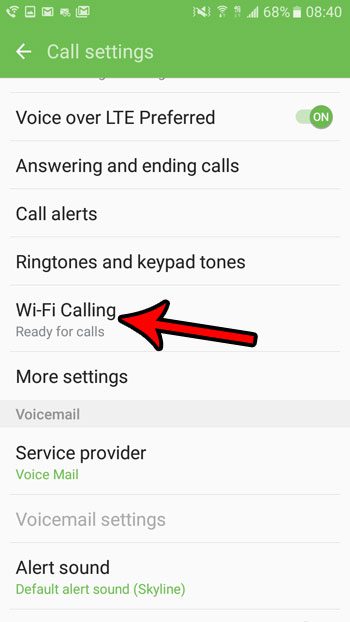
On older phones, such as a Samsung Galaxy running Android 6.0 (Marshmallow), the Wi-Fi calling setting is inside the Phone app. This is the version of the screen that had three choices, and it is the one most likely to leave a phone with no cellular service.
- Open the Phone app.
- Tap More at the top right of the screen.
- Tap Settings.
- Scroll down and tap Wi-Fi Calling.
- Select Wi-Fi Preferred or Cellular Network Preferred.
If Never use Cellular Network was selected, that explains the missing service. With that choice the phone stays off the cellular network, so it reports no service whenever it is away from Wi-Fi. Either of the other two choices lets the phone connect to your carrier again.
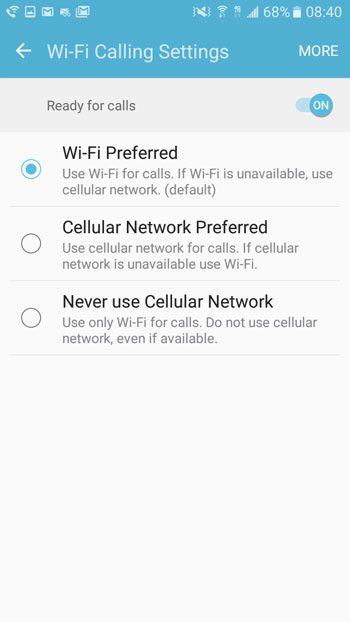
Current Google and Samsung help pages no longer list a choice with that name, so do not expect to find it on a newer phone. If your phone is newer and you cannot find any Wi-Fi-only choice, move on to the checks below.
Which Preference Should You Pick?
The right choice depends on where you use the phone most. The labels below are the ones from the older Phone app screen. Newer phones use similar wording.
| Choice | What it does | Good for |
|---|---|---|
| Cellular Network Preferred | Uses your carrier’s network first and Wi-Fi when the cellular signal is not available | Most people with normal coverage |
| Wi-Fi Preferred | Uses Wi-Fi for calls when it is available and the cellular network otherwise | Homes or offices with weak cellular signal |
| Never use Cellular Network | Keeps calls on Wi-Fi only | Rarely useful, and a common reason for a no-service message |
If you are not sure, pick the cellular-preferred choice. You can change it again at any time from the same screen.
How to Confirm the Fix Worked
- Check the status bar. The signal icon should show strength and the no-service message should be gone.
- Turn off Wi-Fi for a moment. Google suggests turning off Wi-Fi to make sure you are connected to your mobile network. On a Pixel, the signal icon is a triangle at the top right, and the more filled in it is, the stronger the signal.
- Place a test call. Call a friend or your own voicemail. If you have not done that before, see how to check voicemail on Android. Do not call an emergency number to test your phone.
- Turn Wi-Fi back on. When a call is going over Wi-Fi, Google says you will see Internet Call or Wi-Fi calling on the notification screen.
To undo the change, go back to the same Wi-Fi calling screen and choose your earlier preference or turn the switch back on. Nothing is erased by changing this setting.
Still No Service? Check These Next
If the Wi-Fi calling setting was not the cause, work through the checks below in order. They come from Google’s guide to fixing mobile connectivity issues. The menu paths are for Pixel phones, but most Android phones have the same options under similar names.

1. Turn off airplane mode
Airplane mode switches off the phone’s cellular connection. Open Settings, tap Network & internet, and make sure Airplane mode is off. Google also notes that switching airplane mode on and then off again is a quick way to restart the phone’s connections.
2. Make sure the SIM is turned on
Go to Settings > Network & internet > SIMs, tap your carrier’s name, and make sure Use SIM is on. If the carrier name is gray and the screen says No SIM, the phone either has no SIM or the SIM is inactive. An eSIM (a SIM that is built into the phone and downloaded from your carrier instead of inserted) can be switched off the same way as a physical card.
3. Check your signal and location
Walls, buildings, and even some phone cases can block a signal. Move near a window or go outside, and remove the case if you use one. If you have little or no signal in a place where you normally have service, ask your carrier about coverage or an outage in your area.
4. Power the phone off for 30 seconds
Google recommends powering the phone off, not choosing restart, waiting 30 seconds, and then turning it back on. This closes anything that was stuck and makes the phone connect to the network from scratch.
5. Inspect the SIM card
If your phone uses a physical SIM card, push a SIM tool or a small paperclip into the hole on the SIM tray until the tray pops out. Take out the card and look at it. Wipe off dust with a microfiber cloth, then put the card back. If the card is bent or damaged, contact your carrier for a replacement. If you have a second phone, put the SIM in it to find out whether the problem follows the card or stays with the phone.
6. Update Android
Go to Settings > System > Software updates and install anything that is waiting. Google’s page on how to check and update your Android version suggests connecting to Wi-Fi and charging the phone before you start, because updates can be large.
7. Reset the mobile network settings
Try this only after the checks above. On a Pixel, go to Settings > System > Reset options > Reset mobile network settings. Be careful with the separate Reset Bluetooth & Wi-Fi option on the same screen: Google warns that it deletes your saved Wi-Fi connections, so you will need your Wi-Fi passwords again. Our guide to resetting network settings on Android walks through the reset in more detail.
8. Contact your carrier
If nothing has worked, the problem is probably not a setting on the phone. Your carrier can check for outages, confirm that your line and SIM are active, and tell you whether anything changed on your plan.
Wi-Fi Calling Setting Missing or Not Working
- The option is not there. Your carrier may not offer Wi-Fi calling for your phone or plan. Use the search box at the top of the Settings app and type Wi-Fi calling before you decide it is missing, since phone makers put it in different menus.
- Calling Preference does not appear on a Galaxy. Samsung only shows this setting while the Wi-Fi Calling switch is on. Turn the switch on first.
- The switch will not turn on. Samsung says the phone must be connected to a Wi-Fi network and have active service through a SIM card or eSIM. You may also be asked for an emergency address, which is the location your carrier gives to emergency services when you call over Wi-Fi. On AT&T phones, Samsung notes that VoLTE (voice calls over the 4G LTE network) must be on before Wi-Fi Calling can be activated.
- Wi-Fi calling turned itself off. Google says that if the phone detects Wi-Fi calling problems, it turns the feature off until the problem is fixed, and it may show a notification that Wi-Fi calling has been turned off entirely. Restarting the phone or contacting your carrier may be needed to turn it back on.
- The phone says Emergency calls only. Samsung explains that this message usually points to a signal problem or a SIM problem, such as an eSIM that has not been activated or a SIM card with a fault. See Samsung’s page for a phone that displays Emergency calls only.
Frequently Asked Questions
Can Wi-Fi calling make my Android phone say no service?
It can on phones where the Wi-Fi calling preference includes a choice that never uses the cellular network. With that choice selected, the phone does not connect to your carrier’s towers. On phones that only offer Wi-Fi-preferred and cellular-preferred choices, Wi-Fi calling is unlikely to be the reason, and you should check airplane mode, the SIM, and coverage instead.
Should I turn Wi-Fi calling off?
You do not have to. Wi-Fi calling helps in places with a weak cellular signal. If you want to keep it, set the preference so the cellular network is still allowed. Turning it off is a reasonable test when you are trying to find out why the phone has no service, and you can turn it back on from the same screen.
Does Wi-Fi calling work without a SIM card?
On Samsung Galaxy phones, no. Samsung says a SIM card must be inserted or the built-in eSIM must be active, and the line needs active service. Google’s help page adds that on some carriers you can use Wi-Fi calling without a service signal, which means you still need the SIM and the account but not a cell tower in range.
Why is there no Wi-Fi calling option on my phone?
Wi-Fi calling depends on your carrier. Google’s instructions say that if you do not find the option under your carrier SIM, the carrier does not support it. A phone bought from a different carrier may also lack the option. Your carrier can tell you whether your phone model and plan qualify.
Will changing the Wi-Fi calling preference delete anything?
No. The preference only changes which network your calls use first. Your contacts, apps, saved Wi-Fi networks, and other settings stay the same, and you can switch back whenever you like.
How do I find out which Android version I have?
Open Settings, tap About phone, then tap Android version. The version matters here because the Wi-Fi calling setting has moved over time, from the Phone app on older versions to the SIM or Connections menus on newer ones.
Next Step
If the signal is back but calls still fail, follow our Android outgoing-call troubleshooting guide to check the selected SIM, carrier service, and call settings. If you see an error when you dial a code, read Connection Problem or Invalid MMI Code: What to Check First.

Matthew Burleigh has been writing tech tutorials since 2008. His writing has appeared on dozens of different websites and been read hundreds of millions of times.
After receiving his Bachelor’s and Master’s degrees in Computer Science he spent several years working in IT management for small businesses. However, he now works full time writing content online and creating websites.
His main writing topics include iPhones, Microsoft Office, Google Apps, Android, and Photoshop, but he has also written about many other tech topics as well.