To stop apps from updating automatically on Android, open the Google Play Store, tap your profile picture, tap Settings, then Network preferences, then Auto-update apps, and choose Don’t auto-update apps. To stop only one app, open that app’s page in the Play Store, tap More (three dots), and turn off Enable auto update. Samsung Galaxy phones also have a second store, the Galaxy Store, with its own auto-update setting.
What this setting covers and what you need
The steps below follow Google’s current How to update apps on Android help page. They apply to Android phones and tablets that use the Google Play Store, whatever the brand, on current releases such as Android 17. The setting lives in the Play Store app rather than in Android itself, so the path depends on the version of the store, not the phone. Older phones, such as those running Android 6.0 Marshmallow, may show an older store layout; the troubleshooting section explains what to look for.
- You need: the Google Play Store app, signed in with your Google Account. No computer is needed.
- It covers: apps and games installed from Google Play.
- It does not cover: Android system updates, or apps that come from another store such as the Samsung Galaxy Store. Those have their own settings, explained below.
Before you turn it off: app updates often include security and stability fixes. Google says updating apps “improves app security and stability.” If you turn off automatic updates, plan to update by hand on a regular schedule. If your real goal is to save mobile data, the Wi-Fi only option is a safer choice than turning updates off completely.
Turn off auto-updates for all apps
- Open the Google Play Store app.
- Tap your profile picture at the top right. It may show your photo or the first letter of your name. A menu opens.
- Tap Settings.
- Tap Network preferences to expand that section.
- Tap Auto-update apps. A short list of choices appears.
- Select Don’t auto-update apps. If a confirmation button such as Done or OK appears, tap it.
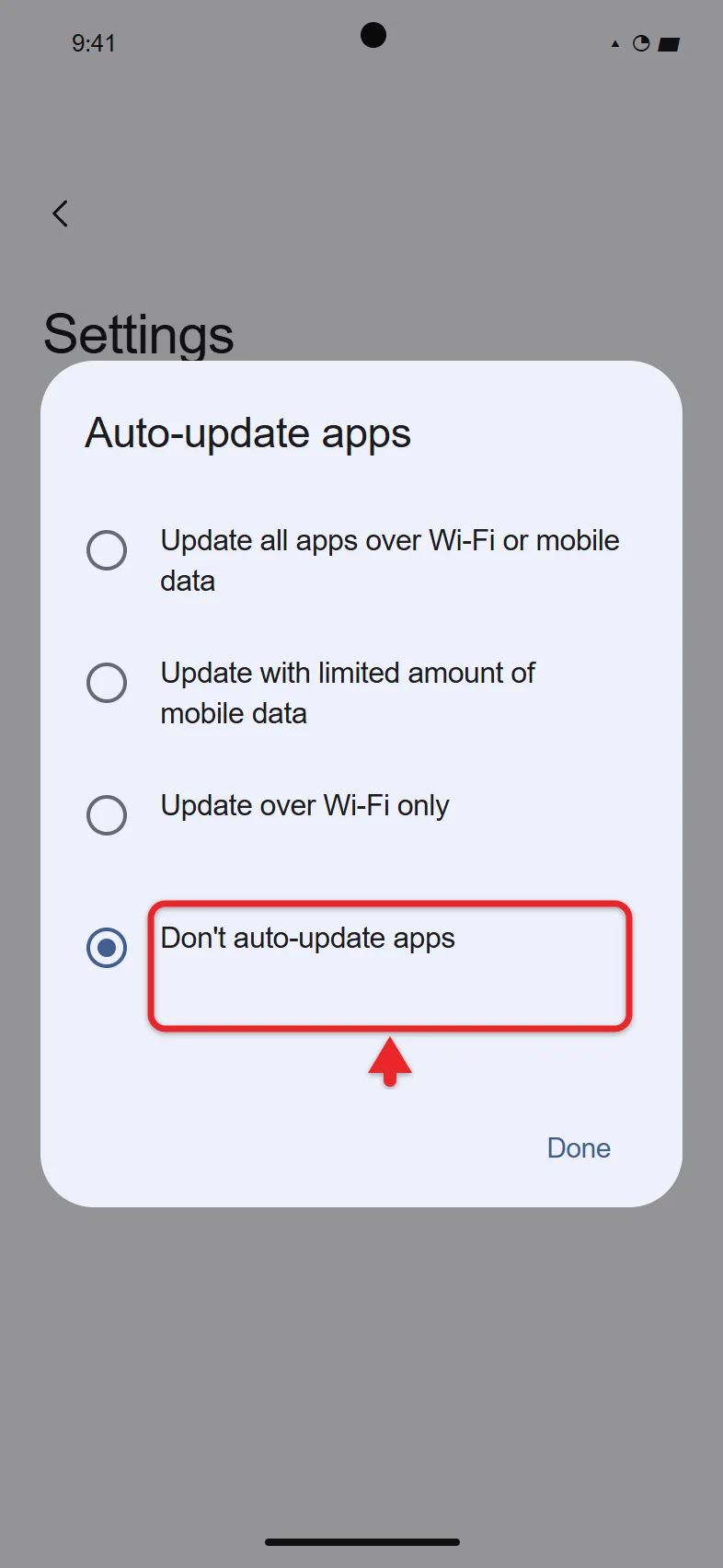
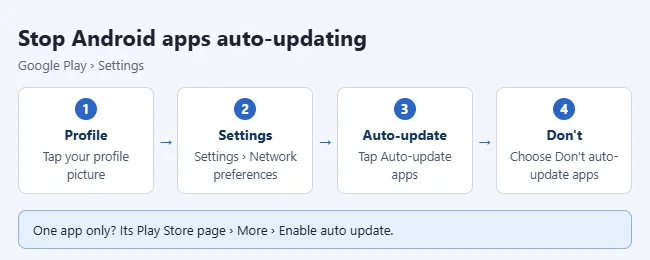
From now on, Google Play waits for you to start app updates. Your apps keep working as they are. Nothing is removed, and you can still update any app whenever you like.
What each auto-update option means
There are four choices on the Auto-update apps screen. The exact wording on your phone may be a little shorter, but the meaning is the same.
| Option | What it does | Good for |
|---|---|---|
| Update all apps over Wi-Fi or mobile data | Apps update on any connection. | Plans with plenty of mobile data |
| Update with limited amount of mobile data | Google Play uses a small mobile data budget and still tries Wi-Fi first. This option is only offered to a limited group, so you may not see it. | Phones that are rarely on Wi-Fi |
| Update over Wi-Fi only | Apps update automatically, but not over mobile data. | Saving mobile data while staying current |
| Don’t auto-update apps | Apps wait until you update them yourself. | Full control over when apps change |
Stop automatic updates for one app
You do not have to turn everything off. If one app is the problem, for example because you want to read about a new version before installing it, leave the main setting alone and turn off updates for that app only.
- Open the Google Play Store app.
- Tap your profile picture at the top right.
- Tap Manage apps & device, then tap the Manage tab. You see a list of your installed apps.
- Tap the app to open its Details page.
- Tap More, the three dots at the top right.
- Turn off Enable auto update.
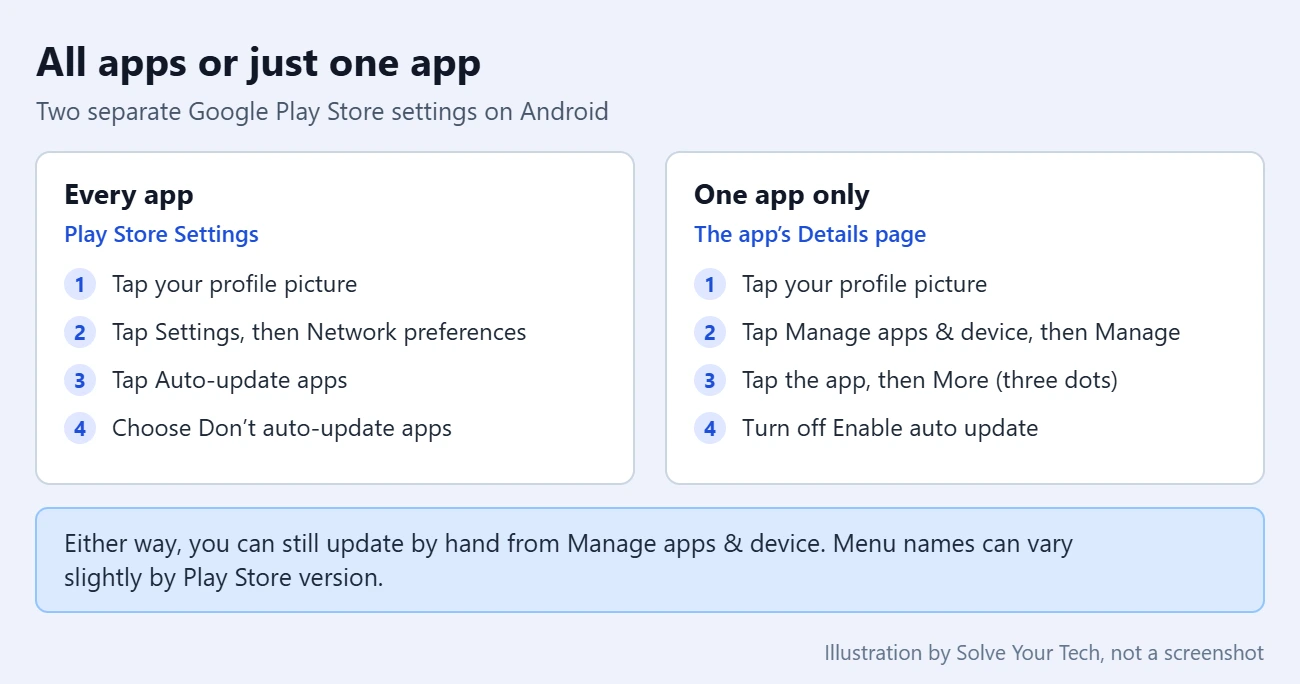
Repeat these steps for each app you want to hold back. Every other app keeps following the main Auto-update apps setting. You can also reach the same Details page by searching for the app in the Play Store.
Samsung Galaxy phones: check the Galaxy Store too
Samsung Galaxy phones and tablets include the Galaxy Store, Samsung’s own app store. Galaxy Store apps are updated separately from Play Store apps, so the Play Store setting above does not control them. Samsung’s Manage app updates on a Samsung Galaxy device page gives this path:
- Open the Galaxy Store.
- Tap Menu (the three horizontal lines) in the bottom right corner.
- Tap the Settings icon, which looks like a gear.
- Tap Auto update apps.
- Select the setting you want. Samsung’s page gives Wi-Fi only as an example; if you want no automatic Galaxy Store updates at all, pick the choice on your screen that turns them off.
Galaxy Store menu paths can vary by store version, device model, and software version. A Samsung account is required to use the Galaxy Store. Other phone makers may include their own app stores as well. If your phone has one, look in that store’s settings for a similar auto-update option.
How to update apps manually
With automatic updates off, updating is your job. Google’s steps are:
- Open the Google Play Store and tap your profile picture.
- Tap Manage apps & device.
- Under “Updates available,” tap See details.
- Tap Update next to a single app, or tap Update all.
Some updates need new permissions, and you may get a notification asking whether you accept them. You may also need to restart your device to finish an update. An app’s Details page shows an Update button whenever a newer version is available. For a closer look at that screen, read about checking app updates on a Google Pixel.
The Play Store app updates itself separately from your other apps. To check it, follow Google’s Update the Google Play app steps: tap your profile picture, tap Settings, then About, then Update Play Store. A message tells you whether the store is up to date; tap Got it. If an update exists, it downloads and installs within a few minutes.
On a Galaxy device, Galaxy Store updates are in a different place: open the Galaxy Store, tap Menu, then tap Updates.
Confirm the change or turn updates back on
To confirm the setting, go back to Settings > Network preferences > Auto-update apps in the Play Store. Don’t auto-update apps should be the selected choice. For a single app, open its Details page, tap More, and check that Enable auto update is off.
To undo the change, follow the same path and pick Update over Wi-Fi only or the Wi-Fi or mobile data option. For a single app, turn Enable auto update back on. Google’s instructions do not mention a restart for either change, and the setting does not remove any apps.
If apps still update, or the setting is missing
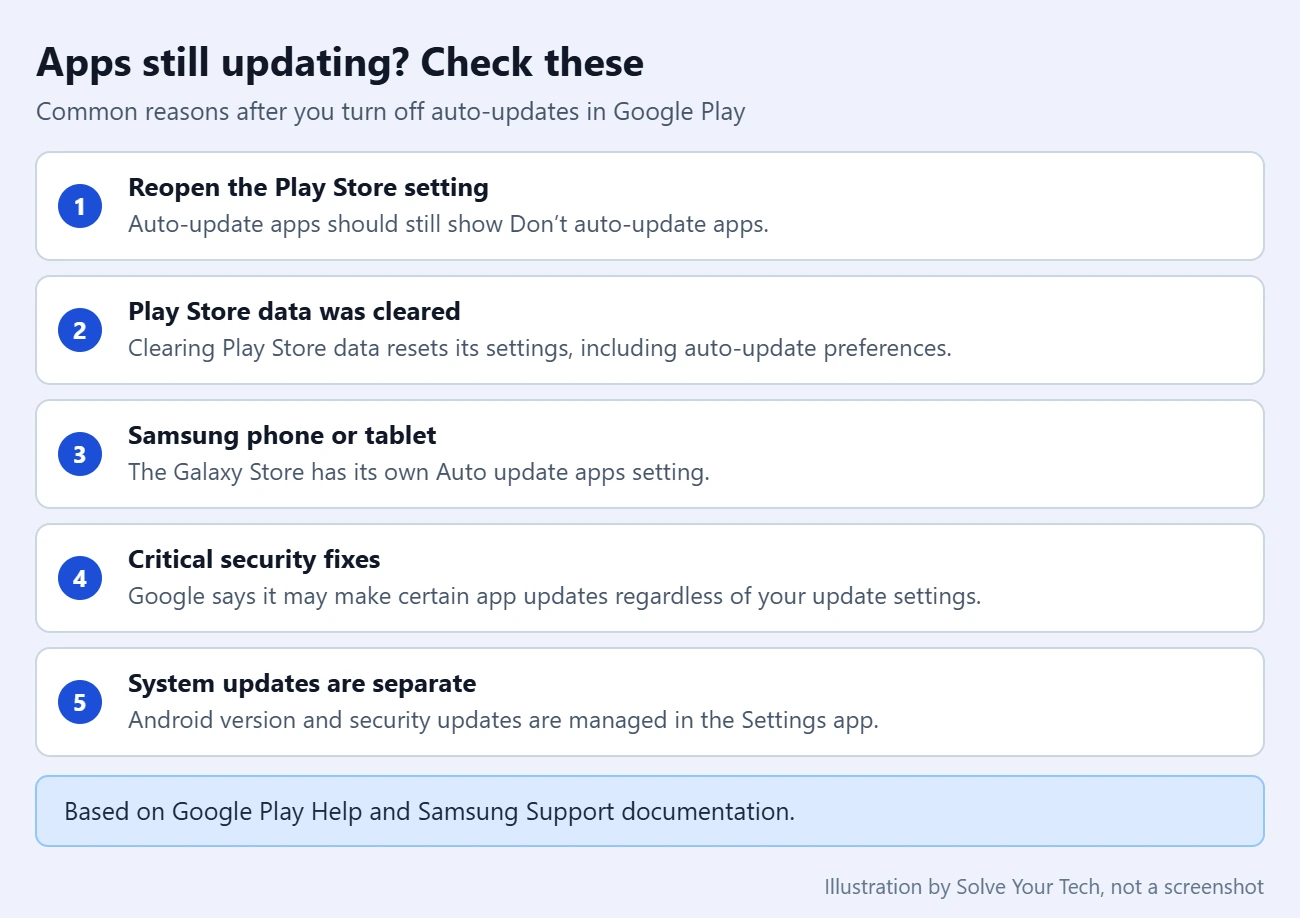
- An app updated anyway. When Google determines that an update fixes a critical security vulnerability, it may install certain app updates regardless of the update settings in the app or on your device.
- The setting went back to automatic. Clearing the Play Store’s data resets its settings. This also resets the data budget for the limited mobile data option. Samsung specifically warns that clearing Play Store data removes auto-update preferences and parental controls. If you recently cleared an app’s cache or storage on Android to fix a store problem, check the setting again.
- A Samsung app updated. It probably came from the Galaxy Store. Change the Galaxy Store setting described above.
- You do not see a profile picture. Older Play Store versions, such as the one on Android 6.0 Marshmallow, used a menu button with three lines at the top left instead. That older layout is no longer covered in Google’s help pages. Try updating the store first, using the Settings > About > Update Play Store steps in the manual update section above. On a very old version, look for Settings in the side menu and then Auto-update apps.
- You do not see “Update with limited amount of mobile data.” That is expected. Only a limited group gets that option.
- The setting is locked or missing on a work or school phone. An organization that manages the device may control app updates. Ask your administrator.
- Update notifications bother you. Samsung’s instructions are to open Settings > Apps > Google Play Store > Notifications and turn off Allow notifications. This hides all Play Store notifications, not only update alerts, and menu names can differ on other brands. Galaxy Store notifications cannot be turned off entirely; under Settings > Apps > Galaxy Store > Notifications > Notification categories, you can switch off individual categories instead.
The opposite problem has a documented cause too. If you want automatic updates and they have stopped, Google’s tip is that apps may not update automatically when an account on your device has a sign-in error.
Should you turn off automatic updates?
- Reasons to turn them off: you decide when an app changes, you can read what is new first, and updates do not use mobile data or storage space without warning.
- Reasons to leave them on: security and stability fixes arrive without any effort, and you are less likely to run an outdated app for months by accident.
- A middle path: keep Update over Wi-Fi only for everything, and turn off Enable auto update only for the one or two apps you want to control.
For most people, the middle path is the safer choice. It saves mobile data and still installs security fixes, while turning updates off for every app makes it easy to fall months behind. Apps that handle money, messages, or passwords are the ones to keep updating automatically.
If storage is the reason you want fewer updates, there are other ways to free space. See what to do when Android phone storage is full.
Frequently asked questions
Does this stop Android system updates?
No. The Play Store setting only affects apps from Google Play. Android version and security updates are handled in the phone’s Settings app. Google’s path is Settings > System > Software updates, and most system updates and security patches install automatically. The path can differ on phones from other manufacturers. Google Play system updates, which update core Android components, are separate as well; you can see their date under Settings > About phone > Android version.
Will turning off auto-updates delete or break my apps?
No. The setting only changes whether Google Play installs new versions for you. Installed apps stay on the phone at their current version. Over time, an app that is far out of date may ask you to update before it will work, which is decided by the app’s developer. If you have stopped using an app, uninstalling it from Android is safer than leaving an old version installed.
Can I go back to an older version of an app after it updates?
Usually not through the Play Store. Galaxy devices have one exception: for some preinstalled apps, you can open Settings > Apps, tap the app, tap More options (three dots), and tap Uninstall updates. This returns the app to the version that came with the phone, and it is only available for some preinstalled apps.
Does the setting apply to my other Android devices?
Treat it as a setting for the device in your hand. Google’s instructions are written per device and do not say the choice syncs across devices, so check each phone or tablet separately.
How do I stop updates from using mobile data without turning them off?
Open Settings > Network preferences > Auto-update apps in the Play Store and choose Update over Wi-Fi only. Apps then update automatically only while the phone is on Wi-Fi.
How do I protect purchases too?
Updates and purchases are separate settings. To lock down purchases too, require authentication for Google Play purchases. Need your phone’s network details while you are checking Wi-Fi? Here is how to find the IP address on an Android phone.
Next step
After you turn off automatic updates, open Manage apps & device in the Play Store once a week or so and install the updates you want. If that becomes a chore, switching to Update over Wi-Fi only gives back most of the control over data use while keeping your apps current. Have an iPhone too? Here is how to stop iPhone apps from updating automatically.

Matthew Burleigh is the founder, head writer, and editor of Solve Your Tech, which he launched in 2012. He has written technology tutorials since 2008 and worked in IT since 2003, including small-business support, IT management, and consulting. He holds Bachelor’s and Master’s degrees in Computer Science from Arizona State University.
Matthew writes practical guides for Windows, iPhone and iPad, Microsoft Office, Outlook, Google apps, and Android. Solve Your Tech’s guides are checked step by step against the device or app maker’s own documentation and tested on his own devices whenever he has the hardware or software, with clear steps, sources, and update dates.
Read more about Matthew and how Solve Your Tech writes and updates its guides, or report a correction.