To make your iPhone iCloud backup smaller, open Settings, tap your name > iCloud > Storage (or Manage Account Storage) > Backups, tap your iPhone, and turn off the apps you don’t need backed up. You can also delete backups from old devices you no longer use.
This guide covers removing apps from your backup, deleting old backups, what iCloud backs up in the first place, and Apple’s Recommended for You cleanup. The steps come from Apple Support’s Manage your iCloud storage and What does iCloud back up? articles.
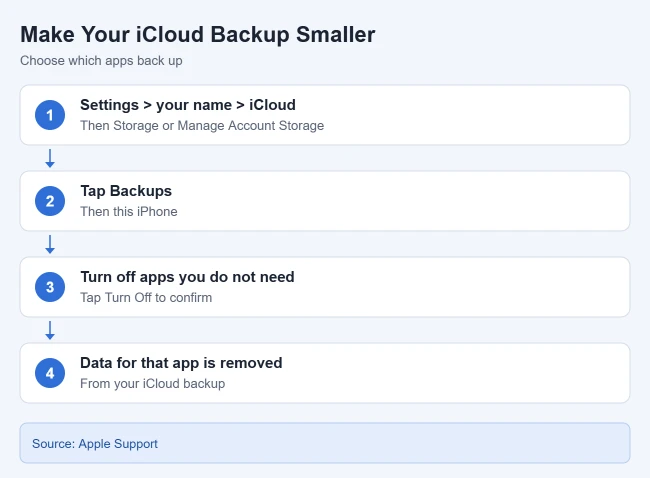
How to Choose Which Apps Get Backed Up
- Open the Settings app.
- Tap your name, then tap iCloud.
- Tap Storage or Manage Account Storage.
- Tap Backups, then tap the name of the iPhone you’re using.
- Turn off any apps you don’t want to back up, then tap Turn Off to confirm.
Result: Apple says iCloud Backup turns off for that app and removes all of its information from iCloud. Some apps are always backed up and can’t be turned off.
You can only change the app list for the device you’re holding. Your next backup will be smaller, and backups run on their own when the iPhone is locked and connected to power and Wi-Fi.
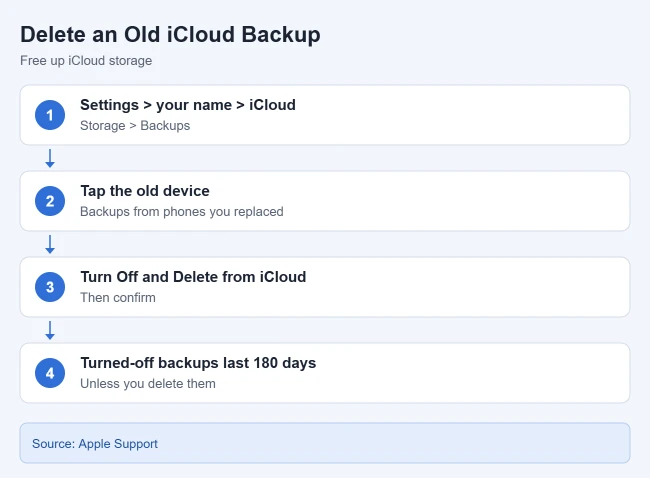
How to Delete an Old Backup
- Open the Settings app.
- Tap your name, then tap iCloud.
- Tap Storage or Manage Account Storage, then tap Backups.
- Tap the old device.
- Tap Turn Off and Delete from iCloud, then confirm.
Result: The backup is removed and iCloud Backup is turned off for that device. Apple says backups are kept for 180 days after you turn off iCloud Backup, and a backup that’s being used to restore a device can’t be deleted.
On a Mac
Apple says to choose Apple menu > System Settings, click your name, click iCloud, click Manage, select Backups, then select a backup and click the remove button (–).
What Takes Up Space in an iCloud Backup
Apple says iCloud Backup includes information that isn’t already synced to iCloud. That means turning on some sync features can shrink your backup:
- Photos and videos: if iCloud Photos is off, your camera roll may be in your backup. With iCloud Photos on, they sync instead.
- Messages: if Messages in iCloud is off, your texts are in your backup. With it on, they sync instead.
- Settings and layout: device settings, Home Screen layout, and app organization are always included.
- Apple Watch: your Apple Watch backup is included in your iPhone backup.
Synced data still counts toward your total iCloud storage, so this moves space around rather than freeing it. Try copying photos to a computer and deleting them from iCloud if photos are the problem.
Use Recommended for You
On iOS 17 and later, Apple says to go to Settings > your name > iCloud > Recommended for You. It suggests things you can delete, like large files or old backups.
Troubleshooting
- Backup still too big: turn off apps that store a lot of data you wouldn’t need restored, and delete backups from devices you no longer use.
- An app can’t be turned off: Apple says some apps are always backed up.
- The old backup won’t delete: it may be in use to restore a device. Wait for the restore to finish.
- Backups stopped: Apple says that if you run out of iCloud storage, your device won’t back up to iCloud.
Frequently Asked Questions
How much free iCloud storage do I get?
Apple says you get 5 GB free when you set up iCloud, shared by backups, iCloud Photos, iCloud Drive, and more.
Does turning off an app delete it from my iPhone?
No. It removes that app’s data from your iCloud backup only. The app and its data stay on your iPhone.
More iPhone Guides
- How to check how much iCloud storage you have left
- How to free up storage on iPhone
- How to back up an iPhone to iCloud
Want to see the documents you keep in iCloud? Here’s where to find iCloud Drive on an iPhone.

Matthew Burleigh is the founder, head writer, and editor of Solve Your Tech, which he launched in 2012. He has written technology tutorials since 2008 and worked in IT since 2003, including small-business support, IT management, and consulting. He holds Bachelor’s and Master’s degrees in Computer Science from Arizona State University.
Matthew writes practical guides for Windows, iPhone and iPad, Microsoft Office, Outlook, Google apps, and Android. Solve Your Tech’s guides are tested on current devices or checked against official product documentation, with clear steps, sources, and update dates.
Read more about Matthew and how Solve Your Tech writes and updates its guides, or report a correction.