To view pictures as a slideshow in Windows 10, open the folder with your pictures in File Explorer and select the photos you want. Click Manage under Picture Tools at the top of the window, then click Slide show. Press Esc to stop.
This guide covers the slideshow built into File Explorer in Windows 10, with no extra apps needed. It also explains the slideshow controls, the desktop background slideshow, and what to do when the Slide show button is missing. Note that Microsoft ended support for Windows 10 on October 14, 2025, so it no longer gets free security updates. The steps still work on a Windows 10 PC.
Using Windows 11? Follow our Windows 11 photo slideshow guide for the current Photos app. Its slideshow control is separate from the Windows 10 File Explorer ribbon shown below.
Before You Start
- A Windows 10 PC. The Picture Tools tab described here belongs to the Windows 10 version of File Explorer, the app you use to browse files and folders.
- Pictures saved on the PC or a connected drive. The slideshow plays ordinary image files, such as JPG and PNG photos, from a folder you can open in File Explorer.
- The ribbon. The ribbon is the strip of tabs and buttons at the top of a File Explorer window. If you only see tab names, press Ctrl + F1 to expand it.
Starting a slideshow does not change, move, or delete your pictures. It only displays them.
How to View Pictures as a Slideshow in Windows 10
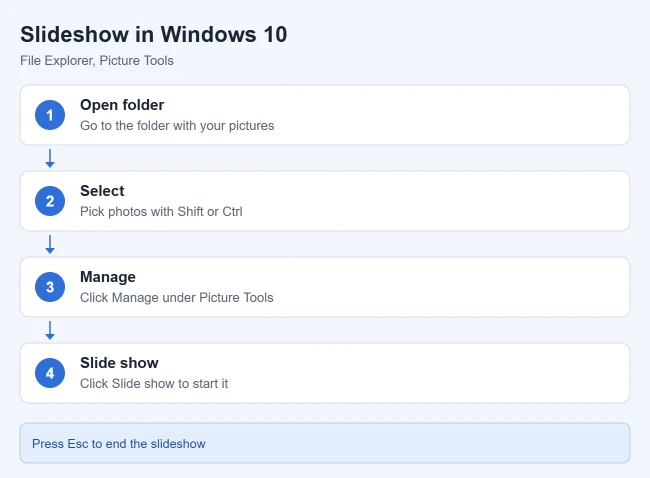
- Open File Explorer. Click the folder icon on the taskbar or press Windows + E, then go to the folder with the pictures you want to view. Your pictures appear in the folder.
- Select the pictures. Click the first one, hold Shift, and click the last one to select everything in between. To pick individual pictures, hold Ctrl and click each one. To select the whole folder, press Ctrl + A. The selected pictures are highlighted.
- Click Manage under Picture Tools at the top of the window. The picture options appear in the ribbon.
- Click Slide show. The screen goes dark and your pictures play full screen, one after another.
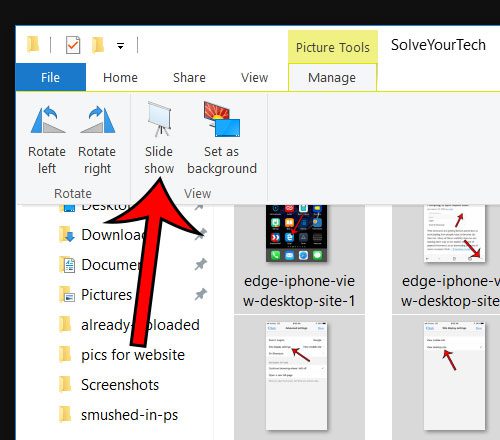
Picture Tools only appears when you have selected picture files. If you do not see it, click one of the pictures first.
You know it worked when File Explorer disappears and the first picture fills the screen. To go back, press Esc. The folder window returns exactly as you left it.
Which Pictures Play, and in What Order
When you select several pictures, the slideshow shows only those pictures. Selecting a single picture is usually enough to play the rest of the pictures in that folder as well, so you do not have to select everything first. If only one picture shows, exit, press Ctrl + A, and start again.
Pictures play in the order the folder shows them. To change the order, right-click an empty area of the folder, point to Sort by, and choose Name or Date before you start. For a fully custom order, rename the files with numbers at the front, such as 01, 02, and 03, and sort by name.
Slideshow Controls
Right-click anywhere on the screen during the slideshow to open its controls:
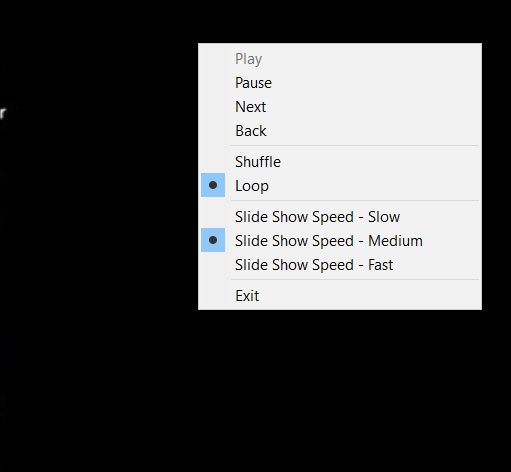
- Play and Pause: stop on the current picture or start again.
- Next and Back: move through your pictures by hand.
- Shuffle: show the pictures in random order.
- Loop: start over after the last picture.
- Slide Show Speed: choose Slow, Medium, or Fast.
- Exit: end the slideshow. Pressing Esc does the same.
These choices apply to the slideshow that is playing. On a touch screen, press and hold the picture to open the same menu.
Use a Slideshow as Your Desktop Background
Windows 10 has a second kind of slideshow that rotates pictures behind your desktop icons instead of playing them full screen. Microsoft documents it in Change the desktop background in Windows.
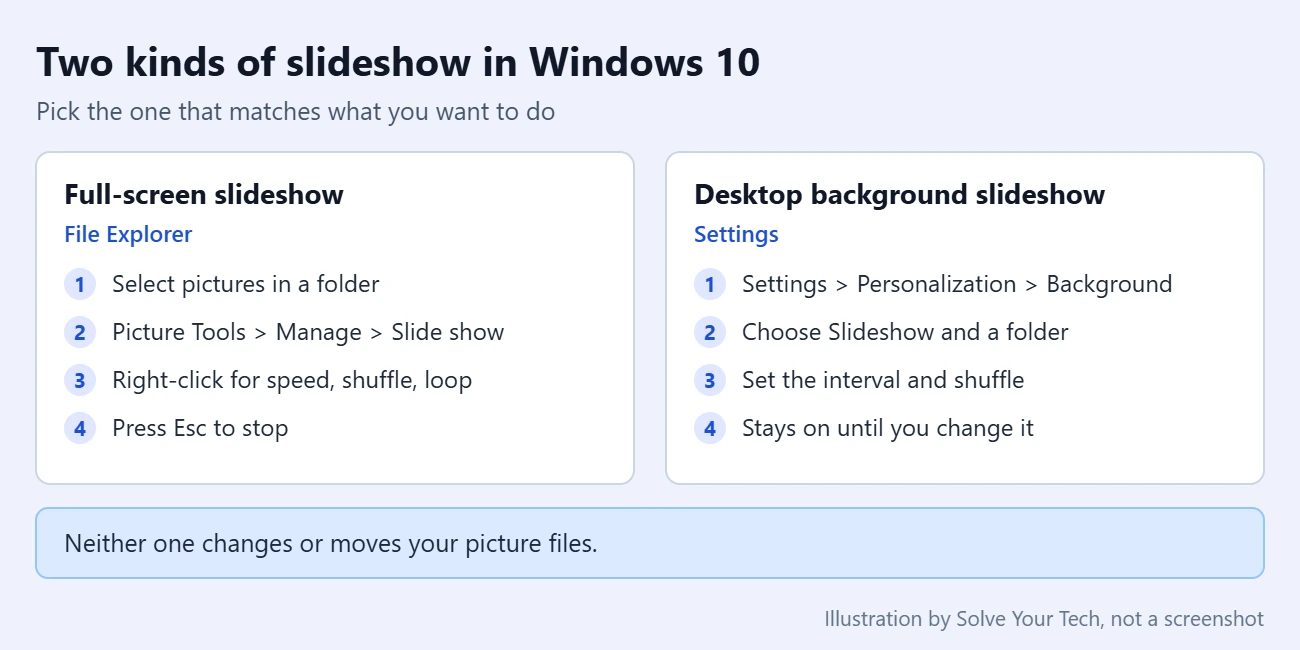
- Right-click an empty part of the desktop and select Personalize. The Settings app opens.
- Select Background.
- Open the Background list and choose Slideshow.
- Click Browse and pick the folder of pictures to use.
- Set how often the picture changes, and turn Shuffle on if you want a random order.
This setting stays on until you change it. To undo it, return to Background and choose Picture or Solid color. To skip ahead at any time, right-click the desktop and select Next desktop background. Microsoft notes that with more than one monitor, each screen shows a different picture from the folder.
Tips for a Better Slideshow
- Put the pictures in one folder first. The slideshow uses the pictures you select, so gathering them in one place makes selecting easy.
- Rotate sideways photos first. The Manage tab also has Rotate left and Rotate right buttons, next to Slide show. Unlike the slideshow, rotating changes the saved picture file.
- Plug in a laptop for long shows. A looping slideshow keeps the screen on, which uses battery.
If the Slide Show Button Is Missing or Does Nothing
- No Picture Tools tab. Click a picture file. The tab is hidden while nothing, a folder, or a non-picture file is selected.
- Only tab names show. The ribbon is collapsed. Press Ctrl + F1 or double-click a tab name to expand it.
- The selection includes other file types. If videos or documents are mixed in, select only pictures and look for the tab again.
- The file type is not recognized as a picture. Some camera formats may not be treated as pictures by File Explorer. Try a JPG or PNG copy.
- You are on Windows 11. File Explorer in Windows 11 has a different toolbar with no Picture Tools tab, so use the Windows 11 guide linked near the top of this page.
Other Ways to Make a Slideshow
The Photos app that comes with Windows 10 can also play the pictures in a folder. Open a picture in Photos, select the three-dot menu at the top right, and look for Slideshow. The menu differs between versions of the app, so the option may be in a slightly different place on your PC.
If you want music, titles, or a video you can share, File Explorer will not do that. Microsoft says the Photos Legacy app includes a slideshow creator, along with a video editor and album maker. See Microsoft’s Photos app help.
Presenting slides instead of photos? See how to hide the toolbar in a PowerPoint full-screen slide show.
Frequently Asked Questions
Why is there no Manage tab?
The Manage tab under Picture Tools only shows when picture files are selected in Windows 10 File Explorer. Select at least one picture and it appears. If you see only tab names, press Ctrl + F1 to expand the ribbon.
How do I stop the slideshow?
Press Esc, or right-click the screen and choose Exit. You return to the folder you started from.
Can I change how fast the pictures change?
Yes. Right-click during the slideshow and choose Slide Show Speed: Slow, Medium, or Fast. The File Explorer slideshow does not offer an exact number of seconds.
Can I add music to the File Explorer slideshow?
No. The File Explorer slideshow only displays pictures. You can play music in another app before you start it, or build a video slideshow in an app such as Photos Legacy.
Does the slideshow include pictures in subfolders?
It plays the picture files you select in the open folder. To include pictures from several folders, copy them into one folder first, then select them there.
Does a slideshow change my photos?
No. Viewing a slideshow, shuffling, and changing the speed do not edit your files. Only the Rotate buttons on the same tab change a picture.
Related Guides
- How to find all photos on your computer in Windows 11
- How to transfer photos from a camera to a Windows 11 computer
Next, gather the photos you want into one folder, select them, and click Slide show. Seeing a box labeled Address on your taskbar? Here is what the Address toolbar in Windows 10 is and how to remove it.

Matthew Burleigh is the founder, head writer, and editor of Solve Your Tech, which he launched in 2012. He has written technology tutorials since 2008 and worked in IT since 2003, including small-business support, IT management, and consulting. He holds Bachelor’s and Master’s degrees in Computer Science from Arizona State University.
Matthew writes practical guides for Windows, iPhone and iPad, Microsoft Office, Outlook, Google apps, and Android. Solve Your Tech’s guides are tested on current devices or checked against official product documentation, with clear steps, sources, and update dates.
Read more about Matthew and how Solve Your Tech writes and updates its guides, or report a correction.