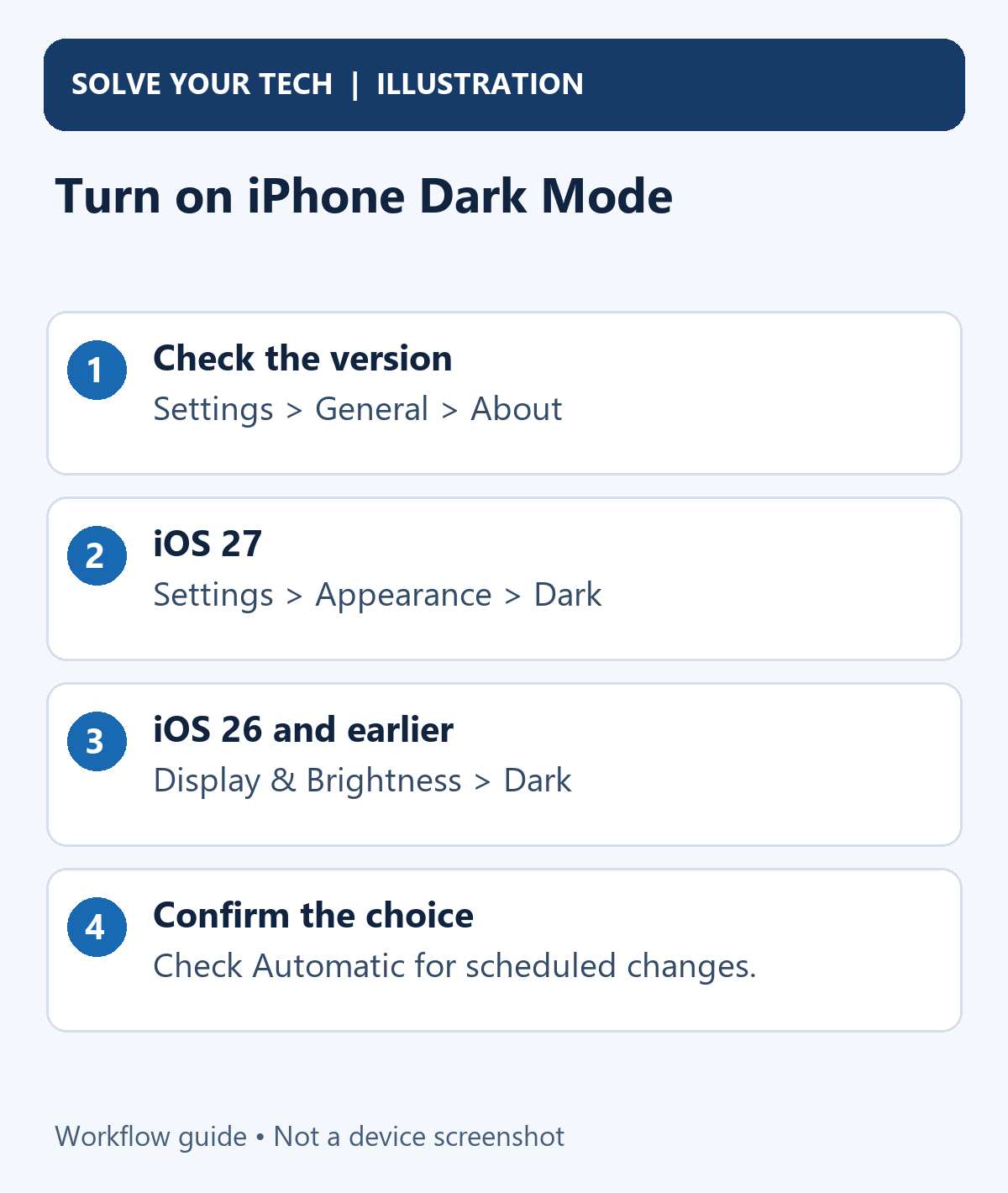
To turn on Dark Mode, open Settings > Appearance > Dark on iOS 27. On iOS 26 and earlier, use Settings > Display & Brightness > Dark. For a quick switch, open Control Center, touch and hold the brightness bar, and tap Dark Mode.
Dark Mode changes the color scheme in supported interfaces. It is useful when you prefer dark backgrounds, especially in a dim room. It does not automatically make every website dark, reduce the brightness slider, or turn off the screen.
Before you start
Check Settings > General > About if you do not know your iOS version. Dark Mode requires iOS 13 or later; the Settings location has changed since many older tutorials were written. These instructions cover current iPhones, including an iPhone 13 running a supported version.
Apple's current Dark Mode support article uses Appearance for iOS 27 and explicitly directs earlier versions to Display & Brightness. Some other Apple guide pages still show the older route. Use the section that matches the controls on your phone.
You do not need to download an app or buy a theme. Start with the system setting, then check any app that continues to look light.
Turn on Dark Mode through Settings
- Open Settings from your Home Screen or App Library.
- On iOS 27, tap Appearance. On iOS 26 or earlier, tap Display & Brightness instead.
- Select Dark. The selected appearance should be indicated on that screen, and supported Settings backgrounds should change immediately.
- Check the Automatic control. Turn it off if you want the phone to remain dark rather than change appearance on a schedule.
- Open an app such as Messages and check its appearance. Then return to Settings if you want to change the choice.
To undo the change, return to the same screen and select Light. If Automatic is enabled, a later scheduled transition can change the appearance again; review that switch when you want a lasting manual choice.
Change a Black Background to White: Turn Off Dark Mode
For a light system interface, open Settings > Appearance on iOS 27, or Settings > Display & Brightness on iOS 26 and earlier. Select Light and turn Automatic off if you want that choice to stay in place. Check Settings again: supported backgrounds should become light. You can select Dark later to undo it.
If only one app stays black, check that app’s own Theme or Appearance preference. If colors look reversed even with Light selected, check Settings > Accessibility > Display & Text Size for Smart Invert and Classic Invert. Turn off an enabled inversion option if it is causing the unwanted result; our iPhone color inversion guide explains the difference. Light appearance changes supported interfaces; it does not replace a black wallpaper with a white image.
Switch Dark Mode from Control Center
Control Center is the panel of quick controls for brightness, volume, and other features. You can use it without navigating back through Settings.
- On an iPhone with Face ID, swipe down from the top-right corner. On an iPhone with a Home button, swipe up from the bottom edge.
- Find the brightness bar, which has a sun symbol. Touch and hold it to expand its controls.
- Tap Dark Mode to switch the appearance on or off.
- Tap outside the expanded control, then close Control Center. Check the app underneath to see the result.
Dragging the brightness bar changes light output. Holding it reveals additional controls. If the display only gets dimmer, you probably dragged the bar rather than opening the expanded panel.
For a dedicated button on current versions, open Control Center, hold a blank area to enter editing, tap Add a Control, and select Dark Mode. Finish editing using the controls shown on your version. You can then tap that control directly next time.
Older versions used Settings > Control Center to add controls. Do not expect that older customization screen when your phone offers Add a Control inside Control Center itself.
Set a daily schedule
Automatic appearance is useful if you want a light interface during the day and a dark one later. The schedule changes appearance, not the times when notifications arrive.
- Open the appearance screen for your version: Settings > Appearance on iOS 27, or Settings > Display & Brightness on earlier versions.
- Turn on Automatic.
- Tap Options to open the scheduling choices.
- Choose Sunset to Sunrise, or choose Custom Schedule and set the Light and Dark times you prefer.
- Return to the appearance screen and confirm Automatic remains enabled.
Sunset to Sunrise follows local daylight timing. A custom schedule lets you choose fixed transition times, which is useful if your routine does not follow sunset. Check the phone's date, time, and location settings if daylight transitions appear wrong.
If Dark Mode seems to turn itself off every morning, first check Automatic and Options. That can be an expected scheduled change rather than a fault. To stop scheduled switching, turn Automatic off and select the appearance you want.
Dark Mode, Night Shift, and brightness are different controls
| What you notice | Setting to check |
|---|---|
| Light backgrounds become dark | Dark Mode |
| The display looks orange or warmer | Night Shift or True Tone |
| Everything looks too bright or dim | Brightness and Auto-Brightness |
| The screen dims and then locks | Auto-Lock |
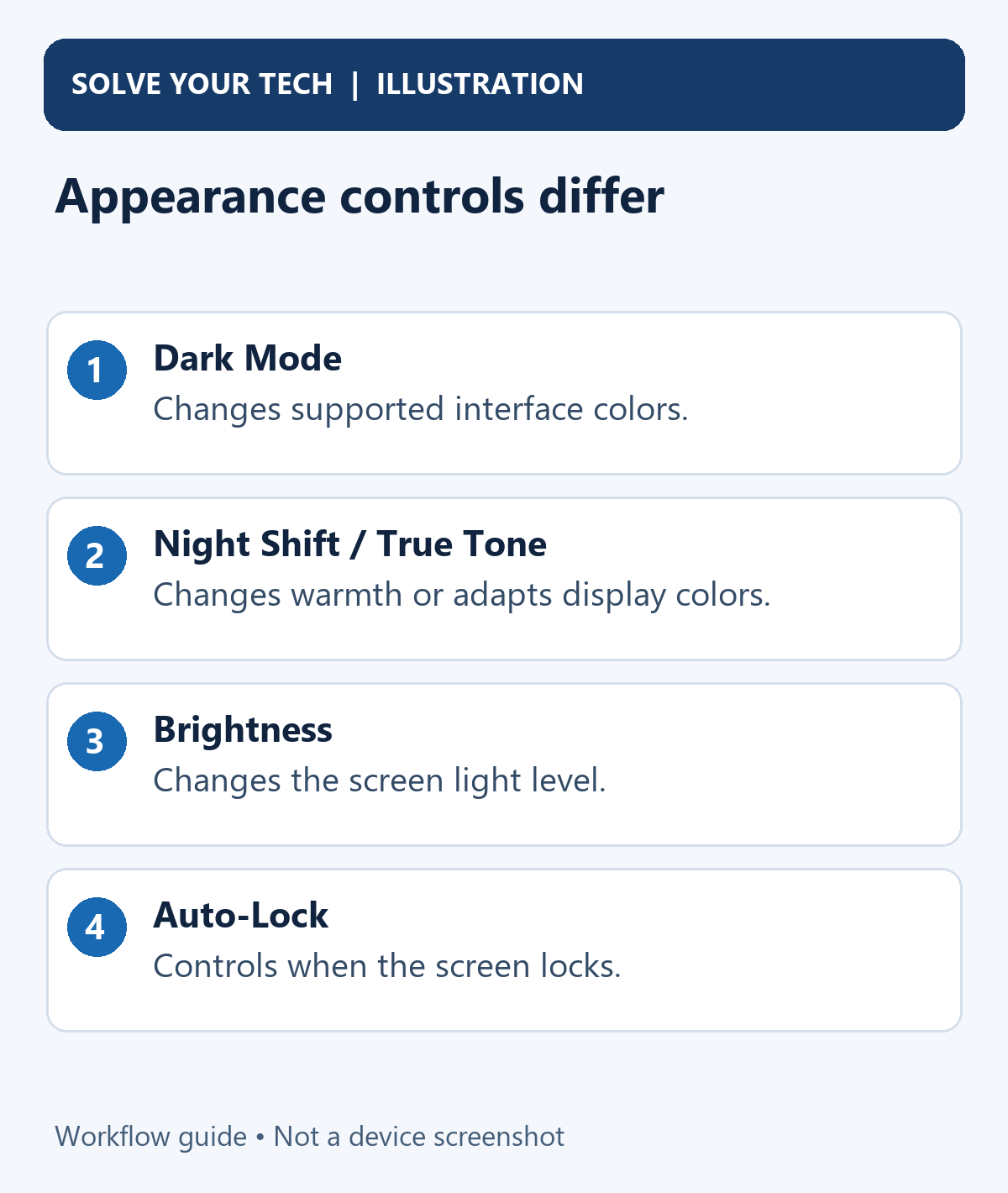
Night Shift moves display colors toward warmer tones, as explained in our guide to using Night Shift on an iPhone. True Tone adapts the display to the surrounding light. Neither replaces the Dark Mode appearance choice, and they can be enabled at the same time. The same settings exist on Apple tablets, as shown in our guide to Night Shift on iPad.
If an orange tint is the problem, see why your iPhone has an orange hue. If the display keeps dimming, use our iPhone dimming guide to distinguish Auto-Brightness from Auto-Lock.
If an app or website stays light
First confirm that Settings itself is dark. If it is, the system change worked. Open the affected app's own settings and look for Appearance, Theme, Dark, or Use System Setting. The names and availability depend on that app. For one example, see how to use a black background in the Reddit iPhone app.
An app can provide its own appearance preference, and a website can have a separate theme. System Dark Mode does not guarantee that every page, image, or document will be recolored. A white PDF page, for example, is content rather than the surrounding interface.
Close and reopen an app if it has not refreshed its appearance. Check for its updates if the setting appears broken. Avoid changing unrelated accessibility settings just to force one website to look dark: color inversion has a different purpose and can change how content appears.
Common questions
Will Dark Mode change my wallpaper or every app icon?
Do not assume it will. Wallpaper and Home Screen icon customization have their own controls and version requirements. Check both screens after changing appearance if their contrast matters to you. If a saved design no longer suits the new appearance, you can delete that wallpaper on your iPhone.
Can I keep Dark Mode on all day?
Yes. Select Dark and turn Automatic off. You can still use Control Center to make a manual change later.
Is Dark Mode a guaranteed battery fix?
No single saving applies to every iPhone or workload. Screen technology, brightness, the displayed content, and time spent using the phone all matter. Choose the appearance you prefer and manage brightness separately. Some apps also have their own switch; see how to turn on dark mode in the X (Twitter) iPhone app for one example.
Finish by checking Settings, one frequently used app, and the Automatic schedule. That confirms which appearance is selected and whether it will change later.

Matthew Burleigh is the founder, head writer, and editor of Solve Your Tech, which he launched in 2012. He has written technology tutorials since 2008 and worked in IT since 2003, including small-business support, IT management, and consulting. He holds Bachelor’s and Master’s degrees in Computer Science from Arizona State University.
Matthew writes practical guides for Windows, iPhone and iPad, Microsoft Office, Outlook, Google apps, and Android. Solve Your Tech’s guides are tested on current devices or checked against official product documentation, with clear steps, sources, and update dates.
Read more about Matthew and how Solve Your Tech writes and updates its guides, or report a correction.