This post contains affiliate links. As an Amazon Associate, solveyourtech.com earns from qualifying purchases, at no extra cost to you.
To transfer photos from an iPad to a flash drive, plug the drive into the iPad’s charging port (with an adapter if needed), open Photos, select the photos, tap the Share button, and choose Save to Files. Pick the flash drive under Locations and tap Save.
Apple also offers an Export Unmodified Original option that copies the original files to the drive. These steps are for iPads running iPadOS 27 with USB-C or Lightning ports; recent earlier versions use the same Share sheet options. Working from an iPhone or with a larger drive? You can transfer iPhone photos to an external hard drive instead.
What You Need
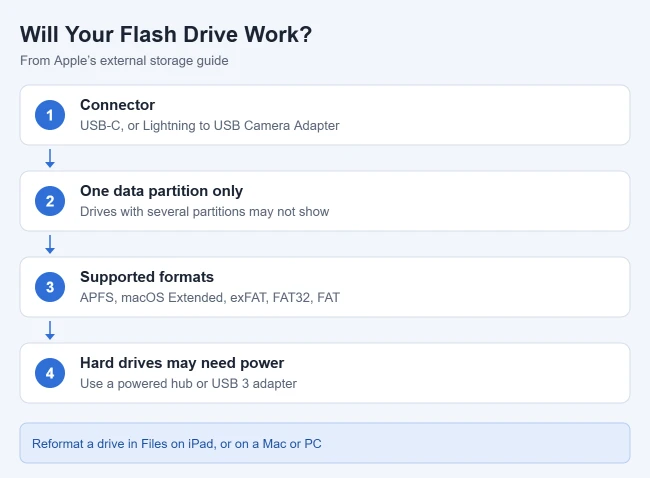
Apple’s Connect external storage devices to iPad guide lists what works:
- iPad with USB-C: a USB-C flash drive plugs right in. For a USB-A drive, use a USB-C to USB adapter.
- iPad with a Lightning port: use the Lightning to USB Camera Adapter or Lightning to USB 3 Camera Adapter (sold separately).
- One partition: the drive must have only a single data partition.
- A supported format: APFS, APFS (encrypted), macOS Extended (HFS+), exFAT, FAT32 or FAT. Most new flash drives use exFAT or FAT32 and work fine. NTFS, the usual format for Windows system drives, isn’t on Apple’s list.
For an iPad with USB-C, a two-ended drive such as the SanDisk Ultra Dual Drive Go (USB-C and USB-A) plugs straight into the iPad and into most computers. Make sure the drive has enough free space for the photos and videos you plan to copy; videos in particular can take up a lot of room.
Which Method Should You Use?
| Method | What lands on the drive | Best for |
|---|---|---|
| Save to Files | The photo as it looks now, including your edits | Sharing or viewing the pictures as you see them |
| Export Unmodified Original | The original file, without edits | Keeping an untouched archive copy |
Both methods copy. Nothing is removed from your iPad.
How to Copy Photos From iPad to a Flash Drive
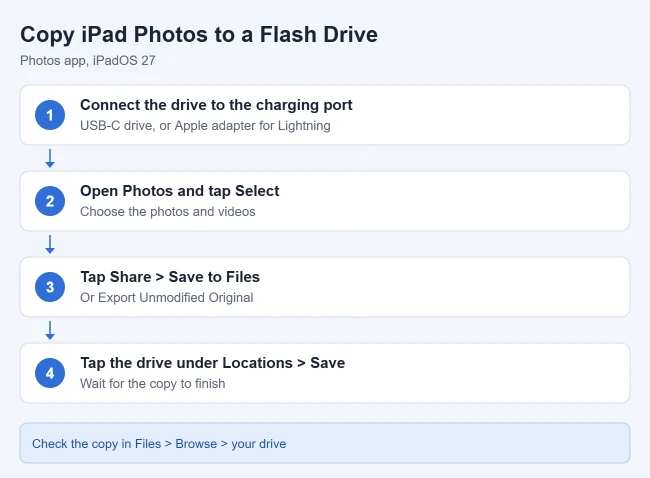
- Connect the flash drive to your iPad’s charging port.
- Open the Photos app.
- Tap Select, then tap each photo or video you want to copy. A check mark appears on each one. You can also drag your finger across a row of thumbnails to select several at once.
- Tap the Share button (a square with an arrow pointing up).
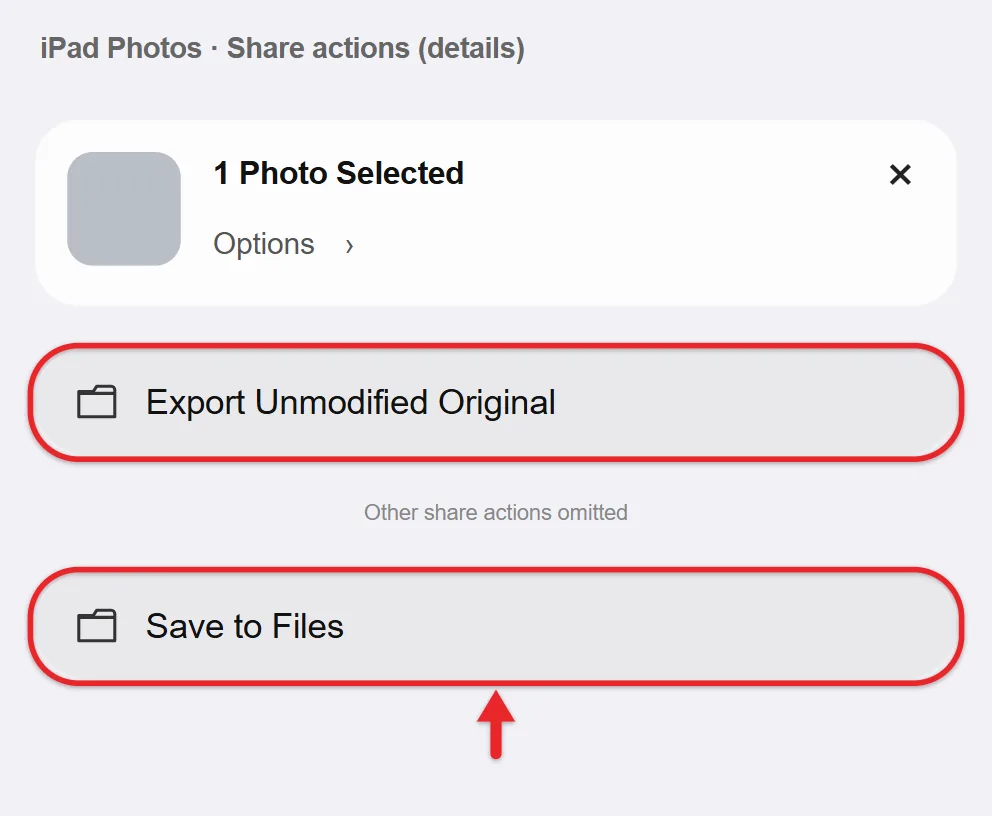
- Tap Save to Files.
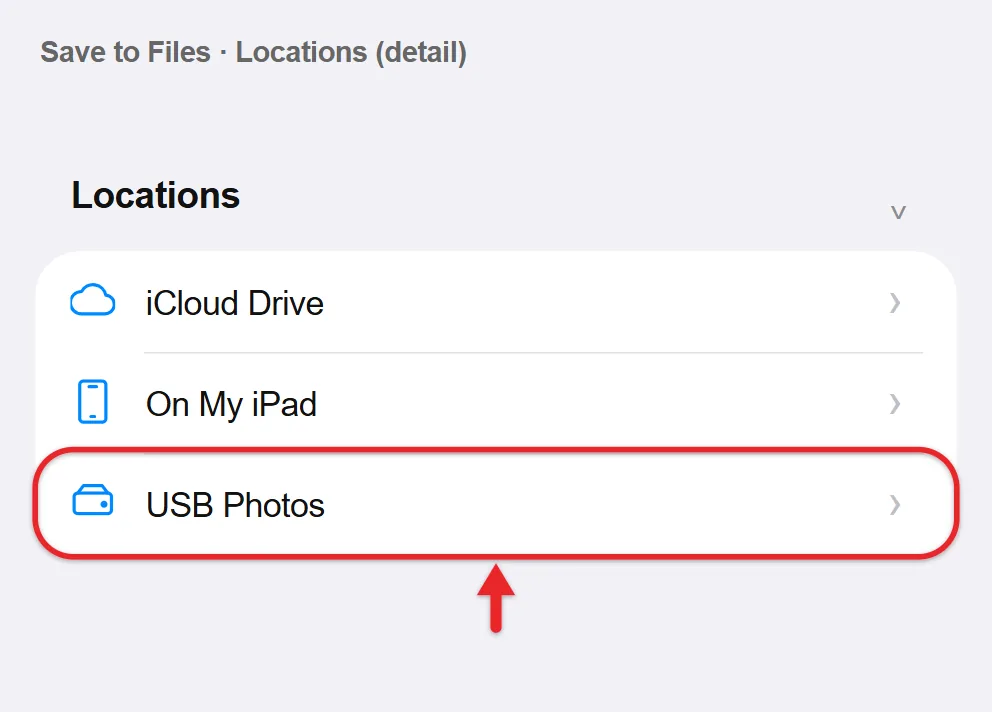
- Under Locations, tap your flash drive. Open a folder on it, or create a new one, if you want to keep the photos together.
- Tap Save. The photos copy to the drive.
Big batches can take a few minutes. Wait until the copy finishes before you unplug the drive. For a large library, copy a few hundred items at a time so one failed copy doesn’t mean starting over.
Copy a whole album
Albums don’t carry over to the drive; the photos land as separate files. To keep an album together, create a folder on the drive with the album’s name in step 6, open the album in Photos, select its photos, and save them into that folder. Repeat for each album.
Export Original Photos and Videos
Apple’s Import and export photos and videos guide describes a second option built for external drives:
- Connect the drive and open Photos.
- Select the photos and videos you want to export.
- Tap the Share button, then tap Export Unmodified Original.
- Tap your storage device below Locations, then tap Save. The original files copy to the drive.
For photos you’ve edited, this exports the unmodified original, not your edited version. Use Save to Files if you want the edited look. Apple also says photos and videos in the Hidden album won’t transfer if the album is locked; to unlock it, go to Settings > Apps > Photos and turn off Use Face ID, Use Touch ID or Use Passcode.
Check and Organize the Photos on the Drive
- Open the Files app.
- Tap Browse, then tap the flash drive under Locations. If you don’t see Locations, tap Browse again.
- Open the folder you saved to and tap a few files to preview them and confirm they copied.
In Files you can also create folders, rename items, and move them around on the drive. When you’re done, you can remove the drive from the charging port.
If the drive needs reformatting on a Windows PC first, here’s how to format a USB drive to FAT32 in Windows 11.
Once the copies are safely on the drive, check how much storage is left on your iPad to see how much room deleting them would free.
For documents and other files, here’s how to open a USB drive on iPad and copy files. It covers finding the drive in Files, choosing an app, checking storage, and troubleshooting connection problems.
Will the Photos Open on a Computer?
iPads usually save photos in HEIC format and videos in HEVC, which keep files small. Macs open them, but some Windows PCs, TVs and photo kiosks can’t. You have two options:
- Convert existing pictures on the computer later; here’s how to convert HEIC to JPG on Windows 11.
- For future pictures, go to Settings > Camera > Formats and choose Most Compatible. The camera then captures photos as JPEG and videos as H.264.
Copy Photos Through a Computer Instead
If your drive won’t connect to the iPad or you’re copying a very large library, you can move photos to a computer first, then onto the drive. Apple’s Transfer photos from your iPhone or iPad article covers this:
- Mac: connect the iPad with a USB cable, open Photos on the Mac, pick photos on the Import screen, and click Import Selected or Import All New Items. Then drag them to the flash drive in Finder. No flash drive icon on your desktop? You can show drives on the Mac desktop.
- Windows PC: install the Apple Devices app from the Microsoft Store, connect the iPad, unlock it and tap Trust if asked, and import with the Microsoft Photos app. Then copy them to the drive in File Explorer. For each screen, follow the steps for transferring iPhone or iPad photos to a Windows PC.
If you use iCloud Photos, you need to download the original, full-resolution versions to your iPad before importing to a PC. The same applies on the iPad itself: if Optimize iPad Storage is on, the iPad may need to download full versions before it can save them, so stay on Wi-Fi during big copies.
Flash Drive Not Showing Up on iPad
- Look in the right place. In Files, tap Browse and check under Locations.
- Check the adapter. Lightning iPads need one of Apple’s USB camera adapters. Try reseating the drive and adapter.
- Check the format. If the drive uses a format like NTFS or has multiple partitions, the iPad may not read it. You can reformat a drive in Files on iPad or on a Mac or PC; reformatting erases everything on it, so copy anything you need first. On a computer, you can check which file format the flash drive uses before deciding.
- Check power. External hard drives often need their own power with iPad. A powered USB hub (USB-C iPads) or the Lightning to USB 3 Camera Adapter with a power adapter can help.
- Free up space. If the copy fails partway, the drive may be full. Check its free space in Files.
Have an iPhone too? Here’s how to back up iPhone photos to an external drive.
Frequently Asked Questions
Does copying photos to a flash drive remove them from my iPad?
No. Both methods copy the photos. They stay in your Photos library until you delete them. If you’re copying to free up room, open a few files on the drive first, then clear iPad storage. With iCloud Photos on, deleting a photo on the iPad also deletes it from your other devices.
Can I copy videos the same way?
Yes. Select videos along with photos in the Photos app and use either method. Videos are much larger, so check the drive’s free space first.
Can I move photos back from the drive to my iPad?
Yes. You can import photos and videos from an external drive directly to the Photos app on your iPad. Connect the drive, open Photos, tap Import, and choose what to bring in.
Where do downloaded files go on iPad?
Here’s how to find downloads on iPad. Related: how to sync an iPad and iPhone and how to view pictures by date on iPad.
For servers and cloud services, Apple’s Transfer files from iPad guide covers more options.

Matthew Burleigh is the founder, head writer, and editor of Solve Your Tech, which he launched in 2012. He has written technology tutorials since 2008 and worked in IT since 2003, including small-business support, IT management, and consulting. He holds Bachelor’s and Master’s degrees in Computer Science from Arizona State University.
Matthew writes practical guides for Windows, iPhone and iPad, Microsoft Office, Outlook, Google apps, and Android. Solve Your Tech’s guides are checked step by step against the device or app maker’s own documentation and tested on his own devices whenever he has the hardware or software, with clear steps, sources, and update dates.
Read more about Matthew and how Solve Your Tech writes and updates its guides, or report a correction.