To transfer photos from an iPhone to a Windows PC, install Apple Devices from the Microsoft Store, connect the iPhone with a USB cable, unlock it, and tap Trust. Then open the Photos app on the PC, select Import, and choose your iPhone. Pick the photos you want and choose the folder where you want to save them. Phone Link won’t show your iPhone photos, but it can put your texts and calls on your PC. See how to link your iPhone to Windows 11.
You don’t need iTunes. If you’d rather skip the cable, iCloud for Windows can sync your photos wirelessly, as shown further down.
Import With the Windows Photos App
- Install Apple Devices from the Microsoft Store if it isn’t already on the PC. It provides the driver Windows uses to talk to the iPhone.
- Connect the iPhone to the PC with a USB cable that can transfer data.
- Unlock the iPhone. If it asks Trust This Computer?, tap Trust or Allow and enter your passcode.
- Select Start and open the Photos app on the PC.
- Select Import at the top, then choose your iPhone.
- Select the photos you want, or select all, and choose where to save them.
- Select Add or Import to start, and keep the iPhone unlocked and connected until it finishes.
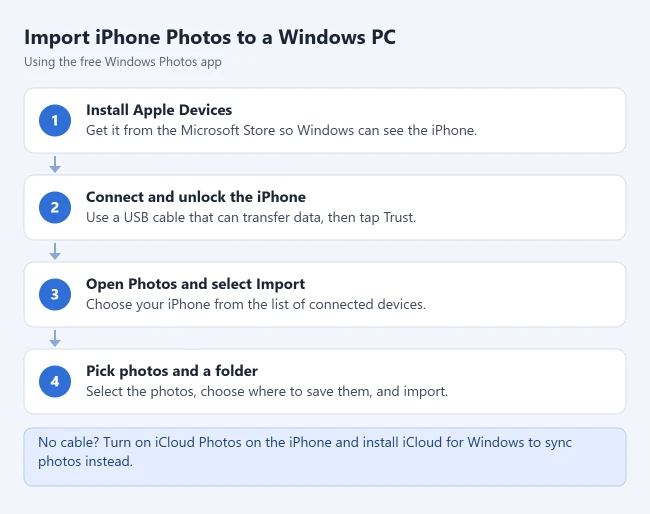
These steps follow Apple’s guide to transferring photos to a Windows PC and Microsoft’s guide to importing photos from a phone, which notes that the PC can’t find the phone while it’s locked. Videos import the same way as photos.
Before You Import
- iCloud Photos: if it’s on and Optimize iPhone Storage is selected, full-size originals may be in iCloud, not on the phone. Apple says to download the originals to the iPhone first, or use iCloud for Windows instead.
- File format: iPhones save photos as HEIC by default. Windows can open them with the HEIF Image Extensions from the Microsoft Store. To save JPEGs instead in the future, go to Settings > Camera > Formats on the iPhone and choose Most Compatible.
- Transfer format: in Settings > Apps > Photos on the iPhone, the Automatic transfer option allows compatible-format conversion during transfer. Choose Keep Originals to retain the original format. Apple documents that USB imports may convert HEIF or HEVC media; conversion is not guaranteed for every file.
- Space: check that the PC has enough free space for your library, especially if you have a lot of videos.
Copy Photos With File Explorer
File Explorer provides another way to copy files that are available locally on the connected phone.
- Connect and unlock the iPhone, and tap Trust if asked.
- Press Windows key + E and select This PC.
- Open Apple iPhone, then Internal Storage, then DCIM.
- Open the folders inside, select the photos, and copy them to a folder on the PC.
Photos may be split across several folders; their names vary. If a copy fails, test a small batch and check the cable, phone unlock status, and cloud-only originals before retrying. Keep Originals controls conversion during USB import; it is not a guaranteed fix for a connection error.
Transfer Photos Wirelessly With iCloud
- On the iPhone, open Settings > [your name] > iCloud > Photos, and turn on syncing.
- Install iCloud for Windows from the Microsoft Store and sign in with your Apple Account.
- In current iCloud for Windows, click the arrow to the right of iCloud Photos, turn on iCloud Photos, and click Done. Open File Explorer and choose iCloud Photos in its navigation pane. If it is not listed, open Pictures, then iCloud Photos.
Apple’s iCloud Photos setup guide documents the current controls. Your iCloud photos are available through File Explorer. iCloud Photos uses your iCloud storage, so make sure your plan has room for your library.
If Your PC Doesn’t See the iPhone
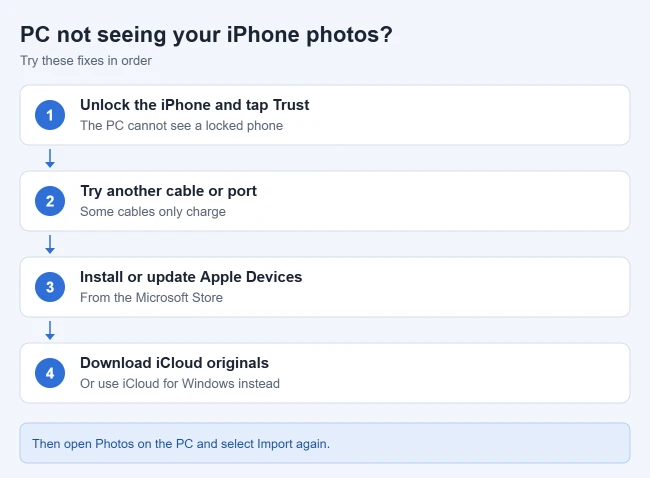
- Unlock the iPhone and tap Trust. If you tapped Don’t Trust by mistake, unplug and reconnect to get the prompt again.
- Try a different USB cable or port. Some cables only charge.
- Install or update Apple Devices from the Microsoft Store, then restart the PC.
- Make sure Windows is up to date in Settings > Windows Update.
- If only some photos appear, the rest may be in iCloud. Download the originals or use iCloud for Windows.
Frequently Asked Questions
Do I need iTunes to transfer photos?
No. Apple Devices and the Windows Photos app handle photo imports. Apple Devices now handles syncing and backups on Windows too.
Where are the imported photos?
In the save location you selected during the import. Check that destination first. See how to find all photos on your computer if you can’t find them.
Why won’t my iPhone videos play on the PC?
iPhones record video in HEVC by default, which some PCs can’t play without an extra codec. Choosing Most Compatible in Settings > Camera > Formats records new videos in H.264 instead, which is more broadly compatible. This changes future recordings; it does not convert existing videos.
How do I do this on a Mac, or move other files?
For a Mac, see how to upload photos from an iPhone to a computer, which covers both Mac and PC. For documents and other files, see how to transfer files from an iPhone to a PC.
Moving to a new phone instead? See how to transfer data from iPhone to iPhone.
Test the copied files on your PC before considering deletion. An iCloud-synced picture deleted on one device is also deleted from iCloud and other synced devices; see Apple’s iCloud download guidance. For another destination, follow our external-hard-drive photo-transfer guide.

Matthew Burleigh has been writing tech tutorials since 2008. His writing has appeared on dozens of different websites and been read hundreds of millions of times.
After receiving his Bachelor’s and Master’s degrees in Computer Science he spent several years working in IT management for small businesses. However, he now works full time writing content online and creating websites.
His main writing topics include iPhones, Microsoft Office, Google Apps, Android, and Photoshop, but he has also written about many other tech topics as well.