To remove the numbers from taskbar icons in Windows 10, right-click an empty spot on the taskbar, choose Taskbar settings, and turn off Show badges on taskbar buttons. The numbers and small symbols are called badges. Microsoft describes a badge as an alert that some activity is happening, or needs to happen, with that app.
The steps below follow Microsoft’s support article on customizing the taskbar in Windows, which has separate tabs for Windows 10 and Windows 11. The switch has a different name in each version, so check whether you have Windows 10 or 11 if you are not sure which steps to use.
What the Numbers on Taskbar Icons Mean
A badge is a small overlay on an app’s taskbar button. Depending on the app, it can be a number, such as a count of unread items in a mail or chat app, or a symbol. Microsoft’s own example is a bell badge on the Alarms & Clock app, which tells you an alarm is active and will go off at the time you set.
Hiding badges only changes what the taskbar buttons look like. The badge switch is separate from the notification settings, which Microsoft keeps on a different Settings page, so it is not the place to turn off banners or sounds. Your unread messages are also still unread; you just have to open the app to see how many there are.
How to Hide Badges on Taskbar Icons in Windows 10
Microsoft’s instructions are a single switch in Taskbar settings and do not call for a restart or any other preparation.
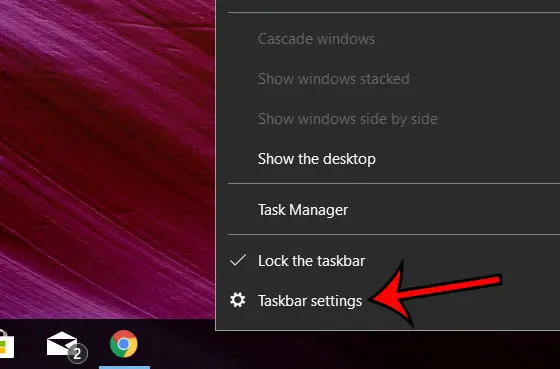
- Right-click an empty space on the taskbar, the bar that holds the Start button and your app icons. A menu opens.
- Choose Taskbar settings at the bottom of that menu. The Settings app opens to the Taskbar page.
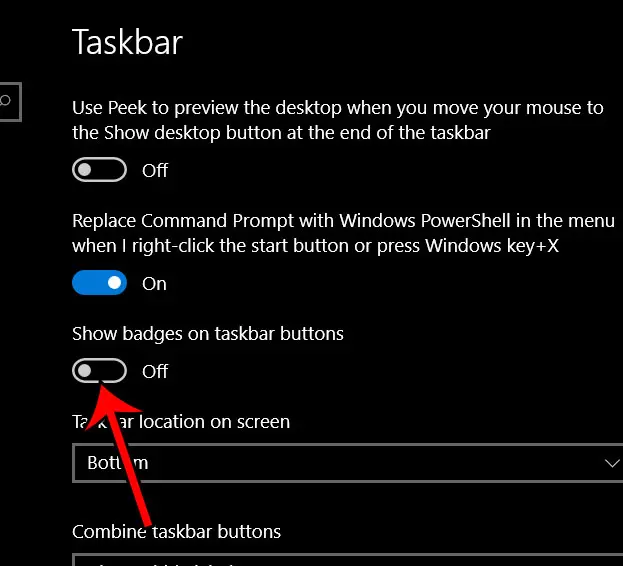
- Scroll down until you see Show badges on taskbar buttons.
- Select the switch under it so that it reads Off.
The same page can usually be reached from the Start menu by opening Settings, then Personalization, then Taskbar. This is useful if right-clicking the taskbar is awkward on a touchscreen.
How to confirm it worked and how to undo it
Look at an app that was showing a number, such as your mail app. Its taskbar icon should now be plain. Microsoft says badges are turned on by default, so to get them back, return to Taskbar settings and turn Show badges on taskbar buttons back On. Nothing else is changed by this switch, so there is nothing more to restore.
How to Turn Off Taskbar Badges in Windows 11
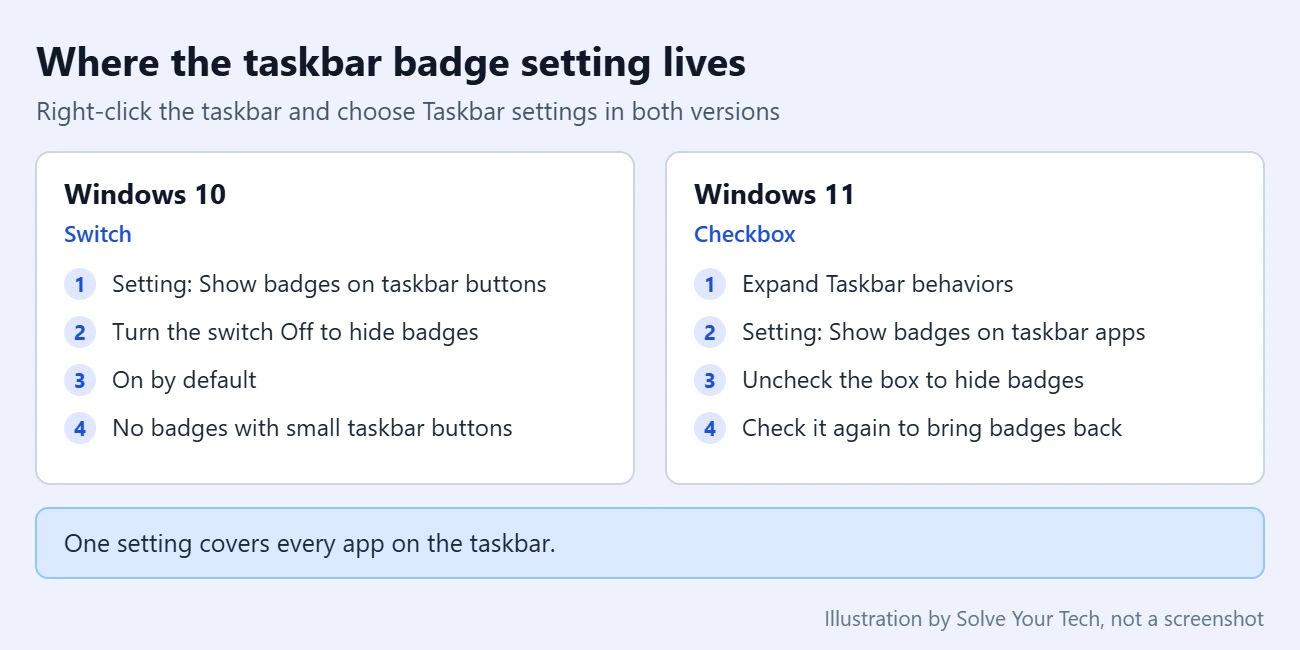
Windows 11 moved the option into a collapsible section and made it a checkbox instead of a switch.
- Right-click the taskbar and select Taskbar settings.
- Scroll down and expand Taskbar behaviors if the section is collapsed.
- Uncheck Show badges on taskbar apps.
Badges disappear from the app icons on the taskbar. Check the box again to bring them back.
What This Setting Does Not Change
Knowing the limits saves time if a number is still showing after you flip the switch.
- It is all or nothing. Microsoft documents one badge option for the whole taskbar, with no per-app list. You cannot keep the count on one app and hide it on another from this page.
- It does not stop notifications. To control banners and sounds in Windows 10, Microsoft says to open Settings > System > Notifications & actions, then pick an app under Get notifications from these senders.
- It does not stop icons from flashing. In Windows 11 that is a separate checkbox, Show flashing on taskbar apps, in the same Taskbar behaviors section.
- It does not cover the notification icon by the clock. The count on the Action Center icon at the far right of the Windows 10 taskbar is not an app badge. See the troubleshooting section below.
Troubleshooting
The badge switch is grayed out or badges never appear
Check the Use small taskbar buttons switch on the same Windows 10 page. Microsoft notes that badges aren’t displayed on small taskbar buttons, and the badge switch is typically unavailable while small buttons are on. If you want badges, turn Use small taskbar buttons off first. If you only wanted the numbers gone, small buttons already hide them.
I cannot find Show badges on taskbar buttons
That label is the Windows 10 wording. If your Taskbar settings page has a Taskbar behaviors section, you are on Windows 11 and the option is Show badges on taskbar apps. On a work or school computer, an administrator may also manage some taskbar options; in that case ask your IT team.
A number still shows next to the clock
That number belongs to Action Center, the Windows 10 panel that lists your notifications. Microsoft’s support page does not cover this one, but in Windows 10 you can normally right-click the Action Center icon and choose Don’t show number of new notifications. Right-click it again to turn the count back on.
The number is inside the app icon itself
Some programs draw their own unread indicator on their icon instead of using a Windows badge. The Windows switch may not affect those. Look in that program’s own notification settings for an unread count or taskbar icon option.
Frequently Asked Questions
Can I turn off the badge for only one app in Windows 10?
Not from Taskbar settings. Show badges on taskbar buttons applies to every app on the taskbar. You can turn off an individual app’s notifications in Settings > System > Notifications & actions, but Microsoft does not say whether that also removes the app’s badge, so treat it as something to try rather than a sure fix.
Will I miss anything if I hide badges?
You lose the at-a-glance count on the taskbar and nothing else. Messages, alarms and reminders are not deleted or changed, and notification settings stay as they were.
Can I make taskbar buttons smaller instead?
Yes, in Windows 10. In Taskbar settings, turn on Use small taskbar buttons to fit more apps on the taskbar. Microsoft notes that badges aren’t displayed on small buttons, so this hides the numbers as a side effect.
Does this still work now that Windows 10 support has ended?
Yes. Microsoft ended Windows 10 support on October 14, 2025, which means no more free security updates or technical help, but Microsoft says the PC keeps working and the taskbar settings are still there. Microsoft recommends moving to Windows 11 if your PC is eligible.
Next Steps
If you want fewer interruptions rather than a tidier taskbar, our guide to Focus assist and Do not disturb in Windows covers silencing notifications. For other taskbar cleanup, see how to remove the Address bar from the Windows 10 taskbar or stop the taskbar from hiding.

Matthew Burleigh is the founder, head writer, and editor of Solve Your Tech, which he launched in 2012. He has written technology tutorials since 2008 and worked in IT since 2003, including small-business support, IT management, and consulting. He holds Bachelor’s and Master’s degrees in Computer Science from Arizona State University.
Matthew writes practical guides for Windows, iPhone and iPad, Microsoft Office, Outlook, Google apps, and Android. Solve Your Tech’s guides are tested on current devices or checked against official product documentation, with clear steps, sources, and update dates.
Read more about Matthew and how Solve Your Tech writes and updates its guides, or report a correction.