To stop typing a password when Windows 11 starts, turn on automatic sign-in with netplwiz. Press Windows key + R, type netplwiz, uncheck “Users must enter a user name and password to use this computer,” and confirm with your password. If you use a local account, you can remove the password completely by changing it to a blank one.
Before you do this, keep in mind that anyone with access to your PC can then open your files, email, and saved passwords. It’s best for desktop PCs at home, not laptops you carry around.
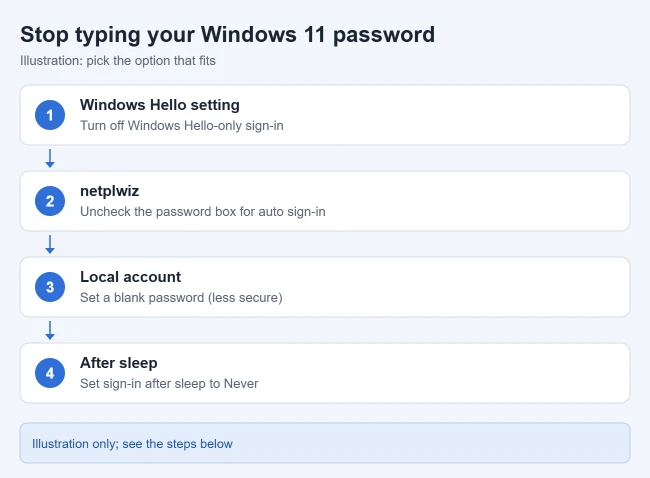
Sign In Automatically With Netplwiz
- Open Settings > Accounts > Sign-in options.
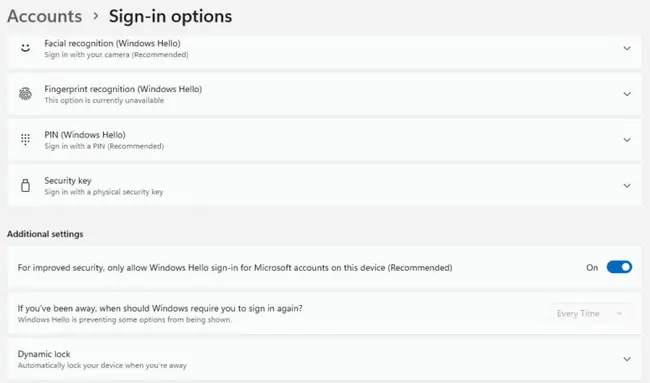
- If For improved security, only allow Windows Hello sign-in for Microsoft accounts on this device is on, turn it off so the netplwiz checkbox appears.
- Press Windows key + R, type
netplwiz, and press Enter. - Select your account.
- Uncheck Users must enter a user name and password to use this computer.
- Select Apply, then enter your password twice and select OK.
Restart the PC to check that it now signs in on its own. In the confirmation box, type your account password, not your Windows Hello PIN. If the checkbox is missing, see the FAQ below; on a work or school PC, your organization may block this setting. To go back to typing a password, reopen netplwiz, check the box again, and select Apply > OK. Microsoft’s sign-in options guide covers these settings.
Remove the Password From a Local Account
- Open Settings > Accounts > Sign-in options.
- Select Password, then Change.
- Enter your current password and select Next.
- Leave the new password, confirm password, and hint boxes empty.
- Select Next, then Finish.
Not sure which account type you have? Open Settings > Accounts > Your info. A local account says Local account under your name. To switch, see how to switch to a local account in Windows 11.
On Windows 10, both methods work the same way: netplwiz is identical, and the blank-password route is at Settings > Accounts > Sign-in options > Password > Change.
Remove a Local Account Password With Command Prompt
If you manage the PC with an administrator account, you can clear a local account’s password with the net user command. This doesn’t work for Microsoft accounts.
- Right-click Start and select Terminal (Admin), then select Yes.
- Type the command below, replacing Name with the account name, and press Enter.
net user "Name" ""- Look for The command completed successfully. The account now signs in without a password.
Run net user by itself to list the account names on the PC. If you don’t know yours, see how to find your username in Windows 11.
Stop Windows Asking for Sign-In After Sleep
For the wake-up prompt, open Settings > Accounts > Sign-in options. Under additional settings, find If you’ve been away, when should Windows require you to sign in again? and choose Never if it is available. This allows someone with access to an unlocked, waking PC to use it, so keep a sign-in requirement on a shared or portable computer.
If Never is missing or the setting is grayed out, Windows Hello or an organization policy is controlling it. Microsoft’s sign-in options guide describes these controls.
This changes the idle/wake sign-in requirement. It does not stop Microsoft account prompts inside Office, OneDrive, or websites, and it does not remove your Microsoft account password. A manually locked session and an organization’s locking policy are separate. Check the result by letting the PC sleep and waking it; automatic sign-in at startup is a different setting.
Remove the PIN or Face Sign-In Too
Automatic sign-in skips the password at startup, but Windows Hello may still ask for your PIN after sleep or when you lock the PC. To remove it, open Settings > Accounts > Sign-in options, select PIN (Windows Hello), and select Remove. If Remove is grayed out, follow our guide on how to turn off the PIN on Windows 11.
Frequently Asked Questions
Is it safe to remove my Windows password?
It’s less safe. Anyone who can reach your PC can use it. A short PIN is a good middle ground: see how to change your PIN on Windows 11.
Why is the netplwiz checkbox missing?
If Sign-in options offers the Windows Hello-only sign-in setting for your account, turn it off, close netplwiz and reopen it to check whether the checkbox appears. Some account types, managed devices or configurations do not offer this setting or automatic sign-in. On a work PC, follow your organization’s policy. Automatic sign-in needs the account password, not its PIN; use the supported sign-in method if you cannot supply it.
Will this remove my Microsoft account password online?
No. Your Microsoft account password still works and is still needed on other devices and websites. If you want to get rid of that password too, Microsoft lets you make the account passwordless. You then sign in with the Microsoft Authenticator app, Windows Hello, or a security key instead. You need the Authenticator app set up first.
How do I change my password instead?
If you’d rather keep a password but use an easier one, see how to change your password on Windows 11.
Does automatic sign-in work if I lock my PC?
No. Automatic sign-in only applies when the PC starts or restarts. Locking the PC with Windows key + L still asks for your PIN or password unless you removed them.

Matthew Burleigh is the founder, head writer, and editor of Solve Your Tech, which he launched in 2012. He has written technology tutorials since 2008 and worked in IT since 2003, including small-business support, IT management, and consulting. He holds Bachelor’s and Master’s degrees in Computer Science from Arizona State University.
Matthew writes practical guides for Windows, iPhone and iPad, Microsoft Office, Outlook, Google apps, and Android. Solve Your Tech’s guides are checked step by step against the device or app maker’s own documentation and tested on his own devices whenever he has the hardware or software, with clear steps, sources, and update dates.
Read more about Matthew and how Solve Your Tech writes and updates its guides, or report a correction.