When an iPhone shows a temperature warning, Apple’s fix is simple: turn the iPhone off, move it somewhere cooler and out of direct sunlight, and let it cool down. The warning clears once the phone is back in its normal range.
Your iPhone went black at the beach and says it needs to cool down. Here’s what to do now, and what a warning that keeps coming back means.
What the iPhone Temperature Warning Means
Every iPhone has built-in protections against overheating. When the temperature inside the phone goes above its normal operating range, iOS starts limiting what the phone can do to protect the battery and other parts. If it keeps climbing past a certain threshold, the iPhone shows a full-screen temperature warning and stops normal use until it cools.
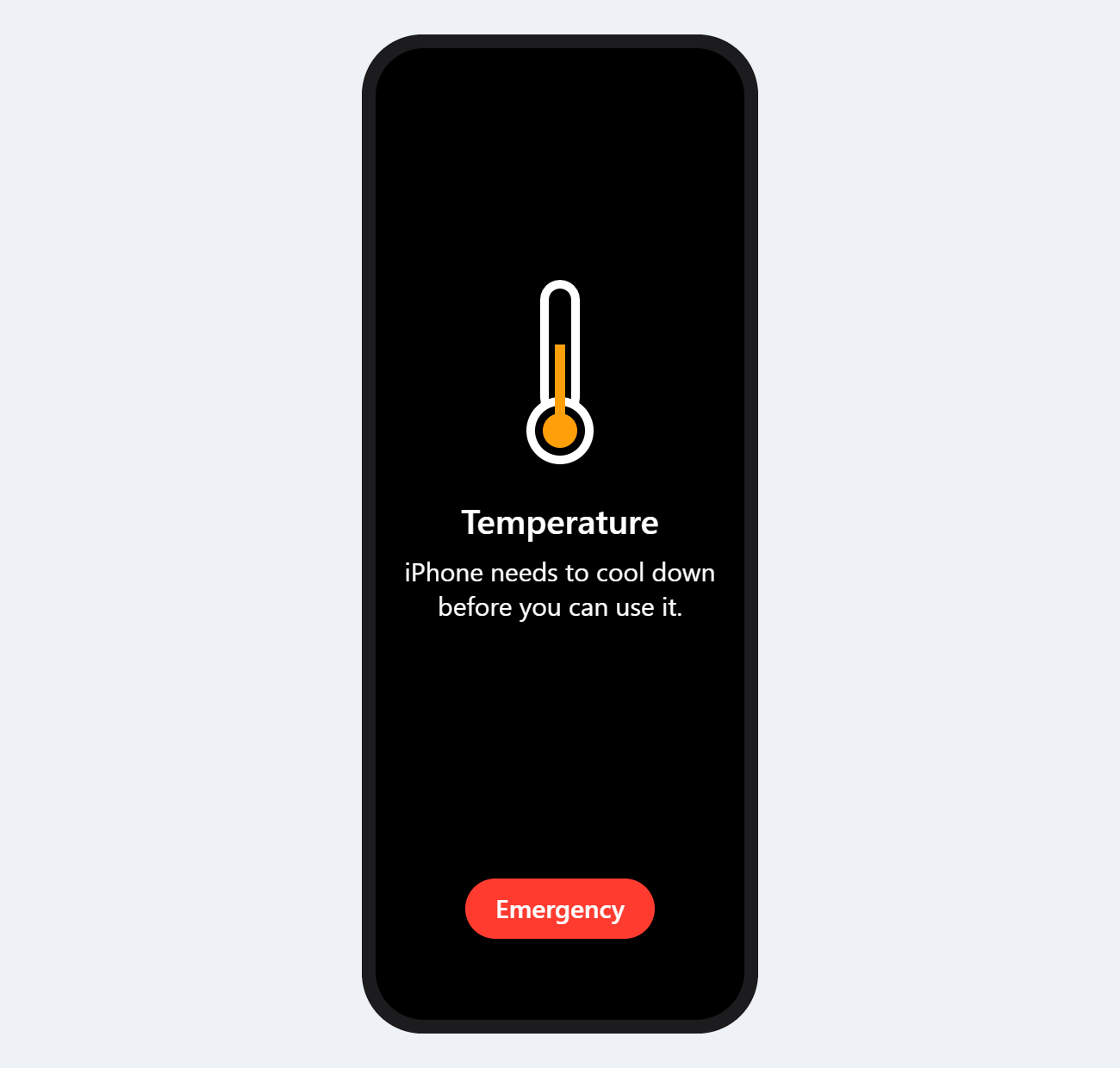
That screen isn’t an error in the usual sense, and it doesn’t mean the phone is broken. It’s the phone protecting itself. According to Apple’s page on iPhone and iPad temperatures, an iPhone showing the warning might still be able to make emergency calls, so you aren’t completely cut off if you need help.
Apple designs iPhone for use where the surrounding (ambient) air is between 0 and 35 degrees Celsius (32 to 95 degrees Fahrenheit). A beach in the afternoon sun can push past that easily, and a phone lying on a towel in direct sunlight gets much hotter than the air around it.
Signs the phone is heating up before the warning
The full-screen warning is usually the last step. Before it appears, Apple says you may notice that:
- Charging slows down or stops, including wireless charging
- The display dims or goes black
- The cellular signal weakens, because the radios move into a low-power state
- The camera flash or other camera features are temporarily disabled
- Some apps run more slowly, with lower frame rates or longer processing times
If you notice these, that’s the moment to get the phone out of the heat, before the warning locks you out.
What to Do Right Now
These are Apple’s three steps for the warning screen, plus a few practical extras that speed things up.
- Turn the iPhone off. A phone that’s switched off stops making its own heat from the screen, radios and processor. If you need help turning it off on a newer model, see how to turn off or force restart an iPhone 16 or iPhone 17; the button combination is the same on many recent models.
- Move it somewhere cooler, away from direct sunlight. Shade, an air-conditioned room, or the inside of a bag that’s out of the sun all help. At the beach, a beach bag in the shade of an umbrella beats leaving it on the sand.
- Take it out of the case. Thick or insulated cases hold heat in. This isn’t one of Apple’s three warning-screen steps, but Apple’s battery advice says to take a phone out of its case if it gets hot while charging, and a bare phone sheds heat faster.
- Unplug it. If the phone is connected to a charger or sitting on a wireless charger, disconnect it. Charging adds heat, and Apple says charging in high temperatures can harm the battery.
- Wait. Let the phone cool on its own. Apple doesn’t give a fixed time, because it depends on how hot the phone got and how warm the room is. Give it a while before you turn it back on to check.
When you turn it back on and the warning is gone, you’re fine to use it normally. If you were using something heavy when it overheated, such as maps navigation or a game, give it a few more minutes in the shade before you go back to it.
What not to do
- Don’t put it in the fridge or freezer. A sudden temperature swing can cause moisture to condense inside the phone. This is common sense rather than an Apple instruction, but there’s no upside to the risk.
- Don’t point a cold air blast or ice pack directly at it. Same reason. Room temperature air and shade do the job.
- Don’t keep using it as soon as the warning clears if it’s still in the sun. It will just heat up again.
- Don’t leave it in a parked car. Apple specifically warns that temperatures in parked cars can go beyond the range the phone can be stored in.
Other Temperature Messages You Might See
Not every temperature alert is the full-screen warning. Apple documents three others, and each one has its own meaning.
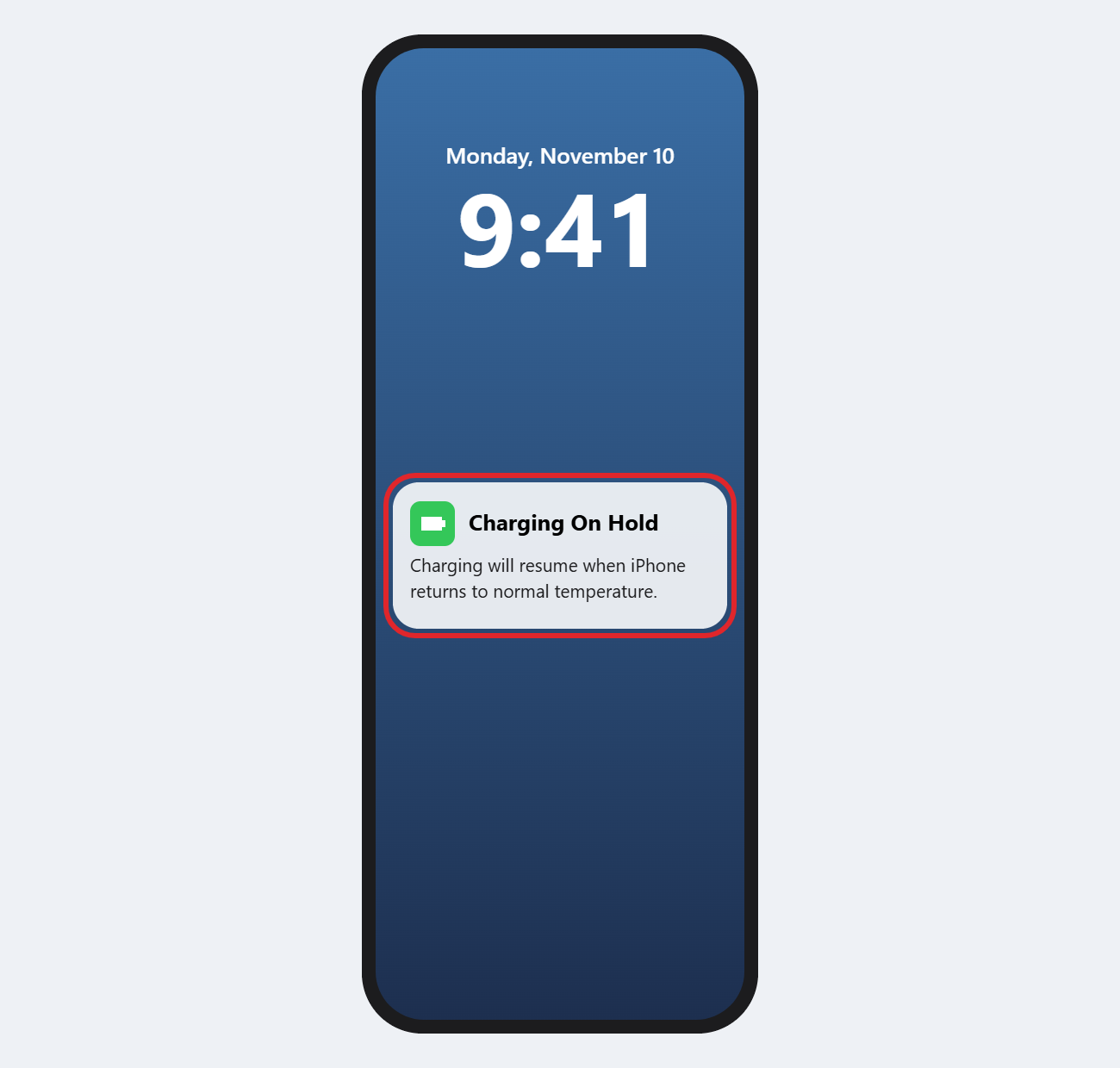
Charging On Hold
If your Lock Screen says “Charging On Hold. Charging will resume when iPhone returns to normal temperature,” the phone is temporarily too hot or too cold to charge. You don’t need to do anything except move it somewhere with a moderate temperature. Charging restarts by itself. This message often shows up when a phone charges on a sunny windowsill or in a car mount in summer.
Restore Paused
If you’re restoring from an iCloud backup and the phone gets too warm, you may see “Restore Paused. Restoring from iCloud will resume when this iPhone cools down.” The pause keeps the phone within a safe temperature, and the restore continues on its own. Restoring is one of the activities Apple says naturally makes a phone warm, so keep it out of the sun and off soft surfaces while it runs. If you’re setting up from a backup now, the steps in restoring an iPhone from a backup explain what to expect.
Navigation alert
If you’re using turn-by-turn directions, the phone may show “Temperature: iPhone needs to cool down” and turn off the display. Navigation still gives spoken directions, and the screen lights up again as you approach a turn. A phone mounted on the windshield in direct summer sun is the classic cause. If you can, move the mount out of direct sun and keep the car’s cabin cool.
When a Warm iPhone Is Normal
A warm phone is not the same as an overheating phone. Apple lists several situations where feeling warmer is expected:
- Setting up the iPhone for the first time
- Restoring from a backup
- Installing a software update, especially a major release
- Charging wirelessly
- Using apps, games or features that work the graphics chip or processor hard, including camera apps
- Streaming high-quality video
Apple’s guidance is that these conditions are normal, the phone cools down when the task is done, and if no temperature warning appears you can keep using it. So if your phone is warm the evening after a big iOS update, that’s usually the phone finishing background work, not a fault.
If the Warning Keeps Coming Back
One warning on a hot day is expected. Repeated warnings, especially in normal room temperatures, deserve a closer look. Work through these in order.
Check what you’re doing when it happens
Apple names a few activities to avoid in hot conditions or direct sun for long periods: GPS tracking or navigation in a car, graphics-heavy games, and using the camera for a long time. If your warnings only happen during one of these, the fix is to take breaks, lower screen brightness and keep the phone in the shade.
Look at the charger and case
Apple’s battery advice notes that charging inside certain styles of cases can generate excess heat that affects battery capacity. If the phone gets hot only while charging, try charging without the case, on a hard surface, using an Apple charger or a certified one. A pillow, bed or sofa traps heat under the phone.
Update iOS
Software updates often include fixes for problems that make the phone work harder than it should. Go to Settings > General > Software Update and install anything available, ideally while the phone is cool and plugged in somewhere shaded. Expect the phone to run warm for a while after a major update.
Restart the iPhone
A restart clears apps or background processes that might be stuck and keeping the processor busy. Turn the phone off, wait a minute, and turn it back on. If it’s frozen, use a force restart instead.
Check Battery Health
An aging battery can make heat problems worse. Open Settings, tap Battery, then tap Battery Health. Apple explains that Maximum Capacity compares your battery with when it was new. If the screen says the battery’s health is significantly degraded, Apple says an authorized service provider can replace it to restore full performance. There’s more on reading that screen in checking iPhone battery health, and Apple’s own iPhone battery and performance page explains each message.
Reset all settings, as a last resort
Some people try Reset All Settings when warnings continue. It isn’t an Apple fix for temperature warnings, so treat it as a last step. It returns settings such as Wi-Fi networks, Bluetooth pairings, Apple Pay cards, and your Home Screen layout and wallpaper to their defaults, but Apple says no data or media are deleted, so your photos, apps and messages stay. Apple’s Reset All Settings page lists everything it changes. The option sits under Settings > General > Transfer or Reset iPhone > Reset. Before you use it, read what each iPhone reset option does so you don’t pick an erase option by mistake.
When the Problem Is Cold, Not Heat
Temperature warnings aren’t only about heat. Apple says that in very cold conditions outside the operating range, an iPhone might show a shorter battery life and could turn off. It may also refuse to charge or stop charging.
That’s why a phone with a low charge can shut down suddenly on a ski lift. Apple’s battery page explains that cold, combined with a low charge, makes unexpected shutdowns more likely, especially when the battery is older. The fix is to warm the phone gradually: put it in an inner pocket close to your body, or bring it indoors. Battery life returns to normal once the phone is back at a normal temperature. Don’t put a frozen phone on a heater, for the same condensation reason as the freezer warning.
Apple’s storage range is wider than the use range: you can store an iPhone between minus 20 and 45 degrees Celsius (minus 4 to 113 degrees Fahrenheit). If you leave a phone in a cold car overnight, let it warm up before you charge it.
When to Contact Apple
Get help from Apple if:
- The warning appears in normal room temperatures without heavy use
- The phone feels hot while idle and switched on, with no charger connected
- Battery Health says the battery is significantly degraded or can’t be verified
- The battery looks swollen, the screen lifts at an edge, or the phone smells of burning
For the last case, stop using and charging the phone right away and keep it away from anything flammable. You can start a repair or chat request from Apple’s contact page, or bring the phone to an Apple Store or authorized service provider. A faulty battery, temperature sensor or other internal part can trigger warnings that no setting will fix.
Questions About iPhone Temperature Warnings
Can I use my iPhone while the warning is on screen?
Not normally. Apple says the phone might still be able to make emergency calls, but other use waits until it cools.
How long does it take for an iPhone to cool down?
There’s no fixed time. It depends on how hot the phone got and how warm it is around it. Turned off, in the shade and out of its case, it cools fastest; a phone that sat in direct sun for a long time needs longer.
Does overheating damage the battery?
It can. Apple says using an iPhone in very hot conditions can permanently shorten battery life, and charging in high ambient temperatures can cause further damage. One warning isn’t a disaster, but frequent overheating adds up.
Why does my iPhone show a temperature warning when it doesn’t feel hot?
The sensor measures the inside of the phone, which can be hotter than the outside feels, especially in a case. If it happens repeatedly in cool rooms, check Battery Health and contact Apple, since a battery or sensor fault is possible.
Is a warm phone during charging a problem?
A little warmth is normal, especially with wireless charging. If it’s hot enough to trigger Charging On Hold, move it somewhere cooler and charge without the case.
Next time you head out on a hot day, keep the phone in a bag in the shade, lower the brightness and avoid long camera or navigation sessions in direct sun; it’s far easier to prevent the warning than to wait it out.

Matthew Burleigh is the founder, head writer, and editor of Solve Your Tech, which he launched in 2012. He has written technology tutorials since 2008 and worked in IT since 2003, including small-business support, IT management, and consulting. He holds Bachelor’s and Master’s degrees in Computer Science from Arizona State University.
Matthew writes practical guides for Windows, iPhone and iPad, Microsoft Office, Outlook, Google apps, and Android. Solve Your Tech’s guides are checked step by step against the device or app maker’s own documentation and tested on his own devices whenever he has the hardware or software, with clear steps, sources, and update dates.
Read more about Matthew and how Solve Your Tech writes and updates its guides, or report a correction.