To find a hidden app on an iPad, swipe down from the middle of the Home Screen and type the app’s name, or search the App Library past your last Home Screen page. On iPadOS 18 and later, an app someone hid on purpose sits in a locked Hidden folder at the bottom of the App Library.
A game your child keeps asking about seems to have vanished from the iPad’s Home Screen, yet it still shows as installed in the App Store.
Search for the App First
Spotlight, the iPad’s built-in search, looks through every installed app at once, so it settles most “where did it go” moments in a few seconds.
- Go to the Home Screen and swipe down from the middle of the screen. Starting at the very top edge opens Notification Center or Control Center instead, so begin your swipe lower down.
- Type the first few letters of the app’s name in the search field.
- If the app shows up in the results, tap it to open it.
If the app opens, it’s installed and only its icon is out of view, which means one of the sections below explains where the icon went. If Spotlight shows nothing, don’t assume the app is gone yet: hidden apps and apps with a certain search setting turned off are left out of the results on purpose. For more ways to use the search screen, see searching on an iPad.
Look Through the App Library
The App Library is the screen that comes after your last Home Screen page. Apple describes it as a place that shows your apps sorted into categories, including apps you’ve removed from the Home Screen, with groups such as Suggestions and Recently Added at the top.
- Swipe left past all of your Home Screen pages, or tap the App Library button at the right end of the Dock.
- Tap the search field at the top of the App Library. You can type the app’s name or scroll the alphabetical list that appears.
- Tap the app to open it. To give it an icon again, touch and hold the app and drag it onto a Home Screen page (on most versions, the touch and hold menu also offers Add to Home Screen).
A recently installed app that never appeared on the Home Screen usually turns up in Recently Added. That’s often the whole story for a new game: the iPad put it in the App Library and nowhere else.
Open the Hidden Folder (iPadOS 18 and Later)
Starting with iPadOS 18, an app downloaded from the App Store can be hidden. Apple’s page on how to lock or hide an app on iPad says a hidden app is removed from the Home Screen, from the App Library categories and from search results, and is moved to a Hidden folder at the bottom of the App Library. That folder only opens after Face ID, Touch ID or the iPad passcode.
- Swipe left past all of your Home Screen pages to reach the App Library.
- Scroll to the very bottom and tap the Hidden folder.
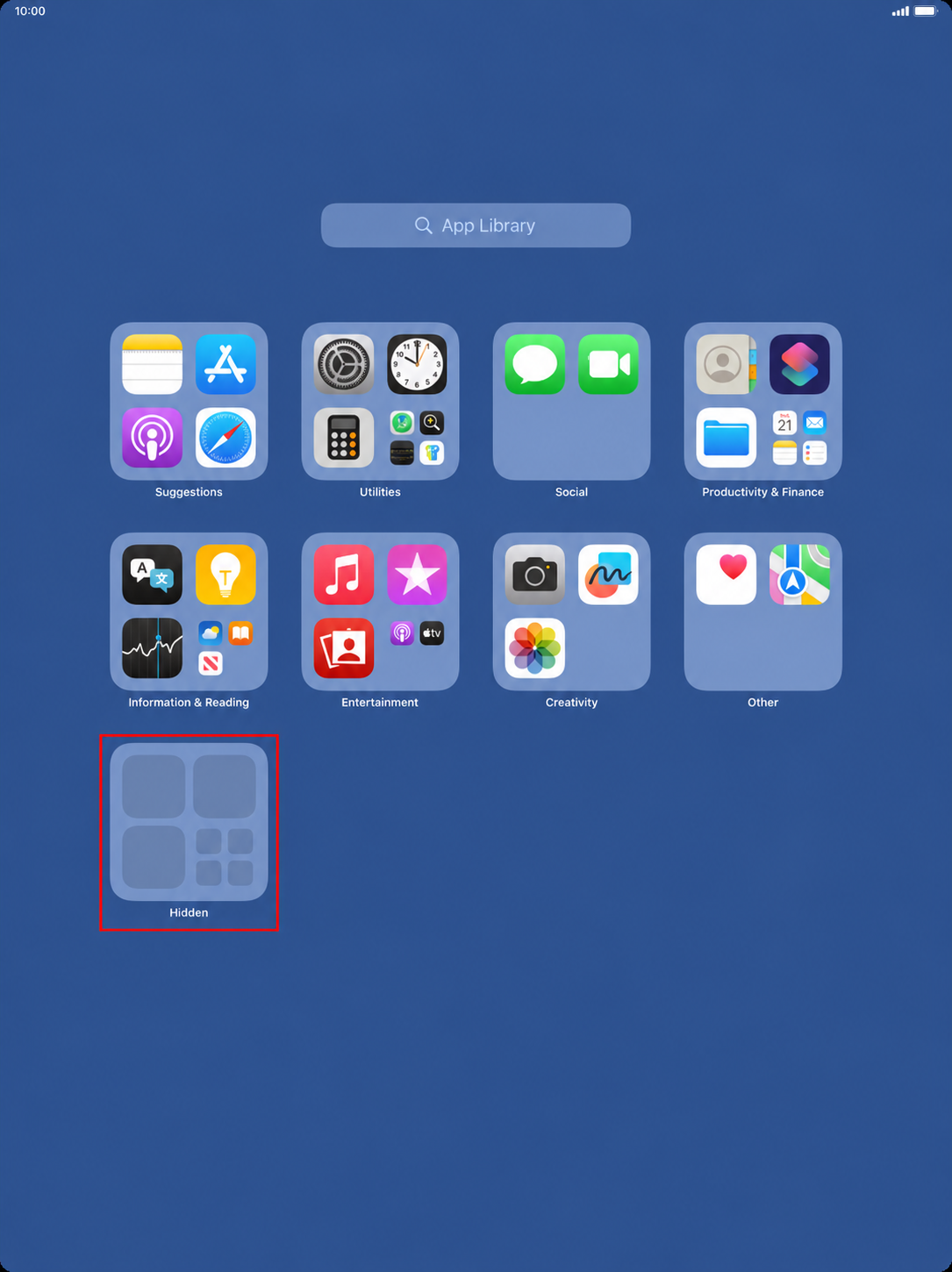
- Authenticate with Face ID, Touch ID or the passcode, depending on your iPad model.
- Tap the app inside the folder to open it.
If you’d rather see a list than open the folder, Apple also lists hidden apps in Settings > Apps > Hidden Apps. Either way, you need the passcode or a registered face or fingerprint, so a hidden app stays private from anyone who doesn’t have them.

Locked Apps Versus Hidden Apps
Locking and hiding are two levels of the same feature. A locked app keeps its icon where it was and asks for Face ID, Touch ID or the passcode when you open it. A hidden app is locked too, but its icon leaves the Home Screen and search. Two details catch people out:
- Hidden status belongs to one device. Apple says locked and hidden apps don’t sync through iCloud, so an app hidden on an iPhone can still be in plain view on the iPad, and the reverse.
- In a Family Sharing group, children under 13 can’t lock or hide apps. Teens from 13 to 17 can, but Apple notes that a parent or guardian can still see the app through Screen Time.
Stop Hiding an App
Once you’ve found the app in the Hidden folder, you can return it to normal view.
- Open the Hidden folder at the bottom of the App Library and authenticate.
- Touch and hold the app you want back.
- Tap Don’t Require Face ID. On other models the option reads Don’t Require Touch ID or Don’t Require Passcode.
- Authenticate again if asked.
The app then appears near the top of the App Library. Drag it onto a Home Screen page if you want an icon there.
Show Hidden Home Screen Pages
An entire page of apps can be hidden, and anything on that page goes with it. A good clue is a row of page dots above the Dock that’s shorter than you expect.
- Touch and hold an empty part of the Home Screen wallpaper until the apps start to jiggle.
- Tap the row of dots near the bottom of the screen. Thumbnails of all your Home Screen pages appear, and pages that are showing have a checkmark under them.

- Tap the empty circle under any page that’s missing a checkmark to show it again.
- Tap Done.
Hidden pages have a side effect worth knowing about. Apple notes that when you hide pages, newly downloaded apps may go to the App Library instead of the Home Screen. To control where new apps land, open Settings > Home Screen & App Library and choose Add to Home Screen or App Library Only. If you choose App Library Only, every app you install on the iPad after that will skip the Home Screen until you drag it there.
Open Every Folder, Including Its Other Pages
Folders are an easy place to lose an icon, especially when an app gets dropped on top of another one by accident and a new folder appears. Tap each folder on each Home Screen page. If a folder holds more apps than fit on one screen, it has its own pages, which you can usually reach by swiping left inside the open folder, since the app you want may be on the second or third page.
Removed From the Home Screen or Deleted
When you touch and hold an app and tap Remove App, the iPad asks you to pick one of two options, and they work very differently:

- Remove from Home Screen takes only the icon away. Apple says the app moves to the App Library and isn’t deleted, so it’s still there with its data.
- Delete App deletes the app and its data from the iPad. Some built-in Apple apps can be removed from the Home Screen but can’t be deleted.
To tell which one happened, search for the app in the App Store. If the app is still installed, the button next to it usually reads Open, and tapping it launches the app. If you see a download button instead, the app is likely no longer on the iPad (it may have been deleted or offloaded), and tapping the button downloads it again. You can also check App Store > your photo or initials > Apps & Purchase History > Your Apps to find and reinstall apps you’ve downloaded before. If you’re cleaning up instead of searching, the steps to delete apps on an iPad explain the removal side in more detail.
When Spotlight Skips an App
Each app has its own search setting, and if it’s switched off the app won’t show up in Spotlight even though it’s installed and visible elsewhere. Apple documents the switch here:
- Open Settings and tap Search.
- Scroll down and tap the app’s name.
- Turn on Show App in Search. A second switch, Show Content in Search, controls whether things inside the app appear in results.
This is worth checking when an app does appear in the App Library but never appears when you search, because that combination points straight at this setting.
Check Screen Time Restrictions
Screen Time can make built-in apps and features disappear, which is a common surprise on an iPad set up for a child. On the iPad itself, Apple’s path is Settings > Screen Time > Content & Privacy Restrictions. Inside it:
- Content Restrictions set age ratings and limits for apps, media and web content.
- Other Features is where you allow or block built-in apps and features such as the Camera and AirDrop. A built-in app that’s switched off here won’t appear until it’s allowed again. On some older versions this list may be labeled Allowed Apps.
Parents who manage a child’s account with Family Sharing and have upgraded to the new parental controls in iPadOS 27 have another control. Apple’s parental controls page describes Settings > Family > the child’s name > Apps & Websites, where a parent can choose an app and tap Block App. A blocked app isn’t deleted; it stays on the child’s Home Screen but appears dimmed. If the game in question looks greyed out rather than missing, this is the likely cause. For the full set of controls, see how to put parental controls on an iPad and how to change age restrictions on an iPad.
Hidden Purchases Are a Different Thing
The App Store has its own “hide” feature, and it often gets mixed up with hidden apps. Hiding a purchase removes it from your purchase list. Apple’s page on hiding App Store purchases says it doesn’t remove the app from your device, so a hidden purchase never explains a missing icon. It matters in two situations: you want to redownload something you hid, or a Family Sharing member can’t find a shared app (family members can’t redownload apps you’ve hidden).
To unhide a purchase on the iPad:
- Open the App Store and tap your photo or initials.
- Tap your name. You may be asked to sign in with your Apple Account.
- Tap Hidden Purchases.
- Find the app and tap Unhide.
If the app had been deleted, unhiding the purchase doesn’t reinstall it, so download it again from the App Store afterward. To hide a purchase in the first place, Apple’s route is App Store > your photo or initials > Apps & Purchase History > Your Apps, then swipe left on the app and tap Hide.
Hide or Lock an App Yourself
If you’d like to keep an app out of sight on purpose, for example a banking app on a family iPad, iPadOS 18 and later can do it without deleting anything.
- Touch and hold the app’s icon on the Home Screen.
- Tap Require Face ID (or Require Touch ID or Require Passcode, depending on the model).
- Choose Require Face ID to lock the app and leave its icon in place, or choose Hide and Require Face ID to hide it.
- If you chose to hide it, tap Hide App to confirm. The app moves to the Hidden folder.
Only apps you downloaded from the App Store can be hidden; Apple says apps that came preinstalled on the iPad can’t be. Apple adds that an app set as your default web browser can’t be hidden either. If the Hide option is missing, the app is most likely a built-in one or your default browser, or the iPad is running a version earlier than iPadOS 18.
When an App Still Won’t Show Up
Did an update or a reset scramble my Home Screen?
Icons can end up in new places, and Settings > General > Transfer or Reset iPad > Reset > Reset Home Screen Layout is sometimes suggested as a fix. Know what it does before you tap it: Apple says it returns the built-in apps to their original layout on the Home Screen, so expect your own arrangement to change; Apple doesn’t say it unhides hidden apps or pages, so check the Hidden folder and page dots first. The other reset options are explained in how to reset settings on an iPad.
Can I ask Siri to open it?
Usually, yes. Siri can usually open an installed app by name, so saying “Open” followed by the app’s name is a quick test when you can’t spot the icon. If Siri opens it, the app is there and the problem is only where its icon lives. Because hidden apps are removed from search, Siri may not open a hidden app, so a failed request doesn’t prove the app is gone.
The App Store shows Open, but I still can’t find the icon
An Open button usually means the app is still installed, so tap it to launch the app, then work through the Hidden folder, hidden pages and folders in that order. If none of those turn it up, restart the iPad and check Settings > General > Software Update as a final check.
How can I see every hidden app at once?
On iPadOS 18 and later, Settings > Apps > Hidden Apps lists them in one place. On earlier versions there’s no Hide feature, so the missing icon is in a folder, on a hidden page, removed to the App Library, or blocked by Screen Time.
Once the app turns up, put it where you’ll find it next time: drag it onto your first Home Screen page or into the Dock, and if it lives in a folder, give that folder a name that makes sense to everyone who uses the iPad.

Matthew Burleigh is the founder, head writer, and editor of Solve Your Tech, which he launched in 2012. He has written technology tutorials since 2008 and worked in IT since 2003, including small-business support, IT management, and consulting. He holds Bachelor’s and Master’s degrees in Computer Science from Arizona State University.
Matthew writes practical guides for Windows, iPhone and iPad, Microsoft Office, Outlook, Google apps, and Android. Solve Your Tech’s guides are checked step by step against the device or app maker’s own documentation and tested on his own devices whenever he has the hardware or software, with clear steps, sources, and update dates.
Read more about Matthew and how Solve Your Tech writes and updates its guides, or report a correction.