To find a downloaded file on your iPad, open Files, show Browse or the sidebar, and tap Downloads. If that shortcut is missing, look in iCloud Drive or On My iPad, depending on where Safari saves downloads. Tap the file to open it.
This guide covers downloaded documents, PDFs, and other files on iPadOS 26 and 27. Content saved inside another app, such as an offline video, stays in that app.
Find and open a downloaded file
- Open Files. If you cannot see its icon, swipe down from the middle of the Home Screen, search for Files, and open the app from the results.
- Show the file locations. Tap Browse or the sidebar button at the top of Files.
- Tap Downloads in the sidebar. Look for the file name in the folder that opens. If Downloads is not shown, open iCloud Drive, then Downloads. Check On My iPad and its Downloads folder if Safari is set to save locally.
- Tap your file. It opens in a preview or a supported app.
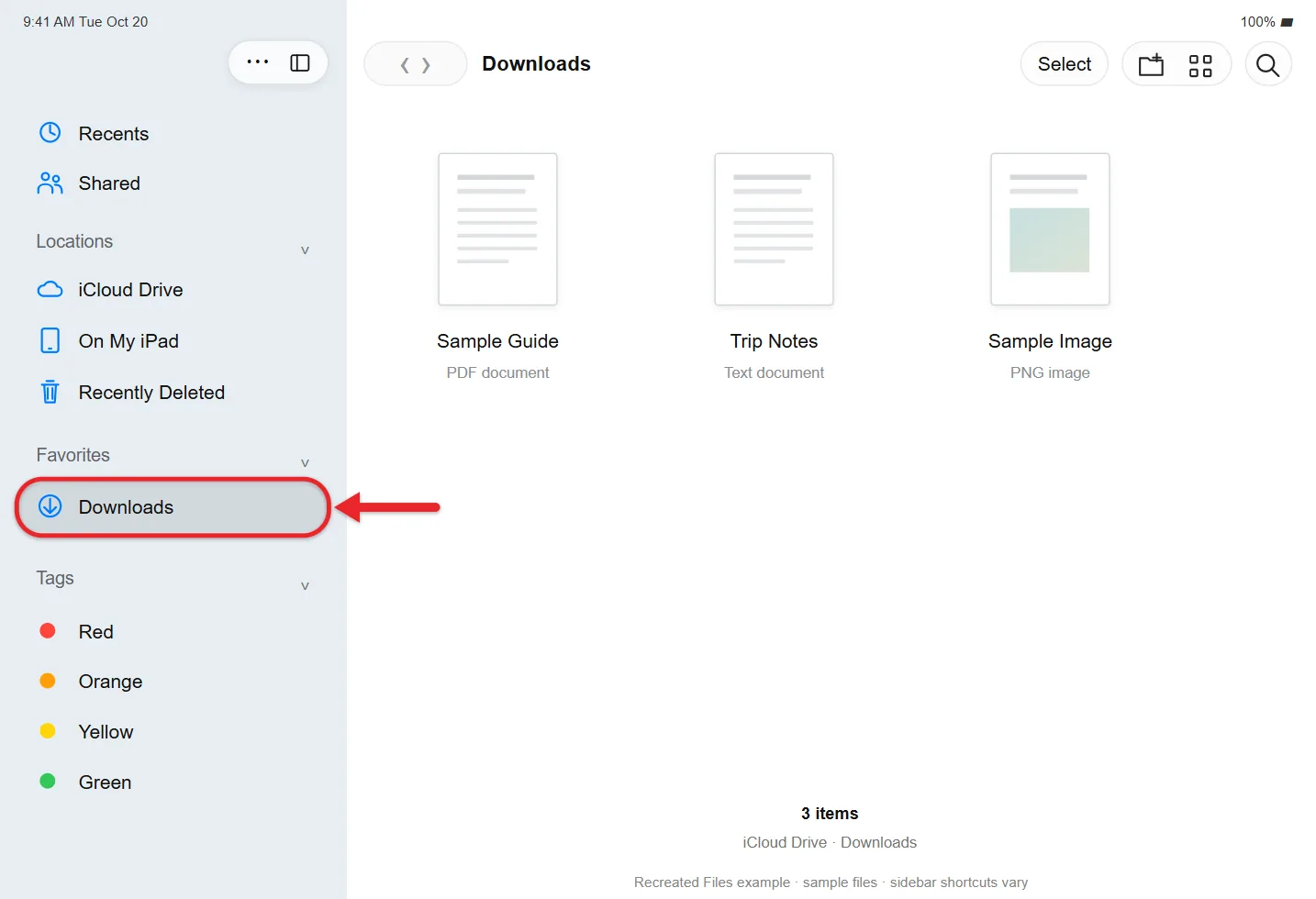
Apple’s downloaded-file instructions show both the Files route and the Safari shortcut. Which folder you need depends on the download location set in Safari.
Put the newest download at the top. Inside the Downloads folder, open the view options menu and sort by Date. The most recent files then appear first.
A cloud icon means the file is not on the iPad yet. Files in iCloud Drive can show a small cloud symbol next to the name. Tap the file to download it, or touch and hold it and choose Download Now. You need an internet connection for this.
Find a download directly from Safari
If you just downloaded something in Safari, tap the Downloads button near the search field and select the file. The same button shows the progress of a download that’s still running. Tap the magnifying glass next to an item to jump to the file’s folder in Files.
Opening a link doesn’t always save a file. To download one, touch and hold the link and choose Download Linked File, as Apple’s Safari browsing guide describes.
If the Downloads button is gone, Safari has probably cleared its list. The Remove Download List Items setting controls this, with choices such as After One Day, Upon Successful Download, and Manually. Clearing the list does not delete the files, so check Files instead.

Check Safari’s actual download location
If the folder you checked is empty, confirm where Safari is saving files before downloading more copies. In the current iPadOS 27 settings:
- Open Settings, then Apps, then Safari.
- Tap Downloads.
- Read the selected location. iCloud Drive saves to its Downloads folder, which can be accessed on other devices using the same Apple Account. On My iPad saves to Downloads on this iPad. Other lets you choose another folder.

- Return to Files and open that location. If you chose Other, look in the folder you picked; it may not be named Downloads.
These choices are in Apple’s Safari settings guide. They apply only to Safari downloads. If your iCloud storage is full, choosing On My iPad lets downloads keep working without more cloud space.
Find downloads from Chrome
Chrome keeps its own list. Open Chrome, tap More (the three dots), then tap Downloads. Touch and hold a file name to copy, share, or remove it.
When you download a file, Chrome asks how to save it. Google’s Chrome download help says to tap Save, then choose Files, so the copy goes to your default download location. If you open a file in another app instead, Chrome keeps it only in a temporary folder that is cleared when you close the Chrome window. Save anything you want to keep to Files.
Find a Mail attachment
Mail does not put attachments in the Downloads folder on its own. Open the email, tap the attachment to preview it, tap Share, and choose Save to Files. Pick iCloud Drive or On My iPad, select a folder, and tap Save. The file is then in the folder you picked.
Chat apps work the same way. Files received in apps such as WhatsApp stay in that app until you share them to Files.
Search when you do not know the folder
In Files, tap Search and enter the file name, part of it, or a document type. Check the search scope below the field: searching only the current folder can miss a file stored elsewhere. Choose a broader location if needed, then tap a result to open it. To see where a result is stored, touch and hold it and choose Show in Enclosing Folder.
Recents shows recently opened files. It can help if you have already opened the download, but it is not a complete history of everything you downloaded. If you saved a document to an external drive or a connected cloud service, use Browse to open that location too. Apple lists local, iCloud, external-drive, and supported third-party locations in its Files app overview.
If the file is there but will not open
On iPadOS 27, touch and hold the file, choose Open With, and select an available app that supports it. To preview rather than edit, use Quick Look when offered. Some files offer it through Open With, then Preview with Quick Look.
If the download is a ZIP archive, tap it in Files to extract it, or read about opening ZIP files on iPhone and iPad.
If no app on your iPad supports the file, install the app the file’s provider recommends. If the file looks incomplete or shows an error, download it again from the original source. Apple’s find and view files guide explains the search, opening, and preview controls.
If the document is still on your Windows computer, you can transfer files from PC to iPad.
Save a PDF From Safari to Files on iPad
Open the PDF in Safari, tap Share, and choose Save to Files. In the current layout, tap More in the share options if needed to find Save to Files. Select a folder under On My iPad or iCloud Drive, check the filename, and tap Save. Then open that folder in Files to confirm the copy is there; viewing a PDF in Safari does not save it. Apple’s iPad PDF guide describes this save route.
If you used the older Save PDF to iBooks option, the file is in the Books app (Apple renamed iBooks to Books), not in Files.
Delete downloads you no longer need
Open the Downloads folder in Files, tap Select, choose the files, and tap the Delete (trash) button. Deleted files usually move to Recently Deleted in the Browse sidebar, where you can recover them for a limited time or remove them for good. Deleting from iCloud Drive removes the file from every device signed in to the same Apple Account. For more ways to free space, read about clearing iPad storage.
Frequently asked questions
Why is a saved picture missing from Downloads?
A picture saved to your photo library belongs in Photos. An image downloaded as a file can be in Files. Check the app and save action you used; an image in Files does not automatically become a photo-library item.
For captures of the iPad screen, read this iPad screenshot guide. Ordinary screenshots go to Photos; a full-page screenshot saved as a PDF goes to the folder you choose in Files, which may be different from your Safari Downloads folder.
Why can’t I find an offline video or other app download?
Open the app you used to save it and check its Downloads or library section. Offline videos and music stay inside that app and don’t appear in Files.
Where do downloaded apps go?
Apps from the App Store appear on the Home Screen or in the App Library, not in Files. Swipe left past your last Home Screen page and use the App Library search field to find one.
Can I change the Downloads folder?
Yes, Safari offers iCloud Drive, On My iPad, and Other in its Downloads setting. Check the selected location using the steps above. The same locations apply on a phone; read about finding your files on iPhone.
Next step: check Safari’s selected folder, then search Files if the download still seems missing.

Matthew Burleigh is the founder, head writer, and editor of Solve Your Tech, which he launched in 2012. He has written technology tutorials since 2008 and worked in IT since 2003, including small-business support, IT management, and consulting. He holds Bachelor’s and Master’s degrees in Computer Science from Arizona State University.
Matthew writes practical guides for Windows, iPhone and iPad, Microsoft Office, Outlook, Google apps, and Android. Solve Your Tech’s guides are checked step by step against the device or app maker’s own documentation and tested on his own devices whenever he has the hardware or software, with clear steps, sources, and update dates.
Read more about Matthew and how Solve Your Tech writes and updates its guides, or report a correction.