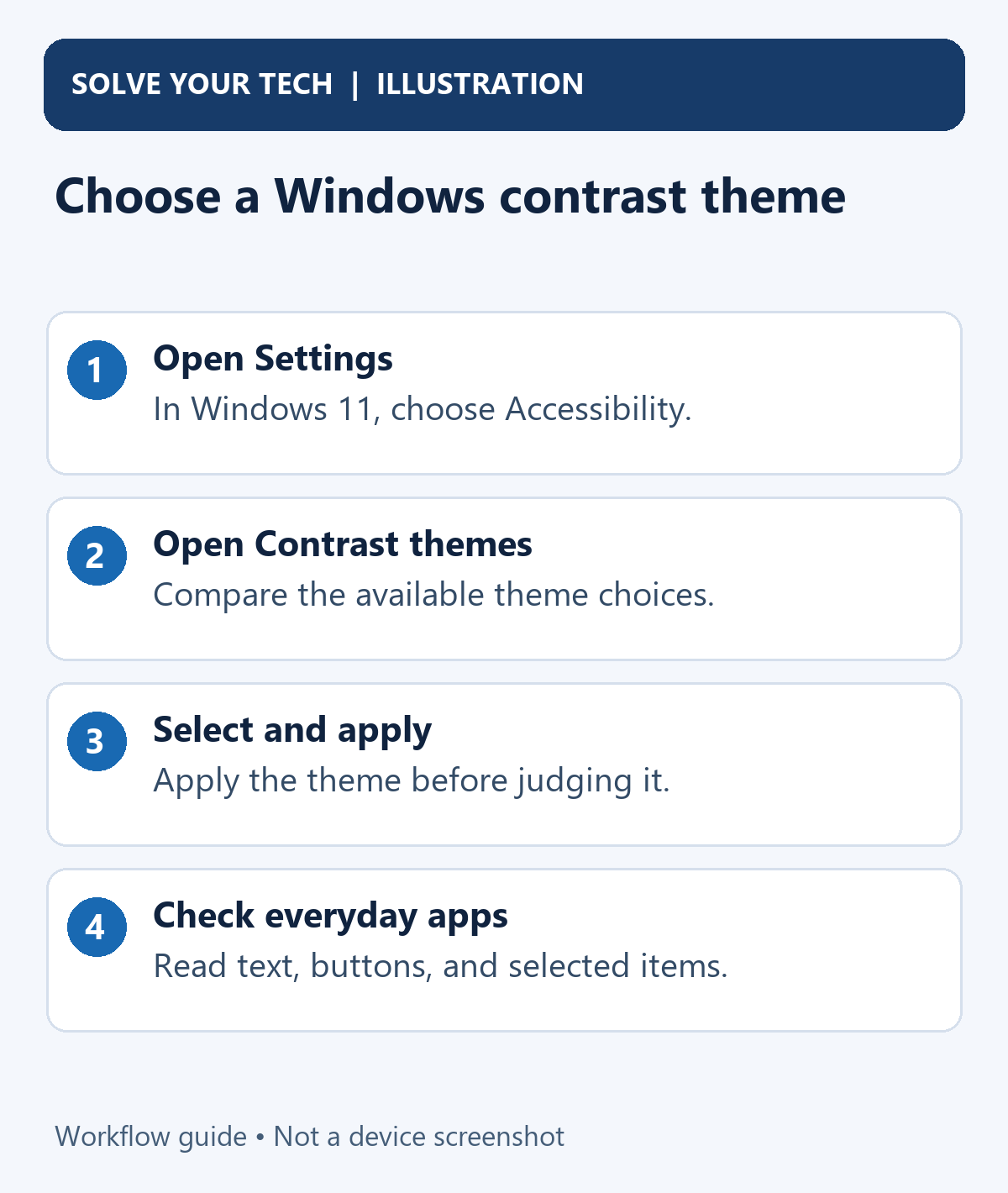
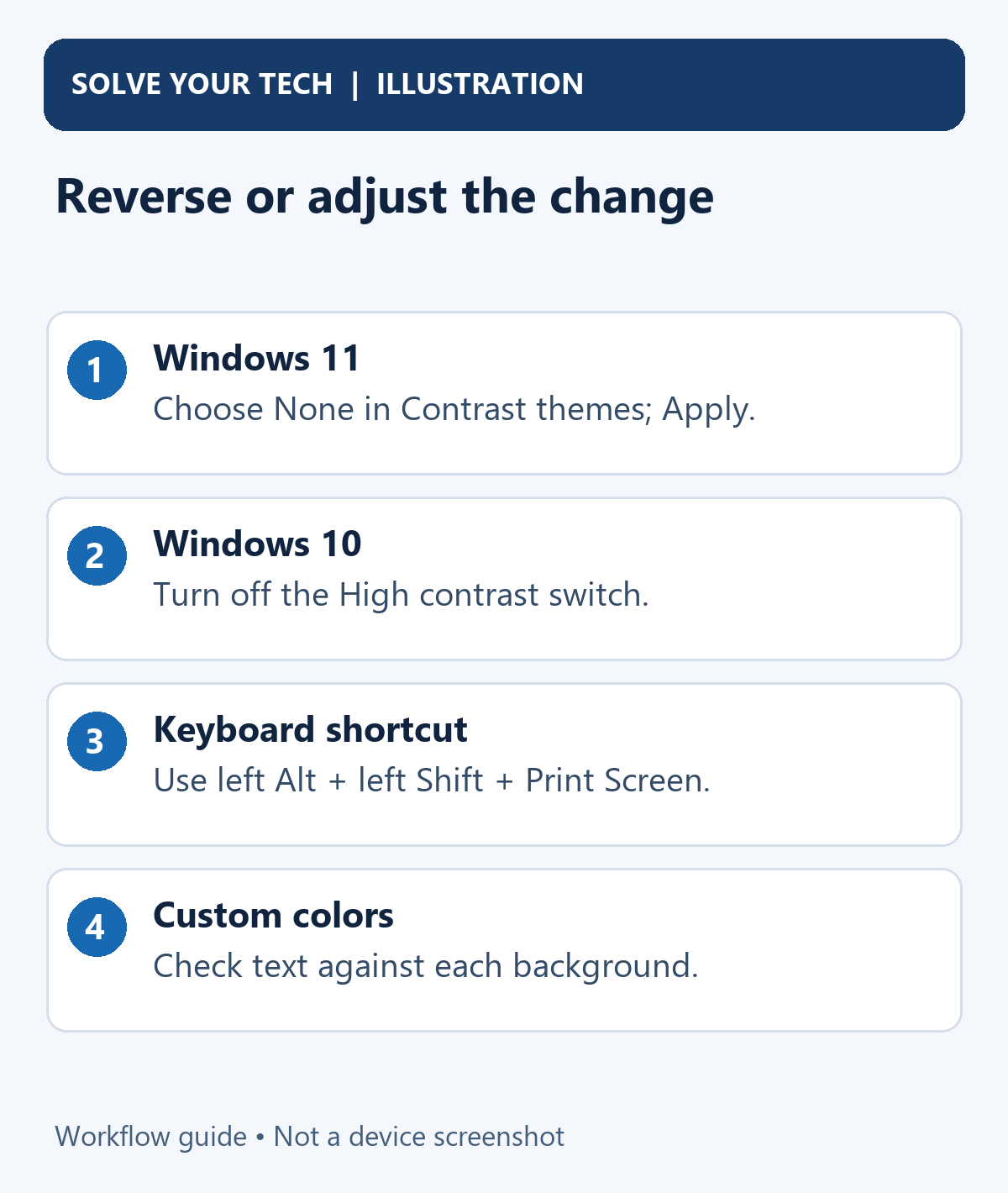
In Windows 11, open Start > Settings > Accessibility > Contrast themes, choose a theme, and select Apply. To turn it off, choose None and apply again. Windows 10 uses Settings > Ease of Access > High contrast and an on/off switch instead.
High contrast changes the colors used for text, backgrounds, links, and controls. It is useful when the usual color combinations are difficult to distinguish. Choose a theme based on what you can read comfortably, rather than assuming the darkest choice will always work best.
Choose the instructions for your Windows version
| Version | Settings route | How to turn it off |
|---|---|---|
| Windows 11 | Accessibility > Contrast themes | Choose None and Apply |
| Windows 10 | Ease of Access > High contrast | Turn off Turn on high contrast |
The original article's Windows 10 route remains relevant to that version. Windows 11 renamed the category and uses a theme selection. Looking for the Windows 10 switch in Windows 11 can therefore make the feature seem missing when it has simply moved.
Before changing your colors, save any work that would be difficult to find if the appearance changes. You do not need to close every app, but knowing how to return to the same settings page makes comparison easier.
Enable a contrast theme in Windows 11
- Open Start > Settings. Select Accessibility in the sidebar.
- Open Contrast themes. Find the theme selection control.
- Choose a theme. Windows offers Aquatic, Desert, Dusk, and Night sky.
- Select Apply. Wait for the change to finish, then inspect the new appearance in your usual apps.
Selecting a theme and applying it are separate actions. If the colors have not changed, check whether you clicked Apply before trying another setting. Microsoft notes that Windows can briefly display a Please wait screen during the change.
Use a familiar window for your first comparison. Can you distinguish its text from the background, identify a selected item, and recognize a button or hyperlink? That is more useful than judging the theme from one decorative image.
Enable high contrast in Windows 10
- Open Start > Settings > Ease of Access. Select High contrast.
- Turn on Turn on high contrast. Let Windows complete the appearance change.
- Choose a theme from the available dropdown.
- Apply any theme changes and check the result in the apps you use.
Microsoft's high contrast instructions also describe using the Ease of access control on the Windows 10 sign-in screen. That can be useful when you need readable colors before reaching the desktop. In Windows 11, the sign-in screen accessibility menu is also where you can turn off Narrator before signing in.
Do not mix the two versions' menu names in one attempt. If you see Accessibility and Contrast themes, use the Windows 11 method; if you see Ease of Access and the high contrast switch, use the Windows 10 method.
Use the keyboard shortcut
Microsoft documents Left Alt + Left Shift + Print Screen as a quick way to toggle high contrast. Use the left-hand Alt and Shift keys, rather than substituting a different combination.
If a confirmation appears, read it and choose the option appropriate for the change you intend. Then check the display. A keyboard press is not evidence that the theme changed unless you can see the result or confirm the selected setting.
Some compact keyboards share Print Screen with another function. Check the keyboard's labeling or manufacturer instructions if the key cannot be found. The Settings method remains available when the shortcut is inconvenient or does not work on your keyboard.
If you accidentally enable the feature, use the shortcut again or the version-specific off method below. There is no need to reinstall an app or reset Windows to undo an appearance change.
Customize colors when a preset is hard to read
In Windows 11, select a contrast theme and choose Edit. Choose a color field, adjust its color and brightness, and select Done. Use Save as, give the custom theme a distinct name, then Save and apply.
In Windows 10, select the relevant colored rectangle beneath the theme dropdown, choose the color, select Done, and apply the changes. Microsoft's color contrast guide explains both interfaces.
Useful fields include background, text, hyperlinks, inactive or disabled text, selected text, and button text. Change one at a time so you can identify which adjustment made the screen clearer.
For example, if ordinary text is readable but links disappear into it, work on the hyperlink color before changing the entire background. If a selected item is hard to distinguish, compare the selected and unselected states while you adjust the relevant colors.
Give a custom theme a descriptive name, such as “Readable links,” so you can recognize it later. Avoid choosing nearly identical foreground and background colors just because they look attractive separately; the pair needs to remain readable together.
Check the result in the places that matter
Try a short checklist using your own everyday tasks:
- Read a paragraph in your browser and locate one link within it.
- Open a menu and identify the current selection.
- Inspect a dialog with an available button and an unavailable option.
- Check the text field where you type most often.
- Revisit a page or app that originally caused difficulty.
If one color causes trouble across several apps, try changing that theme color. If only one app or webpage remains difficult, inspect its own appearance or accessibility choices. A system theme cannot guarantee that every custom interface will respond identically.
Keep a note of what improved and what did not. That helps you choose between a different preset, a small custom-color change, or a separate tool such as larger text. Make one change at a time so you can restore the last useful result.
Turn high contrast off and restore the normal appearance
On Windows 11, return to Settings > Accessibility > Contrast themes, select None, and choose Apply. Wait for the colors to change before closing Settings.
On Windows 10, return to Settings > Ease of Access > High contrast and turn the high contrast switch off. You can use the documented keyboard shortcut on either version if that is easier.
If the appearance still seems unusual afterward, check whether a different feature is enabled. Color filters, Magnifier, an app's dark theme, and a monitor's settings are separate from the high contrast theme. Do not keep toggling the same control when the selected setting already shows that it is off.
Troubleshooting
I cannot find High contrast
Check the Windows version and the table above. On Windows 11, search Settings for Contrast themes; the older High contrast label is not the main page name. Start with the operating system's Settings rather than an app's own appearance menu.
The colors do not change after I choose a theme
Select Apply and allow the change to finish. Then compare a Windows menu or Settings window with the app you were watching. If Windows changed but that app did not, you have identified a more specific app issue.
The shortcut does nothing
Use Settings to establish whether the feature itself works. Check that you used Left Alt and Left Shift, then determine how your keyboard provides Print Screen. Avoid repeated key combinations that could trigger other shortcuts while you are trying to read the screen.
Text is still too small
Contrast changes colors, rather than enlarging everything. Use the separate text-size or zoom tools for size problems. Our guide to turning on Windows Magnifier explains temporary magnification.
If the entire desktop is blurry or the interface size is wrong, you can change Windows resolution or scale as a separate adjustment. Start with the recommended resolution for sharpness and adjust Scale when text and apps need to be larger.
The pointer is difficult to locate
Pointer size and color are separate preferences. In Windows 11, review Accessibility > Mouse pointer & touch. In Windows 10, use Ease of Access > Mouse pointer. Microsoft collects these alternatives in its guide to making Windows easier to see.
Frequently asked questions
Is high contrast the same as dark mode?
No. A dark appearance changes the overall style; a contrast theme is intended to make interface elements easier to distinguish. Choose based on the specific difficulty you are trying to solve.
Does it change the photos or documents I save?
Turning on a Windows theme is not a command to edit an image file or rewrite a document. If you need to assess an image's appearance accurately, compare it with the theme off and avoid using a screen appearance change as an image-editing method.
Can I use high contrast and Magnifier together?
They address different needs: distinguishing colors and enlarging content. Adjust each deliberately and check the combination in your normal tasks. If you only need larger text, try the size controls before changing colors as well.
Microsoft announced a contrast-theme toggle inside Magnifier for the Windows Insider Experimental channel in its September 18, 2026 release notes. That preview feature is not evidence that every Windows 11 installation has the same Magnifier control. Use the main Contrast themes settings route above when that extra control is absent.
Which theme is best?
The best choice is the one that lets you read and identify controls comfortably in the apps you actually use. Compare a light and dark option, then customize only the colors that still cause difficulty.
Apply one theme, test it in a familiar task, and keep the off route available. If contrast helps but size remains a problem, adjust that separate setting next.

Matthew Burleigh is the founder, head writer, and editor of Solve Your Tech, which he launched in 2012. He has written technology tutorials since 2008 and worked in IT since 2003, including small-business support, IT management, and consulting. He holds Bachelor’s and Master’s degrees in Computer Science from Arizona State University.
Matthew writes practical guides for Windows, iPhone and iPad, Microsoft Office, Outlook, Google apps, and Android. Solve Your Tech’s guides are tested on current devices or checked against official product documentation, with clear steps, sources, and update dates.
Read more about Matthew and how Solve Your Tech writes and updates its guides, or report a correction.