To multiply numbers in Word, put them in a table, click the empty result cell, go to Table Layout > Formula, and enter =PRODUCT(LEFT). For the × sign in text, use Insert > Symbol. Word never solves math typed as plain text.
You have a price list or quantity table in a Word document and need each row’s total without opening Excel, or you just need to type a times sign in a math worksheet. Steps are for Word for Microsoft 365 and Word 2016 to 2024 on Windows.
Which Kind of Multiplication Do You Need?
“Multiplication in Word” means one of two unrelated jobs, and each uses a different tool:
- Calculate a product. You want Word to work out 4 × 12.50 and show 50.00. Only a table formula does this. Go to the next section.
- Show a multiplication. You want a worksheet line such as 8 × 3 = ___ or a formatted equation. Word only displays it and never solves it. Skip to the sections on the symbol and equations.
Multiply Numbers in a Word Table
Word calculates with formula fields inside table cells. Here is a small order table used in the examples below. Row 1 holds the headings, so the first item sits in row 2.
| Item | Qty | Unit price | Total |
|---|---|---|---|
| Notebooks | 4 | 12.50 | (formula) |
| Pens | 10 | 1.25 | (formula) |
| Folders | 6 | 3.10 | (formula) |
- Click the cell where the answer should go, such as the Total cell in the Notebooks row. If the cell already has text, delete it first.
- Open the Table Layout tab, which appears only while your cursor is in a table. In some older versions the tab is labeled just Layout.
- In the Data group, click Formula.
- Delete whatever Word suggests in the Formula box (often =SUM(LEFT) or =SUM(ABOVE)) and type
=PRODUCT(LEFT). That multiplies every number to the left of the cell in the same row. - Optional: pick a format from the Number Format list, such as one with two decimal places or a currency sign.
- Click OK. The cell shows 50 (4 × 12.50). Repeat for each row; the Pens row gives 12.5 and the Folders row gives 18.6.

If you’re comfortable with field codes, you can also press Ctrl+F9 inside the cell to insert field braces and type = PRODUCT(LEFT) between them, then press F9 to show the result.
Be careful with LEFT when a row has other numbers in it. PRODUCT(LEFT) multiplies every number to its left, so a column of item codes or years would be pulled into the answer.
Pick Exact Cells Instead of LEFT or ABOVE
Word names cells like a spreadsheet: columns are letters starting with A, and rows are numbers starting with 1. In the table above, the Notebooks quantity is B2 and its price is C2, so =PRODUCT(B2,C2) multiplies just those two cells. You can also give a range, such as =PRODUCT(B2:C2). Word also accepts the RnCn style, where R2C3 means row 2, column 3.
The other positional words work too: ABOVE multiplies the numbers above the cell in the same column, and RIGHT and BELOW work the same way in their direction. Microsoft lists PRODUCT, SUM, AVERAGE, COUNT, MAX and MIN as the functions that accept these positional words. To get a grand total of the Total column, put =SUM(ABOVE) in a cell under it.
Two rules from Microsoft prevent most wrong answers. Header rows are skipped by positional formulas, so a heading row with a year in it won’t break the math. And if a row or column that the formula reads has an empty cell, type a 0 in it to avoid an error.
Update the Answer After You Change a Number
A Word formula is a field, not a live spreadsheet cell. Word calculates it when you insert it and again when the document opens, but it doesn’t recalculate while you type. If you change the Notebooks quantity from 4 to 5, the total keeps showing 50 until you refresh it.
- Select the whole table (click the move handle at its top left corner, or drag across every cell).
- Press F9. Every formula in the table recalculates.
To refresh every formula in the document at once, press Ctrl+A and then F9. That updates every field in the file, including dates, page numbers and tables of contents, so use it only when that is what you want. On laptops where F9 controls brightness or volume, you may need to hold the Fn key as well.
Type the Multiplication Sign in Text
This is purely typography: Word treats × as a character, the same as a letter. Use one of these methods (Microsoft’s Insert a symbol in Word page shows the dialog).
- Click where the sign should go, then go to Insert > Symbol > More Symbols.
- Leave the Font box on (normal text), and look in the Latin-1 Supplement subset for ×. Typing 00D7 in the Character code box jumps straight to it on most versions.
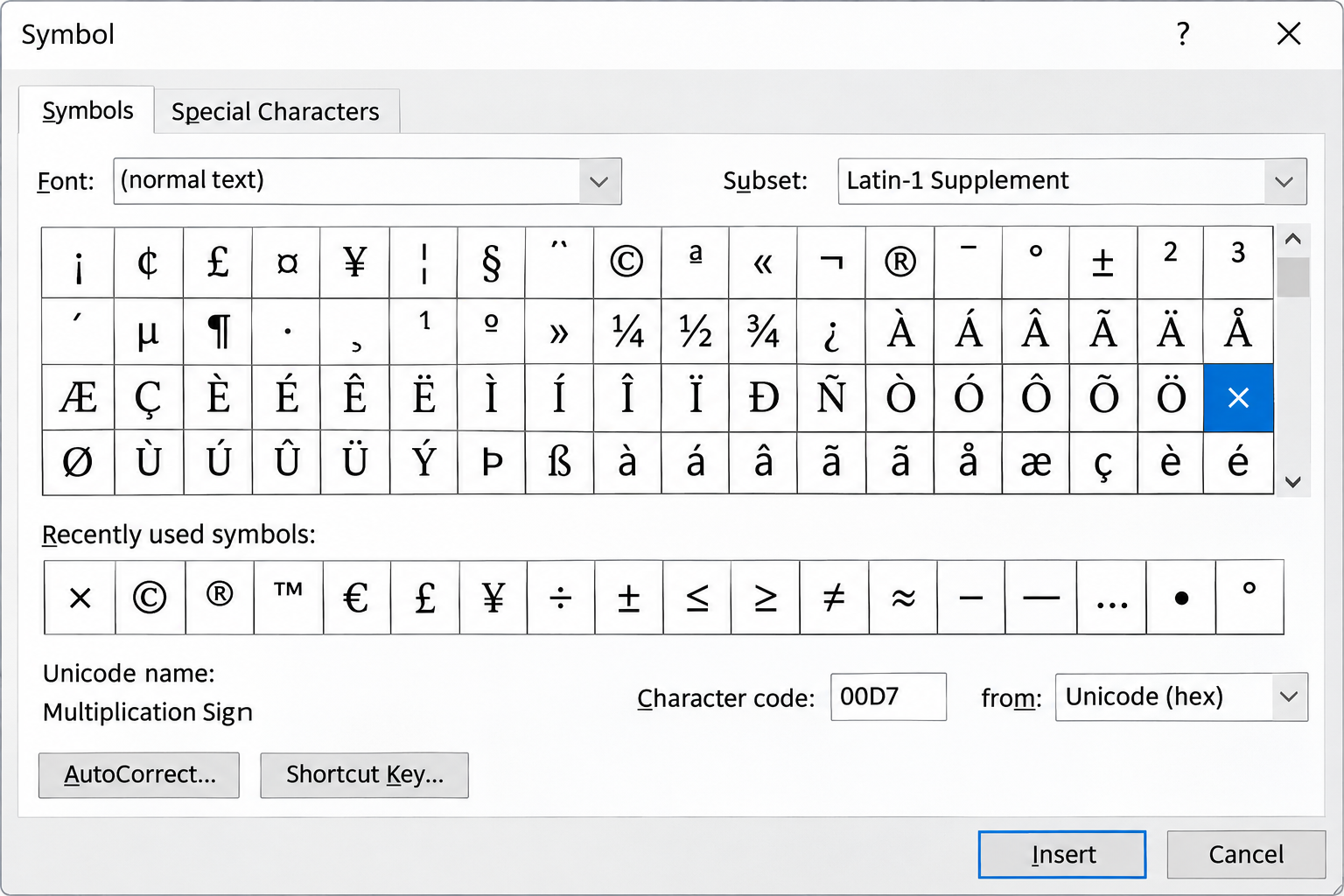
- Click Insert, then Close. Recently used symbols usually show up in the short list under Insert > Symbol, so next time it is one click.
The keyboard route on Windows is faster: type 00D7 and press Alt+X. Word turns a Unicode hex code into its character when you press Alt+X, and 00D7 is the code for the multiplication sign. If the letters before the code merge into it, put a space before the code first.
Which sign should you use? The letter x looks close but is a letter, so screen readers and spell check treat it as one. The real × is the right choice for worksheets and dimensions like 4 × 6. The asterisk (*) is what spreadsheets and code use, and the middle dot (·) shows up in algebra and science. For square roots and other math symbols, the same Symbol dialog works, and there is more detail in inserting square roots and other symbols in Word.
Write a Multiplication as an Equation
For homework sheets or reports that need properly set math, use Word’s equation tool. It formats the math but does not compute an answer.
- Go to Insert > Equation, or press Alt+=. An equation box appears.
- Type the first number, then
\timesfollowed by a space. Math AutoCorrect should turn the code into ×. - Type the rest, for example
3=24, and click outside the box.
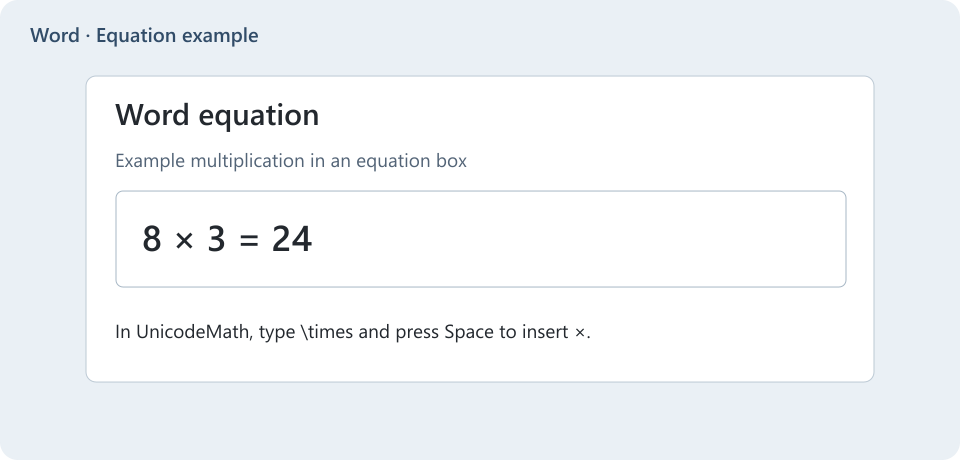
If \times doesn’t convert, click inside the equation box, open the arrow in the Symbols group on the Equation tab, pick the Operators or Basic Math set from the menu at the top of the list, and click the × button.
When Excel Is the Better Tool
Word’s table formulas suit a short invoice or a quote with a handful of rows. Once you need dozens of rows, totals that update as you type, or formulas that refer to other tables, Excel saves time and mistakes. You can copy a Word table into Excel, do the math there, and paste the finished table back. If all you need afterward is a column total, see how to sum a column in Excel.
When the Result Looks Wrong
- The total didn’t change. The field is stale. Select the table and press F9.
- The number is far too big. LEFT or ABOVE picked up an extra number, such as an item code. Switch to exact cell references like B2 and C2.
- You see an error instead of a number. Check for empty cells in the range and type 0 in them, and make sure the formula starts with an equals sign.
- References point to the wrong cells. Merged cells may shift how Word counts columns and rows. Count the columns again, or split the merged cells as shown in merging and splitting cells in Word tables.
- Alt+X turned other text into a strange character. Word read the letters before the code as part of it. Press Ctrl+Z to undo it, add a space before 00D7, and retry.
Word Table Math Questions
Can I Type =B2*C2 Instead of PRODUCT?
Yes. Microsoft’s Formula field reference lists the asterisk (*) as the multiplication operator, so =B2*C2 multiplies those two cells. PRODUCT is handier when you multiply more than two cells or a whole row.
Does the Formula Cell Count Itself?
No. Microsoft notes that the cell holding the formula is left out of any calculation that uses references, so you won’t create a loop by including its column.
Can I Do This in Word for the Web or on a Mac?
Microsoft documents formula fields for the desktop versions of Word on Windows and Mac, so Word for Mac can do the same math, although its menus may be laid out differently. Word for the web may not offer the Formula command; if you don’t see it, open the file in the desktop app.
For the full list of functions and examples, Microsoft’s Use a formula in a Word table page is the reference. Build your first PRODUCT formula in a copy of the document, press F9 after a test edit, and you’ll know the method works before the real numbers go in.

Matthew Burleigh is the founder, head writer, and editor of Solve Your Tech, which he launched in 2012. He has written technology tutorials since 2008 and worked in IT since 2003, including small-business support, IT management, and consulting. He holds Bachelor’s and Master’s degrees in Computer Science from Arizona State University.
Matthew writes practical guides for Windows, iPhone and iPad, Microsoft Office, Outlook, Google apps, and Android. Solve Your Tech’s guides are checked step by step against the device or app maker’s own documentation and tested on his own devices whenever he has the hardware or software, with clear steps, sources, and update dates.
Read more about Matthew and how Solve Your Tech writes and updates its guides, or report a correction.