To clear the cache in Microsoft Edge, press Ctrl + Shift + Delete, choose a time range, check Cached images and files, and select Clear now. You can also get there from Settings and more (…) > Settings > Privacy, search, and services > Clear browsing data. Leave the other boxes unchecked if you only want to clear the cache. To remove the list of sites and searches instead, see how to clear your search history in Edge.
If you only want to clear the cache, you can leave cookies, passwords, browsing history, and other data unchecked. Clearing cached files can help when a website displays old content, looks broken, or does not work correctly.
For temporary files outside the browser on an older PC, see our Windows 10 computer-cache guide. It separates Windows storage cleanup from deleting cached website files.
How to Clear the Cache in Microsoft Edge
These steps clear cached website files from the desktop version of Microsoft Edge on Windows 11 and Windows 10.
- Open Microsoft Edge.
- Click the three dots in the upper-right corner. Microsoft calls this the Settings and more menu.
- Select Settings.
- Select Privacy, search, and services.
- Scroll to Clear browsing data.
- Click Choose what to clear next to Clear browsing data now.
- Choose a Time range. If you are troubleshooting a persistent website problem and want to remove all cached copies, choose All time. You can select a shorter period if you only want to remove recent data.
- Check Cached images and files. Uncheck other categories if you do not want to delete them.
- Click Clear now.
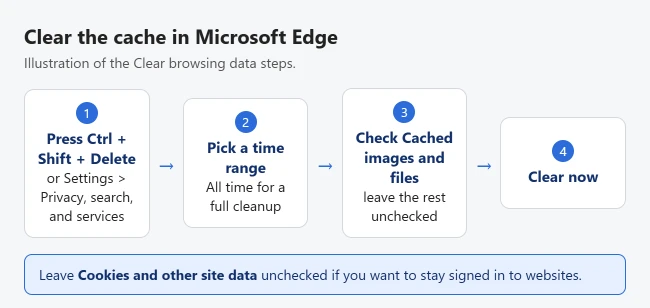
Edge removes the cached files that match the time range you selected. The next time you visit a website, some pages may load a little more slowly at first because Edge needs to download fresh copies of images and other page resources.
Use Ctrl + Shift + Delete to Clear the Edge Cache Faster
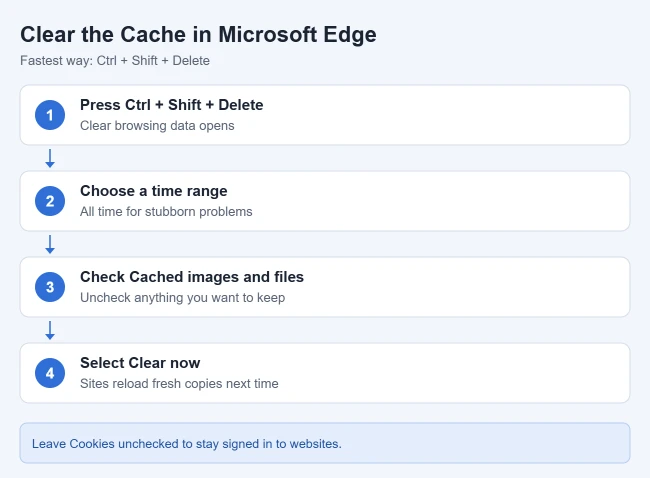
You do not have to navigate through the full Settings menu every time. Edge has a keyboard shortcut that opens the Clear browsing data window directly.
- Open Microsoft Edge.
- Press Ctrl + Shift + Delete.
- Select the Time range you want.
- Check Cached images and files.
- Uncheck any data you want to keep.
- Click Clear now.
This shortcut reaches the same clearing controls as the longer Settings method.
Which Time Range Should You Choose?
The best time range depends on why you are clearing the cache.
If a website started behaving incorrectly within the last hour or day, clearing only recent cached data may be enough. If the problem has been happening for a while, or you were specifically told to completely clear the Edge cache, All time is the safer troubleshooting choice.
Using All time does not mean you have to erase every kind of browsing data. The time range and the checkboxes are separate controls. You can select All time while leaving only Cached images and files checked.
What Is the Difference Between Cache and Cookies?
Cache and cookies are different types of browser data, even though Edge lets you clear them from the same window.
Cached images and files are copies of website resources that Edge stores on your computer. Keeping these copies normally helps websites load faster on later visits.
Cookies and other site data store information websites use for things such as sign-in sessions, preferences, and other site-specific information.
If your goal is simply to clear the Edge cache, select Cached images and files and leave Cookies and other site data unchecked. If troubleshooting instructions specifically tell you to clear both cache and cookies, select both boxes. Be aware that clearing cookies will sign you out of many websites.
Will Clearing the Edge Cache Delete Passwords, Favorites, or History?
Not if you select only Cached images and files.
Edge gives you separate choices for browsing history, download history, cookies and other site data, cached images and files, passwords, autofill information, site permissions, and other stored information. Clearing one category does not require you to clear all of them.
Before clicking Clear now, review the checked boxes. Leave Passwords, Browsing history, and any other information you want to keep unchecked.
Your Edge favorites are not part of the Cached images and files selection.
What Does Clearing the Cache Actually Do?
Edge saves copies of parts of websites on your computer so it does not need to download everything again on every visit. This is normal and usually makes browsing faster.
The problem is that a cached copy can occasionally become outdated or fail to match the current version of a website. When that happens, you might see an old image, incorrect formatting, a page that does not update properly, or another website-specific problem.
Clearing the cache removes those stored copies and makes Edge download fresh website resources when you return.
For that reason, clearing the cache is best viewed as a troubleshooting tool rather than something you must do every day. A healthy cache is useful, and routinely deleting it can make the first visit to your usual sites slower while Edge rebuilds the cached files.
How to Clear Cache and Cookies in Microsoft Edge
If a website’s instructions specifically ask you to clear both cache and cookies, the process is almost identical.
- Press Ctrl + Shift + Delete in Edge.
- Choose the appropriate Time range.
- Check Cached images and files.
- Check Cookies and other site data.
- Review the other boxes and leave anything you want to keep unchecked.
- Click Clear now.
After clearing cookies, expect to sign in again on many websites. Clearing cookies does not require you to delete saved Edge passwords, but a website’s active sign-in session may be removed.
How to Clear Edge Browsing Data Automatically When You Close the Browser
Edge can automatically clear selected types of browsing data whenever you close the browser. This can be useful on a shared computer or when you deliberately do not want certain browsing data to remain between sessions.
- Open Microsoft Edge.
- Click the three dots and select Settings.
- Choose Privacy, search, and services.
- Find the Clear browsing data section.
- Select Choose what to clear every time you close the browser.
- Turn on the data categories you want Edge to clear automatically.
Think carefully before enabling this for cookies. Automatically deleting cookies can cause websites to sign you out whenever you close Edge.
Try a Hard Refresh Before Clearing Everything
If only one page looks outdated or broken, you may not need to clear the entire browser cache first. A hard refresh tells Edge to reload the current page instead of relying on its normal cached copy.
On Windows, press Ctrl + Shift + R while viewing the troublesome page. If that fixes the problem, you can avoid clearing cached data for all of your other sites.
You can also test the site in an InPrivate window. Press Ctrl + Shift + N to open one. If the site works there but not in your normal Edge window, stored browser data or an extension may be involved.
Should You Clear the Edge Cache Regularly?
There is usually no reason to clear it on a fixed daily, weekly, or monthly schedule.
The cache is designed to improve browsing by keeping local copies of website resources. Clearing it is useful when you are troubleshooting stale content, display problems, certain website errors, or potentially corrupted cached data. It can also reclaim some storage space.
If Edge and your websites are working normally, leaving the cache alone is generally fine.
What to Do If Clearing the Cache Doesn’t Fix the Problem
A cache problem is only one possible reason a website or Edge itself might not work correctly. If clearing it does not help, try to narrow down the cause before deleting more data.
If the page loads but a statement or form cannot open a separate window, check allowing pop-ups for a trusted site in Edge before deleting more browsing data. Cache cleanup and pop-up permission address different problems.
- Reload the website and restart Edge.
- Try the same page in an InPrivate window.
- Try another website. If only one site fails, the problem may be with that website.
- Try another browser. If several browsers cannot reach the site, investigate your network connection or the website itself.
- Check for Edge and Windows updates.
- Consider Edge’s repair options if the browser itself repeatedly fails.
Avoid clearing passwords, autofill data, or all cookies simply because clearing the cache did not solve an unrelated problem. Delete additional browsing data only when there is a reason to believe that data is involved.
How to Clear the Cache in Edge on iPhone or Android
The Edge mobile app has the same option in its settings. To check what is in your history on a phone before you clear anything, see how to view your history in the Edge iPhone app. These steps follow Microsoft’s Edge for mobile FAQ.
- Open the Edge app and tap the menu (…) at the bottom of the screen.
- Tap Settings, then Privacy and security.
- Tap Clear browsing data.
- Check Cached images and files, and uncheck anything you want to keep.
- Tap Clear.
On the same screen, you can turn on Clear browsing data upon exit if you want the app to do this automatically. On a Mac, Edge works like the Windows version, and the shortcut is Command + Shift + Delete.
A Note About Edge Sync
If you use a Microsoft account with Edge sync, review your sync settings before deleting broader categories of browsing data. Microsoft notes that some synced information can be cleared across your synced devices when sync is enabled.
For a normal cache-only cleanup, the important choice remains Cached images and files. Be more deliberate if you also plan to delete history, passwords, form information, or other data that may participate in sync.
Frequently Asked Questions
Does clearing the Edge cache log me out of websites?
Clearing only Cached images and files normally does not remove the cookies that keep you signed in. If you also clear Cookies and other site data, you will be signed out of many sites.
Does clearing the cache make Edge faster?
Not necessarily. Cache normally helps websites load faster. Clearing it can fix problems caused by stale or corrupted cached files, but the first visit to a website afterward may be slower because Edge has to download fresh resources.
Should I choose All time when clearing the Edge cache?
Choose All time when you want a complete cache cleanup or are troubleshooting a persistent problem. A shorter time range may be enough if the problem only started recently.
Why does a website load more slowly after I clear the cache?
Edge has removed its locally stored copies of website resources, so it has to download fresh files. Later visits can become faster again as the cache is rebuilt.
More Edge help: restart Microsoft Edge, update Edge to the latest version, or turn off autofill.
How to Clear Stored Data for Just One WebsiteEdge’s Clear browsing data window works on every site at once. To fix a single site without signing out of everything else, delete that site’s stored data instead.
- Open Edge and select Settings and more (three dots) > Settings.
- Select Privacy, search, and services, then Cookies.
- Select See all cookies and site data.
- Search for the site, such as example.com.
- Select the down arrow next to the site and choose Delete.
This removes the cookies and data that site saved, following Microsoft’s guide to managing cookies in Edge. Then reload the page with Ctrl + Shift + R so Edge downloads fresh copies of its files.

Matthew Burleigh has been writing tech tutorials since 2008. His writing has appeared on dozens of different websites and been read hundreds of millions of times.
After receiving his Bachelor’s and Master’s degrees in Computer Science he spent several years working in IT management for small businesses. However, he now works full time writing content online and creating websites.
His main writing topics include iPhones, Microsoft Office, Google Apps, Android, and Photoshop, but he has also written about many other tech topics as well.