To change the shape of an image in Google Slides, click the image, click the small Down arrow next to the Crop button in the toolbar, and pick a shape. The photo is masked to that shape right away.
You dropped a photo into a Google Slides deck and the hard rectangle looks out of place, so you want it in a circle, a rounded box, an arrow or another shape. This works in Slides on a computer and in the Slides app for Android, iPhone and iPad.
What Masking Does to Your Picture
Google calls this feature masking. A mask hides every part of the picture that falls outside the shape you choose, so the slide shows the photo inside a circle, star or speech bubble. Nothing is deleted from the original file. The hidden areas are still there, which is why you can move the photo around inside the shape or put it back to a plain rectangle later.
Masking is different from cropping. Cropping trims the edges of the picture but keeps it rectangular. If all you need is to cut off a busy background or tighten the frame, see how to crop and edit a picture in Google Slides. If you want a new outline, keep reading.
You only need edit access to the presentation and an image already on the slide. To add one, use Insert > Image and choose a source such as Upload from computer, Drive & Photos or By URL, as described in Google’s help page on adding images.
Mask an Image With a Shape on a Computer
These steps are for Google Slides in a desktop web browser such as Chrome, Edge, Safari or Firefox.
- Open the presentation and go to the slide with the picture.
- Click the image once. A blue selection box appears around it, and the toolbar changes to show image tools.
- Find the Crop button in the toolbar. Do not click the button itself, because that starts a normal crop. Instead, click the small Down arrow right next to it. Hovering over the arrow may show the label Mask image.
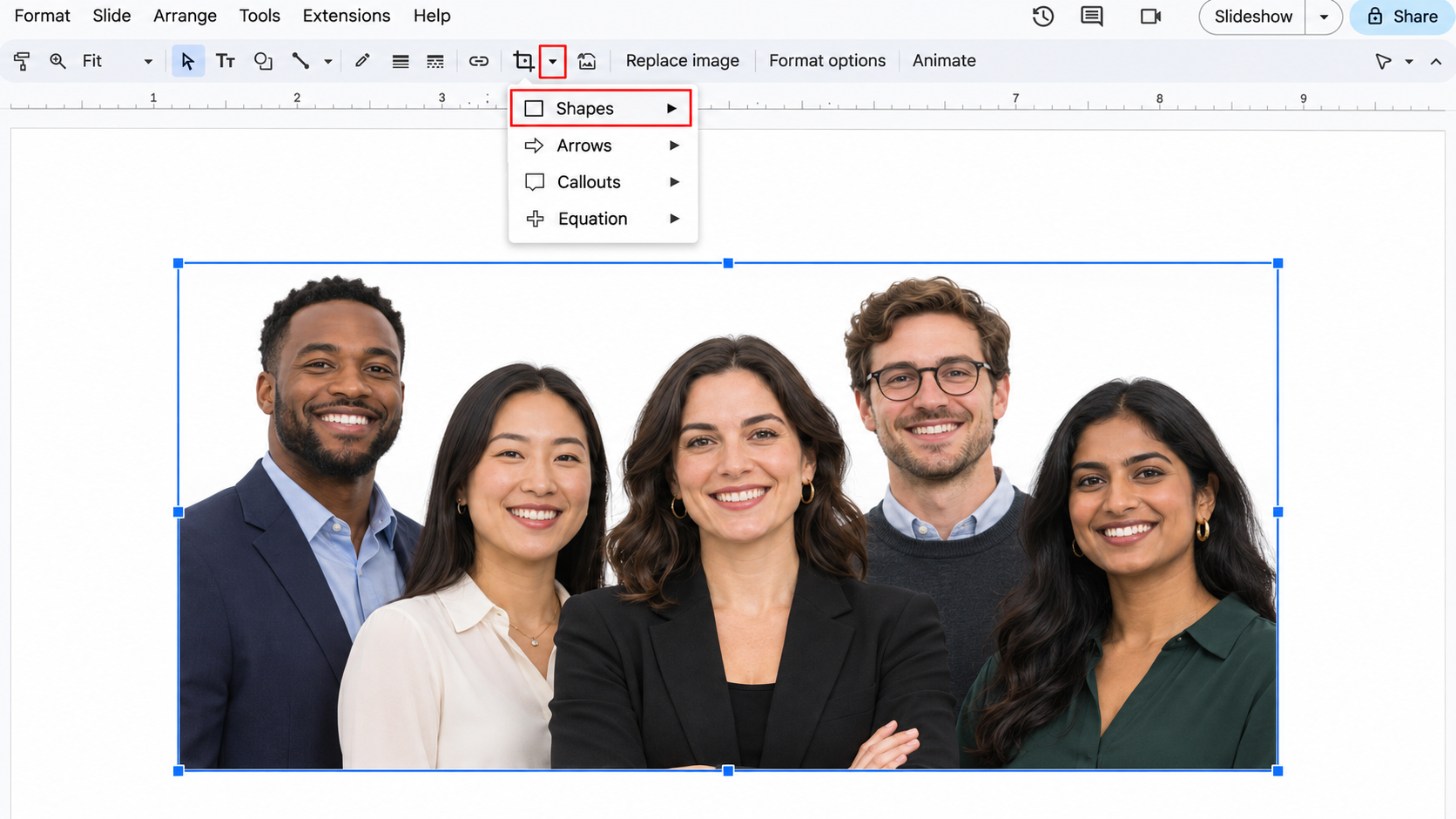
- Point to a category: Shapes, Arrows, Callouts or Equation. Each one opens a grid of preset outlines.
- Click the shape you want. The photo takes that outline immediately.
- If the shape needs adjusting, click and drag the colored handles on the shape. Press Enter or click an empty part of the slide when you are done.
The Shapes group holds the everyday choices: rounded rectangle, oval, triangle, hexagon, star and similar outlines. Arrows, Callouts (speech and thought bubbles) and Equation (plus, minus and similar signs) are more decorative and suit icons or labels better than portraits.
Make a Perfect Circle Instead of an Oval
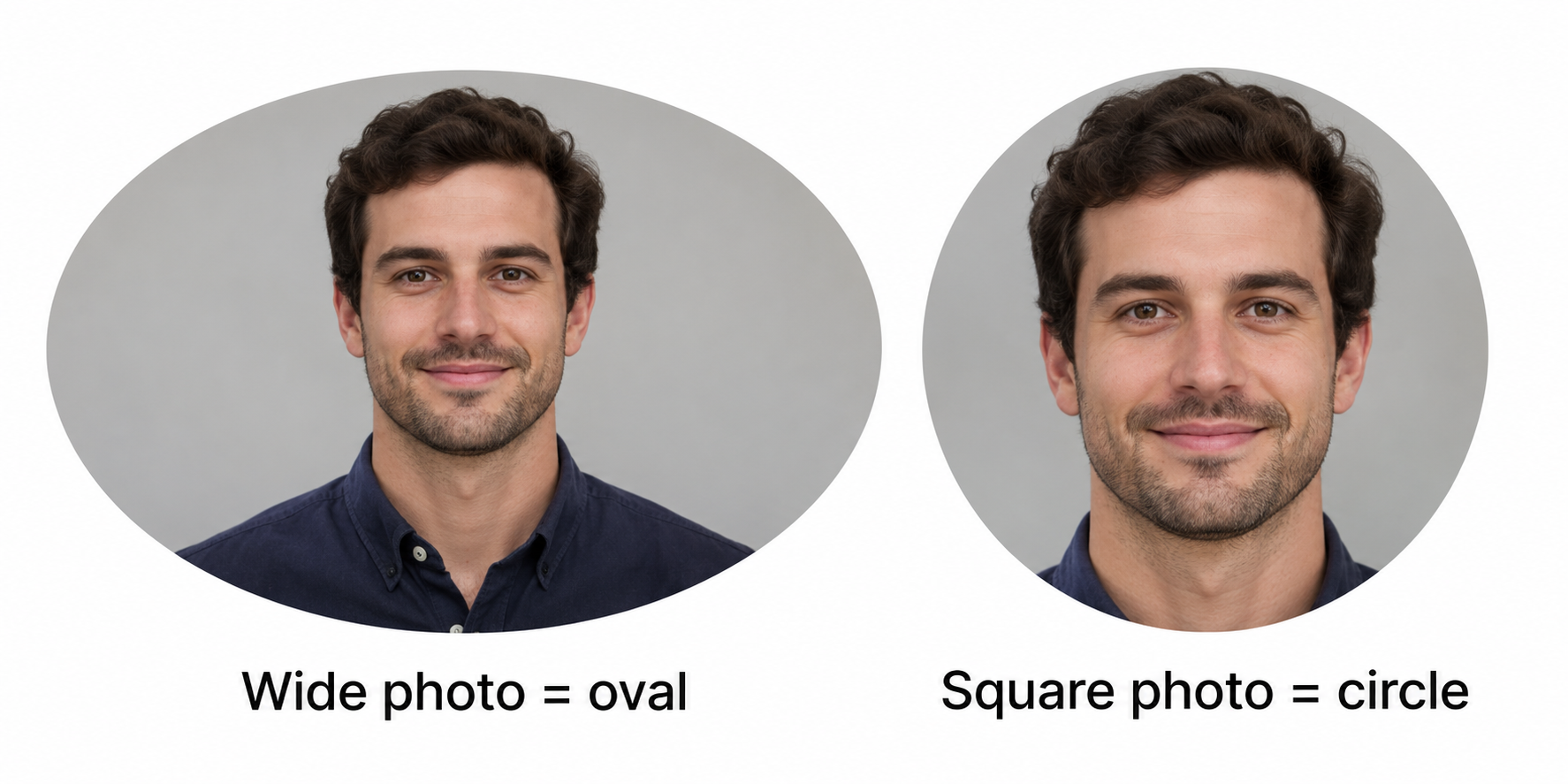
The most common surprise is choosing Oval and getting a stretched ellipse. The mask fills the image’s current frame, so a wide photo produces a wide oval. To get a true circle, make the image square first.
- Select the image and click the Crop button itself.
- Drag the crop handles until the width and height look equal. For an exact match, open Format > Format options, look under Size & rotation and compare the width and height values while you crop.
- Press Enter or click outside the image to finish the crop.
- Click the Down arrow next to Crop again, then choose Shapes > Oval.
Here is a worked example. Noor has a team headshot that is 6 inches wide and 4 inches tall. Masking it straight to Oval gives an egg on its side. She crops 1 inch off each side so the picture is 4 by 4 inches, keeping the face centered, then applies Oval and gets a clean circle. If she resizes it afterward, she drags a corner handle and checks that the width and height still match.
Adjust the Picture Inside the Shape
Once the mask is on, the part of the photo you see may not be the part you want. A person’s head might sit too close to the edge of a circle, for example.
- Reframe the photo: click the Crop button (or double-click the image). The full picture appears faintly behind the shape. Drag the crop edges to change which part shows, then press Enter.
- Change the shape’s proportions: drag the colored handles Google mentions in its help page.
- Switch to a different shape: keep the image selected, open the Down arrow next to Crop again and click another shape. The new outline replaces the old one, so there is no need to reset first.
If the shaped picture overlaps text boxes or other images, right-click it and use the Order options to move it forward or back. Changing layer order in Google Slides covers that in more detail.
Add a Border, Shadow or Color Change
Borders and effects follow the mask, so a circular photo gets a circular border. With the image selected:
- Border color: click the Border color (pencil) button in the toolbar and pick a color. The neighboring Border weight and Border dash buttons set the thickness and the line style.
- Format options: click Format > Format options to open a side panel. Google lists Recolor and Adjustments (Opacity, Brightness and Contrast) there, and the panel also holds Size & rotation, Position, Drop shadow and Reflection.
A thin white or theme-colored border usually looks cleaner on a dark background than a heavy black one. A light drop shadow helps a round headshot stand out from a busy slide.
Swap the Photo or Start Over
Undo the mask completely: right-click the image and choose Reset image. Google says this returns the picture to the original photo you added, so expect crops, recoloring and other adjustments to go as well. If you only want to undo the last change, press Ctrl + Z (Command + Z on a Mac) instead.
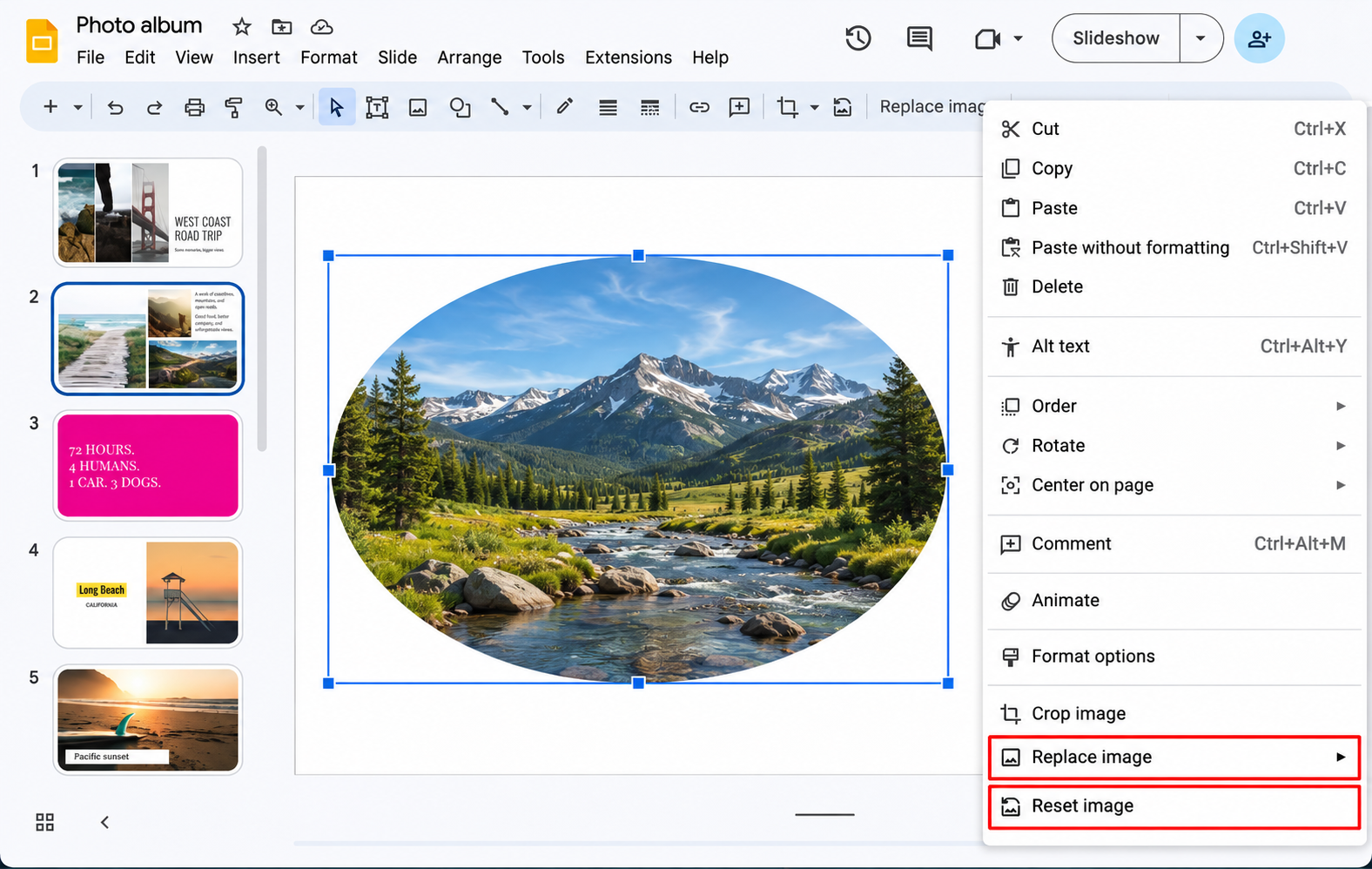
Use a different photo in the same spot: right-click the image, choose Replace image, then pick a source and the new picture. You can also drag a new image file onto the old one. When Google introduced Replace image, it said the new picture keeps the general size, layout and properties of the original. Google does not say whether the shape mask is kept, so check the result after replacing and reapply the shape if the photo comes back as a rectangle.
Change an Image Shape on Android, iPhone or iPad
The Google Slides app can mask images too, though the menus are laid out differently than on a computer.
- Open the Google Slides app and the presentation, then go to the slide.
- Tap the image to select it.
- Tap Crop. On Android, Google places it at the bottom of the screen.
- Tap Mask, then tap the shape you want.
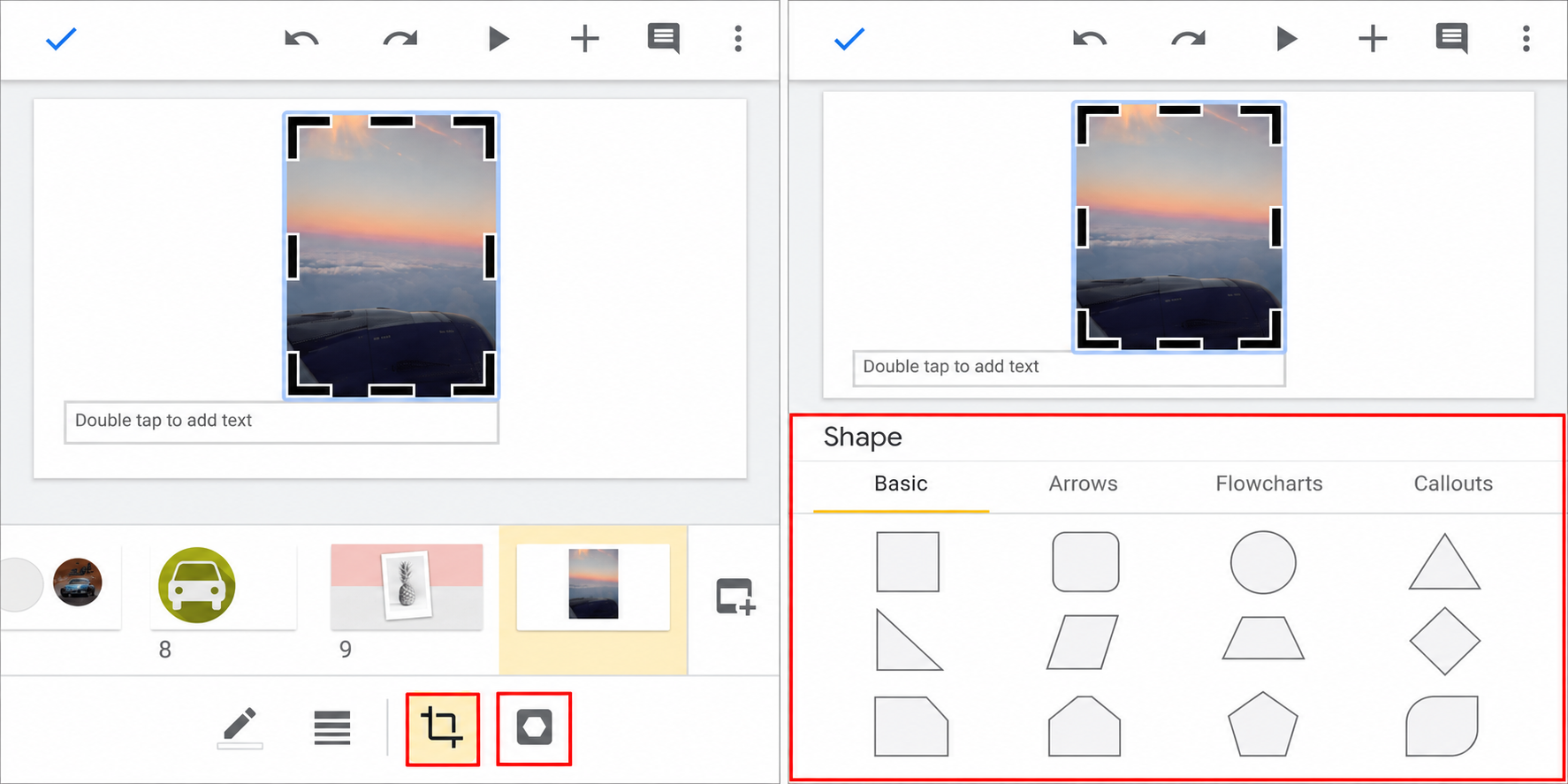
- Touch and drag the border to adjust it, then tap anywhere else on the slide to finish.
One limit to know: Google’s help page says resetting images in Slides needs a computer. If you mask the wrong photo on your phone, use the app’s undo button or open the deck on a computer to run Reset image.
When the Shape Menu Is Missing or Limited
- No Down arrow next to Crop: the selected object probably is not an image. Text boxes, shapes, charts and the slide background do not get the mask option. Click directly on the picture.
- Toolbar buttons are grayed out: you may have view or comment access only. Ask the owner for edit access.
- You want a shape that is not in the menu: Google offers only its preset Shapes, Arrows, Callouts and Equation outlines. For a custom outline, create the shaped picture in an image editor, save it as a PNG with a transparent background and insert that file.
- The photo looks blurry inside the shape: masking does not lower quality, but enlarging a small image does. Start with a large, sharp photo rather than stretching a thumbnail.
Questions About Image Shapes in Slides
Can I apply one shape to several images at once?
Google’s help does not describe masking more than one image in a single step. If selecting several pictures does not show the Down arrow next to Crop, mask each one on its own. Making every image square first gives you matching circles across a team slide.
Does masking change the file in my Google Drive?
No. The mask is part of the presentation, not the source file. The photo in Drive or on your computer stays a normal rectangle.
Will the shape survive if I download the deck?
A PDF export captures the slide as it looks, so the shaped picture should come through. If you plan to share a fixed copy, see converting Google Slides to PDF or PowerPoint, and open a PowerPoint export to check that the shapes look right there too.
Can I animate a shaped image?
Yes. A masked image is still an image, so you can add an entrance or exit animation the same way you would for any picture. Here is how to make a picture fly in on Google Slides.
For the official wording of each control, Google’s crop and adjust images help page has separate computer, Android and iPhone tabs. A good next step is to square up your headshots and apply the same Oval mask to each so a team slide looks consistent.

Matthew Burleigh is the founder, head writer, and editor of Solve Your Tech, which he launched in 2012. He has written technology tutorials since 2008 and worked in IT since 2003, including small-business support, IT management, and consulting. He holds Bachelor’s and Master’s degrees in Computer Science from Arizona State University.
Matthew writes practical guides for Windows, iPhone and iPad, Microsoft Office, Outlook, Google apps, and Android. Solve Your Tech’s guides are checked step by step against the device or app maker’s own documentation and tested on his own devices whenever he has the hardware or software, with clear steps, sources, and update dates.
Read more about Matthew and how Solve Your Tech writes and updates its guides, or report a correction.