This post contains affiliate links. As an Amazon Associate, solveyourtech.com earns from qualifying purchases, at no extra cost to you.
The quickest way to check an item’s price history is on Amazon itself: open the product page and click the price history link right next to the price to see the item’s recent highs and lows. For a longer, more detailed chart, paste the product’s link into CamelCamelCamel or Keepa, two free price trackers that have recorded Amazon prices for years.
This guide covers Amazon.com in the US, in a computer browser and in the Amazon Shopping app on iPhone or Android. Amazon’s built-in price history is free, needs no Prime membership, and Amazon says it is available to all customers in the US, UK, Canada, and India.
Which Price History Tool to Use
All three options answer the same question: is today’s price a good one? They differ in how far back they go and how much detail they show.
| Tool | What you get | Best for |
|---|---|---|
| Amazon’s price history | The last 30, 90, or 365 days, right on the product page | A quick check before you buy |
| CamelCamelCamel | Years of history for Amazon, third-party new, and used prices, plus email alerts | Free long-term charts with no sign-up |
| Keepa | Detailed charts shown directly on Amazon product pages through a browser extension, plus alerts | Frequent shoppers and resellers who want more data |
If you’re checking one item before checkout, start with Amazon’s own link. If you’re willing to wait for a sale, use CamelCamelCamel or Keepa, because a year or more of history shows you how low the price usually drops and when.
Check Price History on Amazon’s Product Page
Amazon launched price history in 2024, and in 2026 it began adding a full year of data. It works in a desktop browser and in the Amazon Shopping app.
- Go to Amazon.com or open the Amazon Shopping app and sign in.
- Search for the item and open its product page. Make sure you’re on the exact size, color, or model you plan to buy, because each version can have its own price.
- Look at the price near the top of the page. On items that support it, a price history link appears right next to the price.
- Tap or click the price history link. A panel opens showing the current price along with the highest and lowest prices in the selected period.
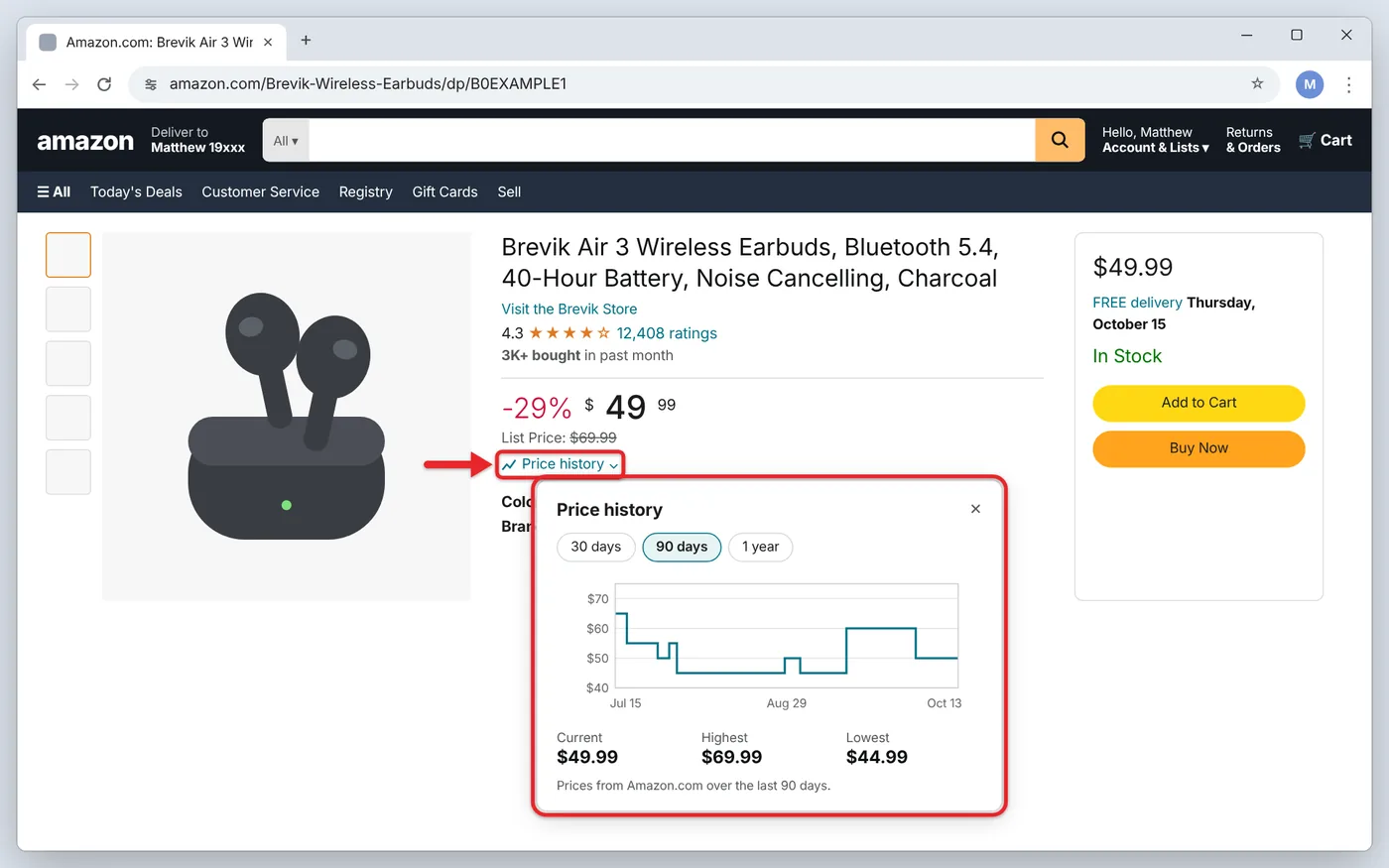
- Switch between the 30-day, 90-day, and 365-day views to compare the current price with longer stretches. The 365-day view is still rolling out in the US, UK, and India, so some accounts and items show only 30 and 90 days.
If the current price matches the low end of the range, it’s a good time to buy. If the item was much cheaper a few weeks ago, waiting for the next sale may save you money.
The same check works for products a creator recommends. If you shop from an Amazon influencer storefront, open each product page and look at its price history before you buy.
Not every listing has the link. Amazon shows it on many product pages, but some items, especially new or rarely sold ones, don’t have enough sales data. For more detail, read Amazon’s guide to price history.
Price Labels Amazon Already Shows
Even without opening the price history, a few labels on the product page tell you how the current price compares. Amazon defines them on its strike-through pricing help page:
- Typical Price is the median price customers paid on Amazon over the last 90 days. A discount measured against Typical Price is a better sign than one measured against List Price.
- List Price is the manufacturer’s suggested retail price. Amazon only shows it if the item actually sold at or above that price recently, but many products rarely sell at full list price.
- Lowest price in 30 days means the current price is the lowest, or tied for the lowest, featured offer in that period.
Ask Alexa for Shopping About the Price
On May 13, 2026, Amazon renamed its Rufus shopping assistant Alexa for Shopping, so older guides may still call it Rufus. You can ask it about an item’s price history in plain language. It’s free when you’re signed in, needs no Echo device or Prime membership, and is available to US customers in the Amazon Shopping app and on Amazon.com.
- Open the product page in the Amazon Shopping app or on Amazon.com.
- Tap the Alexa icon at the bottom of the app screen, or click the Alexa icon at the top of the Amazon.com page on a computer. A chat panel opens.
- Type a question such as “What’s the price history?” or “Has this item been on sale in the past 30 days?” Alexa replies with recent prices and sometimes a small chart.
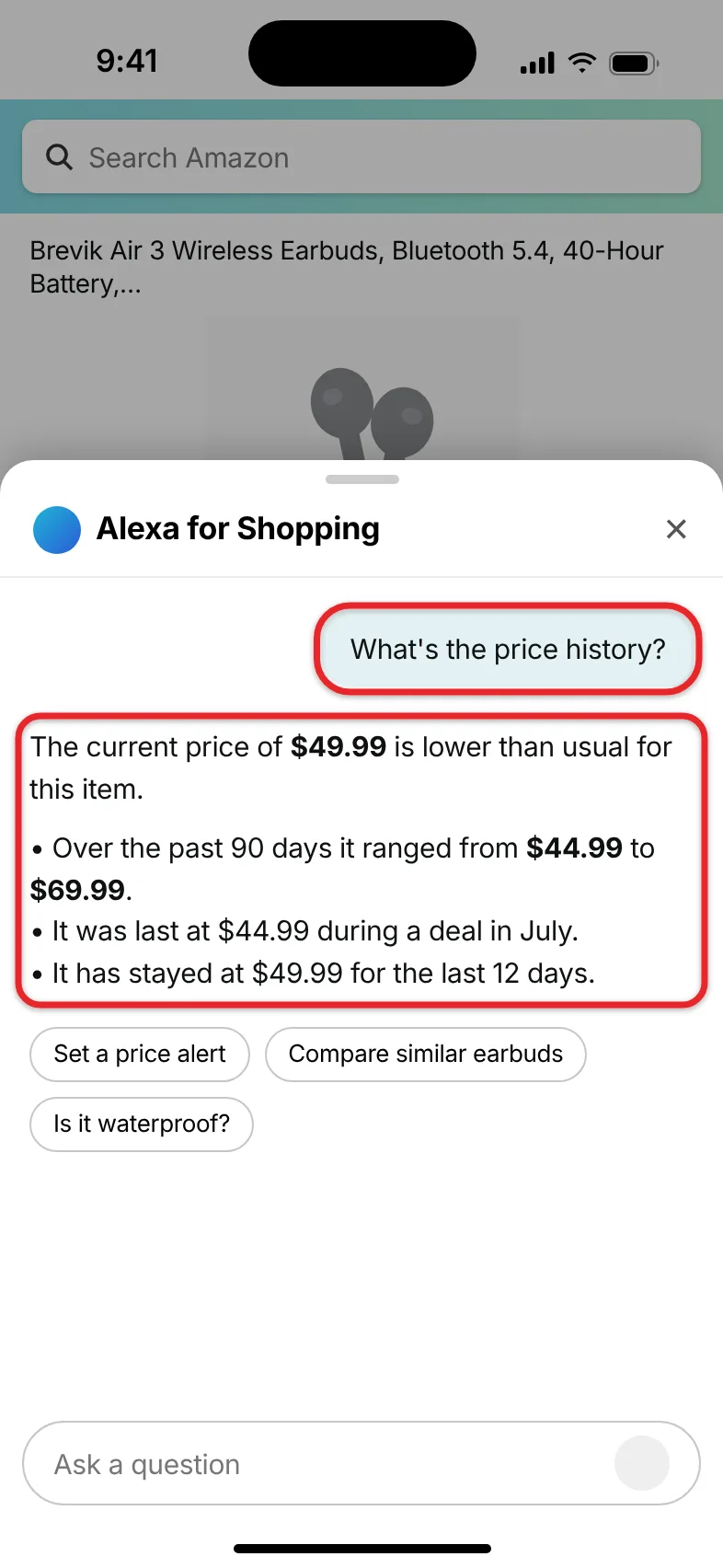
- To get notified about a drop, type something like “Notify me when this goes down to $40.” You can also ask it to add the item to your cart if the price drops to a set amount, so you can review it and check out yourself.
Amazon also lists automatic buying at a set price among Alexa for Shopping’s features. An automatic purchase places a real order, so ask for a notification or a cart add instead if you want to approve the purchase first. Treat its answers as a starting point: Alexa doesn’t know your budget or what next month’s sales will bring. The Alexa for Shopping announcement lists these features.
If you don’t see the Alexa icon, update the Amazon Shopping app from the App Store or Google Play and check again.
Check Price History on CamelCamelCamel
CamelCamelCamel is a free website that has tracked Amazon prices for well over a decade. It works with Amazon in the US, UK, Canada, Germany, France, Italy, Spain, and Australia, and you can check a chart without an account.
- Open the Amazon product page and copy its web address. On a computer, click the address bar and press Ctrl + C (Command + C on a Mac). In the Amazon app, tap Share on the product page and choose Copy.
- Go to camelcamelcamel.com in any browser.
- Click the search box at the top of the page, paste the link with Ctrl + V (Command + V on a Mac), and press Enter. You can also type the product’s name, but pasting the link takes you straight to the right item.
- Open the product if a list of results appears. Its price history page loads with a chart.
- Read the chart. Separate lines show the price when Amazon sells the item, the lowest price from third-party sellers for new copies, and the lowest used price. A table under the chart lists the highest, lowest, and average price for each.
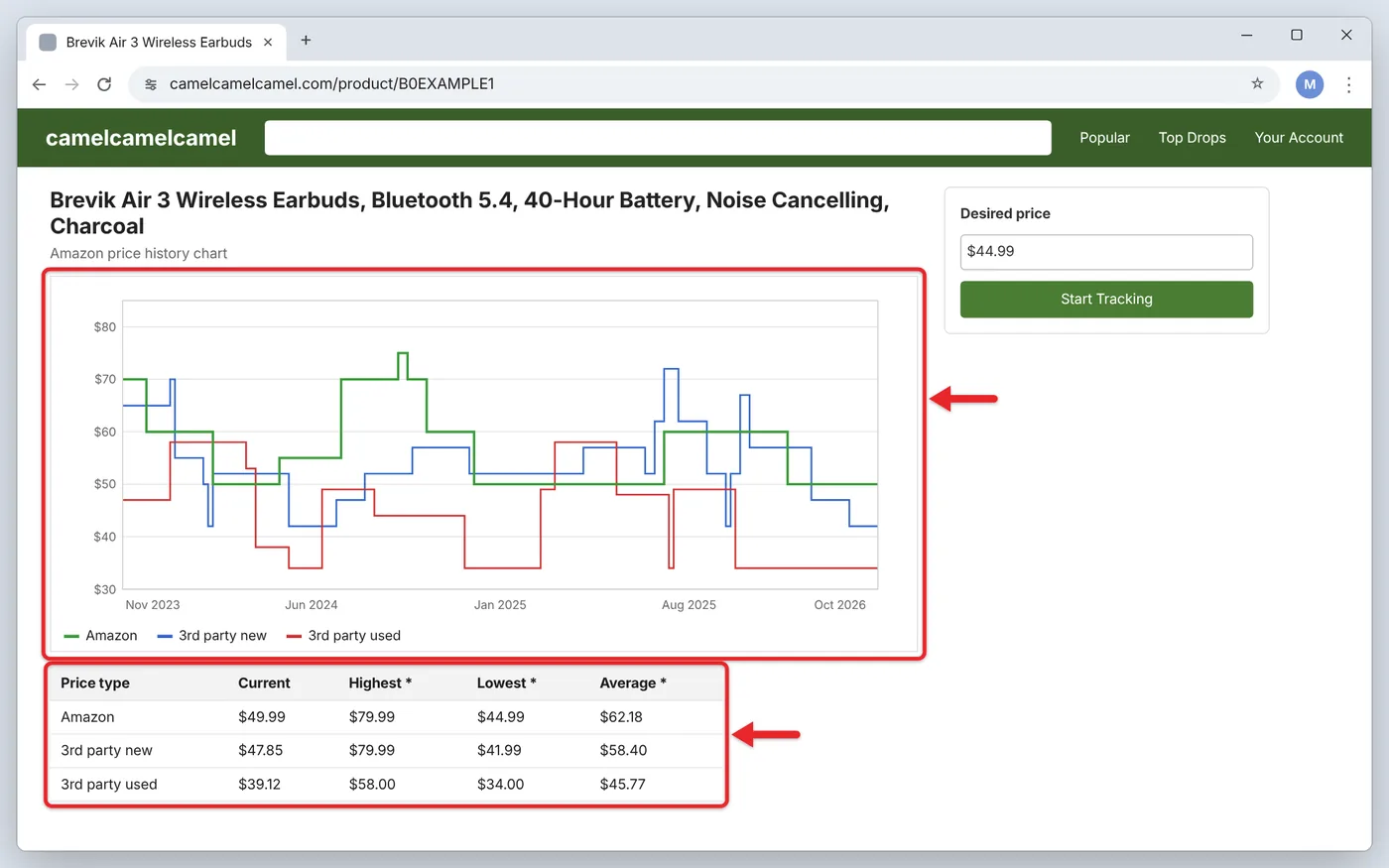
- Use the date range options above the chart to zoom out to a year or the full history.
To get an email when the price falls, enter your target price and email address in the price watch section on the same page and submit it. A free account adds a list of all your watches in one place.
On a computer, the free Camelizer extension for Chrome, Edge, Firefox, and Safari puts a camel icon in your browser toolbar. On Chrome and Edge, it may be hidden behind the puzzle-piece extensions button until you pin it. Click it on any Amazon product page to see the same chart without leaving Amazon. The extension doesn’t work in phone browsers, and there’s no CamelCamelCamel phone app, but the website itself works fine on a phone.
Check Price History with Keepa
Keepa says it tracks more than 7 billion Amazon products, and it’s popular with shoppers who want detailed charts. It covers Amazon.com and other stores, including Amazon in the UK, Canada, Germany, Japan, France, Italy, Spain, India, and Mexico.
- Install Keepa – Amazon Price Tracker from your browser’s extension store. On a phone, or if you’d rather not install an extension, go to keepa.com instead.
- Open any Amazon product page. With the extension installed, an interactive Keepa price chart appears on the product page itself. Scroll down a little if you don’t see it right away.
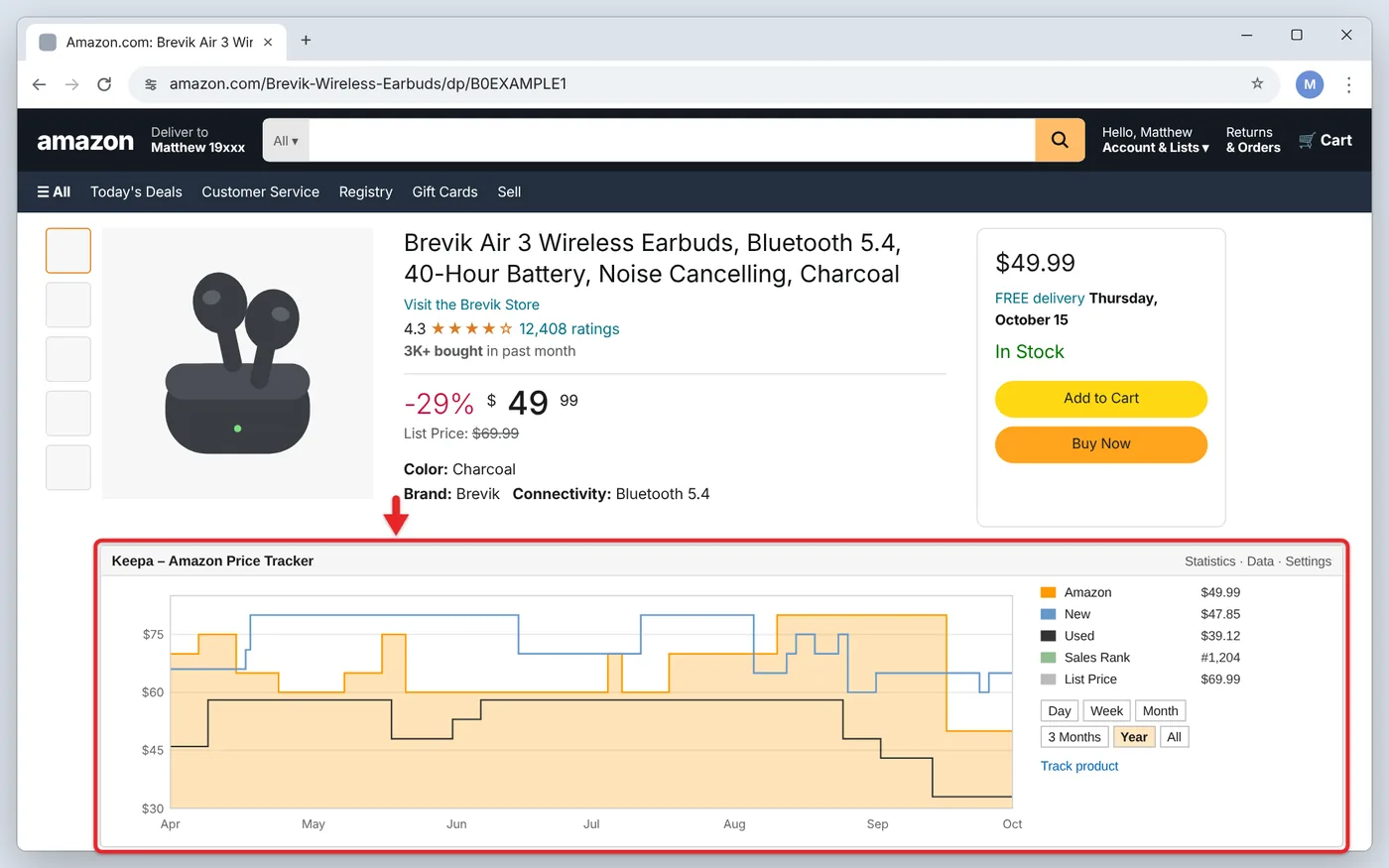
- Hover over the chart to see the price on a given date. Separate lines show the Amazon price, the lowest new price from third-party sellers, and the lowest used price, and you can turn each line on or off.
- Change the time range to see the last few months, a year, or the full history.
- To set an alert, open the Track product tab in the Keepa box, enter the price you want to pay, and start tracking. Keepa notifies you when the price falls below your target or the item comes back in stock.
The price charts are free and don’t require an account to start, and a free account keeps your tracked items and alerts in one place. Keepa sells a paid subscription that adds data like sales rank and seller counts, which mostly matters to sellers and resellers. Free plans can change, so check Keepa’s site if an alert stops working or you hit a limit on how many items you can track.
Install Keepa or the Camelizer only from your browser’s official extension store. Both read the Amazon pages you visit so they can draw their charts.
How to Read a Price History Chart
A chart is only useful if you know what to look for:
- Compare the current price to the low points, not the average. If an item has dropped to the same low several times, it will probably get there again.
- Watch for sale events. Many products hit their lowest prices during Prime Day in July, Prime Big Deal Days in October, and Black Friday in late November.
- Check who sells it. A low price from a third-party seller may come with different shipping, return, or condition terms than the same item sold by Amazon.
- Be wary of sudden “discounts.” If the price jumped up right before a sale, the discount may be smaller than it looks.
- Look for gaps. A break in the line usually means the item was out of stock at that price.
- Remember where the chart starts. A tracker’s history begins when it started following that product, not when the product launched.
Check the Price You’ll Actually Pay
A chart tracks the listed price, which isn’t always what you pay at checkout. Before you decide a deal is real, check these:
- Coupons and Subscribe & Save. A clickable coupon on the product page or a Subscribe & Save discount is applied at checkout, so it usually doesn’t show up in price history charts. The item may be cheaper than the chart suggests.
- Shipping. Trackers record the item price, not shipping charges, so a low third-party price can cost more once shipping is added.
- The exact version. A discount on one size, color, or storage capacity doesn’t mean the others are on sale. Match the model, size, and condition to the chart you’re reading.
- The seller and condition. The lowest line on a tracker may be a used item or a third-party seller with a different return policy.
Here’s a quick example. If a blender is listed at $79.99 with a List Price of $129.99, it looks like nearly 40% off. If its 90-day chart shows it usually sells for about $85, the real savings is closer to $5. That’s still a fine price, but probably not worth rushing for.
If you’re tracking an item to buy later, save it to your Amazon wish list so it’s easy to find when the price drops.
If You Can’t Find the Price History
- There’s no link next to the price. Amazon doesn’t show price history on every item. Ask Alexa for Shopping, or check CamelCamelCamel or Keepa instead.
- You only see 30 and 90 days. The 365-day view is still rolling out and isn’t available in every country. In Canada, Amazon offers the 30- and 90-day views.
- CamelCamelCamel says the product isn’t found. Make sure you pasted a product page link, not a search results page. A newly listed product may not have much history yet.
- The prices don’t match what you see on Amazon. Trackers record the price at intervals, so a short flash sale may not show up. Price can also differ by size, color, or seller, so confirm you’re looking at the same version.
- The extension doesn’t show a chart. Reload the Amazon page, check that the extension is turned on in your browser’s extensions menu, and make sure you’re on a supported Amazon store.
- Alexa for Shopping isn’t in the app. Amazon offers it to US customers. Update the Amazon Shopping app and sign in. If you have more than one Amazon account, confirm you’re signed in to the one you shop with. The steps for checking whether you have Amazon Prime also show which account is active.
Amazon Price Tracking Questions
Does Amazon show price history?
Yes. Many Amazon product pages in the US, UK, Canada, and India have a price history link next to the price that shows recent highs and lows. In the US, you can also ask Alexa for Shopping for an item’s price history.
Does price history include coupons?
Usually not. Price history charts follow the listed price, while coupons and Subscribe & Save discounts are applied at checkout. Check the product page and your cart total before comparing.
Is CamelCamelCamel still free?
Yes. CamelCamelCamel’s charts, price watches, and Camelizer extension are free. The site earns money from Amazon affiliate commissions when people click through to buy.
Is Keepa or CamelCamelCamel better?
For most shoppers, either one works. CamelCamelCamel is simpler and needs nothing installed. Keepa puts the chart right on the Amazon page and shows more detail, which is handy if you shop on Amazon often.
Can I check Amazon price history on my iPhone or Android phone?
Yes. Amazon’s own price history and Alexa for Shopping both work in the Amazon Shopping app. You can also open camelcamelcamel.com or keepa.com in your phone’s browser and paste the product link.
Does price history include third-party sellers?
Amazon’s tool focuses on the featured offer price on the product page. CamelCamelCamel and Keepa show separate lines for Amazon, third-party new, and used prices.

Matthew Burleigh is the founder, head writer, and editor of Solve Your Tech, which he launched in 2012. He has written technology tutorials since 2008 and worked in IT since 2003, including small-business support, IT management, and consulting. He holds Bachelor’s and Master’s degrees in Computer Science from Arizona State University.
Matthew writes practical guides for Windows, iPhone and iPad, Microsoft Office, Outlook, Google apps, and Android. Solve Your Tech’s guides are checked step by step against the device or app maker’s own documentation and tested on his own devices whenever he has the hardware or software, with clear steps, sources, and update dates.
Read more about Matthew and how Solve Your Tech writes and updates its guides, or report a correction.