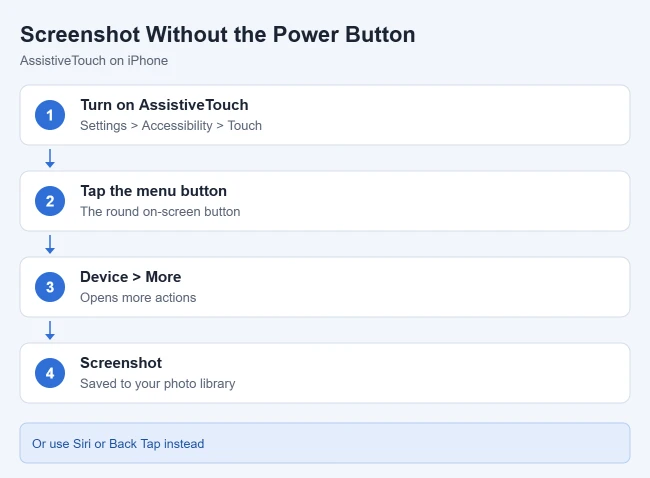
To take a screenshot without the power button, turn on AssistiveTouch in Settings > Accessibility > Touch > AssistiveTouch. Tap the round menu button that appears, then tap Device > More > Screenshot. The same menu can lock the screen and restart your iPhone. You can also take a screenshot by asking Siri or by tapping the back of the phone with Back Tap.
The power button is the side button on current iPhones (Apple used to call it the Sleep/Wake button). These steps follow Apple’s iPhone User Guide for iOS 26 and iOS 27, mainly the pages on AssistiveTouch and taking a screenshot. Older iOS versions use the same Accessibility path, but some menu labels can differ.
Which Method Should You Use?
| Method | What it does | Best when |
|---|---|---|
| AssistiveTouch | Screenshot, lock the screen, restart | The side button is broken or hard to press |
| Back Tap | Screenshot with two or three taps on the back | You do not want a button on the screen |
| Siri | Screenshot by voice | Your hands are busy and you are online |
| Auto-Lock | Locks the screen after a set time | You only need the phone to lock by itself |
Nothing here needs an app from the App Store. All four features are built into iOS, and you can turn each one off again later.
How to Turn On AssistiveTouch
AssistiveTouch is an accessibility feature that puts a floating menu button on the screen. Apple says you can use it when you need to press iPhone buttons.
- Open the Settings app.
- Tap Accessibility, then tap Touch.
- Tap AssistiveTouch, then turn on the AssistiveTouch switch at the top.
The AssistiveTouch menu button appears on the screen right away. Drag it to any edge so it is out of your way. Tapping it once opens the menu, and tapping anywhere outside the menu closes it. Apple notes you can also ask Siri something like “Turn on AssistiveTouch.”
How to Take a Screenshot With AssistiveTouch
- Open the screen you want to capture.
- Tap the AssistiveTouch menu button.
- Tap Device, then tap More.
- Tap Screenshot.
The iPhone captures the screen the same way the button combination does. If you do not see Screenshot under Device > More on your iOS version, add it to the first menu screen with the customize steps further down.
What happens next depends on your screen capture settings. On iOS 26 and later, a screenshot opens in a full-screen preview by default. Swipe up, or tap the done control and choose a save option, to keep it. If you see a small thumbnail in the lower left instead, the screenshot saves automatically. To switch to thumbnails, go to Settings > General > Screen Capture and turn off Full-Screen Previews.
To confirm it worked, open Photos, tap Collections, scroll to Media Types, and tap Screenshots. For the normal button method and editing options, see our iPhone screenshot guide.
Make it one tap
Opening three menu levels gets slow if you take screenshots often. A custom action is faster:
- Go to Settings > Accessibility > Touch > AssistiveTouch.
- Under Custom Actions, tap Double-Tap or Long Press.
- Choose Screenshot from the list.
Now double-tapping (or pressing and holding) the menu button takes a screenshot without opening the menu. Leave Single-Tap set to Open Menu so you can still reach the other actions.
How to Take a Screenshot With Back Tap
Back Tap runs an action when you tap the back of the iPhone two or three times. It adds nothing to the screen.
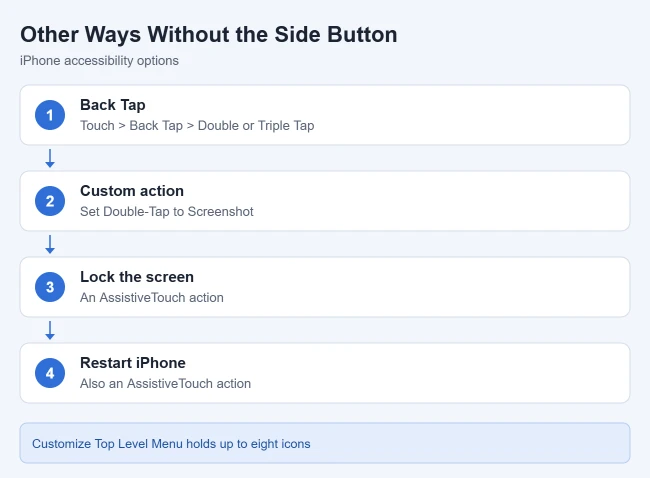
- Go to Settings > Accessibility > Touch > Back Tap.
- Tap Double Tap or Triple Tap.
- Select Screenshot.
Double-tap or triple-tap the back of the iPhone to take the screenshot. Accidental taps can trigger it too, so choose Triple Tap if you end up with screenshots you did not mean to take. To undo the setting, return to the same screen and choose None, as described in Apple’s Back Tap instructions.
How to Take a Screenshot With Siri
Apple lists Siri as another way to take a screenshot without the hardware buttons. Open the screen you want, say “Siri” or “Hey Siri,” then say “Take a screenshot.”
Two things have to be true first. Siri must be turned on in Settings > Siri, with the voice option enabled, and the iPhone must be connected to the internet. Holding the side button also starts Siri, but that does not help when the button is the part that is broken.
How to Lock the Screen Without the Power Button
Apple’s AssistiveTouch support article lists locking the screen among the things the menu can do in place of a button.
- Tap the AssistiveTouch menu button.
- Tap Device.
- Tap Lock Screen.
The display turns off and the iPhone locks, unless Always On Display keeps a dimmed Lock Screen visible. If the label is missing from Device on your iOS version, add Lock Screen to the top-level menu or assign it to a custom action such as Long Press.
To wake the iPhone again without the side button, tap the screen or raise the phone. Apple notes that tap to wake is not available on iPhone SE.
Let the iPhone lock by itself
The iPhone also locks automatically when you stop using it. Go to Settings > Display & Brightness > Auto-Lock and pick a short time. If Auto-Lock is set to Never, the screen stays unlocked until you lock it yourself, so change it while your button is not working. Our guide to changing the lock screen timeout on iPhone covers the options.
How to Restart or Turn Off Without the Side Button
Warning: Apple’s instructions for turning an iPhone on use the side button. If yours does not respond at all, do not shut the phone down unless you have to. Use Restart instead, because the iPhone comes back on by itself.
- Restart: Apple lists Restart among the AssistiveTouch actions. Open the menu, tap Device > More, and look for Restart.
- Turn off: go to Settings > General, scroll down, tap Shut Down, then drag the slider.
How to Customize the AssistiveTouch Menu
- Go to Settings > Accessibility > Touch > AssistiveTouch.
- Tap Customize Top Level Menu.
- Tap an icon, then choose Screenshot or Lock Screen to put that action in its place.
- Tap the plus or minus button to change how many icons the menu shows.
The menu can hold up to eight icons, so there is room for both actions. Tap Reset on the same screen to restore the default menu.
If the floating button gets in the way, lower Idle Opacity on the AssistiveTouch screen so the button fades when you are not using it. To remove it completely, turn the AssistiveTouch switch off.
If It Does Not Work
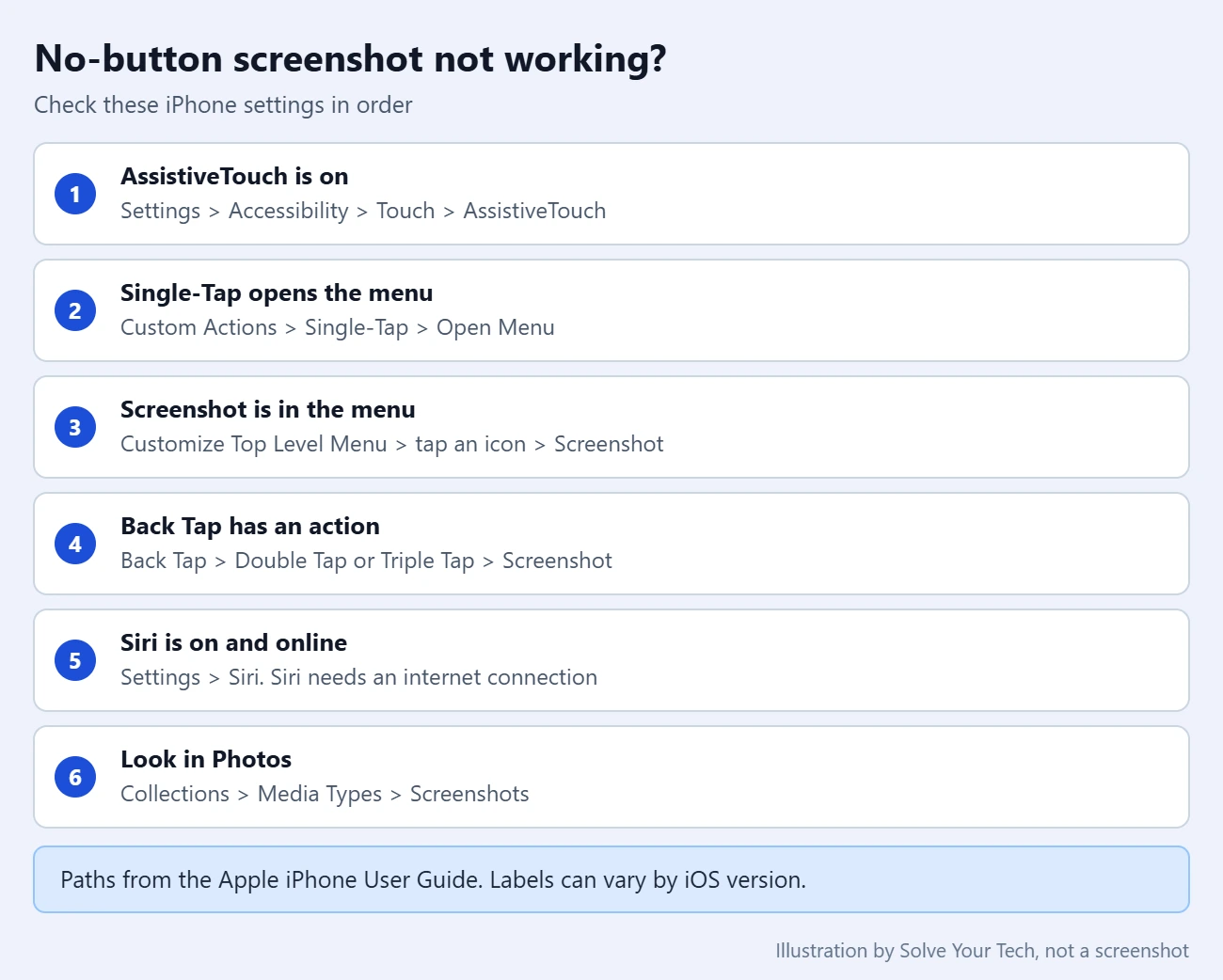
- Tapping the menu button takes a screenshot instead of opening the menu. Single-Tap was reassigned. Set Single-Tap back to Open Menu under Custom Actions.
- Screenshot or Lock Screen is not in the menu. Add it with Customize Top Level Menu. Menu layouts vary between iOS versions.
- Back Tap does nothing. Check that Double Tap or Triple Tap is set to Screenshot and not None. If you do not see Back Tap under Touch, your iPhone or iOS version may not support it. Use AssistiveTouch instead.
- Siri does not respond. Confirm Siri is turned on and that you have Wi-Fi or cellular data.
- The screenshot is not in Photos. With full-screen previews on, a screenshot is not saved until you swipe up or choose a save option.
- The side button still does not work. These features are workarounds. A button that stays unresponsive is a repair question for Apple Support.
Frequently Asked Questions
Can Siri take a screenshot?
Yes. Apple lists Siri, AssistiveTouch, and Back Tap as ways to take a screenshot instead of using the hardware buttons. Siri has to be turned on and the iPhone needs an internet connection.
Can AssistiveTouch lock or restart my iPhone?
Yes. Apple says AssistiveTouch can lock the screen and restart the device, along with adjusting the volume and taking screenshots. If you want to lock your iPhone to a single app instead, see how to use Guided Access.
How do I turn AssistiveTouch on and off quickly?
Go to Settings > Accessibility > Accessibility Shortcut and select AssistiveTouch. The shortcut normally runs with a triple-click of the side or Home button. If that button is broken, assign AssistiveTouch to Back Tap instead, or ask Siri to turn it on or off.
Does this work on an iPhone with a Home button?
Yes. AssistiveTouch and Siri use the same settings on iPhone models with a Home button. The usual button method on those phones is to press the Home button and the side button together, so AssistiveTouch is the replacement when either one fails.
More iPhone Guides
- How to screen record on iPhone
- What the icons at the top of your iPhone mean
- How to use (and get out of) Guided Access on iPhone

Matthew Burleigh is the founder, head writer, and editor of Solve Your Tech, which he launched in 2012. He has written technology tutorials since 2008 and worked in IT since 2003, including small-business support, IT management, and consulting. He holds Bachelor’s and Master’s degrees in Computer Science from Arizona State University.
Matthew writes practical guides for Windows, iPhone and iPad, Microsoft Office, Outlook, Google apps, and Android. Solve Your Tech’s guides are tested on current devices or checked against official product documentation, with clear steps, sources, and update dates.
Read more about Matthew and how Solve Your Tech writes and updates its guides, or report a correction.