To use emoji on your iPhone, tap a text field, tap the Emoji button (the smiley face) or the globe key on the keyboard, and tap an emoji. If you don’t see the Emoji button, add the Emoji keyboard in Settings > General > Keyboard > Keyboards > Add New Keyboard > Emoji.
These steps follow Apple’s Use emoji on your iPhone support article and the iPhone User Guide pages on emoji, Memoji, and stickers and adding keyboards. They are written for the current iPhone User Guide (iOS 27). Recent earlier versions use the same path, though a few labels differ slightly, and those differences are noted below.
What You Need
- An app that uses the standard iPhone keyboard. Apple says the emoji keyboard is available in any app that uses the standard keyboard, like Mail or Messages.
- The Emoji keyboard in your keyboard list. It is a separate keyboard, like a language keyboard. If it has been removed, the Emoji button disappears until you add it back.
- Nothing else. The Emoji keyboard is built into iOS. You do not need to download an app to get it.
How to Type an Emoji on iPhone
- Tap a text field, such as a new message in Messages. The keyboard opens.
- Tap the Emoji button or the globe key. The letters are replaced by a grid of emoji.
- Swipe left or right to browse, or tap one of the gray symbols below the grid to jump to a category.
- To find a specific emoji, tap the Search Emoji field and type a word, such as “cake”.
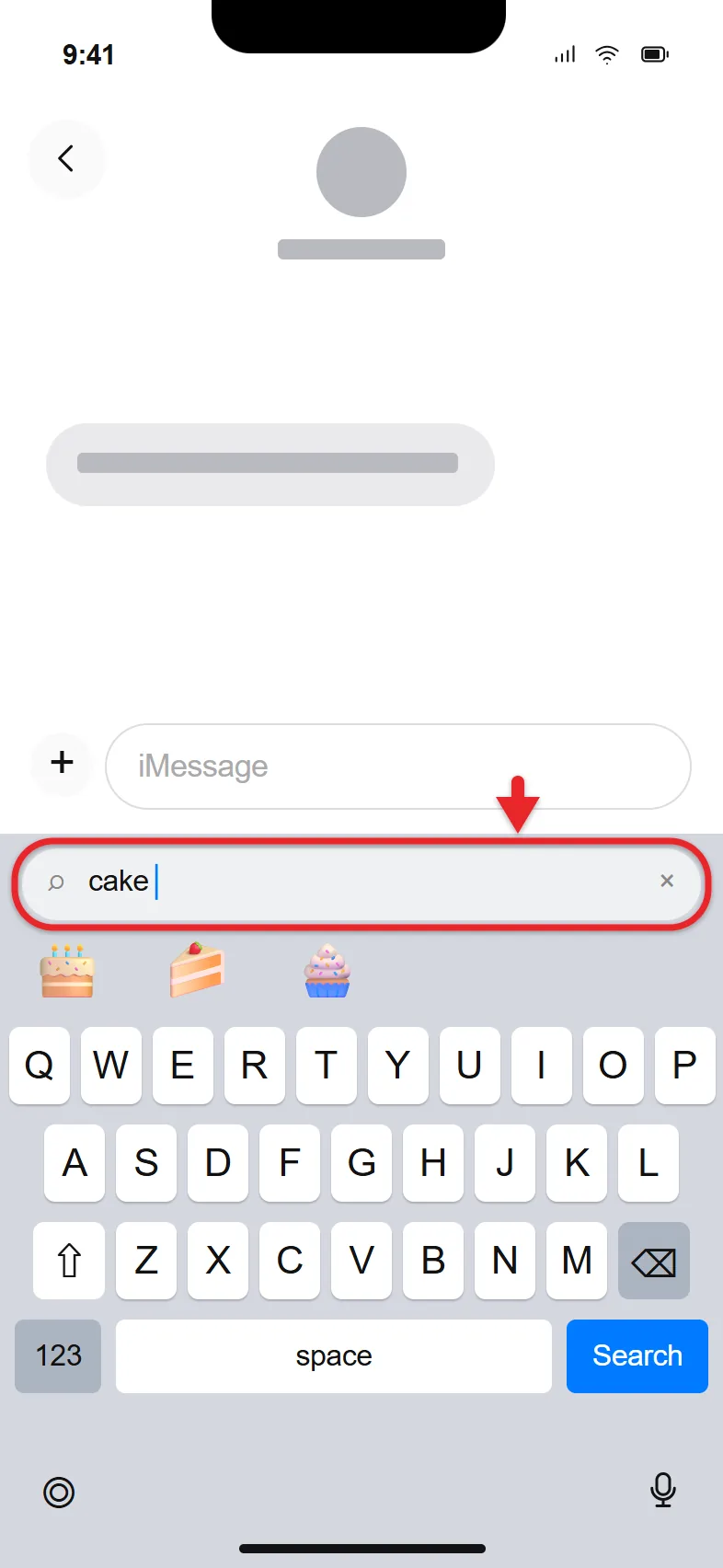
- Tap an emoji to add it. It appears in the text field where your cursor is.
- Tap ABC to return to the regular keyboard.
Two extras are worth knowing. Tap the clock symbol to see the emoji you used recently. To see variations of an emoji, such as different skin tones, touch and hold the emoji, then drag your finger to the variation you want and release.

How to Add the Emoji Keyboard if It’s Missing
If the keyboard shows no smiley face, and touching and holding the globe key doesn’t list Emoji, the Emoji keyboard is not in your keyboard list. Adding it takes a few taps and doesn’t change your other keyboards.
- Open the Settings app and tap General.
- Tap Keyboard.
- Tap Keyboards at the top of the screen. You see the keyboards that are currently installed.
- Tap Add New Keyboard.
- Tap Emoji in the list.
To confirm it worked, check that Emoji now appears on the Keyboards screen. Then open an app such as Messages or Notes, tap a text field, and look for the Emoji button or the globe key.

Faster Ways to Add Emoji
You don’t have to open the emoji keyboard every time. iOS offers several shortcuts, and each one works a little differently.

Tap a suggested emoji
As you type, suggested words and emoji appear above the keyboard. This feature is called predictive text. Type a word such as “pizza”, then tap the emoji in the suggestion row to use it. Predictive typing isn’t supported in every language, though, so the row may not appear on some keyboards.
Replace words with emoji in Messages
- Open Messages and write your message, but don’t send it yet.
- Tap the Emoji button or the globe key.
- Wait for the words that have a matching emoji to turn orange.
- Tap an orange word to replace it with an emoji. If more than one emoji fits, choose from the options that appear.
Changed your mind? You can tap the emoji to switch back to the original word. This feature is described for the Messages app, so don’t expect orange words in every app.
Say the emoji name with Dictation
Dictation is the iPhone feature that turns speech into text. Tap the microphone key on the keyboard and say the name of an emoji, such as “heart emoji” or “smiley face emoji”. If you don’t see the microphone, go to Settings > General > Keyboard and turn on Enable Dictation. Apple covers this in its Dictate text on iPhone guide, and notes that Dictation isn’t available in all languages or regions.
Set up a text replacement
A text replacement swaps a short code you type for a longer phrase or an emoji. Go to Settings > General > Keyboard > Text Replacement, tap the add button, put the emoji in the Phrase field, and type a code such as ;heart in the Shortcut field. Apple’s text replacement guide shows the screen, and you can read more about adding shortcuts with Text Replacement.
The same trick can store an invisible character if you want to send a blank text message on iPhone.
How to Switch Between Keyboards
Touch and hold the Emoji button or the globe key, then tap the keyboard you want. That’s the quickest route when you have several keyboards installed, for example after you add a Spanish or other language keyboard.
You can also change the order of your keyboards. Go to Settings > General > Keyboard > Keyboards, tap Edit, drag the handle next to a keyboard to a new spot, then finish editing.
How to Turn Off Emoji Suggestions or Remove the Emoji Keyboard
Everything above can be undone.
Stop emoji suggestions: While typing, touch and hold the Emoji button or the globe key, tap Keyboard Settings, then turn off Predictive Text. Some iOS versions label this switch Predictive. Be aware that this hides word suggestions too, not just emoji. It also turns off inline predictions, the gray text that completes a word as you type. Turn the switch back on to restore all of them.
Remove the Emoji keyboard: Go to Settings > General > Keyboard > Keyboards, swipe left on Emoji, then tap Delete. The Emoji button leaves the keyboard. To get it back, repeat the steps in the section on adding the Emoji keyboard.
Troubleshooting

- You see a globe, not a smiley. That’s normal. Apple’s instructions say to tap either the Emoji button or the globe. Which one you see depends on your keyboards and iOS version. Tap the globe, or touch and hold it and choose Emoji.
- Neither key appears. Add the Emoji keyboard using the Settings steps above.
- The keyboard looks different in one app. Emoji is available in apps that use the standard keyboard. An app that shows its own keyboard, or a keyboard you installed from another developer, may handle emoji differently. Touch and hold the globe key and switch back to your regular keyboard.
- No emoji appear above the keyboard. Touch and hold the Emoji button or the globe key, tap Keyboard Settings, and make sure Predictive Text is on. Apple’s predictive text guide also notes that the feature isn’t supported in every language.
- Words don’t turn orange. Tap-to-replace is described for Messages. Write the text first, then tap the Emoji button and give it a moment.
- An emoji you want isn’t there. Try the Search Emoji field first. If it still doesn’t show up, your iOS version may not include it. Check for an update in Settings > General > Software Update. Back up your iPhone before you update iOS.
Send a Sticker or Place It on a Message
Open Messages and the conversation, tap + > Stickers, choose the Live Stickers, Emoji, Memoji or installed sticker-app collection, and select an item. Add optional text and tap Send. The full set of sticker collections and sending controls is on Apple’s support site. For stickers from another creator, install its iMessage app from the App Store.
To decorate an existing message, touch and hold the sticker and drag it onto the message bubble, adjusting its size or angle before you let go. To remove an attached sticker, touch and hold the bubble, choose Sticker Details, swipe left on the sticker and tap the delete button. This removes it on your iPhone only, so the other person still sees it.
For animated reactions, use the built-in #images app to send a GIF in iPhone Messages.
Want something more personal than emoji? Here’s how to make a sticker on iPhone from a photo.
Frequently Asked Questions
Do I have to download the emoji keyboard?
No. The Emoji keyboard is part of iOS. If it’s missing, add it in Settings > General > Keyboard > Keyboards > Add New Keyboard > Emoji. Nothing has to be installed from the App Store.
How do I change an emoji’s skin tone?
Open the emoji keyboard, touch and hold an emoji that supports variations, drag your finger to the version you want, and release. This only works for certain emoji, so not every one opens a variation menu.
Can I react to a message with an emoji instead of sending one?
Yes. In Messages, a Tapback attaches a reaction to a specific message. Double-tap, or touch and hold, the message and pick a reaction; you can choose any emoji. For the full steps, read about reacting with a Tapback.
Can I make my own emoji or stickers?
Yes. From the emoji keyboard you can make a sticker from a photo or create a Memoji, which is a cartoon-style character you design. Apple also offers Genmoji, custom emoji made from a description. According to Apple’s Genmoji guide, that feature requires Apple Intelligence, which is available on iPhone 15 Pro, iPhone 15 Pro Max, and iPhone 16 models or later, and not in all languages or regions.
Does the emoji keyboard work on iPad?
Yes. On an iPad, add it in Settings > General > Keyboard > Keyboards > Add New Keyboard and choose Emoji, then tap the Emoji button or the globe key in any text field. Apple’s emoji support article covers iPhone and iPad together.
Will removing the Emoji keyboard delete anything?
Removing a keyboard takes it out of your keyboard list, and you can add it again at any time. Apple doesn’t say whether your recently used emoji are kept when you do this.
Next Steps
Once emoji are working, you may want to tidy up the rest of the keyboard. These guides cover related settings:
- How to change iPhone keyboard settings
- How to show or hide notifications on the Lock Screen
- How to react to a message with a Tapback

Matthew Burleigh is the founder, head writer, and editor of Solve Your Tech, which he launched in 2012. He has written technology tutorials since 2008 and worked in IT since 2003, including small-business support, IT management, and consulting. He holds Bachelor’s and Master’s degrees in Computer Science from Arizona State University.
Matthew writes practical guides for Windows, iPhone and iPad, Microsoft Office, Outlook, Google apps, and Android. Solve Your Tech’s guides are checked step by step against the device or app maker’s own documentation and tested on his own devices whenever he has the hardware or software, with clear steps, sources, and update dates.
Read more about Matthew and how Solve Your Tech writes and updates its guides, or report a correction.