To play the same music on several Echo speakers, create a Multi-Room Music group in the Alexa app: Devices > Plus (+) > Combine Speakers > Multi-Room Music. Select the speakers, give the group a name, and finish the setup. Then ask, “Alexa, play music downstairs,” using your group's name.
If you already have more than one compatible device, Alexa automatically creates an Everywhere group. Try “Alexa, play music everywhere” for whole-home playback, or edit that group to check which speakers belong to it.
This guide covers compatible Echo devices and the Alexa app on iPhone or Android. A Multi-Room Music group plays the same song on every speaker in it. It can’t play a different song in each room.
Before you create the group
You need at least two compatible Echo devices that are set up and powered on. Amazon lists current and previous generations of Echo Pop, Echo Dot, Echo, Echo Studio, and Echo Show.
All of them must be registered to the same Amazon account, connected to the same Wi-Fi network, and running current software.
If you’re still deciding which speakers to add, read what to know before buying an Amazon Echo.
Give each speaker a clear name, such as Kitchen Echo or Bedroom Echo, so it’s easy to pick in the list. You can rename an Alexa device in the Alexa app.
You also need a supported music service, such as Amazon Music, Apple Music, Spotify, Pandora, or iHeartRadio, per Amazon’s Multi-Room Music overview. To link one, open More > Settings > Music & Podcasts (under Preferences in some versions) and tap Link New Service, as Amazon’s music-service linking instructions describe.
Create a Multi-Room Music group
- Open the Alexa app and tap Devices.
- Tap Plus (+), then Combine Speakers.
- Tap Multi-Room Music.
- Select the speakers for this group, such as the kitchen and living room Echos.
- Pick or type a group name, then finish the setup. Use names with at least two syllables and no special characters.
- Open Devices > Speaker Groups and check that the group lists the right speakers.
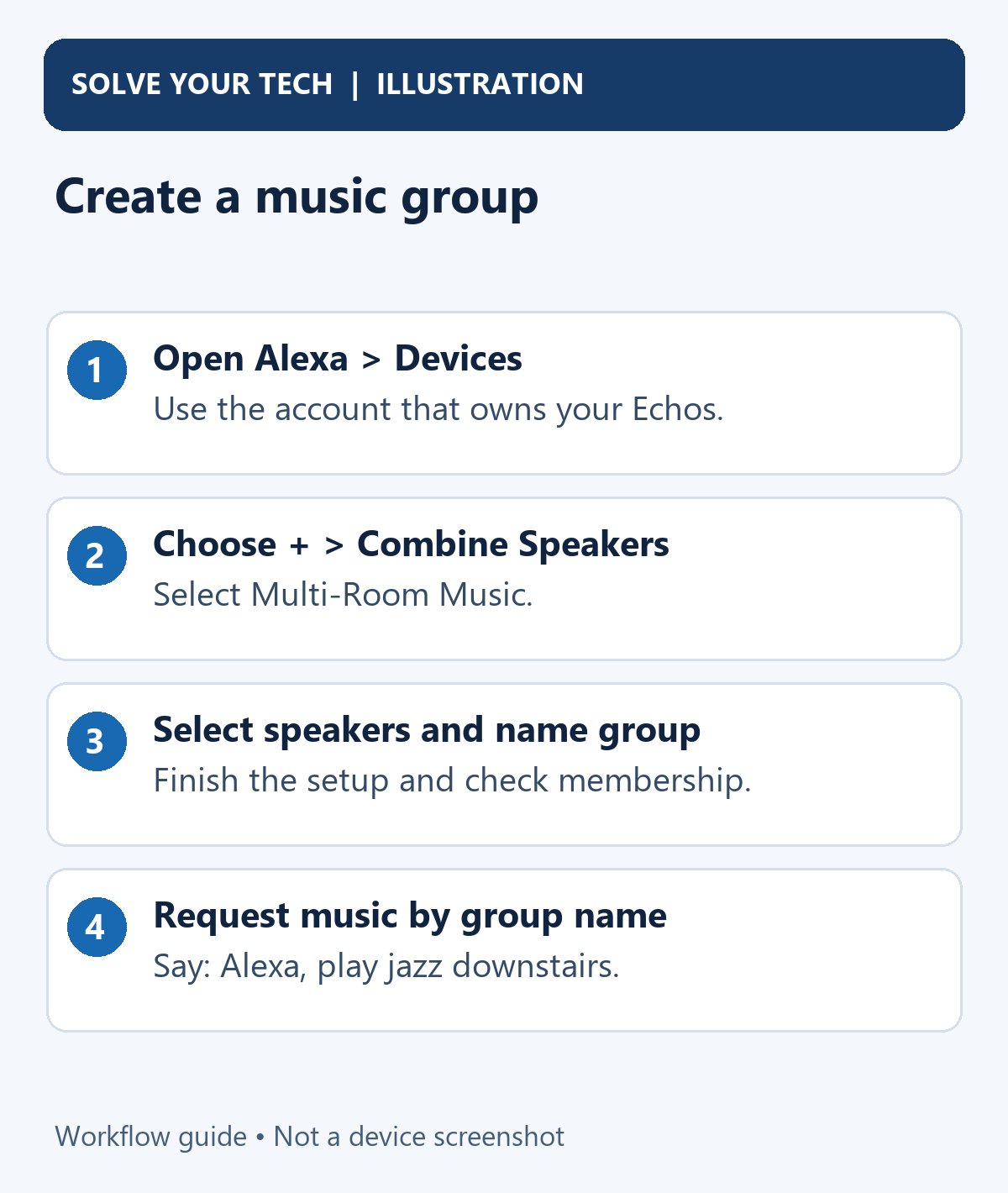
Amazon’s Play Music with Multiple Alexa Devices page documents this route.
Start playback using the group name
Say a request that includes the group, such as “Alexa, play jazz downstairs.” You can request an artist, playlist, or other supported audio and specify the linked provider when necessary: “Alexa, play my dinner playlist on Spotify downstairs.” The requested content still needs to be available through that service and account.
To move music that’s already playing, say “Alexa, move music to the everywhere group.”
Check that the group works
Start at a comfortable volume, then listen at each selected speaker. The same audio should play on all of them together. Check that any speaker you left out isn't playing.
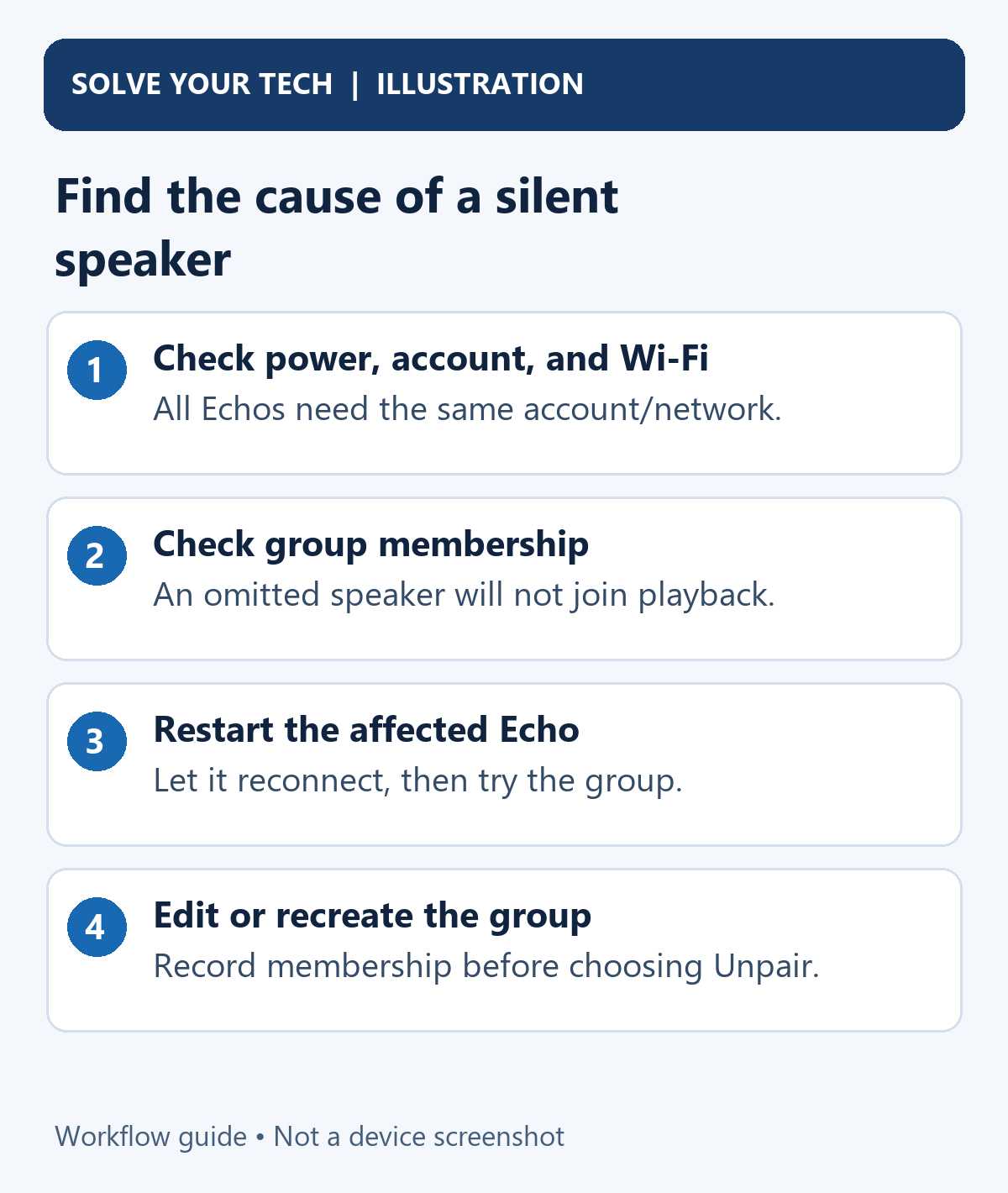
If you hear music only in the room where you spoke, check the group name and which speakers are in it. If most speakers play but one stays silent, follow the missing-speaker steps below.
Use or edit the Everywhere group
Everywhere is useful when you want all participating speakers, while a custom group gives you a smaller selection. Alexa creates Everywhere automatically when you have more than one device. Still, check the group to see whether a newly added speaker is included.
- Open Alexa > Devices.
- Scroll to or open Speaker Groups and select Everywhere.
- Check the speakers listed. Tap Edit to add or remove devices, then tap Save.
- Say “Alexa, play music everywhere” and check playback on the speakers you expect.
Amazon lets devices belong to more than one Multi-Room Music group. For example, a kitchen speaker can be in both Downstairs and Everywhere. That gives you different destinations for the same kind of synced playback; it doesn't let overlapping devices play different songs at the same time.
Choose the right kind of speaker group
| Setup | What it does | When to choose it |
|---|---|---|
| Multi-Room Music | Plays supported audio together on compatible speakers, including speakers in different rooms | The same music in the kitchen and living room |
| Stereo pair | Uses two compatible speakers for left and right stereo sound in one room | A wider sound stage in one listening area |
| Smart Home Group speakers | Assigns music speakers to a room or other smart-home group | Room-based playback and preferred-speaker behavior |
| Alexa Home Theater | Combines compatible Echo and Fire TV equipment for supported entertainment audio | Television or Fire TV sound with the right equipment |
Audio from video content doesn’t play on Multi-Room Music groups. TV sound needs the separate Alexa Home Theater setup.
Change membership or remove a group
To add or remove a speaker, open Devices > Speaker Groups, select the group, tap Edit, and save your changes.
To remove the group entirely, open Devices > Speaker Groups, select the group, and select Unpair. On this screen, Unpair deletes the whole group; the speakers stay set up and keep working on their own.
Troubleshoot Multi-Room Music
- A speaker is missing or unreachable: make sure every Echo is powered on, on the same Wi-Fi network, and registered to the same Amazon account (see Amazon’s Device Unreachable help). If you changed your router, follow the steps to connect Alexa to Wi-Fi.
- One speaker stays silent: unplug it, plug it back in, and let it reconnect. Then edit the group, remove that speaker, and add it back, per Amazon’s speaker group help.
- Alexa doesn’t recognize the group: say the exact group name. Review Alexa voice history to see what Alexa heard.
- The group exists but nothing plays: try another linked service, turn off Do Not Disturb on the Echos, and check your plan. Amazon Music’s Single Device Plan doesn’t support multi-room playback. If that fails, delete the group with Unpair and create it again, or see Amazon’s Multi-Room Music troubleshooting.
Multi-Room Music Questions
Can Echo Dots and larger Echo speakers play together?
Yes, compatible devices can join a Multi-Room Music group; they do not all have to be the same model. Check which devices your Alexa app lists as eligible. The matching requirements for a stereo pair are separate.
Do I have to create a group every time?
No. Create and save it once, then request music using its name. Revisit the group when you add a device, change membership, or troubleshoot. Everywhere is a ready-made destination, but check which speakers it includes.
Can I play a different song on every Echo?
No. A Multi-Room Music group plays the same audio on every speaker in it. To play different songs, start each one separately and check your plan’s stream limit. Amazon’s Unlimited streaming-limit help lists up to six devices at once on the Family Plan and one at a time on the Individual Plan.
Can I use my phone to control music?
Yes. The Alexa app has playback controls for music you start there or by voice. Pairing your phone with one Echo over Bluetooth is a different connection and doesn’t use your group. For that, read about letting a guest play audio on your Echo now that Guest Connect is discontinued.
Can I use the group for podcasts or audiobooks?
Amazon's overview lists supported podcasts, radio, news, and Audible audio as well as music. Availability depends on the source and compatible devices. Video audio remains outside ordinary Multi-Room Music playback.
Start with a group of two speakers and test it with a clearly named playback request. Once that works, add the other speakers you want and check each room before using whole-home playback.

Matthew Burleigh is the founder, head writer, and editor of Solve Your Tech, which he launched in 2012. He has written technology tutorials since 2008 and worked in IT since 2003, including small-business support, IT management, and consulting. He holds Bachelor’s and Master’s degrees in Computer Science from Arizona State University.
Matthew writes practical guides for Windows, iPhone and iPad, Microsoft Office, Outlook, Google apps, and Android. Solve Your Tech’s guides are checked step by step against the device or app maker’s own documentation and tested on his own devices whenever he has the hardware or software, with clear steps, sources, and update dates.
Read more about Matthew and how Solve Your Tech writes and updates its guides, or report a correction.