To make Microsoft Edge open to a specific page, select Settings and more (…) › Settings › Start, home, and new tabs. Under When Edge starts, choose Open these pages, then add the page. To pick up where you left off instead, choose Open tabs from the previous session.
These steps apply to the current desktop version of Microsoft Edge on Windows 11, Windows 10, and Mac, and follow Microsoft’s Edge startup settings guide. The Edge apps for iPhone and Android use different settings and aren’t covered here.
The Three Startup Choices
Edge gives you one choice under When Edge starts. Pick the one that matches how you work:
| Option | What opens when you launch Edge | Good for |
|---|---|---|
| Open the new tab page | A single new tab with search, quick links, and the news feed | The default, a clean start every time |
| Open tabs from the previous session | Every tab you had open when you last closed Edge | Picking up a task where you stopped |
| Open these pages | Only the pages on your list, each in its own tab | Email, a work dashboard, or a news site you check daily |
Older Edge versions and some Microsoft pages call the second option Continue where you left off. It’s the same setting.
How to Open Edge to a Specific Page
- Open Edge and select Settings and more (…) in the top-right corner, then select Settings. The Settings page opens in a new tab.
- Select Start, home, and new tabs in the left pane. If you don’t see the pane, make the window wider or select the menu button next to Settings. You can also type edge://settings/startHomeNTP in the address bar and press Enter to go straight there.
- Under When Edge starts, select Open these pages. An empty page list and an Add a new page button appear below it.
- Select Add a new page, type or paste the full web address, such as https://www.google.com, and select Add. The page appears in the list.
- Repeat step 4 for each extra page. Edge opens them in the order they appear in the list.
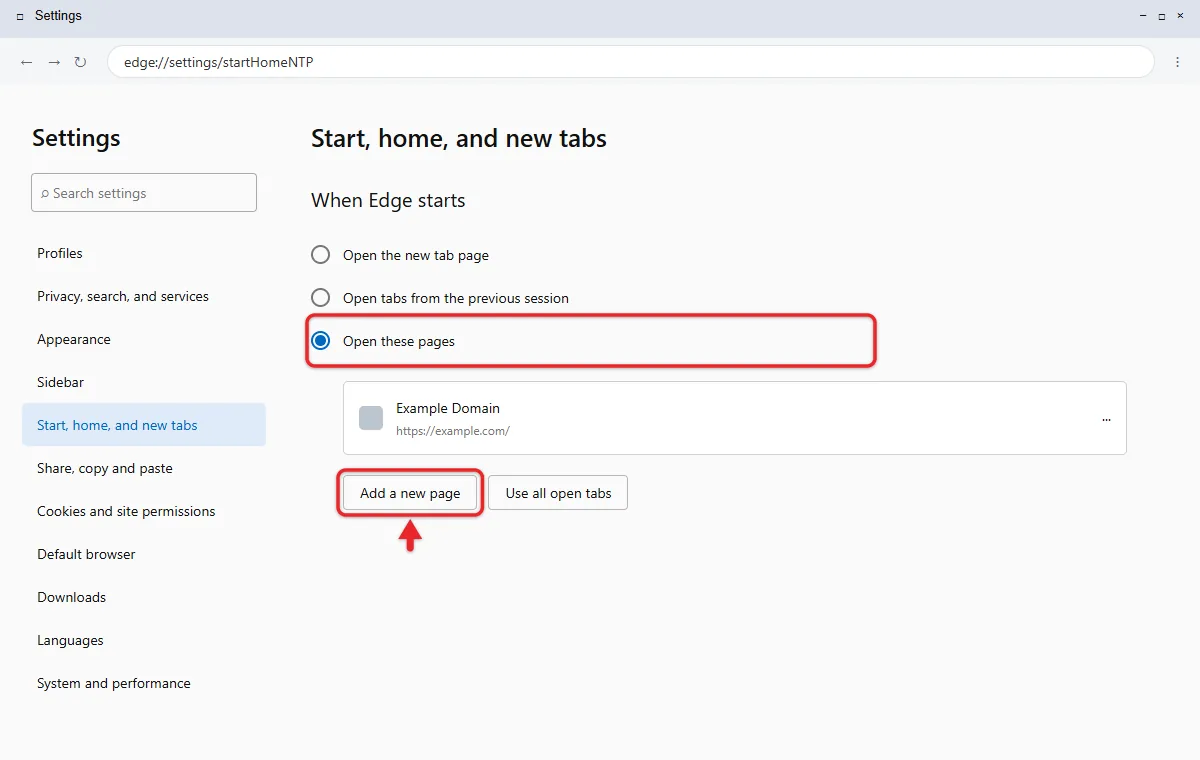
Close every Edge window, then open Edge again. Each page you added should load in its own tab. There’s no save button, since Edge saves the change as soon as you make it.
Add the tabs you already have open
If the pages you want are already open, you don’t have to type each address.
- Open the sites you want in one Edge window, and close any tabs you don’t want at startup.
- Go to Settings › Start, home, and new tabs.
- Under Open these pages, select Use all open tabs.
Every tab open in that window is added to your startup list. Remove any extras as described next.
Edit or remove a startup page
- Go to Settings › Start, home, and new tabs.
- Select the three-dot button (…) next to the page under Open these pages.
- Select Edit to change its address, or Delete to take it off the list.
To stop using startup pages altogether, switch When Edge starts back to Open the new tab page.
How to Open Edge With Your Previous Pages
Edge can reopen every tab you had open when you last closed it, which is handy if you restart your computer in the middle of a task.
On a phone, the quickest way back to a closed page is to view your history in the Edge iPhone app.
- Go to Settings › Start, home, and new tabs.
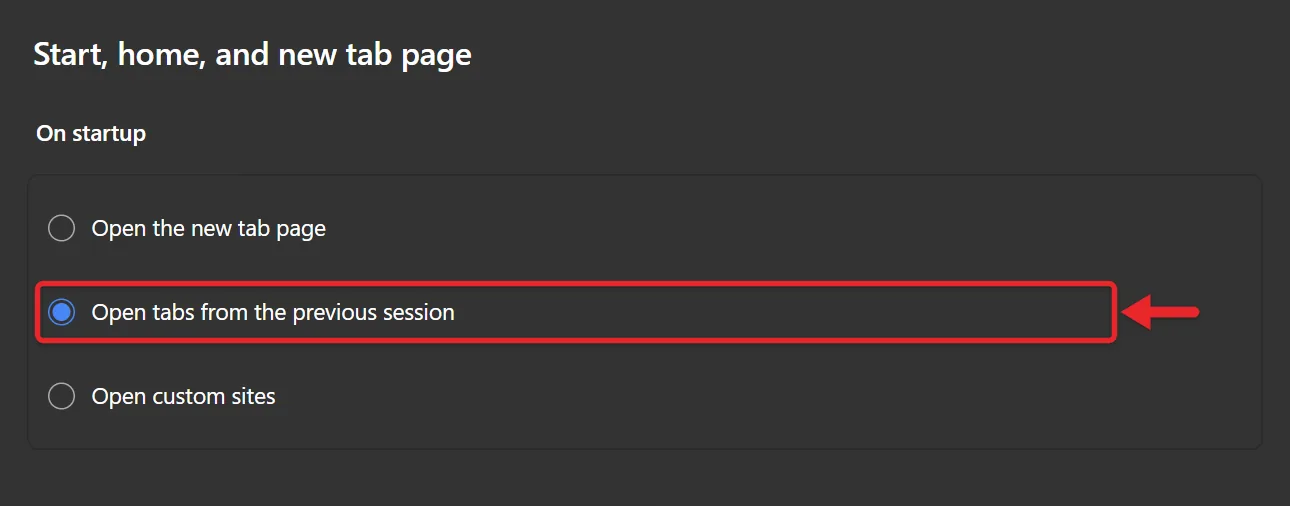
- Under When Edge starts, select Open tabs from the previous session.
- Close Edge with your tabs open, then reopen it. The same tabs load again.
InPrivate windows aren’t saved, so they never come back with your previous session. Microsoft’s policy documentation also notes that restoring the last session turns off features that depend on clearing data when the browser closes, such as Clear browsing data on exit. If you have that turned on to clear your history or cookies, Edge can’t reopen your old tabs as well.
Get back tabs you closed by accident
The startup setting only affects what opens at launch. To recover a tab or window you closed a moment ago:
- Press Ctrl + Shift + T (Command + Shift + T on a Mac). Each press reopens the next most recently closed tab.
- Select Settings and more (…) › History, and look under Recently closed.
- Press Ctrl + H to search your full history for an older page.
How to Set the Home Button Page
The Home button is a separate setting from the startup page. Microsoft’s home page article lists these steps:
- Go to Settings › Start, home, and new tabs.
- Turn on Show home button on the toolbar.
- Choose New tab page, or select Enter URL, type the page you want, and save it.
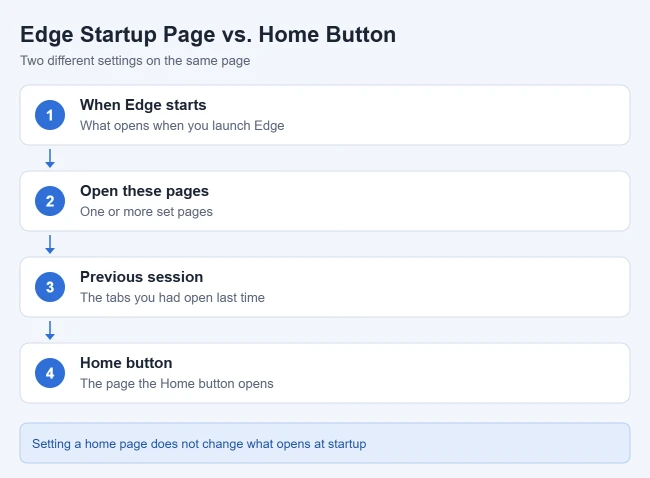
A house icon appears on the toolbar and opens the page you chose. It doesn’t change what opens when Edge starts, so set both if you want the same site at launch and one click away.
For a worked example in Edge, Chrome, and Firefox, see how to make Yahoo your homepage on Windows 11.
Startup Page, Home Page, and New Tab Page
Edge treats these as three separate pages, and changing one doesn’t change the others:
- Startup pages open when you launch Edge.
- The Home button page opens when you select the house icon.
- The new tab page appears each time you press Ctrl + T or select + next to your tabs.
Edge has no setting that turns the new tab page into a website of your choice. You can change its layout and content with the gear icon on any new tab, or use an extension from the Edge Add-ons store that replaces it. To clean up that page instead, see how to remove frequently visited sites from the new tab page.
If Edge Doesn’t Open the Right Page
- You changed a different profile. Edge saves startup settings separately for each profile. Check the profile picture in the top-left corner and repeat the steps in every profile you use.
- Edge never fully closed. The startup setting only applies when Edge starts from scratch. Startup boost and background apps can keep Edge running after you close the window. Open edge://settings/system/manageSystem and turn off Startup boost to test, and see how to restart Microsoft Edge for other ways Edge keeps running. Restarting the computer also works.
- The setting is greyed out or keeps changing back. On a work or school computer, an administrator can control startup pages with the RestoreOnStartup policy. Microsoft says this policy only applies to managed devices, not personal Microsoft account profiles. Type edge://policy in the address bar to see whether a startup policy is set, and ask your IT department to change it.
- An extension took over. Some extensions change the startup page or new tab page. Open edge://extensions, turn off anything you don’t recognize, then restart Edge.
- The page opens but loads incorrectly. Make sure the address includes https:// and works when you type it in the address bar. Sites that need you to sign in may show a sign-in page first.
Frequently Asked Questions
Can Edge open my previous tabs and a specific page?
Not from the Settings page, which lets you pick only one option. A workaround is to choose Open tabs from the previous session and keep the extra page open as a pinned tab, so it’s part of every session. On managed PCs, Microsoft offers a policy that combines both, which your IT department can set.
Does this work the same on a Mac?
Yes. The Start, home, and new tabs page has the same options on a Mac. Open it from Settings and more (…) › Settings, and use Command + Shift + T instead of Ctrl + Shift + T to reopen a closed tab.
How do I make Edge open by itself when I turn on my computer?
That’s a Windows setting, not an Edge setting. Open Settings › Apps › Startup in Windows 11 and turn on Microsoft Edge if it’s listed. Edge then opens your startup pages each time you sign in.
How do I stop Edge from opening old tabs?
Go to Settings › Start, home, and new tabs and change When Edge starts to Open the new tab page or Open these pages.
What’s the difference between the startup page and the new tab page?
The startup page opens when you launch Edge. The new tab page is what you see each time you open a new tab. To point both the startup page and the Home button at Google, see how to make Google your homepage in Microsoft Edge.
More Edge Guides
- How to add a web page to Start or the taskbar in Edge
- How to show or hide the favorites bar
- How to update Microsoft Edge to the latest version

Matthew Burleigh is the founder, head writer, and editor of Solve Your Tech, which he launched in 2012. He has written technology tutorials since 2008 and worked in IT since 2003, including small-business support, IT management, and consulting. He holds Bachelor’s and Master’s degrees in Computer Science from Arizona State University.
Matthew writes practical guides for Windows, iPhone and iPad, Microsoft Office, Outlook, Google apps, and Android. Solve Your Tech’s guides are checked step by step against the device or app maker’s own documentation and tested on his own devices whenever he has the hardware or software, with clear steps, sources, and update dates.
Read more about Matthew and how Solve Your Tech writes and updates its guides, or report a correction.