This post contains affiliate links. As an Amazon Associate, solveyourtech.com earns from qualifying purchases, at no extra cost to you.
To use an Apple wireless keyboard with an iPhone, turn the keyboard on, open Settings > Bluetooth on the iPhone, turn on Bluetooth, and select the keyboard when it appears under Other Devices. If the keyboard is already paired with a Mac or iPad, unpair it there first.
Apple’s current wireless keyboard is the Magic Keyboard (including Magic Keyboard with Numeric Keypad), and Apple’s iPhone User Guide explains how to pair Magic Keyboard with iPhone. Older Apple Wireless Keyboards also connect over Bluetooth, so the same Settings > Bluetooth process is where to start. Typing on a real keyboard is handy for long emails, notes, and documents.
How to Pair an Apple Keyboard With Your iPhone
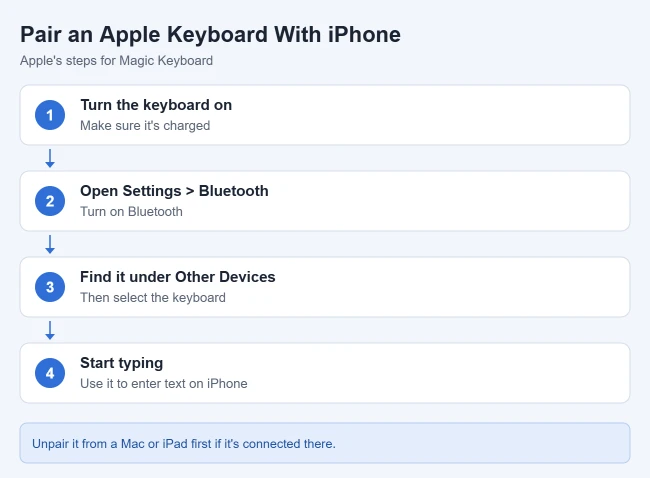
- Make sure the keyboard is turned on and charged.
- On your iPhone, open Settings, tap Bluetooth, then turn on Bluetooth.
- Select the keyboard when it appears in the Other Devices list.
- Open any app where you type, such as Notes, and start typing.
Result: The keyboard is paired, and what you type on it appears on the iPhone.
If the Keyboard Is Paired With a Mac or iPad
Apple notes that a Magic Keyboard that’s already paired with another device has to be unpaired before it can connect to your iPhone. Do this on the device it’s paired with:
- iPhone or iPad: Unpair the Bluetooth accessory in Settings > Bluetooth. Our guide on how to forget a Bluetooth device on iPhone walks through it.
- macOS 13 or later: Choose Apple menu > System Settings, click Bluetooth in the sidebar, Control-click the keyboard, then choose Forget.
- macOS 12.5 or earlier: Choose Apple menu > System Preferences, click Bluetooth, Control-click the keyboard name, then click Remove.
After that, go back to your iPhone and pair it using the steps above.
How to Reconnect the Keyboard
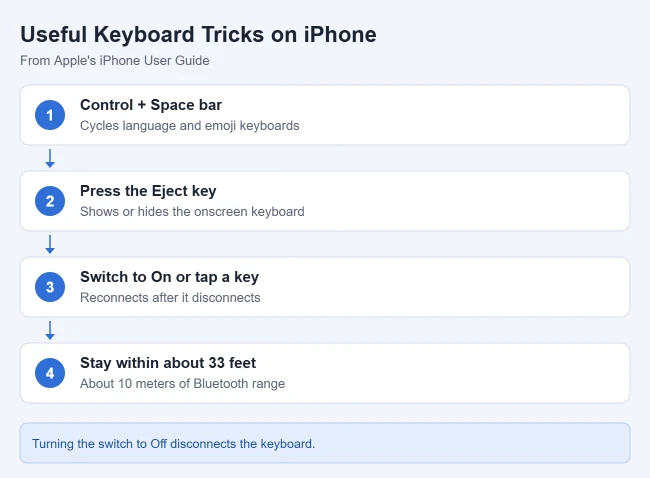
Apple says Magic Keyboard disconnects when you turn its switch to Off or when you move it or the iPhone out of Bluetooth range, which is about 33 feet (10 meters). To reconnect, turn the keyboard switch to On, or bring the keyboard and iPhone back into range, then tap any key.
Keyboard Shortcuts to Know on iPhone
Apple’s guide to switching between keyboards with Magic Keyboard covers two handy shortcuts:
- Switch keyboards: Press and hold the Control key, then press the Space bar to cycle between your region’s language keyboard, the emoji keyboard, and any other language keyboards you added.
- Show or hide the onscreen keyboard: Press the Eject key on Magic Keyboard. Press it again to hide the onscreen keyboard.
If you type in more than one language, you can add a Spanish keyboard (or any language) on iPhone and switch to it with Control-Space.
Which Keyboards Work With iPhone?
Apple’s pairing steps are written for Magic Keyboard, but iPhone connects to many Bluetooth keyboards the same way through Settings > Bluetooth. If you’re shopping for one that matches your Mac, the Apple Magic Keyboard is Apple’s current model.
Frequently Asked Questions
Can I use the same keyboard with my Mac and iPhone?
Yes, but not at the same moment without re-pairing. Apple says you must unpair the keyboard from another device before connecting it to your iPhone.
Why doesn’t my keyboard show up in Bluetooth settings?
Check that it’s turned on and charged, that Bluetooth is on, and that it isn’t still paired with another device. Then look again under Other Devices.
How do I disconnect the keyboard?
Turn the keyboard switch to Off. Apple says it disconnects and reconnects when you turn it back on and tap a key.
Related Guides
- How to change iPhone keyboard settings
- How to connect Bluetooth headphones to an iPhone
- How to change your iPhone name (and Bluetooth name)

Matthew Burleigh is the founder, head writer, and editor of Solve Your Tech, which he launched in 2012. He has written technology tutorials since 2008 and worked in IT since 2003, including small-business support, IT management, and consulting. He holds Bachelor’s and Master’s degrees in Computer Science from Arizona State University.
Matthew writes practical guides for Windows, iPhone and iPad, Microsoft Office, Outlook, Google apps, and Android. Solve Your Tech’s guides are tested on current devices or checked against official product documentation, with clear steps, sources, and update dates.
Read more about Matthew and how Solve Your Tech writes and updates its guides, or report a correction.