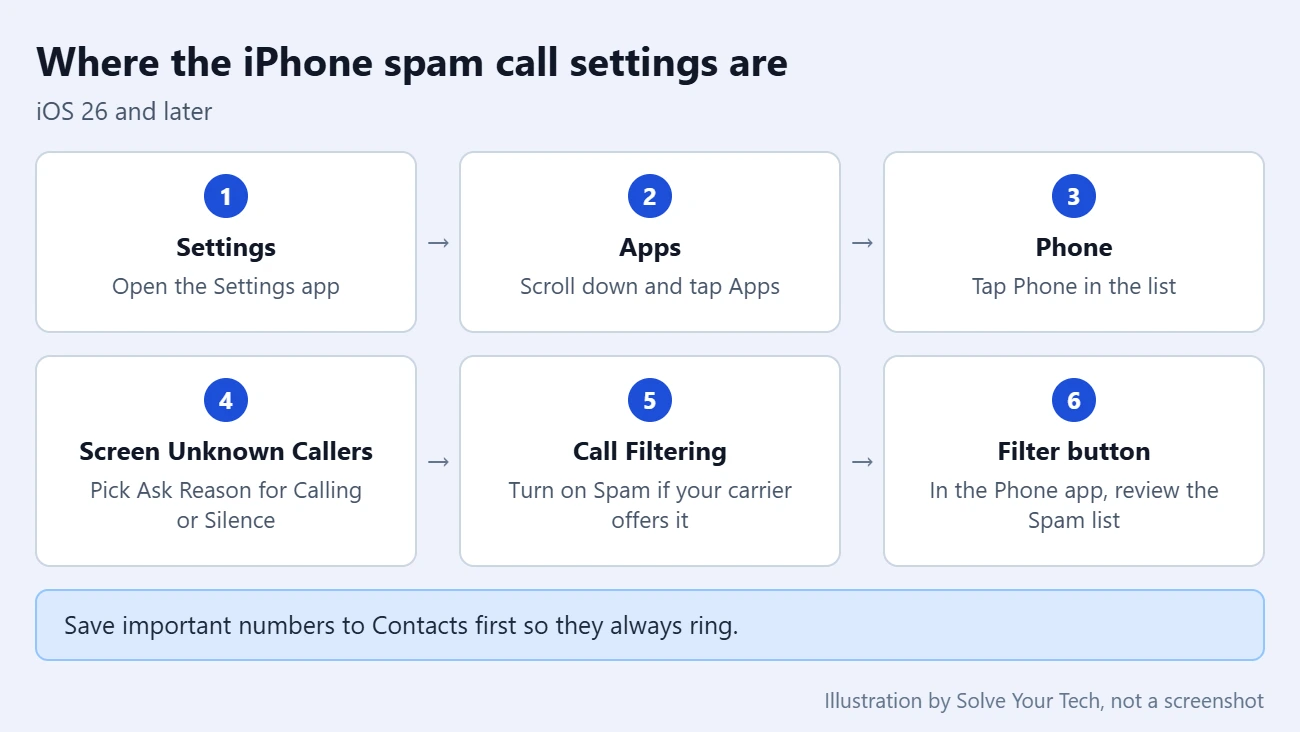
To cut down spam calls on an iPhone, open Settings > Apps > Phone, find Screen Unknown Callers, and choose Ask Reason for Calling or Silence. Then scroll to Call Filtering on the same screen and turn on the spam filter. The first setting deals with every number that is not saved in your contacts. The second one silences calls that your carrier has flagged as likely spam or fraud.
No iPhone setting stops every spam call, because spammers change numbers constantly. What these settings do is stop most unwanted calls from ringing, while keeping a record so you can check for anything you missed. This guide covers the built-in options in iOS 26 and later, the older switches in iOS 18 and iOS 17, how to block single numbers, and how to undo each change.
What You Need Before You Start
The steps below follow Apple’s guide to managing unknown callers on iPhone. The three-option Screen Unknown Callers menu appears in Apple’s iPhone User Guide for iOS 26 and iOS 27. Earlier versions have a simpler on/off switch, which is covered in its own section below. To see your version, open Settings > General > About and look at iOS Version.
Do these two things first:
- Save the numbers you care about. Apple recommends adding important numbers to Contacts, such as family, friends, your child’s school, and your doctor’s office. These settings act on unsaved numbers, so a saved number always rings.
- Make sure voicemail works. Silenced and spam-filtered calls are sent to voicemail. If your voicemail is not set up, a real caller has nowhere to leave a message.
A quick definition helps here. An unknown caller, in Apple’s wording, is a phone number that is not saved in your contacts. A spam call is a call that your carrier has identified as potential spam or fraud. The iPhone has separate settings for each.
Screen or Silence Unknown Callers (iOS 26 and Later)
This is the setting that makes the biggest difference, because most spam comes from numbers you have never saved.
Before you change it: both options affect every unsaved number, not just spammers. A delivery driver, a new client, or a clinic calling from a different line is treated the same way as a robocaller.
- Open the Settings app.
- Scroll down and tap Apps.
- Tap Phone.
- Scroll to Screen Unknown Callers.
- Select Ask Reason for Calling or Silence.
The setting takes effect as soon as you select it. There is no Save button.
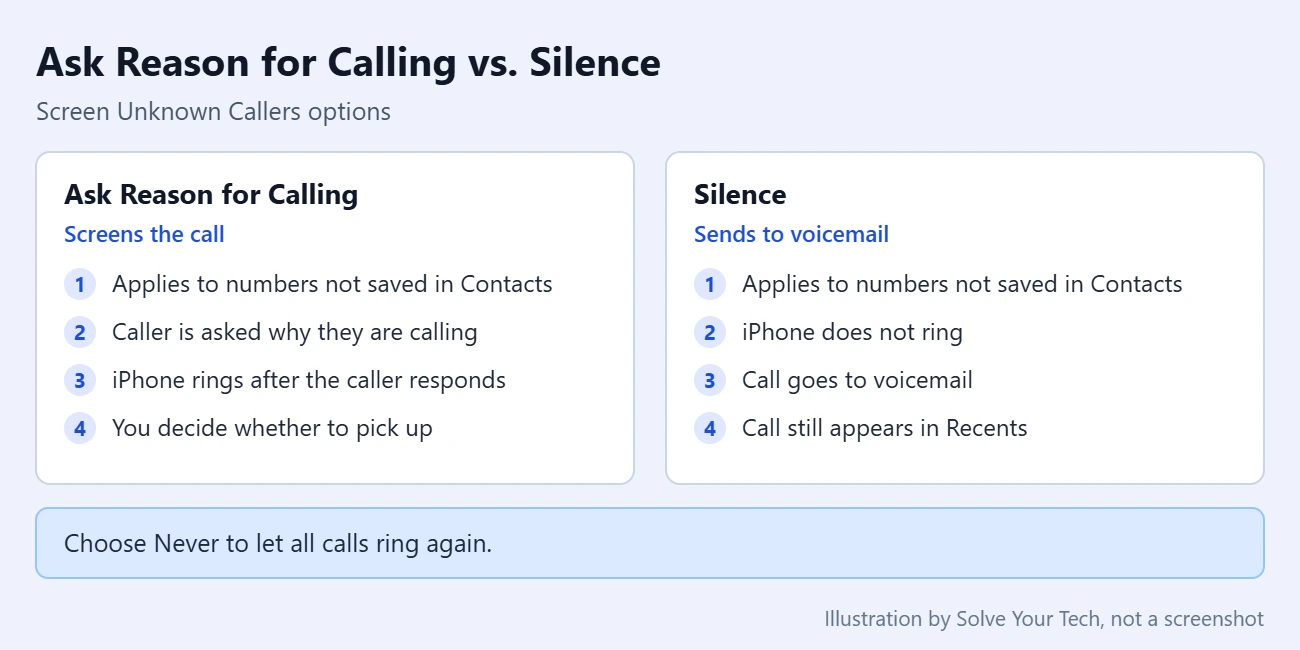
What each option does
| Option | What happens to a call from an unsaved number | Good fit when |
|---|---|---|
| Never | It rings like any other call. Call screening is off. | You cannot afford to miss calls from new numbers. |
| Ask Reason for Calling | The iPhone answers without interrupting you and asks the caller for their name and reason. Then it rings and shows you the response so you can decide whether to pick up. | You get some wanted calls from numbers you have not saved. |
| Silence | The call is silenced, sent to voicemail, and listed in Recents. | You only want calls from people in your contacts to ring. |
Apple lists a few limits for call screening that are worth knowing before you rely on it:
- If you are roaming, calls are not screened, whatever your settings are.
- If you call emergency services, call screening turns off for 24 hours so a callback can reach you.
- Standard calling and data rates may apply with call screening.
- When the iPhone answers a screened call, Siri speaks in your iPhone’s default language.
Turn On the Spam Filter in Call Filtering
The spam filter is separate from call screening. It only acts on calls your carrier has identified as potential spam or fraud, so it does not hold back ordinary calls from unsaved numbers.
- Open Settings.
- Tap Apps, then tap Phone.
- Scroll down to Call Filtering.
- Turn on Spam.
According to Apple’s iPhone User Guide, calls identified by your carrier as potential spam or fraud are then silenced, sent to voicemail, and moved to the Spam list. They are not deleted.
The same section has a second switch, Unknown Callers. It does not stop any call from ringing. Apple says it moves missed calls and voicemails from unknown numbers to an Unknown Callers list, which keeps your main call list for people you know. Turn it on if your call history is cluttered with numbers you do not recognize.
Because the Spam filter depends on your carrier’s spam detection, it may not appear on every iPhone. In iOS 18, Apple labeled the equivalent switch as available with certain carriers. If you see no Spam switch under Call Filtering, use call screening, block repeat numbers, and ask your carrier what it offers.
Check the Spam and Unknown Callers Lists
Filtering is only safe if you look at what was filtered. A wanted call can land in either list, so check them now and then, especially when you are expecting a call from a new number.
- Open the Phone app.
- Tap Calls if you use the Unified layout, or Recents if you use the Classic layout.
- Tap the Filter button.
- Tap Unknown Callers or Spam.
If a caller in the Unknown Callers list turns out to be someone you want to hear from, tap Mark as Known next to the call, then tap Mark as Known again to confirm. Apple says future calls from that number are no longer sent to the Unknown Callers list. Saving the number as a contact has the same effect and also gives the caller a name.
These lists are also how you confirm the settings are working. After a day or two, silenced and filtered calls should show up there instead of ringing.
Block a Number That Keeps Calling
Blocking is the right tool for one persistent number. It is less useful against spam in general, because the next call often comes from a different number.
- Open the Phone app and go to your recent calls.
- Tap the phone number or contact you want to block. In the Classic layout, tap the Info button next to it.
- Scroll down and tap Block Caller.
In iOS 26 and later you can also block a number that has not called you yet. Open Settings > Privacy & Security > Blocked Contacts, tap Add Blocked Contact, enter the contact, and tap Block Contact.
Apple explains in its article on blocking phone numbers and contacts that a blocked caller can still leave a voicemail, but you do not get a notification, and the caller is not told that the call was blocked. Messages from that number are not delivered. To review the list later, see how to see blocked numbers on iPhone. Blocking also applies to texts, which is covered in how to block text messages and calls on iPhone.
Use Caller Identification and Call-Blocking Apps
The iPhone can label incoming calls so you know more before you answer. These options are in a different part of the Phone settings.
- Open Settings.
- Tap Apps, tap Phone, then tap Call Blocking & Identification.
- Turn on Business Call Identification to show caller details from Apple Business Connect or your carrier.
- Under Call Identification apps, turn on any caller ID app you have installed.
A call-blocking or caller ID app from the App Store does nothing until its switch is turned on here. If you install one and it does not seem to work, this screen is the first place to look. These apps are made by other companies, so read the app’s privacy details before you give it access to anything.
Many phone carriers also have their own spam-blocking tools or apps. Apple does not document those, and the features and prices differ from carrier to carrier, so check your carrier’s website or support line for what is included with your plan.
Silence Unknown FaceTime Callers
FaceTime has its own setting, so changing the Phone settings does not cover FaceTime calls.
- Open Settings and tap Apps.
- Tap FaceTime.
- Turn on Silence Unknown Callers.
Apple says FaceTime calls from unknown numbers are then silenced and sent to voicemail. The FaceTime settings also have a Call Filtering section with the same kind of switches as the Phone app.
Older iPhones: iOS 18 and iOS 17
If your Phone settings show a single Silence Unknown Callers switch instead of three choices, your iPhone is on an earlier version of iOS. The settings do a similar job but have different names.
| Version | Silence unknown numbers | Silence carrier-flagged spam |
|---|---|---|
| iOS 26 and later | Settings > Apps > Phone > Screen Unknown Callers > Silence | Settings > Apps > Phone > Call Filtering > Spam |
| iOS 18 | Settings > Apps > Phone > Silence Unknown Callers | Settings > Apps > Phone > Call Blocking & Identification > Silence Junk Callers |
| iOS 17 | Settings > Phone > Silence Unknown Callers | Settings > Phone > Call Blocking & Identification > Silence Junk Callers |
Two details differ on these versions. First, Apple’s iOS 18 and iOS 17 guides say that with Silence Unknown Callers on, you still get notifications for calls from people in your contacts, recent outgoing calls, and Siri Suggestions. That means a number you called recently can ring back even if it is not saved. Second, Apple marks Silence Junk Callers as available with certain carriers, so it may be missing from your list.
For a closer look at that switch, see our guide on how to silence unknown callers on iPhone.
Use a Focus for Quiet Hours
Call screening runs all day. If you only want quiet at certain times, such as overnight, a Focus is a better fit. A Focus is an iPhone mode, such as Do Not Disturb or Sleep, that silences notifications except from the people and apps you allow.
- Open Settings and tap Focus.
- Choose a Focus, for example Do Not Disturb.
- Tap People.
- Tap Allow Notifications From and add the contacts who should still reach you.
Apple notes that you can also allow calls from certain groups of people and allow repeated calls, meaning two or more calls from the same person within three minutes. Our guide on how to turn on Do Not Disturb on iPhone walks through turning the mode on and off.
How to Undo These Settings
Every change in this guide is reversible, and none of them deletes calls or voicemails.
- Stop screening or silencing: go to Settings > Apps > Phone > Screen Unknown Callers and select Never.
- Stop filtering: in the same screen, turn off Spam and Unknown Callers under Call Filtering.
- Unblock a number: go to Settings > Apps > Phone > Blocked Contacts, tap Edit, tap the delete button next to the number, then tap Unblock. The same list is under Settings > Privacy & Security > Blocked Contacts in iOS 26 and later. More detail is in how to unblock a contact on iPhone.
- Turn off a call-blocking app: go to Settings > Apps > Phone > Call Blocking & Identification and turn off its switch.
- FaceTime: go to Settings > Apps > FaceTime and turn off Silence Unknown Callers.
Troubleshooting
I can’t find Phone in Settings
In iOS 18 and later, Phone settings are inside Settings > Apps. Scroll to the bottom of the main Settings screen, tap Apps, and then find Phone in the list. In iOS 17 and earlier, Phone is on the main Settings screen. You can also type “Phone” in the search field at the top of Settings.
I only see Silence Unknown Callers, not three options
The three choices under Screen Unknown Callers are documented for iOS 26 and later. On iOS 18 or iOS 17, use the Silence Unknown Callers switch described above. To check for an update, go to Settings > General > Software Update. If you are on a current version and Ask Reason for Calling is still missing, the feature may not be offered for your language or region.
There is no Spam switch under Call Filtering
The Spam filter relies on your carrier identifying spam calls. If the switch is not there, your carrier may not support it on your line. Use Ask Reason for Calling or Silence instead, and ask your carrier whether it has its own spam-blocking service.
Spam calls still ring after I turned everything on
Check these causes, which all come from Apple’s documented limits:
- The number is saved. Screening only applies to unsaved numbers. A spam number you once saved rings normally. Delete or block it.
- You are roaming. Calls are not screened while roaming.
- You recently called emergency services. Call screening is off for 24 hours afterward.
- The setting is Never. Open Screen Unknown Callers and confirm that Ask Reason for Calling or Silence is selected.
- It is a FaceTime call. FaceTime uses its own Silence Unknown Callers switch.
Wanted calls are going straight to voicemail
This is the usual side effect of Silence. Save the caller’s number to Contacts, or switch to Ask Reason for Calling so real callers can get through after stating why they are calling. Also check the Spam list and your Blocked Contacts for the number. If the problem affects callers who are saved in your contacts, something else is the cause, and our guide on why an iPhone goes straight to voicemail covers the other settings to check.
Stay Safe on the Calls That Do Get Through
No filter is perfect, so a few habits still matter. Apple warns that scammers use fake caller ID information to make a call look like it comes from a company you trust, which is called spoofing. A familiar name or a local-looking number on the screen is not proof of who is calling.
Apple’s advice for an unsolicited or suspicious call from someone claiming to be from Apple or Apple Support is simple: hang up. The same approach works for any unexpected call that asks for passwords, verification codes, or payment. End the call, then contact the company yourself using a number from its official website or your account statement. Apple’s page on recognizing and avoiding scams has more examples.
In the United States, you can also add your number to the National Do Not Call Registry, which is run by the Federal Trade Commission. It is meant to reduce sales calls from legitimate companies. It will not stop scammers who ignore the rules, so treat it as an extra step and not a replacement for the settings above.
Frequently Asked Questions
Will I miss calls from people not in my contacts?
With Silence, calls from unsaved numbers do not ring. They go to voicemail and still appear in your recent calls, so you can call back. With Ask Reason for Calling, the caller is asked for a name and reason first, and then the iPhone rings and shows you the response. Saving a number to Contacts makes it ring normally under either option.
What is the difference between the Spam filter and Screen Unknown Callers?
Screen Unknown Callers acts on any number that is not saved in your contacts, whether or not it is spam. The Spam filter under Call Filtering acts only on calls your carrier has identified as potential spam or fraud. You can use both at the same time.
Do blocked callers know they’re blocked?
No. Apple says the contact does not get a notification that the call or message was blocked. A blocked caller can still leave a voicemail, but you will not be notified about it.
Does this stop spam texts?
No. Call settings do not affect messages. For texts, open the Messages app, tap the Filter button in the conversation list, tap Manage Filtering, and turn on Screen Unknown Senders. Messages from unknown senders then go to a separate folder, which is explained in where the Unknown Senders folder is in iPhone Messages.
Are silenced or filtered calls deleted?
No. Silenced calls are sent to voicemail and listed in your recent calls. Calls caught by the Spam filter are moved to the Spam list, and missed calls from unknown numbers go to the Unknown Callers list if that switch is on. You can open both from the Filter button in the Phone app.
Does call screening work when I travel?
Not always. Apple states that if you are roaming, phone calls are not screened, regardless of your settings. Expect unsaved numbers to ring normally until you are back on your home network.
Can I turn off spam calls completely?
No setting can do that. Spam callers switch numbers and can fake caller ID, so some calls will get past any filter. Combining call screening, the Spam filter, and blocking repeat numbers stops most of them from ringing.
Next Steps
Start with Ask Reason for Calling and the Spam filter, then check the Spam and Unknown Callers lists after a few days to make sure nothing important was caught. Apple’s iPhone User Guide page on screening and blocking calls lists every option for the current iOS version.
Not sure what a call status means? Read what Canceled Call means on iPhone.
Using an Android phone too? See how to block private numbers on a Google Pixel.

Matthew Burleigh has been writing tech tutorials since 2008. His writing has appeared on dozens of different websites and been read hundreds of millions of times.
After receiving his Bachelor’s and Master’s degrees in Computer Science he spent several years working in IT management for small businesses. However, he now works full time writing content online and creating websites.
His main writing topics include iPhones, Microsoft Office, Google Apps, Android, and Photoshop, but he has also written about many other tech topics as well.