To print labels from Word, select Mailings > Labels, type the text, select Options to choose your label vendor and product number, and select Print. The product number is printed on the label package, such as Avery 5160. For a sheet of different addresses, use New Document or Mail Merge instead. If the address can go straight on the envelope, you can print envelopes in Word from the same Mailings tab.
These steps cover Word for Microsoft 365, Word 2024 and Word 2021 on Windows and Mac, plus Word for the web. They show how to print a full page of the same label, a single label, a page of different labels, and labels from a mailing list.
Which Method Do You Need?
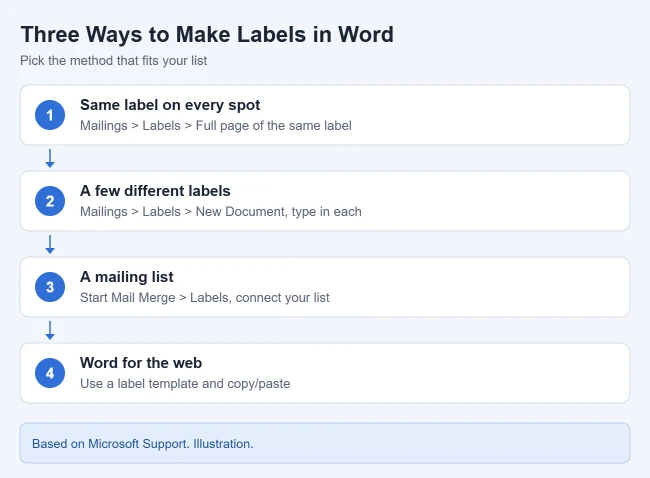
| What you’re printing | Method | Where it starts |
|---|---|---|
| The same label in every spot, like return address labels | Full page of the same label | Mailings > Labels |
| One label on a partly used sheet | Single label | Mailings > Labels |
| A handful of different labels, like name tags | New Document | Mailings > Labels > New Document |
| Many addresses from a list | Mail Merge | Mailings > Start Mail Merge > Labels |
| Labels in a browser | Label template | Word for the web, new document from a template |
Find the Label Product Number
- Find the product number. It’s on the label box or the sheet’s wrapper, for example Avery 5160 or 8160. Word uses it to set the label size, the number of labels per sheet and the page margins.
- Check the paper size. Most US label sheets are Letter size (8.5 by 11 inches). A4 sheets use different product numbers, so pick the vendor entry that matches your paper.
- Have plain paper ready. You’ll print a test page before you use the label stock.
Choose Avery 5160 in Word
Avery’s 5160 template is for 30 address labels per sheet, each 1 inch by 2-5/8 inches. Check the product number on your package before choosing a layout. Many business card sheets have their own product numbers in that list too, so the Labels tool can lay out business cards in Word as well.
- In desktop Word, open Mailings > Labels > Options. The label settings appear.
- Choose Avery US Letter for the vendor, then select product 5160. Confirm with OK.
- For a repeated address, follow the same-label steps below. For individual addresses, choose New Document to fill the label table, or use the mailing-list method.
- Print on plain paper first and compare the result with your label sheet before using the adhesive stock.
If 5160 is missing, Avery’s page also offers a blank Microsoft Word template. Download that layout and open it in Word. Microsoft confirms that the Avery Wizard is retired; you do not need that old add-in for these methods. In Word for the web, use a template as described below. Pre-scored card sheets work through the same Label Options dialog, which is one way of making tent place cards in Word.
How to Print a Sheet of the Same Label
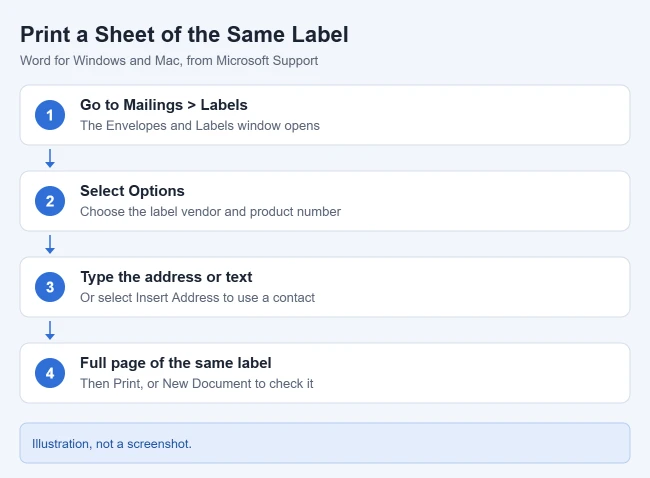
- Select the Mailings tab, then Labels. The Envelopes and Labels window opens on the Labels tab.
- Select Options. Choose the Label vendors (like Avery US Letter) and the Product number from your label package, then select OK. The Label area now shows your product.
- Type the address or other text in the Address box. To use an address from your contacts, select the Insert Address icon. To reuse a return address you saved for envelopes, check Use return address. For a single return address you type often, an AutoText entry or AutoCorrect code from Word’s autofill options saves retyping it.
- To change the formatting, select the text, right-click, and use Font or Paragraph.
- Choose Full page of the same label so every label on the sheet matches.
- Load the label sheet and select Print. To check, edit, or save the sheet first, select New Document instead. Word opens the full sheet as a document you can review.
On a Mac, Microsoft’s steps are similar: in Options, choose the printer type, Label products and Product number, and type into the Delivery Address box.
Print Just One Label
Microsoft’s partly used sheet guide lets you print on the next empty spot instead of wasting a sheet:
- Go to Mailings > Labels, type the label text, and confirm your product in Options.
- Under Print, choose Single label.
- Set the Row and Column of the first unused label. Rows count down from the top, and columns count from the left.
- Load the partly used sheet and select Print.
If Your Label Number Isn’t Listed
In Label Options, select New Label and enter the measurements from the package (top and side margins, label height and width, and the number across and down), then give it a name. The custom label is added to the Product number list so you can pick it next time. The same label layouts can also hold spine strips, as shown in how to create binder inserts in Microsoft Word.
How to Print a Page of Different Labels
For a few different labels, such as name tags, Microsoft’s name tag and address label guide uses a blank label sheet: For a long guest list, it’s faster to make name tags from an Excel list with mail merge.
- Go to Mailings > Labels and select Options. Choose your label type and size, then select OK.
- Select New Document. Word opens a document with a table that matches your labels.
- If you can’t see the label edges, select View Gridlines on the Table Layout tab (in some versions, Layout > Align > View Gridlines). Gridlines show on screen but don’t print.
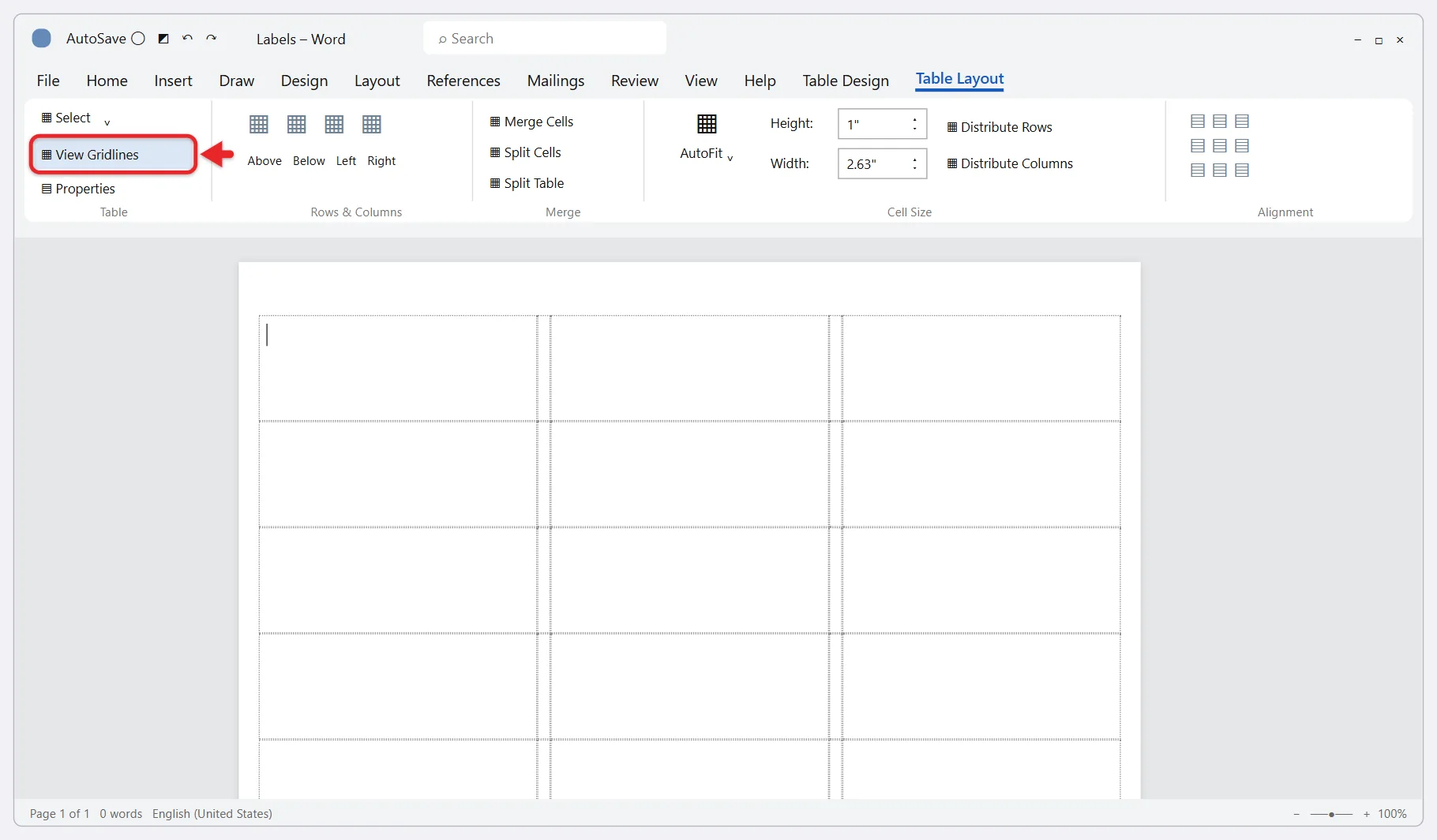
- Click in each label and type the information you want there.
- Go to File > Print and select Print.
Save the document if you’ll print the same set again. Don’t merge, add or resize table cells, because each cell lines up with a label on the sheet. Some layouts, including 5160, have narrow blank columns between labels; leave those empty.
Print Labels With Different Addresses (Mail Merge)
If your address list is in Excel, review how to prepare Excel data and insert fields for a Word mail merge before choosing recipients. Make sure the data is accurate and consistently formatted, with one header row (such as First Name, Address, City, State and ZIP). Then use these label-specific steps:
- Select Mailings > Start Mail Merge > Labels and pick your label product. Word sets up a sheet of blank labels.
- Select Select Recipients. Choose Use an Existing List for an Excel sheet or saved list, or Choose from Outlook Contacts.
- No list yet? Choose Select Recipients > Type a New List. Type the first person’s name and address, select New Entry for each additional person, and use Customize Columns if you need other fields. Select OK and save the list so you can reuse it later. On a Mac this option is called Create a New List.
- Select Address Block to add the address fields to the first label, or use Insert Merge Field to place each field yourself. Then select Update Labels so every label gets the same fields.
- Select Preview Results and check several of the real addresses.
- Select Finish & Merge > Print Documents. To check every label before printing, choose Edit Individual Documents instead, then use File > Print.

Prefer guided prompts? Microsoft’s mailing list labels guide uses Mailings > Start Mail Merge > Step-by-Step Mail Merge Wizard, then walks you through choosing labels, selecting recipients, arranging labels and printing.
Microsoft’s new mail merge list guide covers typing a new list in more detail. The saved list holds only the names and addresses, so save the label document separately too. Word for the web doesn’t support mail merge labels.
Labels in Word for the Web
Word for the web doesn’t support creating labels directly. Instead, open Word for the web and choose a label template when you create a new document (select More templates if you don’t see one you like). For a sheet of identical labels, fill out one label and copy and paste it into the rest. If you work in a browser instead of Word, see these steps for making labels in Google Docs with a table or an add-on.
If a template sheet doesn’t line up when printed, make sure the document matches your label paper; here’s how to change the paper size in Word Online. Checking a plain-paper test print first also helps with two-sided jobs like a folded brochure or pamphlet in Word.
Print Settings That Keep Labels Lined Up
- Print a test page first. Use plain paper before loading labels, then hold the page against a label sheet to check alignment.
- Print at full size. In File > Print, make sure the pages-per-sheet setting says 1 Page Per Sheet and no scaling is applied. A shrunken page throws every label off; see why a Word document prints small for each setting.
- Pick the label paper type. Avery’s print help suggests opening Printer Properties and choosing Labels as the paper type, plus the tray you’re feeding from. Names vary by printer.
- Load the sheet the right way. Load label sheets in the direction your printer’s manual shows. Mark the top of your test page with an arrow so you can see how the printer feeds paper.
- Save your layout. Use New Document so you can save and reprint the same labels later.
Labels Don’t Line Up or Print Right
- Every label is off by the same amount. The product number or paper size probably doesn’t match the sheet. Recheck Options, or download the vendor’s Word template for that exact number.
- Labels drift lower down the page. Scaling is on, or the sheet is A4 while Word is set to Letter (or the other way around). Turn off scaling and match the paper size.
- Text is cut off. Shorten the text, use a smaller font, or reduce the space after each paragraph with Paragraph settings. A 1-inch-tall address label fits about four or five lines of normal-size text.
- Only the first mail merge label has fields. Select Update Labels, then Preview Results again.
- Insert Address does nothing. On Windows it reads your Outlook contacts, so it may not work if classic Outlook isn’t set up on the PC. Type the address instead.
- Your printer is a roll label printer. Thermal printers such as Zebra models print one label at a time. Set the label size in the printer’s own driver settings, then set Word’s page size to the same size under Layout > Size, and follow the printer maker’s instructions. Check that the right printer is selected, too; here’s how to set a default printer in Windows 11.
Word Label Questions
Can I add a logo to labels?
Yes. Select New Document instead of Print, then insert the picture into each label. For a sheet of identical labels, format the first one and copy it to the others. In a mail merge, add the picture to the first label before you select Update Labels.
Can I use labels made for A4 paper?
Yes. In Options, choose a vendor list for A4 sheets (for example Avery A4/A5) and the matching product number. Make sure your printer is set to A4 paper as well.
How do I save labels to print again later?
Select New Document before printing and save that file. For a mail merge, save both the label document and the address list so you can reconnect them next time.
Can I make labels people can fill in?
For a form instead of labels, read about making a Word document fillable.

Matthew Burleigh is the founder, head writer, and editor of Solve Your Tech, which he launched in 2012. He has written technology tutorials since 2008 and worked in IT since 2003, including small-business support, IT management, and consulting. He holds Bachelor’s and Master’s degrees in Computer Science from Arizona State University.
Matthew writes practical guides for Windows, iPhone and iPad, Microsoft Office, Outlook, Google apps, and Android. Solve Your Tech’s guides are checked step by step against the device or app maker’s own documentation and tested on his own devices whenever he has the hardware or software, with clear steps, sources, and update dates.
Read more about Matthew and how Solve Your Tech writes and updates its guides, or report a correction.