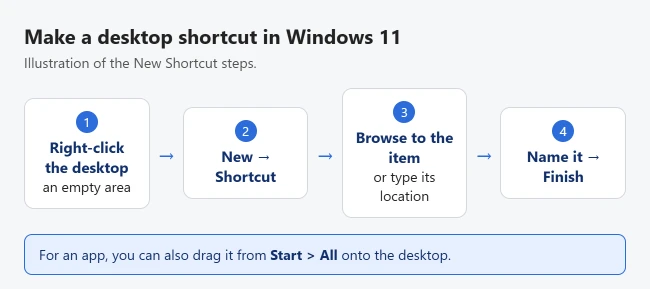
To make a desktop shortcut in Windows 11, right-click an empty part of the desktop, select New > Shortcut, browse to the app, file, or folder, then select Next and Finish. To add an app, you can also drag it from the Start menu straight onto the desktop, or use Send to > Desktop (create shortcut) in File Explorer.
A shortcut is a small link to something stored elsewhere, so deleting it never deletes the app or file. Below are the main methods, plus shortcuts for Settings pages, Microsoft Store apps, and shutting down.
Create a Shortcut From the Desktop
This method works for any app, file, folder, or website address. If you are still using the older version of Windows, the website steps are in how to create an internet shortcut in Windows 10.
- Right-click an empty area of the desktop.
- Select New, then Shortcut.
- Select Browse and pick the item you want, or type its full location, such as C:\Windows\System32\notepad.exe.
- Select Next.
- Type a name for the shortcut. This is the label that appears under the icon.
- Select Finish.
Drag an App From the Start Menu
- Select the Start button.
- Select All to see every installed app. If you already see the full list, skip this step.
- Find the app, then click and drag it onto the desktop.
- Release the mouse button. Windows creates a shortcut and leaves the app in the Start menu.
This is the method Microsoft recommends for apps in its desktop shortcut guide. For a file, that guide uses Show more options > Create shortcut, which puts the shortcut in the same folder. Drag it to the desktop afterward, or use Send to below.
For an installed app such as Spotify, Microsoft Teams, or Microsoft Word, find that app in the full Start list rather than dragging a web search result. Creating its shortcut does not install the app or move its program files. If it is not installed, install it from its official source first. Microsoft Store apps can also use the Applications folder method below.
Use Send To in File Explorer
Use this for a file, folder, or program you already have open in File Explorer.
- Open File Explorer with Windows key + E and find the item.
- Right-click it and select Show more options. You can also select the item and press Shift + F10.
- Select Send to, then Desktop (create shortcut).
Another quick way: hold Alt while you drag a file or folder from File Explorer onto the desktop. Windows makes a shortcut instead of moving the item.
Make a Shortcut for Any App, Including Store Apps
If an app won’t drag out of the Start menu, or you can’t find its program file, use the hidden Applications folder.
- Press Windows key + R.
- Type shell:AppsFolder and press Enter.
- Find the app in the window that opens.
- Right-click it and select Create shortcut.
- Select Yes when Windows asks to put the shortcut on the desktop.
Move an App From the Taskbar to the Desktop
Create the app’s desktop shortcut using Start or shell:AppsFolder above, then double-click it to check that it opens the intended app. If you want to remove the taskbar pin afterward, right-click the pinned app on the taskbar and select Unpin from taskbar, as described in Microsoft’s taskbar guide.
The desktop shortcut and taskbar pin are separate links to the installed app. You can keep both. Unpinning does not uninstall the app; a running app can still appear on the taskbar until its window closes. There is no need to move files out of Program Files or WindowsApps.
Make Shortcuts for Settings, Shut Down, and Websites
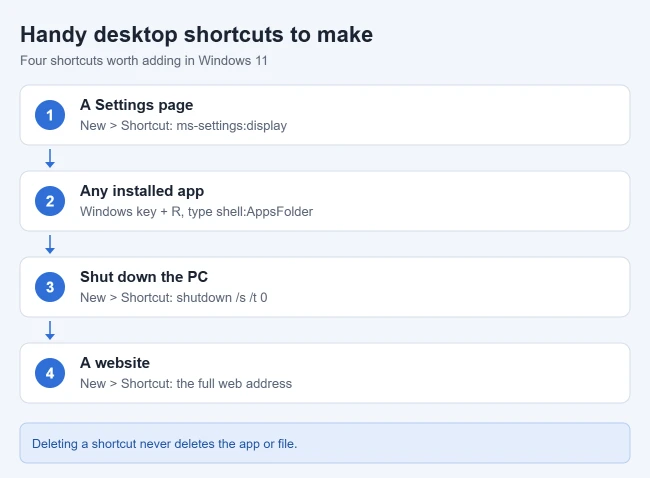
Use the New > Shortcut steps above, and type one of these in the location box:
- A Settings page: ms-settings:display opens Display settings, and ms-settings:windowsupdate opens Windows Update. Microsoft lists every page in its ms-settings reference.
- Shut down: shutdown /s /t 0 turns off the PC right away when you double-click the shortcut, so save your work first. Use shutdown /r /t 0 to restart instead.
- A website: type the full address, such as https://www.bing.com. For more options, see how to make a desktop shortcut for a website.
Tips for Desktop Shortcuts
- A shortcut has a small arrow on its icon. Deleting the shortcut doesn’t delete the app or file it opens.
- To rename a shortcut, select it and press F2.
- If you don’t see your shortcuts, right-click the desktop and make sure View > Show desktop icons is checked.
- For This PC, Recycle Bin, and other system icons, see how to add desktop icons in Windows 11.
Frequently Asked Questions
How do I change a shortcut’s icon?
- Right-click the shortcut and select Properties.
- On the Shortcut tab, select Change Icon.
- Pick an icon, then select OK twice.
Can I open a shortcut with a keyboard shortcut?
Yes. Right-click the shortcut, select Properties, click in the Shortcut key box on the Shortcut tab, and press a letter. Windows sets it to Ctrl + Alt + that letter. This works for shortcuts on the desktop or in the Start menu. The same tab has the Target box, which you can edit to change the program or file a shortcut opens.
Can I put a shortcut on the taskbar instead?
Yes. Right-click the app in the Start menu and select Pin to taskbar. See how to pin to the taskbar in Windows 11.
Why does my shortcut say the item can’t be found?
The app or file was moved, renamed, or deleted. Delete the old shortcut and create a new one that points to the current location.
You can also install some websites as apps with their own icons. See how to get JioHotstar on a Windows 11 laptop for an example.

Matthew Burleigh is the founder, head writer, and editor of Solve Your Tech, which he launched in 2012. He has written technology tutorials since 2008 and worked in IT since 2003, including small-business support, IT management, and consulting. He holds Bachelor’s and Master’s degrees in Computer Science from Arizona State University.
Matthew writes practical guides for Windows, iPhone and iPad, Microsoft Office, Outlook, Google apps, and Android. Solve Your Tech’s guides are tested on current devices or checked against official product documentation, with clear steps, sources, and update dates.
Read more about Matthew and how Solve Your Tech writes and updates its guides, or report a correction.