Your printer setup screen is asking for the iPad’s IP address, and you have no idea where iPadOS keeps it. Open Settings > Wi-Fi, tap the More Info button (ⓘ) beside the network with the checkmark, and read the IP Address line in the IPv4 section. That number is the iPad’s address on your local network. The Router line on the same screen is a different device, and the address websites see is different again, so check which one you were asked for.
Which IP Address Do You Need?
An IP address is a number that identifies a device on a network so data reaches the right place. Your iPad can have more than one address associated with it at the same moment, which is why instructions that just say “enter your IP” cause confusion. Use this table to match the request to the right number.
| If you are asked for | Where to find it | What it identifies |
|---|---|---|
| The iPad’s IP on the Wi-Fi network (printer, game console, media server, IT help desk) | Settings > Wi-Fi > ⓘ > IP Address | Your iPad on your home or office network |
| The router, gateway or default gateway address | The Router line on the same screen | The router that connects your network to the internet |
| Your public or external IP | A web search on the iPad, or the router’s status page | The address your whole network shows to websites |
| The Wi-Fi address or MAC address | The Private Wi-Fi Address line on the same screen | The network hardware identifier, not an IP address |
Most printer, smart home and file-sharing setups want the first one. A website that blocks or allows you by address, or a remote access setup, usually wants the public one.
Find Your iPad’s Local IP Address
The local address is assigned by your router, so the iPad has to be connected to Wi-Fi for this to work. If you are not connected yet, see how to join a Wi-Fi network on iPad first.
- Open the Settings app.
- Tap Wi-Fi in the left column.
- Find the network with a checkmark beside it. Apple’s Wi-Fi connection instructions note that the checkmark marks the network you are connected to.
- Tap the More Info button (the ⓘ icon) on the right side of that network. Tap the icon, not the network name, or you may start joining a different network.
- Scroll to the IPv4 Address section and read the value next to IP Address.
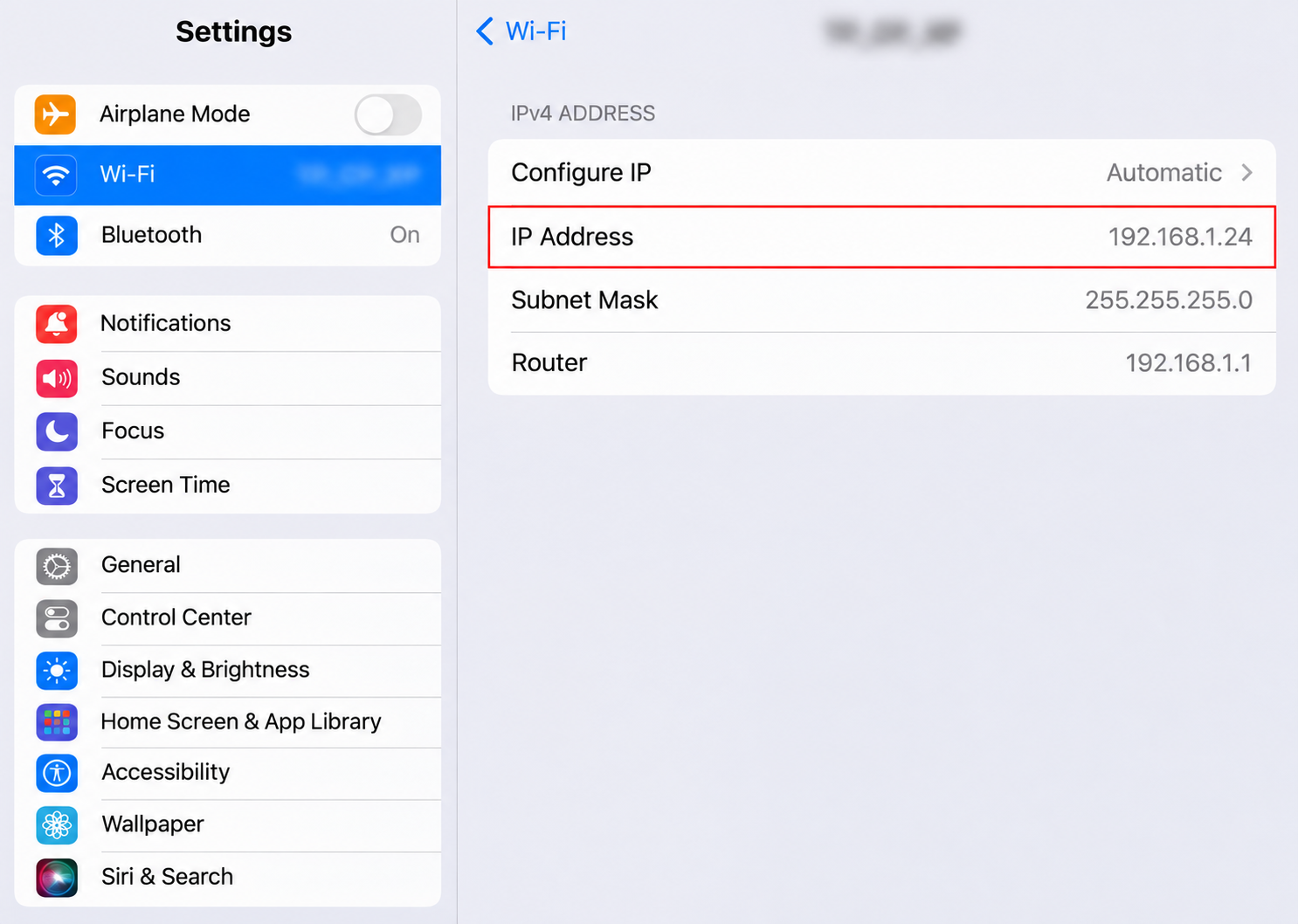
That number is what the printer screen or app is asking for. On a typical home network it looks something like 192.168.1.42 or 10.0.0.15, but your numbers will be different.
Here is a worked example. Priya is adding a networked printer, and its setup screen asks which device will send print jobs. She opens Settings > Wi-Fi, taps ⓘ beside “Home-5G”, and sees IP Address 192.168.1.42 and Router 192.168.1.1. She enters 192.168.1.42 on the printer, not the Router number, and the printer finds the iPad. If you are setting up the printer itself, the steps for adding a printer to an iPad cover AirPrint, and the printer may need its own address, which you can look up with these steps for finding a printer’s IP address.
What the Other Lines on the Wi-Fi Screen Mean
The network details screen shows several numbers that look alike. Here is what each one does.
- Configure IP: how the iPad gets its address. Automatic means the router assigns it.
- IP Address: the iPad’s own local IPv4 address. This is usually the one you need.
- Subnet Mask: defines which addresses count as part of your local network. You rarely need it unless you are setting a manual address.
- Router: the address of your router (the gateway). Type this into Safari to open many routers’ admin pages.
- IPv6 Address: if your network supports IPv6, the iPad can also show one or more longer addresses written with colons. Only give these when someone specifically asks for IPv6.
- DNS: the servers that translate website names into addresses.
A common mistake is reading the Router value because it appears in a similar format. On many home networks the router address ends in .1 and the iPad’s address ends in a higher number, but do not rely on that pattern. Always read the label.
Find the Public IP Address Websites See
Your public IP belongs to your internet connection, not to the iPad alone. Every device on your home Wi-Fi typically shares it, and iPadOS Settings does not list it. Two ways to find it:
- Search for it. Open Safari and search for “what is my IP address”. Major search engines show the address they see at the top of the results, so you do not need to install an app or visit a separate lookup site.
- Check the router. Open the router’s admin page (type the Router address from the Wi-Fi screen into Safari) or the router maker’s app and look for a status or internet page that lists the WAN or internet IP.
Three things can change what a website sees:
- Cellular vs Wi-Fi: on a Wi-Fi + Cellular iPad, the public address on mobile data comes from your carrier and differs from your home Wi-Fi address. Check each connection separately.
- VPN: a VPN replaces your public address with one belonging to the VPN service. To see whether one is connected right now, check the VPN switch described in using a VPN on iPad.
- iCloud Private Relay: if you subscribe to iCloud+ and Private Relay is on, Safari traffic is sent through relays, so sites may see a different address than your router reports.
Do not turn privacy features off just to read a number. Ask the person who wants the address which connection and which kind of address they mean.
IP Address vs Private Wi-Fi Address
The Private Wi-Fi Address line on the same screen often gets mistaken for the IP address. It is a different thing. According to Apple’s Private Wi-Fi Address article, it is the Wi-Fi address (a MAC address, the hardware-style network identifier) that your iPad presents to that network. Using a different address for each network makes it harder to track your device across networks.
On iPadOS 18 and later, tapping Private Wi-Fi Address offers three choices:
| Setting | What it does |
|---|---|
| Off | The iPad uses its real hardware Wi-Fi address on this network |
| Fixed | A private address that stays the same on this network; Apple’s default for networks using WPA2 or stronger security |
| Rotating | A private address that changes every two weeks; the default for networks with weak or no security |
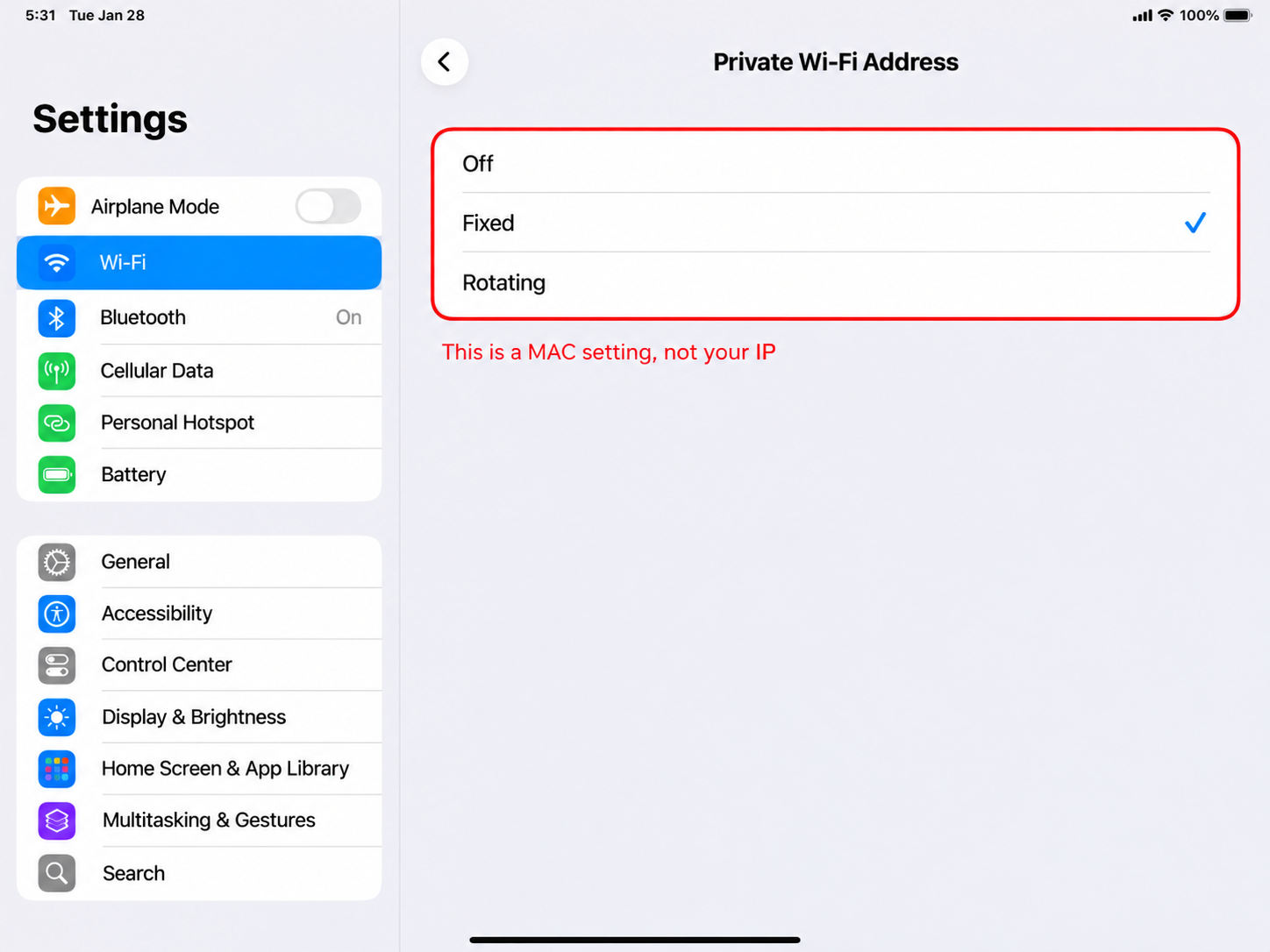
Earlier iPadOS versions show a simple on or off switch instead.
Why this matters for IP addresses: many routers hand out IP addresses based on the MAC address. If the network sees a new Wi-Fi address (after you switch to Rotating, for example), the router may treat the iPad as a new device and give it a new IP. If an IT desk asks for your “Wi-Fi address”, they usually mean this line. The steps on an iPhone are almost identical, as shown in finding the MAC address on an iPhone.
Refresh or Set the Address: Renew Lease and Configure IP
Your router uses DHCP (Dynamic Host Configuration Protocol) to assign addresses. Apple’s recommended router settings explain that DHCP assigns IP addresses to devices on your network, that a network should have only one DHCP server, and that the lease time is how long an address stays reserved for a device. Apple recommends 8 hours for home and office networks and 1 hour for hotspots and guest networks.
Renew Lease
If the iPad shows a strange address, cannot reach other devices or reports an address conflict, ask the router for a fresh assignment.
- Go to Settings > Wi-Fi and tap ⓘ beside your network.
- Tap Renew Lease, then confirm.
- Wait a few seconds and check the IP Address line again.
The address may stay the same, which is fine. Renewing only matters if the old one was wrong.
Configure IP: Automatic or Manual
Leave Configure IP on Automatic unless a network administrator gives you specific numbers. A manual (static) address that does not match the network, or that duplicates another device’s address, will break the connection.
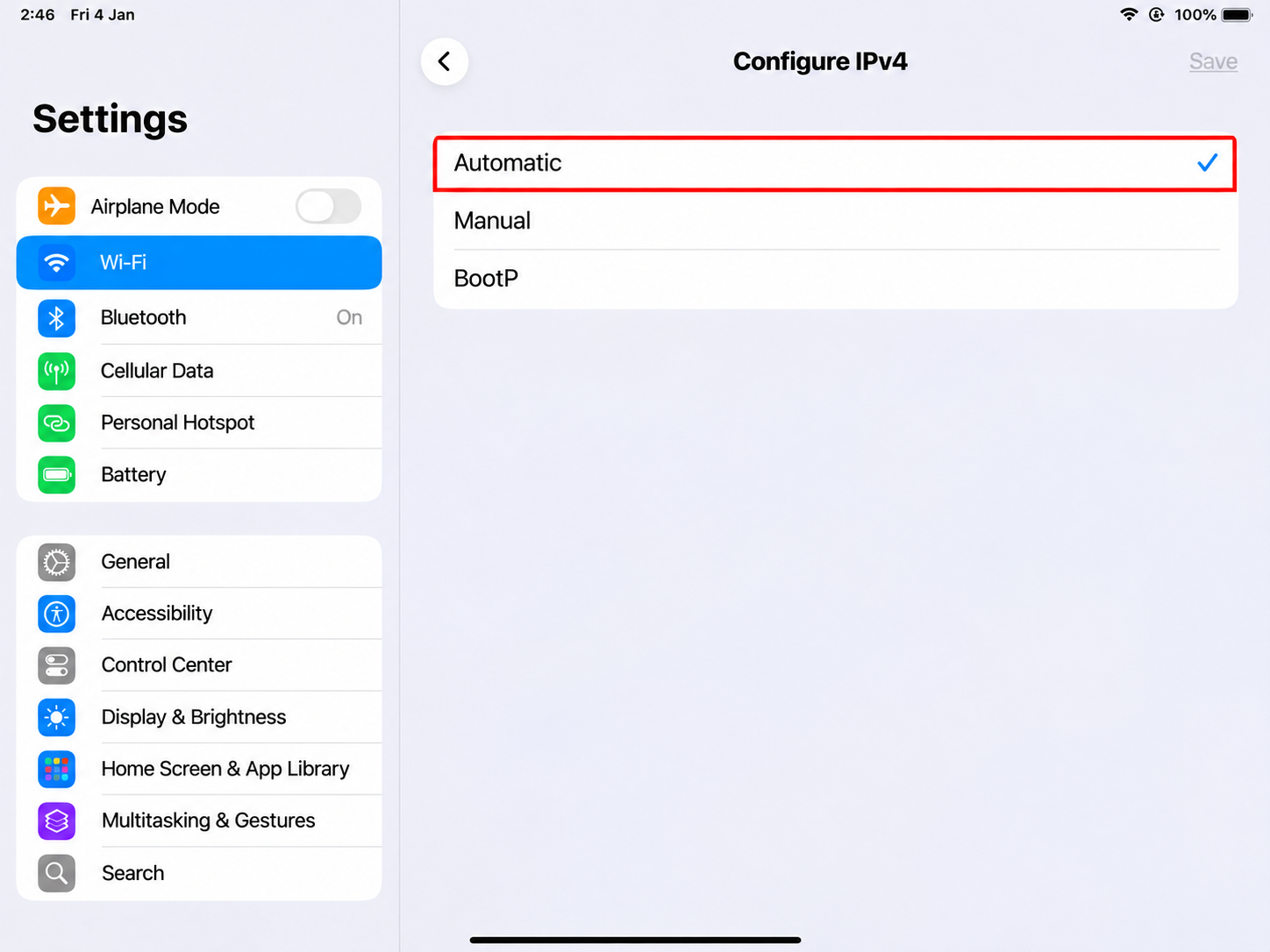
If you do need a fixed address for a printer or a home server, the cleaner option is a DHCP reservation in your router’s settings, which keeps automatic setup on the iPad while always giving it the same address. If you must set it on the iPad:
- Write down the current IP Address, Subnet Mask and Router values first.
- Tap Configure IP and choose Manual.
- Enter the IP address, subnet mask and router address your administrator gave you, then tap Save.
- To undo it, return to Configure IP and choose Automatic.
Changing an address on a Windows PC works on the same principles; how to change your IP address in Windows 11 walks through it if you manage both.
If You Cannot See an Address or It Keeps Changing
- No IP Address line, or no ⓘ details: the iPad is not connected to Wi-Fi. Join the network and try again.
- An address starting with 169.254: the iPad did not get an address from the router. Tap Renew Lease, turn Wi-Fi off and back on, or restart the router.
- Only cellular data: the network details screen covers Wi-Fi. iPadOS Settings has no matching details screen for a cellular IP address, so use the search method above for the public address on cellular.
- The address changes every few days: that is normal with DHCP. If a printer or app needs a steady address, set up a reservation in the router.
- A managed iPad from work or school: some settings may be locked by the organization. Ask its IT team.
If you also need the address of a Windows PC on the same network, see how to find your IP address on Windows 11.
Questions About iPad IP Addresses
Is 192.168.1.1 my iPad’s IP address?
Usually not. On many home networks that is the router. Check the label: the iPad’s address is beside IP Address, and the router’s is beside Router.
Does a Wi-Fi + Cellular iPad have one IP address for both?
No. Each connection gets its own address. The Wi-Fi details screen only covers the Wi-Fi network, and the public address on cellular comes from your carrier.
Can someone find my location from my iPad’s IP address?
A public IP address can reveal your internet provider and a rough area, but not your street address from the number alone. Your local IP (such as 192.168.1.42) is only meaningful inside your own network and reveals nothing to websites.
Why did my iPad’s IP address change?
The router assigns addresses for a limited lease time, and joining a different network, restarting the router or changing the Private Wi-Fi Address setting can all produce a new one.
Should I give my iPad a static IP address?
Only if a device or app requires it. A reservation on the router is simpler and safer than a manual address on the iPad.
Once you have the IP Address value, type it exactly as shown into the printer or app that asked for it, and keep Configure IP on Automatic so the iPad continues to connect normally.

Matthew Burleigh is the founder, head writer, and editor of Solve Your Tech, which he launched in 2012. He has written technology tutorials since 2008 and worked in IT since 2003, including small-business support, IT management, and consulting. He holds Bachelor’s and Master’s degrees in Computer Science from Arizona State University.
Matthew writes practical guides for Windows, iPhone and iPad, Microsoft Office, Outlook, Google apps, and Android. Solve Your Tech’s guides are checked step by step against the device or app maker’s own documentation and tested on his own devices whenever he has the hardware or software, with clear steps, sources, and update dates.
Read more about Matthew and how Solve Your Tech writes and updates its guides, or report a correction.