Your Apple Account email appears under your name at the top of the account screen in Settings. Open Settings and tap your name to see it. To see every email address and phone number you can sign in with, tap Sign-In & Security. Apple now calls an Apple ID an Apple Account; the name change doesn’t require a new account.
These steps match iOS 27 and also work in iOS 26 and iOS 18, and the same path works on iPad. You don’t need to sign out, switch accounts or erase anything to see which account your iPhone uses.
Find the Account in Settings
- Open Settings on the iPhone.
- Tap your name at the top of the main Settings screen to open account settings. The address under your name and photo is usually your primary email.
- Tap Sign-In & Security.
- Read the listed email addresses and phone numbers. These identify the account and its available sign-in details.
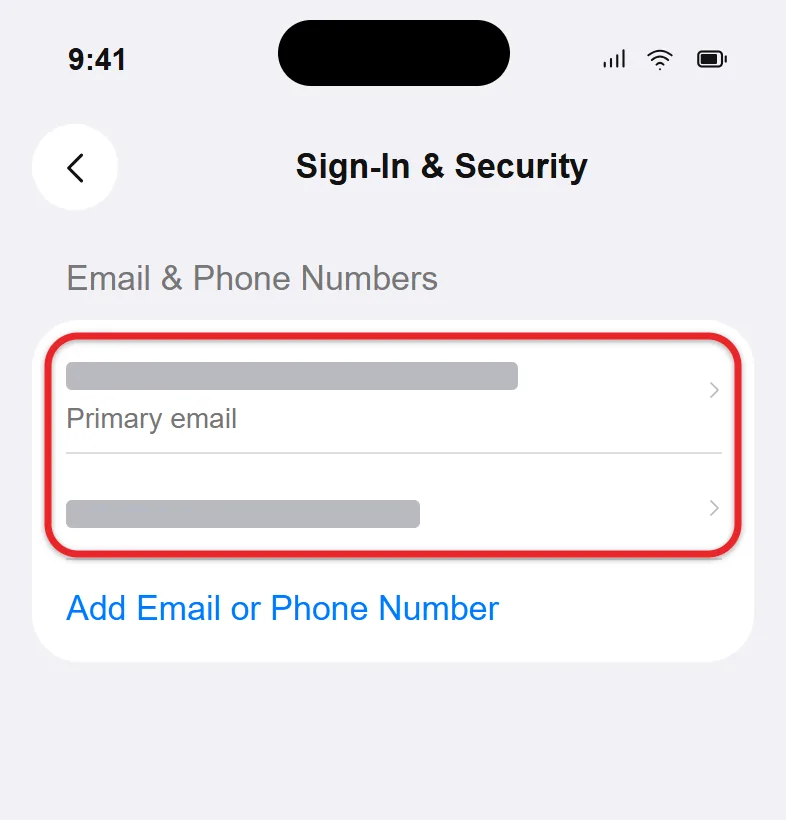

Apple’s instructions for finding a forgotten Apple Account use this route. You do not need to sign out and back in just to see it. Write the primary address down, or save it in a password manager, so you have it the next time a sign-in screen asks.
If the top of Settings says Apple Account or Sign in to your iPhone instead of a name, this iPhone isn’t signed in. Skip to the section on a missing name below.
Which Address Should You Keep?
The primary email address receives Apple’s account communications. Additional email addresses associated with that same account can also work for signing in. Seeing two addresses therefore does not, by itself, mean you have two separate Apple Accounts. Apple’s account email explanation describes the different address types.
| Type | What it is for | Can you sign in with it? |
|---|---|---|
| Primary email | Apple’s account and security messages | Yes |
| Additional email | Lets people reach you in Messages, FaceTime, and Find My | Yes |
| Phone number | Sign-in and, if trusted, verification codes | Yes |
| Rescue email | Security messages, only on accounts without two-factor authentication | Apple lists it for security notices, not sign-in |
For example, a personal email address and an iCloud email address can both belong to one account. Note the primary address and any other sign-in address you recognize. If you see an address you don’t recognize, look into it before changing anything.
Check the Account Used by a Specific App
Check whether you are signed in to the App Store, FaceTime, or Messages, because those apps can show the address too. They are useful when one app asks for a password and you aren’t sure which account it means.
- Messages: go to Settings > Apps > Messages > Send & Receive. The addresses where you receive iMessages are listed there. The steps for turning on iMessage explain each option on that screen.

- FaceTime: go to Settings > Apps > FaceTime and look at the addresses listed for being reached by FaceTime.
- App Store: open the App Store and tap your account picture in the top-right corner. The account screen shows which account the App Store is signed in to.
On iOS 17 and earlier, Messages and FaceTime settings are in the main Settings list instead of under Apps.
If the App Store shows a different address from the one in Settings, the iPhone may be using a separate account for purchases. Compare both before you buy, restore, or cancel anything.
If Your Name Is Missing or You Cannot Remember the Address
A sign-in prompt at the top of Settings will not reveal a previously used account. Check another device or Apple service where you are already signed in instead:
- Another iPhone or iPad: check the same name and Sign-In & Security settings.
- A Mac: open System Settings, select your name, then Sign-In & Security. On older Macs with System Preferences, click Apple ID.
- iCloud for Windows: look beneath your name for the primary email address or phone number.
- Other clues: check a signed-in Apple app, an Apple receipt, or the sign-in page at account.apple.com, which may remember your address.
You can also search your email inbox for receipts, repair, support, or billing messages from Apple. The primary address can appear in the body of those emails. That same inbox search is a quick way to find the receipt that proves your iPhone’s purchase date.
If you use Family Sharing, a family member may also be able to check your account information. An address masked with asterisks is only a clue, since the number of asterisks need not match the missing characters.
If you plan to sign in with an address you found, make sure it really is the account you want before you sign out. Read about signing out of your Apple Account on iPhone to learn what turns off when you switch.
Check the Account That Matches Your Task
An Apple Account provides access to iCloud, the App Store, and other Apple services. Apple’s account management guide recommends using the same account across your devices and services. The same Apple Account also signs in to Xcode when you create an app for iPhone and test it on your own device.
Once you know which account the iPhone uses, you can change iCloud settings on iPhone to pick the apps that sync with it.
The same account screen is where you change the card your Apple Account uses for App Store purchases and subscriptions.
If you are looking into a charge, compare the account you found with the account on the receipt. An address you recognize may not own every purchase. The iPhone subscriptions and purchase history guide explains how to find the billed subscription or purchase and what to check when it is missing.
Some settings ask for the account password before they change, such as turning off Find My. If yours is rejected, confirm you are using the account shown at the top of Settings. The steps for turning off Find My iPhone cover that case.
The Address, Password, and Verification Code Are Different
The email address or phone number identifies the account. Your account password authenticates a sign-in; your iPhone passcode unlocks the device. They are separate pieces of information.
That account password is also what your iPhone asks for when you require a password for App Store purchases.
With two-factor authentication, a new-device or web sign-in can also require a six-digit code delivered to a trusted device or phone number. That code is not your Apple ID. See Apple’s two-factor authentication explanation if a sign-in asks for it. Keep passwords and codes private, and don’t share them with anyone who calls or texts claiming to be Apple.
Apple ID Questions
How do I reset a forgotten Apple Account password?
On a trusted iPhone already signed in to the account, open Settings > your name > Sign-In & Security > Change Password, then follow the prompts. Apple may ask for the device passcode. Finding the email address alone does not reset the password or bypass verification.
Apple’s password reset guide also covers the Apple Support app on a borrowed device: open Support Tools, choose Reset Password, then Help Someone Else. Without a trusted device, use iforgot.apple.com. If Apple can’t confirm your identity, account recovery can take several days or more.
Can I change the email address without switching accounts?
Yes. Changing the primary email address of an existing account is different from signing into a separate account. A primary email change preserves access to contacts, purchases, and other account information.
Use Apple’s primary email change instructions for the options and verification steps. The new address can’t already belong to another Apple Account. If you only want to find the account address, leave those settings as they are.
Can I use my phone number as my Apple ID?
You can sign in with any phone number listed under Sign-In & Security. Apple counts those numbers as sign-in details for the same account, so you don’t need to remember an email address to use them.
Is my Apple ID the same as my iCloud account?
Yes. iCloud is one of the services your Apple Account signs in to, so the address you found is also your iCloud sign-in. An @icloud.com email address, if you have one, can be the primary address or an extra address on that same account.
What if I have never created an Apple Account?
After checking that you do not already have one, follow Apple’s new account instructions. Creating an account will not recover purchases or data belonging to an older account.

Matthew Burleigh is the founder, head writer, and editor of Solve Your Tech, which he launched in 2012. He has written technology tutorials since 2008 and worked in IT since 2003, including small-business support, IT management, and consulting. He holds Bachelor’s and Master’s degrees in Computer Science from Arizona State University.
Matthew writes practical guides for Windows, iPhone and iPad, Microsoft Office, Outlook, Google apps, and Android. Solve Your Tech’s guides are checked step by step against the device or app maker’s own documentation and tested on his own devices whenever he has the hardware or software, with clear steps, sources, and update dates.
Read more about Matthew and how Solve Your Tech writes and updates its guides, or report a correction.