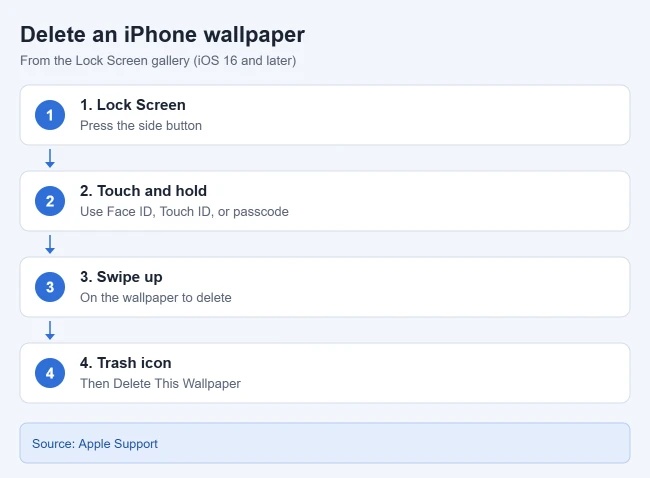
To delete a wallpaper on iPhone, press the side button to show the Lock Screen, then touch and hold the Lock Screen until the wallpaper gallery opens. Swipe to the wallpaper you want to remove, swipe up on it, tap the trash icon, and tap Delete This Wallpaper. This works on iPhones with iOS 16 or later.
These steps follow Apple’s support article Delete a wallpaper on your iPhone and the iPhone User Guide page Create a custom iPhone Lock Screen, which has a version for each release from iOS 16 through iOS 27.
Before You Start
- iOS version: The wallpaper gallery exists in iOS 16 and later. To check, go to Settings > General > About and read the iOS Version line.
- A way to unlock: You need Face ID, Touch ID or your passcode. The gallery does not open on a phone that is still locked.
- What a wallpaper is now: Each saved wallpaper is a full Lock Screen design. It includes the background, the clock style, any widgets, and the Home Screen look that was set with it. Apple’s User Guide calls the same action “Delete a Lock Screen.”
Warning: Apple’s instructions do not describe an undo for this. When you delete a wallpaper, expect to lose that design’s clock style, widgets and Focus link along with the background. If you only want a different picture, use Customize instead, which is covered below.
How to Delete a Wallpaper on iPhone
- Press the side button. This shows the Lock Screen. If you are already using the phone, press the side button once to turn the screen off, then press it again.
- Touch and hold the Lock Screen. Keep your finger on an empty part of the screen until the Customize button appears at the bottom. If nothing happens, touch and hold again and enter your passcode when asked.
- Swipe to the wallpaper you want to remove. The gallery shows your saved wallpapers side by side. Swipe left or right until the one you want to delete is in the middle of the screen.
- Swipe up on that wallpaper. A trash icon appears below it.
- Tap the trash icon. A confirmation message appears.
- Tap Delete This Wallpaper. The design is removed from the gallery.
To leave the gallery without deleting anything, tap the wallpaper you want to keep using. Apple lists that tap as the way to switch between Lock Screens.
How to Confirm the Wallpaper Is Gone
Touch and hold the Lock Screen again and swipe through the gallery. The deleted design should no longer be in the row. You can also open Settings > Wallpaper, which shows the same saved wallpapers.
There is no “recently deleted” list for wallpapers in Apple’s documentation. To get a design back, you build it again with Add New Wallpaper. Apple’s steps for removing a wallpaper only mention the gallery, not the Photos app, so a photo you used should still be in your library to pick again. Check Photos if that picture matters to you.
Delete Several Wallpapers
Apple does not document a way to select and delete several wallpapers at once. Repeat the swipe up, trash icon and Delete This Wallpaper steps for each design while the gallery is still open. You do not need to lock the phone again between them.
Keep the Design and Change the Picture Instead
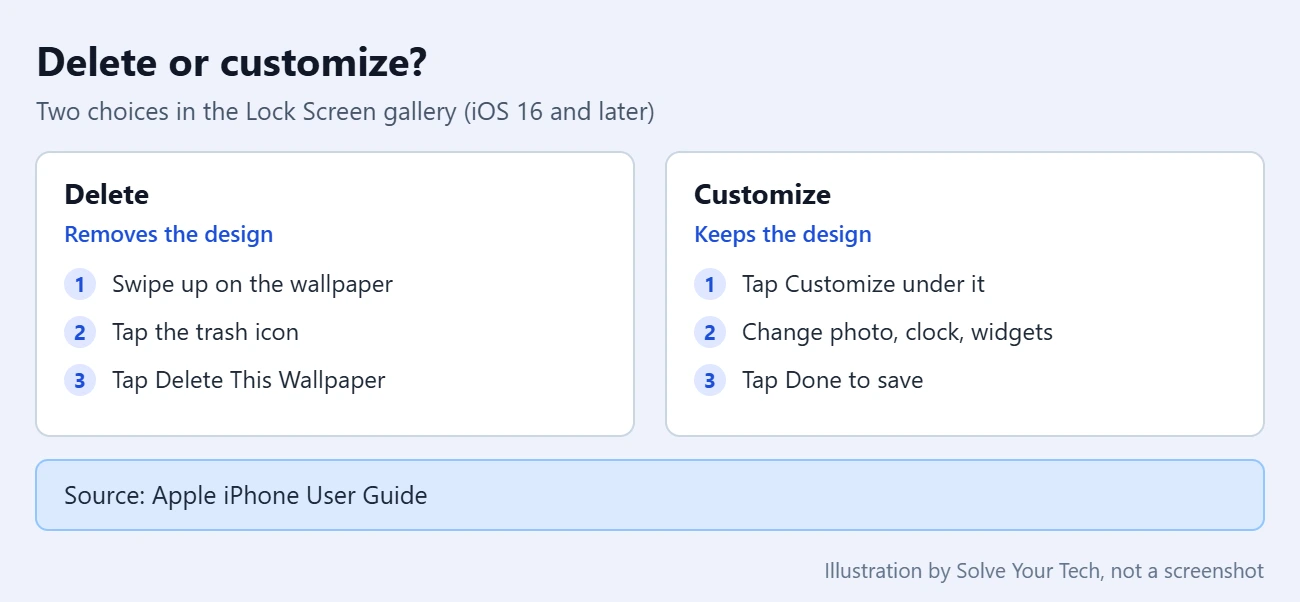
Deleting is the wrong tool if you like your clock and widgets and only want a new background. In that case, edit the existing Lock Screen.
- Press the side button, then touch and hold the Lock Screen until the gallery opens.
- Swipe to the wallpaper you want to change and tap Customize.
- Make your changes. Apple says the options depend on the wallpaper type. They can include repositioning the photo, changing the clock, adding or changing widgets, and swiping left or right for color filters.
- Tap Done.
Remove Photos From a Photo Shuffle Wallpaper
Photo Shuffle is a wallpaper type that rotates through a set of photos. If one picture in the set is the problem, you do not have to delete the whole wallpaper. Open the gallery, swipe to the Photo Shuffle wallpaper and tap Customize. Apple says you can then tap the photo thumbnail to change the photo selection, and you can change how often the photos shuffle from the same screen. Tap Done to save.
The exact buttons for removing a single photo are not spelled out in Apple’s guide and can differ by iOS version, so follow the choices shown on your phone.
Add a New Wallpaper From Settings
You can add a replacement before or after you delete the old one. Apple documents this route in Change the wallpaper on iPhone.
- Open Settings and tap Wallpaper.
- Tap Add New Wallpaper.
- Tap a button at the top of the gallery, such as Photos, Emoji or Color, or pick a wallpaper from one of the featured sets. If you do not see an option such as Weather or Astronomy, scroll down and tap Get below it.
- Tap Add.
- Tap Set as Wallpaper Pair to use it on both the Lock Screen and Home Screen, or tap Customize Home Screen to give the Home Screen its own color, photo or blur.
For fonts, widgets and other design choices, see our guide to changing the Lock Screen on iPhone. If your goal is a plain screen with no picture, our article on changing or removing the Lock Screen picture covers that.
iOS 15 or Earlier
Older versions do not have a wallpaper gallery, so there is nothing to swipe up on. Apple says that in iOS 15 and earlier you set a new wallpaper in the Settings app. To delete an image that you used as a wallpaper, you open the Photos app and delete the image there.
Warning: That second step removes the photo itself, not just the background. Only delete it from Photos if you no longer want the picture.
Change Wallpaper on iPad or an Older iPhone
On a current iPad, open Settings > Wallpaper > Add New Wallpaper. Choose a photo or a featured design, adjust its preview and tap Add. Choose Set as Wallpaper Pair for both screens, or Customize Home Screen for a separate Home Screen appearance. Leave Settings and check both screens. Apple’s iPad wallpaper guide describes those choices. On an older layout, use Choose a New Wallpaper and the offered Set controls instead.
For the iPhone 5’s original iOS 6 layout, open Settings > Brightness & Wallpaper, tap the wallpaper previews and choose a built-in wallpaper or an image from a photo album. Preview it, tap Set, then choose Set Home Screen, Set Lock Screen or Set Both. Later software calls the Settings page Wallpaper. Check the screen you selected; changing the wallpaper does not delete its source photograph. These older menus do not use the modern Lock Screen wallpaper gallery.
Change Wallpaper on an iPad 2
In the original iPad 2 Settings layout, open Settings > Brightness & Wallpaper, tap the wallpaper previews, and select a built-in collection or your photo album. Tap the desired image, adjust its preview where offered, then choose Set Lock Screen, Set Home Screen or Set Both. Check the screen or screens you selected. Later iPad software may call the Settings page Wallpaper and use Choose a New Wallpaper instead; use the current Add New Wallpaper instructions above when that is your layout. Changing the background does not delete its photograph from your album.
Change Wallpaper on a School iPad
A school-managed iPad can have wallpaper changes restricted. Apple’s device-management restrictions include preventing changes to either screen. If your school permits changes and the older menu is available, open Settings > Wallpaper > Choose a New Wallpaper, choose an available image or photo, adjust its preview and tap Set. Select Set Lock Screen, Set Home Screen or Set Both as intended, then check those screens. Newer iPadOS versions use the Add New Wallpaper route described above. If the controls are missing or locked, ask the school administrator; do not remove management or reset the iPad to bypass the restriction.
Change the iPad Lock Screen Clock Font
On an iPad running a version that supports custom Lock Screens, wake it with the top button, touch and hold the Lock Screen, and authenticate if asked. Swipe to the design you want and tap Customize, then choose Lock Screen if offered. Tap the time and choose an available font and appearance in its controls. Dismiss that panel, tap Done to save an existing design and select the finished screen; when creating a new design, use Add and the wallpaper-pair choices instead. Check the clock on the actual Lock Screen. Apple’s custom Lock Screen guide explains the time controls; available choices depend on the version and wallpaper. Display & Brightness > Text Size does not select a different clock font, and installing an arbitrary font app does not replace this system clock font.
Troubleshooting
| Problem | Likely cause | What to try |
|---|---|---|
| Gallery does not open | Not on the Lock Screen, or not unlocked | Press the side button, touch and hold, enter the passcode |
| Swipe up goes Home | Swipe started at the bottom edge | Swipe up from the middle of the wallpaper |
| No trash icon | Possibly the only saved wallpaper | Add a second wallpaper, then try again |
| No gallery at all | iOS 15 or earlier | Set a new wallpaper in Settings |
The gallery does not open
Start from the Lock Screen, not the Home Screen. Press the side button first, then touch and hold. Apple notes that if the add button does not show, you should touch and hold the Lock Screen again and enter your passcode. Touch an empty area rather than a notification or a widget, since those respond to a long press in their own way.
Swiping up does nothing or goes to the Home Screen
A swipe from the very bottom edge of the screen is the gesture for going Home. Begin the swipe on the wallpaper preview itself, in the middle of the screen, and make sure the gallery is open first. You should see the Customize button before you swipe.
There is no trash icon
Apple does not list cases where the trash icon is hidden. Some guides report that it does not appear when only one wallpaper is left, because the iPhone always needs a background. That detail is not confirmed by Apple. If you see no trash icon, add a second wallpaper with Add New Wallpaper, switch to it, and try the old one again.
The steps do not match your phone
Check your version in Settings > General > About. On iOS 15 or earlier, use the older method above. On a work or school iPhone, an administrator can restrict wallpaper changes, so ask them if the wallpaper controls are unavailable.
Change the Wallpaper on an iPhone 5 With iOS 7
In the iOS 7 layout, open Settings > Wallpapers & Brightness and tap either preview under Choose Wallpaper. Choose Dynamic, Still, or an available photo album, then select the image you want. Adjust the preview where offered, tap Set, and choose Set Home Screen, Set Lock Screen or Set Both. Leave Settings and check the screen you selected. To replace it again, repeat with another image; this does not delete the source photo. Dynamic uses the built-in moving designs offered by that version. This older menu differs from both the iOS 6 Brightness & Wallpaper page and the modern Add New Wallpaper gallery above.
Set a Lock Screen Wallpaper on iOS 17
On iOS 17, open Settings > Wallpaper > Add New Wallpaper, choose Photos or an offered design, and adjust the preview. Tap Add, then choose Set as Wallpaper Pair for both screens or Customize Home Screen to choose its separate appearance. Check the Lock Screen and Home Screen after finishing. This version uses Add New Wallpaper rather than the older Choose a New Wallpaper > Set Lock Screen sequence. To return to another saved design, open the Lock Screen gallery and select it; changing the selection does not delete the source photo.
Use an iPad 2 Photo as Home Screen Wallpaper
In the older iPad 2 Photos layout, open Photos, select the album and intended image, tap Share > Use as Wallpaper, adjust the preview where offered and choose Set Home Screen. Check the background behind the app icons. The offered Lock Screen or Both choice applies to those screens instead. You can replace the image again through this route or the iPad 2 Settings method above. This sets the background without deleting or editing the photograph; current iPadOS uses the newer wallpaper controls described above.
Can You Use a Video as iPhone Wallpaper?
The old iOS 16 instructions to select an ordinary video in Photos and use it as a continuously playing Lock Screen wallpaper were incorrect. Trimming a video does not turn it into a supported wallpaper, and a normal video does not acquire a Use as Wallpaper option through that edit. For a still image, choose a photo and use the Add New Wallpaper or older photo-wallpaper steps above. Check the resulting Lock Screen after locking and waking the phone; it should show the chosen image.
A supported Live Photo is a separate option on iOS 17 or later. Open Settings > Wallpaper > Add New Wallpaper, choose Photos > Live Photo, select one, and make sure the play button is on. Tap Add, then choose Set as Wallpaper Pair or Customize Home Screen. The Live Photo can animate when the phone wakes; this does not make any ordinary video a looping wallpaper. See Apple’s Live Photo wallpaper instructions.
Use a Photo on the iPad Lock Screen in iOS 7
On the older iPad iOS 7 layout, open Photos, find the picture in Camera Roll or an album, open it, and tap Share. Choose Use as Wallpaper, drag or pinch the preview to position the image, tap Set, and choose Set Lock Screen. Lock and wake the iPad to check the result. Set Home Screen changes the background behind the app icons instead; Set Both changes both screens. Choosing wallpaper does not delete the source photo. These are historical menus; the newer Add New Wallpaper controls above have different labels.
Change Samsung Galaxy Home or Lock Screen Wallpaper
On the Samsung Galaxy On5 with Android 6.0.1, open Apps > Settings > Wallpaper. Use the screen selector at the top to choose Home screen, Lock screen, or Home and lock screens. Select a built-in image, or open Gallery and choose your own picture, then tap Set as wallpaper. Return to the Home screen to check the image behind the icons, or lock and wake the phone if you selected the Lock screen. Repeat with another image to change it again.
On a newer Galaxy layout, touch and hold an empty area of the Home screen, choose Wallpaper and style > Change wallpapers, then open Gallery. Select a photo and tap Done; choose Home screen, Lock screen, or both and continue with Next when offered. Position the preview with drag or pinch, then tap Done to apply it. Check the chosen screen afterward. Available preview effects and labels depend on the model and One UI version. Samsung’s wallpaper guide shows the current controls.
Change Home Screen Wallpaper on an iPhone With iOS 9
In the historical iOS 9 layout, open Settings > Wallpaper > Choose a New Wallpaper. Choose Dynamic, Stills, or a photo album, then select the intended picture and adjust its preview where offered. Tap Set > Set Home Screen to change the background behind the app icons. Set Lock Screen changes the lock display instead; Set Both applies to both screens. Leave Settings and check the screen you selected. Repeat with another picture to replace it; this does not delete the source photo. This version predates the wallpaper gallery and Add New Wallpaper controls described above.
Use a Downloaded Image as Wallpaper in iOS 16 or Later
In Safari, open the image you have chosen, touch and hold the actual image, and select the available image-saving command, such as Save to Photos or Add to Photos. Check that the image appears in Photos before continuing. Some sites or embedded viewers do not offer this command; use the site’s legitimate image-download option or choose a photo already in your library. On iOS 16 or later, open Settings > Wallpaper > Add New Wallpaper > Photos, choose the saved image, adjust the crop and tap Add. Choose Set as Wallpaper Pair for both screens, or Customize Home Screen to choose a separate Home Screen appearance. Apple documents the wallpaper controls. Check the Lock Screen and Home Screen afterward. This adds a wallpaper configuration rather than deleting the original photo; return to the wallpaper gallery to select your previous design if you prefer it. The older Choose a New Wallpaper menu belongs to earlier iOS versions.
Frequently Asked Questions
Does deleting a wallpaper delete the photo?
Apple’s steps for iOS 16 and later remove the wallpaper from the gallery and say nothing about removing the picture from the Photos app. Deleting from Photos is a separate action that Apple only mentions for iOS 15 and earlier. If the photo is important, confirm that it is still in Photos after you delete the wallpaper.
Can I delete a wallpaper from the Settings app?
Apple’s instructions only describe deleting from the Lock Screen gallery. Settings > Wallpaper is documented for adding and customizing wallpapers. Some guides say a swipe up works there on recent iOS versions as well, but Apple does not document it, so the Lock Screen route is the reliable one.
What happens if the wallpaper is linked to a Focus?
A Focus is a mode, such as Work or Sleep, that limits notifications. Apple says a Lock Screen can be linked to a Focus, so that Lock Screen appears whenever the Focus is on, and switching Lock Screens also switches your Focus. After you delete a linked wallpaper, open Settings > Focus and check which screen that Focus uses. Apple explains the options in Set up a Focus on iPhone.
Can I delete the wallpapers that came with the iPhone?
You can delete saved Lock Screens that you no longer need, including ones built from Apple’s own designs. The choices shown under Add New Wallpaper are a catalog of options, not saved wallpapers, and Apple does not offer a way to remove them.
How many wallpapers can I save?
Apple says you can create more than one Lock Screen and switch between them, but its guide does not state a maximum. Deleting designs you no longer use keeps the gallery quick to swipe through.
Next Step
Once the gallery is tidy, tap the wallpaper you want to use and check both the Lock Screen and Home Screen. The picture behind a new Safari tab is a separate setting, covered in how to change the Safari background on iPhone. For other display changes, see how to make apps bigger on iPhone.

Matthew Burleigh is the founder, head writer, and editor of Solve Your Tech, which he launched in 2012. He has written technology tutorials since 2008 and worked in IT since 2003, including small-business support, IT management, and consulting. He holds Bachelor’s and Master’s degrees in Computer Science from Arizona State University.
Matthew writes practical guides for Windows, iPhone and iPad, Microsoft Office, Outlook, Google apps, and Android. Solve Your Tech’s guides are tested on current devices or checked against official product documentation, with clear steps, sources, and update dates.
Read more about Matthew and how Solve Your Tech writes and updates its guides, or report a correction.