To delete a user profile in Windows 11, open Settings > Accounts > Other users, select the account, select Remove next to Account and data, and then select Delete account and data. This removes the account and the files stored in it on this PC, such as its Desktop, Documents, and Downloads folders, so back up anything you want to keep first. You must be signed in as an administrator, and you can’t remove the account you’re currently using.
Account or Profile: Know Which One You’re Deleting
The two words are often used as if they mean the same thing, but they are different. A user account is the sign-in: the name and password, PIN, or Microsoft account someone uses to get into Windows. A user profile is that person’s data on the PC: a folder in C:\Users that holds their Desktop, Documents, Downloads, Pictures, and app settings.
That gives you two options:
- Remove the account in Settings. This takes away the sign-in and the data together. It is the right choice when someone no longer uses the computer.
- Delete only the profile in System Properties. This clears the stored files and settings but leaves the sign-in in place. It is mainly used to clean up a profile left behind by an account that is already gone, or to give an account a fresh start when its profile is damaged.
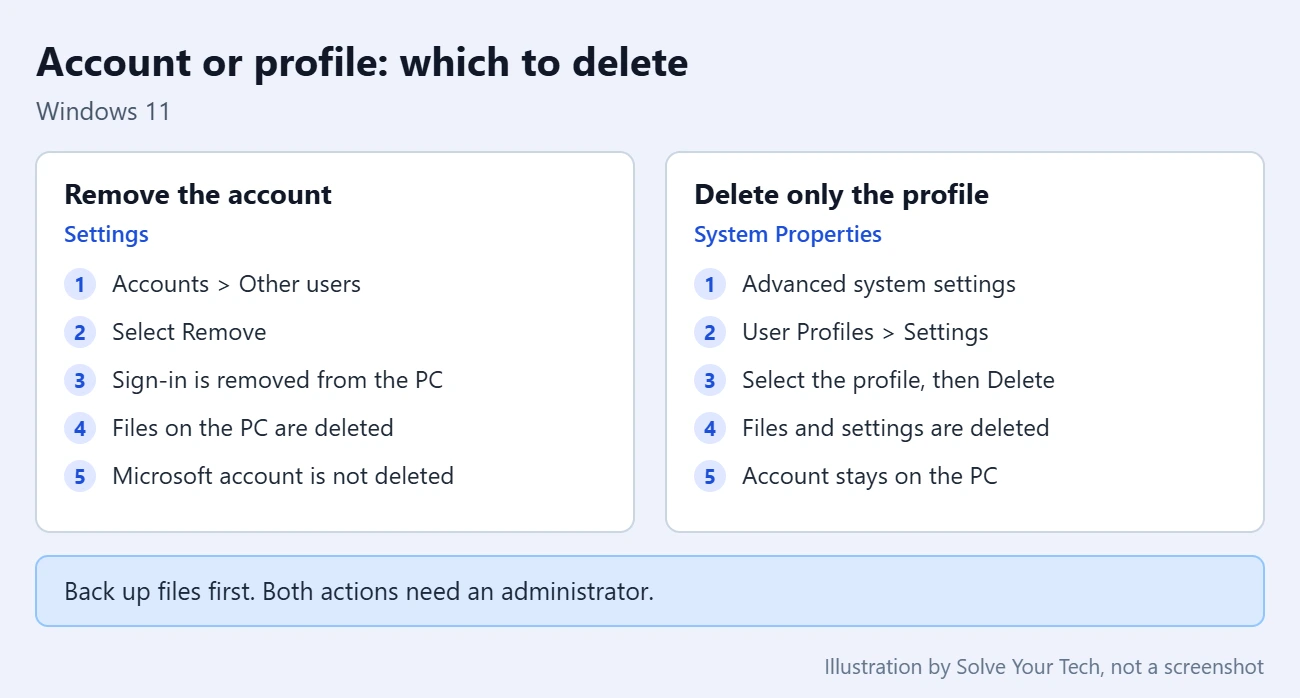
Neither option deletes a Microsoft account. Microsoft’s guide to managing user accounts in Windows says removing an account takes the person’s sign-in information and data off the device, and nothing more. Their email, OneDrive files, and purchases stay with their Microsoft account.
Both Methods Delete Files
Warning: both methods in this article delete files from the PC. Treat the deletion as permanent.
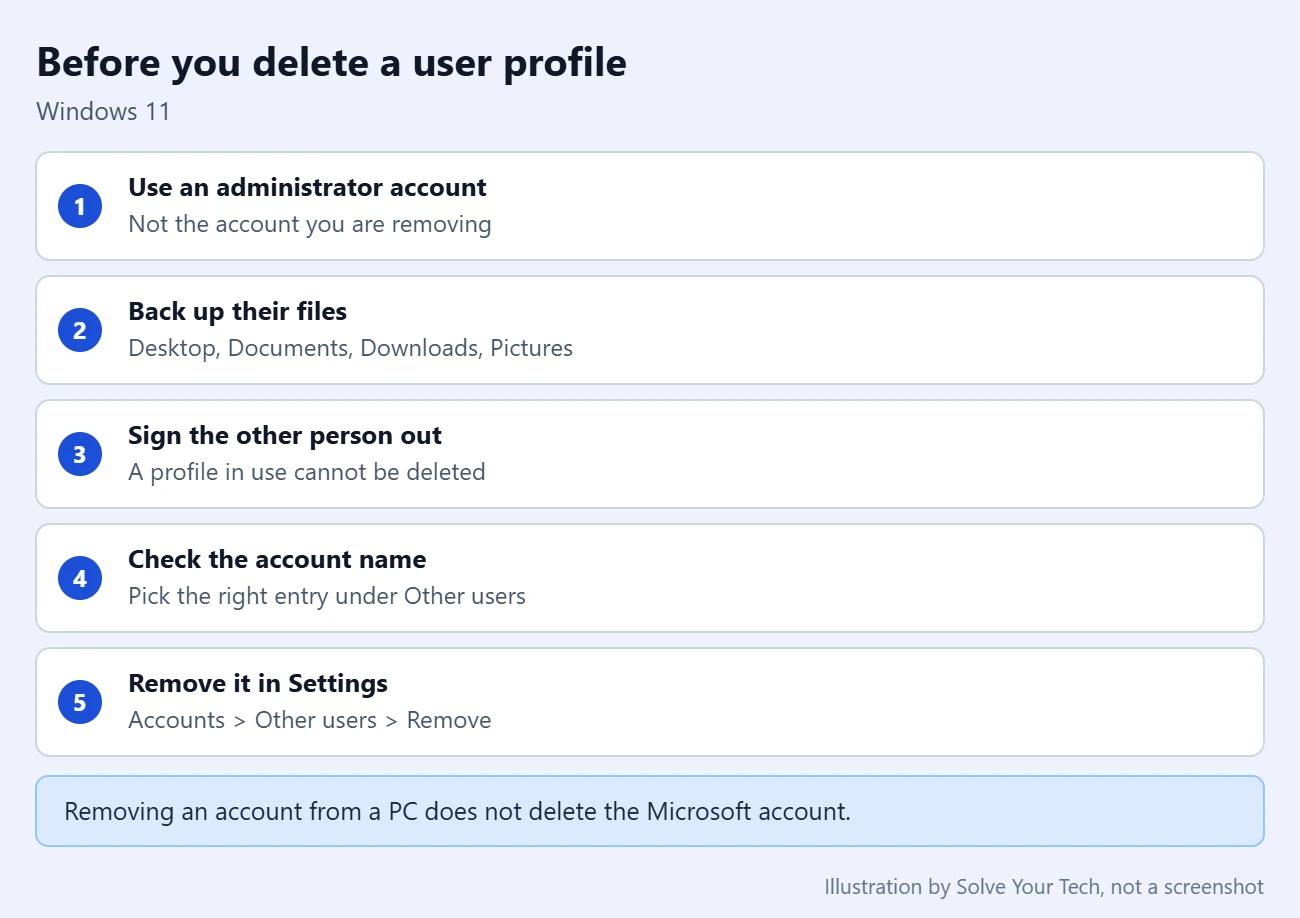
- Sign in as an administrator. An administrator is an account that is allowed to change system settings and manage other users. Use one that is not the account you plan to remove.
- Back up the other person’s files. Copy what matters from their folder in
C:\Usersto an external drive or cloud storage. For a full copy of the PC, you can back up Windows 11 to an external hard drive. - Sign the other account out. If that person used the PC since it was last restarted, their account may still be signed in the background. Have them sign out, or restart the computer and sign in with your administrator account only.
- Check the name. Make sure you know exactly which entry belongs to the person you’re removing, especially if two accounts have similar names.
To get to that account to sign it out, switch users in Windows 11 with Ctrl + Alt + Delete.
Delete a User Account and Its Files in Settings
This is the method Microsoft documents for Windows 11 and Windows 10, and it is the one most people need.
- Press Windows key + I to open Settings.
- Select Accounts in the left column.
- Select Other users. On older Windows 11 versions this page is called Family & other users.
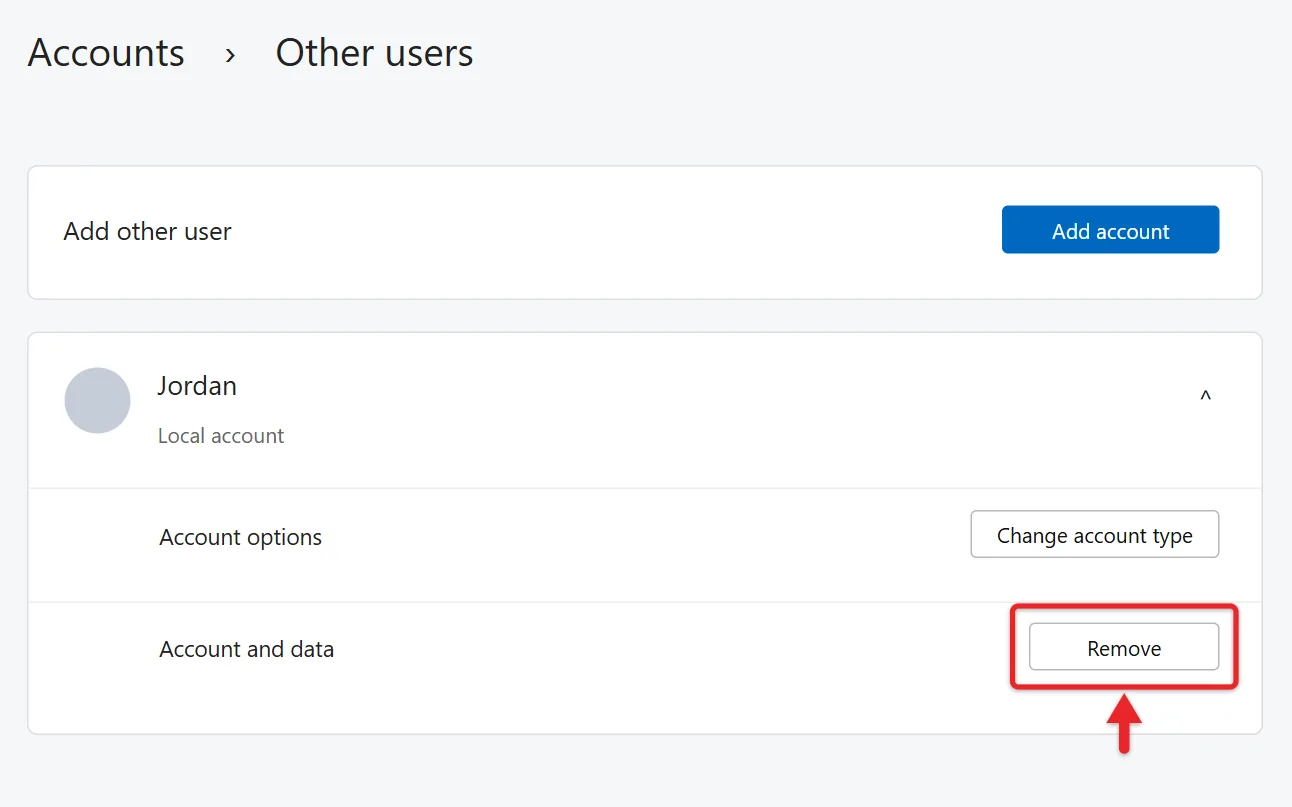
- Under Other users, select the account you want to delete. The entry expands to show its options.
- Next to Account and data, select Remove.
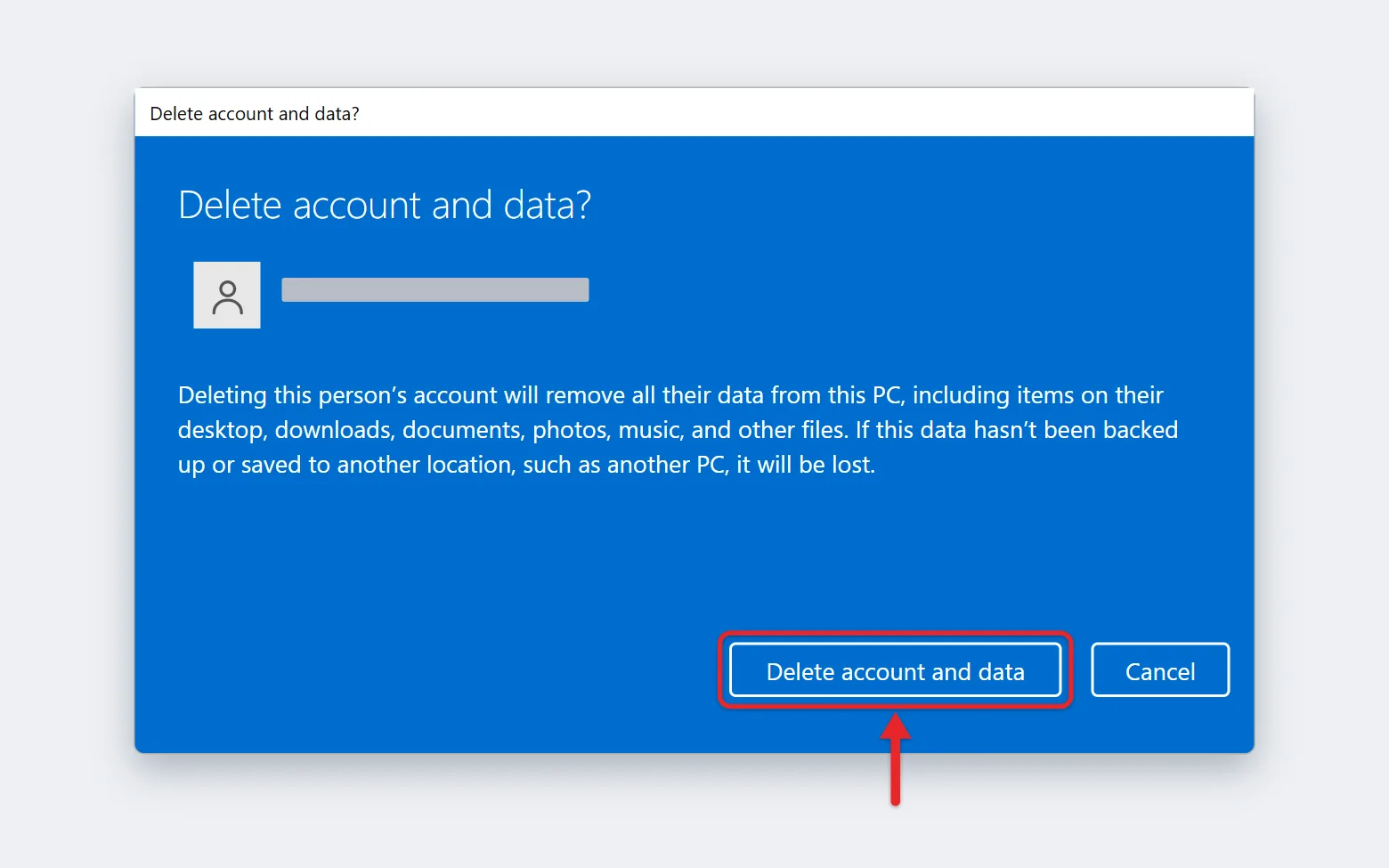
- Read the warning that appears. It explains that the person’s data will be deleted from this PC. Select Delete account and data to confirm.
The account disappears from the list when Windows finishes. A profile with a lot of files can take a little while to remove.
Delete Only the Profile in System Properties
Use this method when an account has already been removed but its data is still on the PC, or when you want to wipe an account’s files and settings without removing the account. It’s described in Delete a user profile in Windows, and it also requires an administrator.
Warning: this deletes everything stored in the profile. If the account still exists, the person can still sign in, but their old files and settings will not be there. Windows normally sets up a new, empty profile at their next sign-in.
- Open Settings and select System, then About.
- Select Advanced system settings. The System Properties window opens on the Advanced tab.
- In the User Profiles section, select Settings.
- Select the profile you want to remove from the list. A profile whose account has already been deleted may appear as Account Unknown.
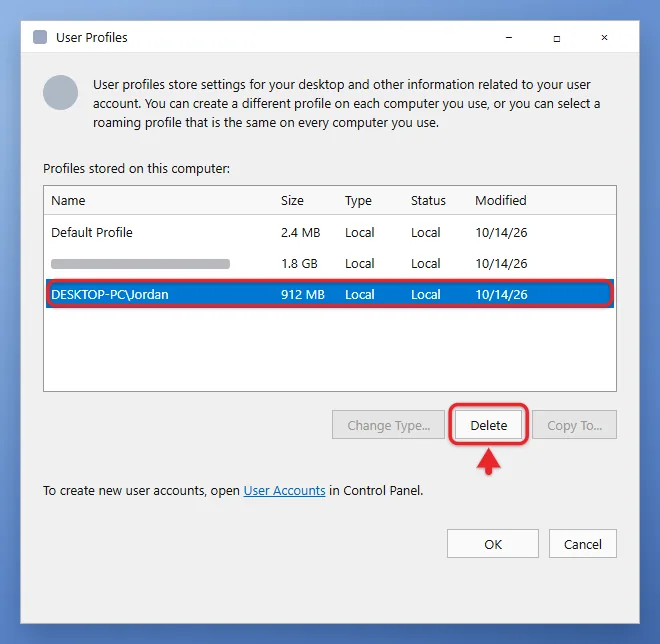
- Select Delete, then confirm.
- Select OK to close the windows.
A faster way to reach the same window is to press Windows key + R, type sysdm.cpl, press Enter, and open the Advanced tab.
Deleting the profile this way is safer than deleting the folder from C:\Users by hand, because Windows also removes the profile’s registry entries. The registry is the database where Windows stores its settings, and a profile entry left there with no matching folder can cause sign-in problems later. For the same reason, this article does not cover editing the registry yourself.
Other Ways to Remove an Account
Windows 11 still includes older tools that remove an account. They are useful if you already work in them, but they are not all equal.
| Method | How to open it | What to know |
|---|---|---|
| Settings | Settings > Accounts > Other users | Removes the account and its data together. Documented by Microsoft. |
| Control Panel | Control Panel > User Accounts > Remove user accounts | May offer a choice to keep or delete the person’s files before the account is deleted. |
| User Accounts dialog | Windows key + R, then netplwiz | Select the user, then Remove. The profile data may be left behind. |
| Command line | Command Prompt opened as administrator | Removes a local account only. The profile data may be left behind. |
For the command line, Microsoft’s net user reference lists net user to show the accounts on the PC and net user UserName /delete to delete one, where UserName is the account’s name. The command only works in a window opened with administrator rights, so run Command Prompt as admin first.
If you use one of the tools that removes only the account, finish the job with the System Properties steps above so the old files do not keep taking up space.
Confirm the Result for the Method You Used
If you removed the account in Settings, check that it is no longer listed under Accounts > Other users. If you deleted only the profile, reopen System Properties > Advanced > User Profiles > Settings and check that the selected profile is gone. The account can remain available for sign-in after profile-only deletion.
Keep your backup while you check the remaining or replacement account. Do not delete an unfamiliar folder merely because its name resembles the old account.
Can You Undo It?
No. Windows has no button that brings a deleted profile back. You can add the person again in Settings > Accounts > Other users with Add account, but they start with an empty profile. Their old files return only if you copy them back from a backup. Anything they saved to OneDrive or another cloud service is still available when they sign in to that service again. A visitor who needs a temporary account can use a guest account in Windows 11 instead.
When Remove Is Missing or the User Is Under Family
The Remove button is missing
You are probably signed in with a standard account, or you are looking at your own account. Your own account is listed under Your info, not Other users. Sign in with a different administrator account and try again.
The person is listed under Family, not Other users
Members of a Microsoft family group appear on the Settings > Accounts > Family page. Family membership is managed online, not on the PC. Microsoft’s instructions for removing members from a family group say only a family organizer can remove someone, at account.microsoft.com/family. Removing a member also ends their access to things the family shares, such as a Microsoft 365 Family subscription, so check that first.
Delete is grayed out in User Profiles
This usually means the profile is in use. You can’t delete the profile you are signed in with, and a profile that is still signed in the background may be locked too. Restart the PC, sign in with a different administrator account, and open the list again.
The account is a work or school account
Accounts connected by an employer or school are handled on a different page. Go to Settings > Accounts > Access work or school, select the account, and select Disconnect. On a computer your organization owns, the IT department may have turned these controls off, so ask them before you remove anything.
The full process, including the local administrator account you need first, is in removing an organization from Windows 11.
There is only one account on the PC
You need a second administrator account to do the removal. Create a second account in Other users, change its account type to Administrator with Change account type, sign in with it, and then remove the first one.
Once the old profile is gone, check that the accounts left on the PC have the right access. In Settings > Accounts > Other users, select each account and use Change account type so that only the people who need to manage the computer are administrators.
Settings, netplwiz, Control Panel and Terminal can all give an account administrator rights in Windows 11.
Windows 11 Profile Removal Questions
Can I delete the account I’m signed in with?
No. Windows won’t remove the account or profile that is currently in use. Sign in with a different administrator account first. If you only want to stop using a Microsoft account on your PC, remove the Microsoft account from Windows 11 instead.
Does deleting a user delete their Microsoft account?
No. It only removes the account’s sign-in information and data from this PC. The Microsoft account itself, including its email and OneDrive, is not affected, and the person can still use it on other devices.
Does deleting a user profile free up disk space?
Yes. The space used by the files in that profile is released once the profile is deleted. How much you get back depends on how much the person stored on the PC.
Will deleting a profile remove installed programs?
Programs installed for everyone on the PC stay installed. What goes is the deleted user’s own settings and data for those programs, along with anything installed only inside that profile.
Do these steps work in Windows 10?
Yes. On Windows 10 the Settings page is called Family & other users, and the Remove and Delete account and data steps are the same. For profile-only deletion, use the Windows 10 user-profile deletion guide.

Matthew Burleigh is the founder, head writer, and editor of Solve Your Tech, which he launched in 2012. He has written technology tutorials since 2008 and worked in IT since 2003, including small-business support, IT management, and consulting. He holds Bachelor’s and Master’s degrees in Computer Science from Arizona State University.
Matthew writes practical guides for Windows, iPhone and iPad, Microsoft Office, Outlook, Google apps, and Android. Solve Your Tech’s guides are checked step by step against the device or app maker’s own documentation and tested on his own devices whenever he has the hardware or software, with clear steps, sources, and update dates.
Read more about Matthew and how Solve Your Tech writes and updates its guides, or report a correction.