Facebook has no general customer-service phone number or support email, so you contact it through tools inside Facebook: Help & support > Report a problem for a broken feature, account recovery for a lost or hacked account, and the Report option on the post, profile or message itself. Live chat or email with an agent is mainly for Meta Verified subscribers and some advertisers. For rejected listings or lost selling access, follow the steps to appeal a Facebook Marketplace restriction instead.
This guide covers personal Facebook accounts on a computer and in the iPhone and Android apps, with a short section for advertisers. If a support form or an app developer asks for your account identifier, find your Facebook ID first.
Choose the right support route
| Your problem | Where to go |
|---|---|
| A feature is broken or shows an error | Help & support > Report a problem |
| You can’t sign in, or someone took over the account | facebook.com/hacked or the login recovery screens |
| Your account is locked or asks you to confirm your identity | The unlock or confirmation steps Facebook shows when you sign in |
| A post, profile or message is abusive or a scam | The Report option on that content |
| You have an active Meta Verified subscription | Meta Verified > Get support in the mobile app |
| An ad account, Page or business asset | Meta Business Support Home |
Picking the matching route matters. A bug report about a hacked account goes nowhere useful, and a content report doesn’t reach anyone about your login.
Report a broken feature on a computer
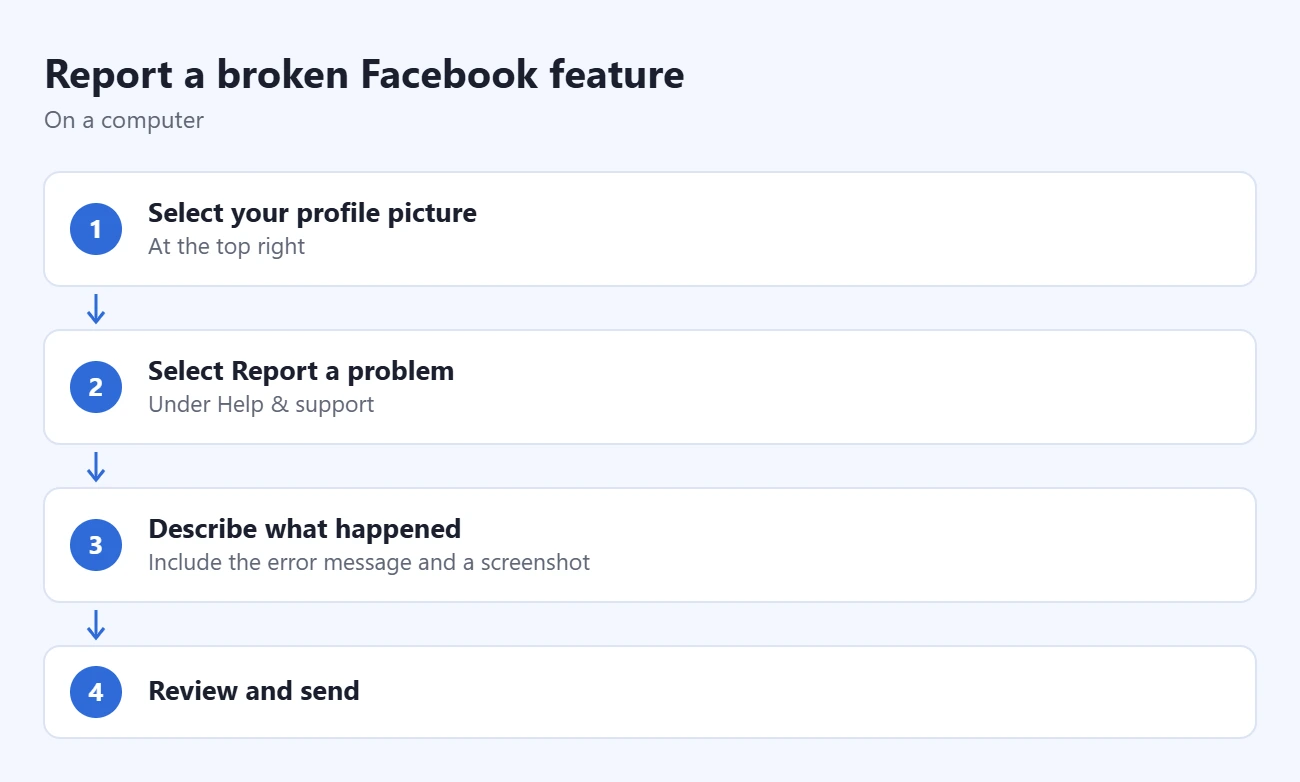
- Sign into Facebook in your browser and select your profile picture at the top right.
- Select Help & support > Report a problem. Follow the prompts to identify the affected feature.
- Describe what happened, what you expected and the steps that reproduce it. Include the error message and a relevant screenshot when available.
- Review the details and click Send. A bug report goes to Facebook’s teams; it does not open a chat with a support agent.
Facebook’s problem-reporting instructions send login problems and hacked accounts to a different process. Don’t use a general bug report as your only attempt to recover access.
Report a problem in the iPhone or Android app
- Open Menu, scroll down to Help & support, and select Report problem.
- Select Continue to report and review the choice to include additional diagnostic information. Choose Include or Don’t include.
- Select the feature, explain the steps that led to the problem, and add a screenshot with Upload from phone if it helps. Check the image for unrelated personal information before sending it.
- Select Send. Keep a copy of your description for any follow-up.
The same help article describes a shortcut: go back to the screen with the problem, shake the phone and select Report problem. On Android, the menu sits in a slightly different place, so select Android App Help on that article for its exact path.
Get back into a hacked or locked account
If your account was hacked, start at facebook.com/hacked on a device you previously used to sign in. Follow the hacked Facebook account recovery steps for lost access, changed contact information and the security checklist after recovery. Messaging an alleged “security team” does not replace Facebook’s ownership checks.
If Facebook says your account is locked, the locked Facebook account guide walks through the unlock and identity checks. If you’re stuck on the security-code screen instead, the steps for recovering from a Facebook 2FA lockout list the official verification options.
For a suspicious email or message claiming to be Facebook, don’t open attachments or follow its login links. Facebook’s phishing-report guidance identifies phish@fb.com and the reporting links inside Facebook. That address is for suspected phishing only; it is not an account-recovery inbox. Facebook will not ask for your password by email.
Report a post, profile or message
Facebook’s Report control sits next to the content. On a computer, open the post’s Options > Report post, choose the reason and review the summary before Submit. For a profile, open it and select Options > Report profile, then follow the choices offered. Some profile feedback categories don’t need a separate report submission. For scam posts, messages and Marketplace listings, the right path is the item’s own report option, explained in how to report a scam on Facebook.
Marketplace listings and buyers have their own report options, covered with the steps for setting up Facebook Marketplace.
The content-reporting help page also covers messages, Pages and other content, and links to forms you can use if you can’t see the content or don’t have an account. Facebook won’t necessarily remove content you report, but you can check the outcome in your Support Inbox.
Use Meta Verified support if your account has it
Meta’s creator support guide documents direct support for active Meta Verified subscriptions, including account-security issues. In the Facebook mobile app:
- Sign into the verified account.
- Open Menu > Settings & privacy > Settings.
- Open Accounts Center > Meta Verified > Get support > Contact support.
- Select a channel offered for your subscription and issue, then follow its prompts.
Some accounts show Meta Account settings instead of Accounts Center; use whichever your account shows. The guide lists chat and email support, with call requests on some higher plans. Chat works in the Facebook and Instagram mobile apps, not on a computer, and hours depend on channel, language and region.
If you don’t see these options, check that you’re signed in to the verified account, that the subscription is active, and that the app is up to date. Buying Meta Verified after you’ve lost access won’t get you into the account.
Can you call or email Facebook?
No general line exists. Meta’s phone support policy says Meta, including Facebook, doesn’t have a general public phone number for customer service. Specialized support can exist for some products or regions, including the Meta Verified call requests above, and those are started from inside the official app.
There’s no general support email either. The phish@fb.com address only takes phishing reports.
Watch out for fake Facebook support
Search results, forum posts and comment sections are full of “Facebook support” phone numbers. One forum post that ranked for this exact question repeated a toll-free number nine times and promised guaranteed fixes. Facebook doesn’t publish such a number, so whoever answers is not Facebook.
- Don’t call numbers from search results, ads or comments that claim to be Facebook support.
- Ignore DMs or comments offering to recover your account, remove a ban or verify your Page. Account fixes happen inside Facebook’s own screens, not through a stranger’s messages.
- Never pay for recovery. Facebook’s own recovery and reporting tools are free.
- Never share your password, login codes or recovery codes, and send ID documents only through Facebook’s own upload screens.
If you already gave a scammer your password or a code, change your password right away and follow the hacked-account steps above.
Request help for a Facebook business account
For an advertising or business issue, open Meta Business Support Home and sign in with an account that has access to the business. Select the business or asset if asked, review its issue and account-status information, then use whatever help or contact option it offers.
If you get a support form or chat, pick the matching category, describe the problem and any error message, and attach a relevant screenshot. Keep the case ID and watch the case or Support Inbox for replies. Channels depend on the account and issue, and a live agent or a reply by a set time isn’t guaranteed. If there’s no contact button, follow the help or appeal link shown.
Check progress and follow up
On a computer, open your profile picture, then Help & support > Support inbox. Facebook’s Support Inbox guide explains that it holds your reports, account alerts and messages. For Page or group messages, use the admin account.
Meta Verified cases have a case ID and their own status screen. Keep that ID, use the verified account, and reply while the case is open. These cases close automatically after seven days without a response from you, and a closed case needs a new request.
If a bug report is marked resolved but the problem is still there, Facebook’s bug-report follow-up guidance says to report it again with the steps that cause it and a screenshot.
Facebook Support Questions
Does Facebook have a customer service phone number?
No. There is no general public phone number for Meta customer service. Some Meta Verified plans can request a call from inside the app.
Can I talk to a real person at Facebook?
Usually only through Meta Verified support or, for some advertisers, Meta Business Support chat. Bug reports and content reports are reviewed, but you don’t get a conversation.
Can I contact Facebook if I can’t log in?
Yes. Use facebook.com/hacked or the recovery and identity steps on the sign-in screen. The content-reporting page also links to forms for people without an account.
How long does Facebook take to respond?
Facebook gives no set time for bug or content reports. Check your Support Inbox for updates, and for a Meta Verified case, reply within seven days so it stays open.
If your problem is a lost account, go straight to the hacked or locked account route above before sending any other report.

Matthew Burleigh is the founder, head writer, and editor of Solve Your Tech, which he launched in 2012. He has written technology tutorials since 2008 and worked in IT since 2003, including small-business support, IT management, and consulting. He holds Bachelor’s and Master’s degrees in Computer Science from Arizona State University.
Matthew writes practical guides for Windows, iPhone and iPad, Microsoft Office, Outlook, Google apps, and Android. Solve Your Tech’s guides are checked step by step against the device or app maker’s own documentation and tested on his own devices whenever he has the hardware or software, with clear steps, sources, and update dates.
Read more about Matthew and how Solve Your Tech writes and updates its guides, or report a correction.