To sync a Fitbit with an iPhone, keep the tracker near the phone, turn on Bluetooth, and open the Google Health app. Then pull down on the Today tab, or tap Connections and then Sync, and check the last-synced time under your device.
These steps cover the Google Health app (the app that was called Fitbit until its May 2026 rename) on an iPhone running iOS 16.4 or later, including iOS 26. They apply to Fitbit trackers and smartwatches such as the Charge, Inspire, Luxe, Versa, Sense, and Fitbit Air. Aria scales and the Google Pixel Watch work differently, as explained near the end.
Before You Start
- The Google Health app. If you had the Fitbit app, it became Google Health through a normal App Store update, so you don’t need a separate download. If you have neither, install Google Health from the App Store.
- A Google Account. Google Health requires one. Fitbit account sign-in stopped working after May 19, 2026, so an old Fitbit login has to be moved to a Google Account first (see the account section below).
- Bluetooth on. Trackers and watches send their data to the iPhone over Bluetooth, and the iPhone passes it to Google over Wi-Fi or cellular data. Both connections matter.
- A charged Fitbit. A tracker with a nearly empty battery can stop syncing before it shuts down.
How Fitbit Syncing Works
A Fitbit stores your steps, heart rate, sleep, and workouts on the device itself. Syncing copies that stored data to the Google Health app so it appears on your iPhone and in your Google Account. Google says the tracker syncs throughout the day whenever it’s near your phone, and opening the app also starts a sync. You only need a manual sync when you want new numbers right away, such as after a workout, or when the app looks out of date.
This table shows where to check each part of the process.
| Check | Where to look | What it tells you |
|---|---|---|
| Connected device | Connections in Google Health | The tracker is paired with this account, but it doesn’t prove recent data arrived |
| Manual sync | Pull down on Today, or Connections > Sync | Asks the tracker to send its data now |
| Last-synced time | Below the device image after you tap it under Connections | A time from the last few minutes means the sync finished |
| New data | Today tab | A fresh step count or activity shows the data came through |
How to Sync Your Fitbit Now
- Turn on Bluetooth on your iPhone and keep the Fitbit within a few feet of it.
- Open the Google Health app. The Today tab opens.
- Press and hold the screen, then pull down and let go. The app requests a sync with your tracker. You can also tap Connections at the top left, then tap Sync.
- Tap your device under Connections. The last-synced time appears below the device image and should show the current time or a moment ago.
- Go back to Today and check that your step count or latest activity matches what the tracker shows.
If the last-synced time doesn’t change after a minute, go to the troubleshooting steps below. Google’s sync help page lists both manual sync methods.
How to Set Up a Fitbit on an iPhone for the First Time
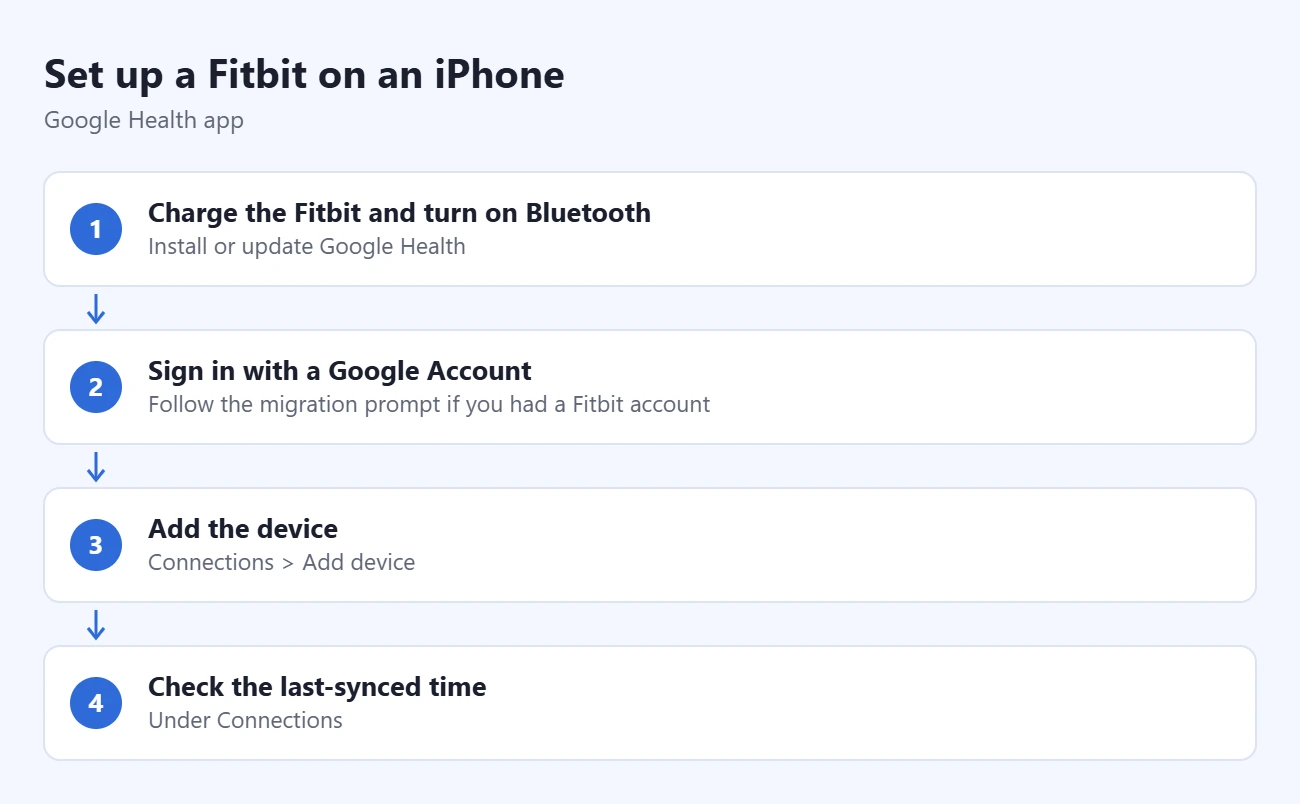
A Fitbit won’t sync until it’s set up in Google Health. Pair it in the app, not from the iPhone’s Bluetooth screen. Google specifically warns against starting setup from Settings > Bluetooth.
- Put the Fitbit on its charger.
- Open Google Health and tap Sign in with Google.
- Choose your Google Account. If you don’t have one, tap Sign in, then Create account.
- Follow the prompts to connect the device. Some Fitbit models show a setup notification on the iPhone; tap it if it appears.
- Enter your height, weight, and sex when asked. Google uses them to estimate stride length, distance, and calories burned.
- Tap Connections and confirm that your device is listed with a last-synced time and battery level.
Add or Replace a Device
Already signed in? Tap Connections, then Add device, pick your model, and follow the on-screen steps. If the new tracker replaces an old one, remove the old Fitbit from the iPhone’s Bluetooth list first. For help with that step, read about deleting a Bluetooth device on an iPhone. Google’s iPhone setup instructions cover each model.
What to Do When Your Fitbit Won’t Sync
Work through these steps in order and try a sync after each one. The early steps fix most problems and don’t remove anything.
- Charge it and bring it close. Put the Fitbit on its charger next to the iPhone, then sync.
- Turn off power-saving modes on the tracker. Battery saver and Bedtime mode on the Fitbit limit background connections. Turn them off, then tap the tracker’s screen to wake it.
- Check the iPhone permissions. Open Settings > Privacy & Security > Bluetooth and make sure Google Health is turned on. Then open Settings > General > Background App Refresh and turn it on for Google Health. Read about Background App Refresh on iPhone to learn why that switch can be grayed out.
- Check Low Power Mode. Low Power Mode turns off Background App Refresh, so background syncing can pause while it’s on. Turn it off under Settings > Battery (or Battery > Power Mode on iPhone 15 and later).
- Reset Bluetooth. Go to Settings > Bluetooth, turn the switch off for a few seconds, then turn it back on. Use Settings for this, because the Control Center button only disconnects accessories for a while.
- Refresh the app. In Google Health, tap Connections, pull down until a progress bar appears at the top, and release.
- Restart both devices. Restart the iPhone, open Google Health, and sync. Then restart the Fitbit and sync again once the clock face returns. A restart doesn’t erase activity data.
- Update everything. Install iPhone updates from Settings > General > Software Update, update Google Health in the App Store, and accept any Fitbit firmware update the app offers.
- Remove competing connections. If Google Health is installed on another phone or tablet nearby, that device can grab the tracker first. Delete the app there or forget the Fitbit in its Bluetooth settings. Also remove any other Fitbit devices from your account under Connections > your device > System > Disconnect.
Reconnect the Fitbit as a Last Resort
Disconnecting deletes data that hasn’t synced yet. Try every step above first, and if you plan to give the device away, erase it before removing it.
- In Google Health, tap Connections, select your device, and tap Disconnect device.
- On the iPhone, open Settings > Bluetooth, tap the i next to the Fitbit, and choose Forget This Device.
- In Google Health, tap Connections > Add device, choose your model, and follow the prompts.
If that still fails, delete and reinstall Google Health, but check first that your iPhone runs iOS 16.4 or later so the App Store will let you install it again. Google’s troubleshooting page lists these steps and links to support.
How to Restart a Fitbit
Restarting turns the device off and on without losing activity data. The method depends on the model:
- Charge 6: open Settings on the tracker, select Restart Device, and confirm Restart.
- Inspire 3: from the clock, open Settings, swipe up to Restart Device, and confirm Restart.
- Versa 4 and Sense 2: hold the button for 10 seconds until the Fitbit logo appears, then let go.
- Fitbit Air: place it on the plugged-in charger, hold the charger’s button for 10 seconds or until the status light flashes white, then release.
Google’s restart instructions cover other models. Don’t confuse a restart with a factory reset, which erases unsynced data.
Old Fitbit Accounts and Missing History
If you signed in with a Fitbit email and password before, Google Health asks you to move that account to a Google Account. Open the app, sign in with the Fitbit account, and follow the prompt about moving it. The move takes a few minutes, you can cancel before the final step, and it can’t be undone afterward.
Signing in with a brand-new Google Account instead gives you an empty history. Data deletion for accounts that weren’t moved began processing on July 15, 2026. After a move, a large amount of older data can take up to 48 hours to appear. Google’s account migration page has the details, including steps for family accounts.
Send Fitbit Data to Apple Health (Optional)
Syncing your Fitbit with Google Health is a separate step from sharing data with Apple’s Health app. Since mid-2026, Google Health can share data with Apple Health directly, so you no longer need a paid third-party sync app.
- In Google Health, tap Connections, then Apps and services.
- Under Add connections, tap Apple Health, then Get started.
- Tap Agree on the consent screen.
- Tap Turn All Categories On, or pick categories one by one, then tap Allow.
- Tap Done.
Steps, distance, exercise, sleep, heart rate, weight, and several other categories can flow both ways. Skin temperature and heart rate variability only go from Apple Health to Google Health. Google Health shows about three months of past Apple Health data. To change permissions later, use Manage data and access in Google Health or Sharing > Apps > Google Health in the Health app. Google’s Apple Health connection guide lists every category.
If you also wear an Apple Watch or carry your iPhone all day, Apple Health may get steps from more than one source. Apple’s Health app uses the source at the top of its list. To change the order, open Health > Browse, choose a category such as Activity > Steps, tap Data Sources & Access, tap Edit, and drag your preferred source to the top. The full steps are in Apple’s Health data management guide.
Devices That Sync Differently
- Aria Air and Aria 2 scales set up in Google Health. Aria 2 then sends weigh-ins over Wi-Fi, so iPhone Bluetooth tips don’t apply. The original Aria sets up in a web browser.
- Google Pixel Watch needs an Android phone and the Pixel Watch app for setup, so the iPhone steps above don’t apply.
- Fitbit Ace LTE has its own help center, and Ace trackers for kids use a child’s own Google Account, which a parent can create during setup.
Frequently Asked Questions
Does the Google Health app have to be open for my Fitbit to sync?
No. The tracker syncs throughout the day when it’s near your phone. Opening the app starts a sync too, which helps if Background App Refresh or Low Power Mode has paused background activity.
Do I need Wi-Fi to sync a Fitbit?
The tracker connects to the iPhone over Bluetooth. The iPhone then needs an internet connection, either Wi-Fi or cellular data, to upload the data to your Google Account.
Can I sync more than one Fitbit to the same account?
Multiple Fitbit devices can sync to one account, but some devices allow only one Fitbit per account. A Pixel Watch can share an account only with one Fitbit Air. If a new tracker won’t pair, remove the older one under Connections first.
Can I sync my Fitbit with an iPad?
Yes. A tracker can sync with any compatible phone or tablet. If the Fitbit shows phone notifications, forget it in the old device’s Bluetooth settings before you pair it with a different one.
Why is my sleep or workout missing after a sync?
Check the last-synced time first. If it’s current, the data may be under the Sleep or Fitness tab rather than on Today. If the time is old, the tracker hasn’t sent the data yet, so work through the troubleshooting list before you disconnect anything.
Once your tracker syncs reliably, consider turning on the Apple Health connection so your activity shows up in both apps.

Matthew Burleigh is the founder, head writer, and editor of Solve Your Tech, which he launched in 2012. He has written technology tutorials since 2008 and worked in IT since 2003, including small-business support, IT management, and consulting. He holds Bachelor’s and Master’s degrees in Computer Science from Arizona State University.
Matthew writes practical guides for Windows, iPhone and iPad, Microsoft Office, Outlook, Google apps, and Android. Solve Your Tech’s guides are checked step by step against the device or app maker’s own documentation and tested on his own devices whenever he has the hardware or software, with clear steps, sources, and update dates.
Read more about Matthew and how Solve Your Tech writes and updates its guides, or report a correction.