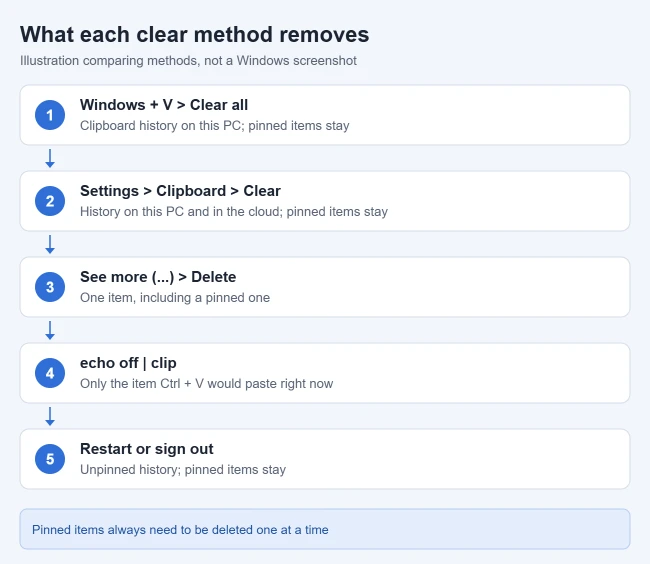
To clear the clipboard in Windows 11, press Windows + V and select Clear all. To also clear clipboard data synced to the cloud, open Settings > System > Clipboard and select Clear next to Clear clipboard data. Both methods keep pinned items, which you delete one at a time.
These steps apply to current versions of Windows 11 Home and Pro. The same controls exist in Windows 10, but Windows 10 reached end of support on October 14, 2025, so it no longer gets security updates. Clearing the clipboard never deletes the files or documents you copied from. It only removes the temporary copies Windows keeps so you can paste them.
Clipboard History vs. the Current Clipboard
Windows keeps two related things. The current clipboard is the one item that Ctrl + V pastes right now. Clipboard history is the optional list of up to 25 recent items that opens with Windows + V. Methods 1 through 3 clear history. The commands in Method 4 empty only the current clipboard. If you want both gone, use Method 1 or 2, then copy something harmless or run a command.
Method 1: Clear Clipboard History with Windows + V
This is the fastest way if clipboard history is turned on.
- Press Windows + V. A panel opens with the text and images you copied recently.
- Select Clear all at the top of the list. Everything except pinned items is removed, and the list now shows only your pinned items, if any.
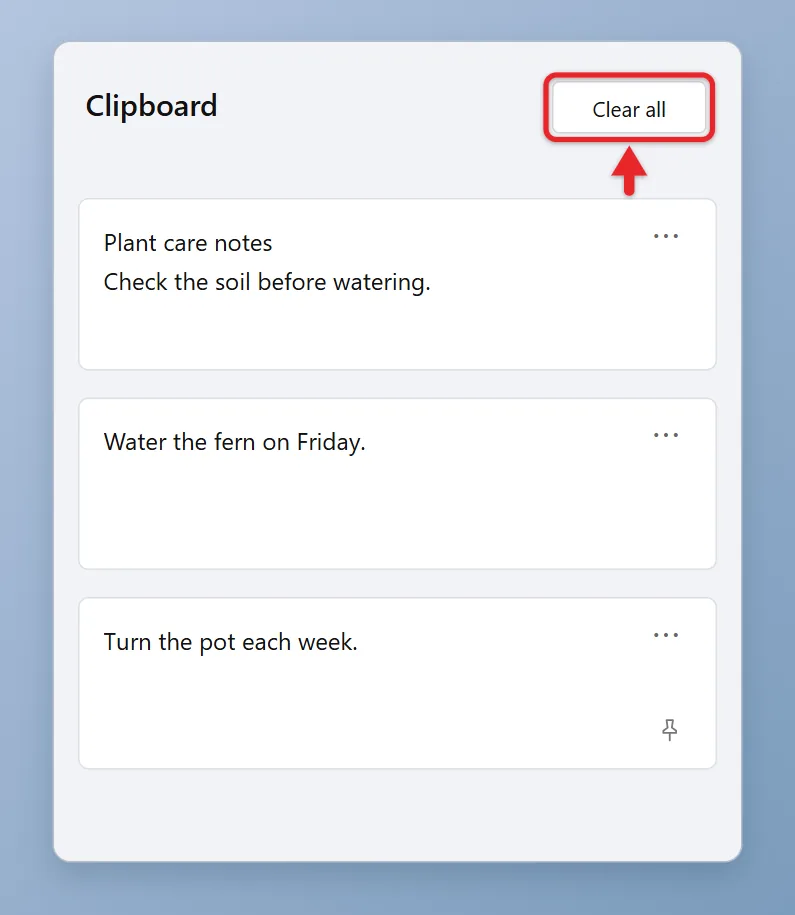
Save or paste anything you want to keep before you select Clear all. There’s no undo. New to the clipboard? See how to copy and paste on Windows 11.
If you need a paper copy first, learn how to print copied text or images before clearing.
Method 2: Clear Clipboard Data in Settings
Use this method if you sync your clipboard across devices. Microsoft says it clears everything except pinned items on your device and in the cloud.
- Press Windows + I to open Settings.
- Select System, then Clipboard.
- Next to Clear clipboard data, select Clear. Your unpinned history is cleared on this PC and in the cloud.

Items that already synced to another PC stay in that PC’s own history. Run Clear all there too, or turn off Clipboard history across your devices if you don’t use it. Sync works through your Microsoft account or work account, so every PC signed in with that account can receive your copied text.
Method 3: Delete One Item, Including Pinned Items
- Press Windows + V.
- Find the item you want gone.
- Select See more (…) next to it, then Delete (the trash can icon).
- Only that entry is removed. To remove a pinned item, delete it the same way, or unpin it first so the next Clear all removes it.
This is the one to use if you copied a password or account number but want to keep the rest of your history.
Method 4: Clear the Current Clipboard with a Command
These commands empty or overwrite what Ctrl + V pastes right now, and they work even when clipboard history is off. They don’t remove older entries from the Windows + V list.
Command Prompt
Press Windows + S, type cmd, and open Command Prompt. Here are more ways to open Command Prompt. At the prompt, type echo off | clip and press Enter. The clip command sends whatever comes before the pipe symbol to the clipboard, and echo off produces no text, so the clipboard ends up empty. Paste into Notepad to check: nothing appears.
You can do the same thing without opening a window. Press Windows + R, type cmd /c "echo off | clip" in the Run box, and select OK. A black window may flash for a moment.
PowerShell
In PowerShell or Terminal, type Set-Clipboard -Value " " and press Enter. This replaces the clipboard with a single space, because Set-Clipboard always clears the old content before it adds the new value.
Microsoft documents the clip command and Set-Clipboard. Neither command needs administrator rights.
Method 5: Make a One-Click or Hotkey Shortcut
If you clear the clipboard often, for example after copying passwords, put a shortcut on your desktop.
- Right-click an empty spot on the desktop and choose New > Shortcut.
- In the location box, enter one of the two commands described below, then select Next.
- Name it Clear Clipboard and select Finish.
- Optional: right-click the shortcut, choose Properties, click in Shortcut key, and press a combination such as Ctrl + Alt + C. Select OK.
- Double-click the shortcut, or press your keys, to run it.
For the location in step 2, cmd /c "echo off | clip" empties the current clipboard in one click, but it leaves clipboard history alone. If you want the shortcut to clear history too, use ms-settings:clipboard instead. That address opens the Clipboard page in Settings, which Microsoft lists among its Settings page addresses, and you then select Clear next to Clear clipboard data.
Shortcut keys work for shortcuts on the desktop or in the Start menu. If you move the shortcut into a regular folder, the key combination stops working.
Other Ways the Clipboard Gets Cleared or Replaced
- Restart: Microsoft says clipboard history is cleared every time you restart, except pinned items.
- Copy something harmless: copying a single letter or space replaces what Ctrl + V pastes, though the earlier item stays in history.
- Take a screenshot: a snip made with Windows + Shift + S, or the Print Screen key, also replaces the current clipboard with an image.
- Automatic limits: history holds 25 entries. Older unpinned items drop off as you copy new ones, and items over 4 MB aren’t saved to history.
Clear the Office Clipboard in Word or Excel
Microsoft Office has its own clipboard that holds up to 24 items and is separate from Windows + V. If Office says the clipboard is full, clear it inside the app:
- On the Home tab, select the small launcher arrow in the corner of the Clipboard group.
- In the Clipboard pane, select Clear All, or point at one clip, select its arrow, and choose Delete.
These are Microsoft’s steps for Excel. The same Clipboard pane appears in Word and other Office apps, as Microsoft’s Office Clipboard guide explains. See also how to clear the clipboard in Excel.
Turn Off Clipboard History to Stop Saving Items
If you don’t want Windows keeping a list at all, turn history off. Copy and paste still work, and Windows remembers only the last item.
- Open Settings > System > Clipboard.
- Turn Clipboard history off.
- Press Windows + V to check. It now offers to turn history on instead of showing a list.
Our guide to viewing the clipboard in Windows 11 covers turning history back on and pinning items.
Troubleshooting
Windows + V shows nothing or asks to turn on history
Clipboard history is off. Select Turn on in the panel, or turn on Clipboard history in Settings > System > Clipboard. Items you copied before turning it on won’t appear, but Ctrl + V still pastes the last one. Use Method 4 to clear it.
An item comes back after I clear it
It’s probably pinned, or it synced from another device. Delete pinned items individually, run Clear all on your other PCs, or turn off clipboard sync.
The clipboard settings are missing or locked
On work or school PCs, your organization can turn off clipboard history and sync. If the switches are grayed out, ask your IT department. Windows + V and the commands in Method 4 still clear what you can see.
Copy and paste stops working
Clear the clipboard, then copy a short line of plain text and paste it into Notepad. If that fails, restart the app you’re copying from, then restart Windows. Our guide to fixing copy and paste problems in Windows 11 goes further. You don’t need a third-party cleaner or repair tool to clear the clipboard.
Frequently Asked Questions
Is there a keyboard shortcut to clear the clipboard?
Not a single built-in one. Windows + V followed by Clear all is the quickest, or you can assign a hotkey to the shortcut in Method 5.
Does clearing the clipboard delete my files?
No. Copied files, text, and pictures stay where they were. If you cut something and clear the clipboard before pasting, the cut text is lost, so paste it first.
Does clearing the clipboard free up disk space?
Not meaningfully. For real space, delete junk files or empty the Recycle Bin.
Should I clear the clipboard for privacy?
It’s a good habit on a shared PC, especially after copying passwords or card numbers. Password managers can clear copied passwords for you after a short time. You might also want to clear recent files in Windows 11.

Matthew Burleigh is the founder, head writer, and editor of Solve Your Tech, which he launched in 2012. He has written technology tutorials since 2008 and worked in IT since 2003, including small-business support, IT management, and consulting. He holds Bachelor’s and Master’s degrees in Computer Science from Arizona State University.
Matthew writes practical guides for Windows, iPhone and iPad, Microsoft Office, Outlook, Google apps, and Android. Solve Your Tech’s guides are checked step by step against the device or app maker’s own documentation and tested on his own devices whenever he has the hardware or software, with clear steps, sources, and update dates.
Read more about Matthew and how Solve Your Tech writes and updates its guides, or report a correction.