To change your IP address in Windows 11, open Settings > Network & internet, select Wi-Fi or Ethernet and your network, then select Edit next to IP assignment. Choose Manual to type in a fixed (static) address, or Automatic (DHCP) to let the router assign one.
These steps cover Windows 11 Settings, Control Panel, and the command line. A separate section covers Windows 10, which reached end of support on October 14, 2025. All of it changes the PC’s local address on your own network. The public address that websites see belongs to your router and is covered at the end.
Local IP Address vs. Public IP Address
Every device on your home network has a local (private) address, such as 192.168.1.23. The router hands these out with DHCP (Dynamic Host Configuration Protocol), the service that assigns addresses automatically. When you browse the web, the router translates those local addresses to one public address that your internet provider assigns. Microsoft’s network planning guide explains this distinction.
That means:
- Changing the IP in Windows Settings changes only the PC’s local address. Websites still see the same public address.
- A static local address is useful when other devices need to find the PC at the same address every time: Remote Desktop, a shared printer or folder, port forwarding for a game or home server, or a network camera recorder.
- For everyday use, Microsoft recommends leaving the PC on DHCP, because the settings keep working when you take a laptop to another network.
Before You Change the Address
A wrong configuration can disconnect the PC. Save your work and avoid making this change during a remote session that depends on the connection. On a work or school network, get the values from IT, or ask before changing anything.
For a manual address you need four values:
| Value | What it is | Where to get it |
|---|---|---|
| IP address | The new address for this PC | Pick an unused address in the same range as your current one |
| Subnet mask | Defines which addresses are on your local network | Copy from your current settings (usually 255.255.255.0 at home) |
| Gateway | Your router’s address | Copy the Default Gateway from your current settings |
| DNS server | The server that turns website names into addresses | Copy from your current settings, or use the router’s address |
Pick an address outside the router’s DHCP range. The router keeps a pool of addresses it hands out automatically (for example 192.168.1.2 to 192.168.1.199). If you choose an address inside that pool, the router can later give the same address to another device, and both lose their connection. Your router’s admin page shows the range, usually under LAN or DHCP settings.
Example for a typical home network: if ipconfig shows IPv4 address 192.168.1.23, subnet mask 255.255.255.0, and default gateway 192.168.1.1, you could pick 192.168.1.200 as the new address. Keep the same subnet mask and gateway, and use 192.168.1.1 as the Preferred DNS. The first three groups of numbers stay the same as the gateway’s; only the last group changes.
A router reservation is often the better choice. If you only want the PC to keep the same address, a DHCP reservation (sometimes called address reservation or static lease) in your router’s settings does that while Windows stays on Automatic. Nothing breaks if you take the laptop to another network, and the router never hands that address to another device.
A network printer has its own settings, so follow the steps to change a printer’s IP address instead of changing the PC.
Record the Current Configuration
Write down your current settings first so you can put them back.
- Open Command Prompt. There are several ways to open Command Prompt in Windows 11 if you can’t find it.
- Type
ipconfig /alland press Enter. - Find the adapter you use (Wireless LAN adapter Wi-Fi or Ethernet adapter Ethernet) and note DHCP Enabled, IPv4 Address, Subnet Mask, Default Gateway, and DNS Servers. Ignore adapters that say Media disconnected.
You can also see the address in Settings > Network & internet: select Wi-Fi and your network, or Ethernet, and look next to IPv4 address. For a simpler lookup, read the Windows 11 IP address guide. Microsoft’s ipconfig reference documents the command options used here.
Set a Static IPv4 Address in Windows 11 Settings
These steps follow Microsoft’s TCP/IP settings instructions.
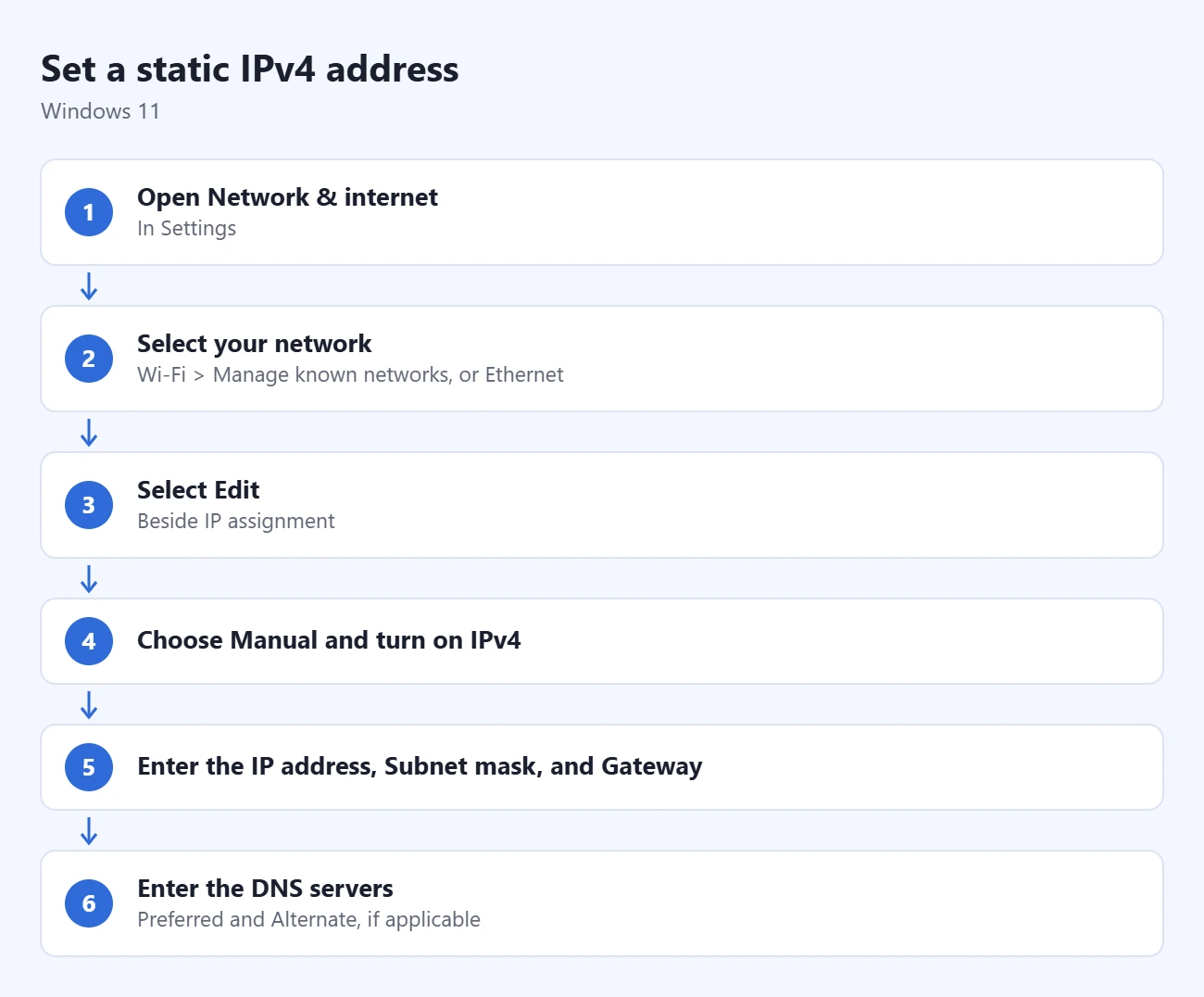
- Press Windows + I to open Settings, then select Network & internet in the left pane.
- For wireless, select Wi-Fi > Manage known networks, then the network you want to configure (or select Wi-Fi and then your connected network’s properties). For wired, select Ethernet. The connection’s properties page opens.
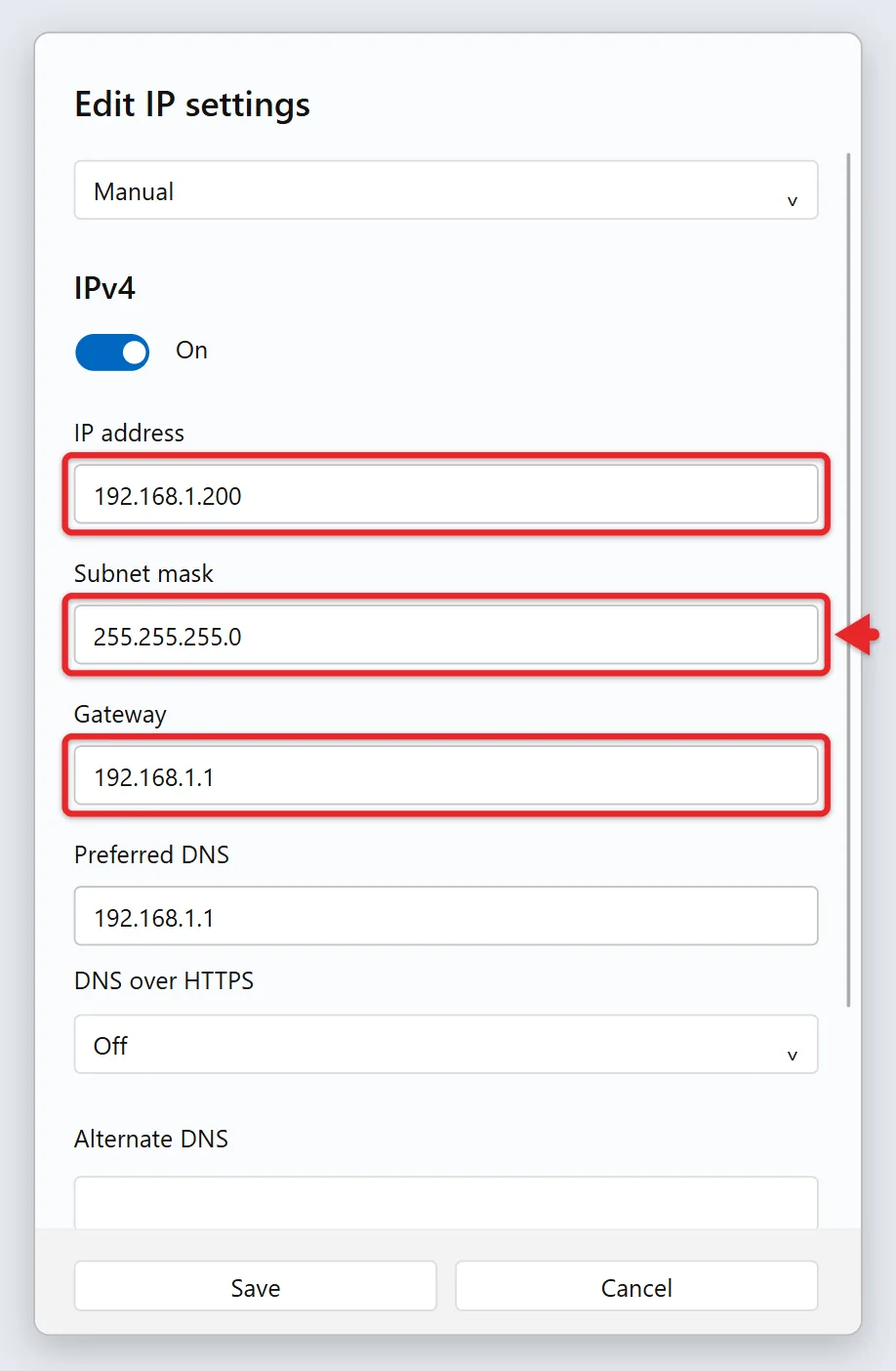
- Beside IP assignment, select Edit. The Edit IP settings window opens.
- Change the drop-down from Automatic (DHCP) to Manual, then turn on IPv4. Empty address boxes appear.
- Enter the new IP address, the Subnet mask (for example
255.255.255.0), and the Gateway (your router’s address). - Enter the Preferred DNS address (often your router’s address, such as
192.168.1.1) and an Alternate DNS if you have one. Leave DNS over HTTPS set to Off unless you know your DNS server supports it. - Check the values, then select Save. The connection drops for a moment and reconnects, and the properties page now shows IP assignment: Manual with your new address.
Change the connection you actually use. An Ethernet setting does not affect Wi-Fi, and each saved Wi-Fi network keeps its own IP settings, so a static address on your home Wi-Fi does not follow the laptop to a coffee shop. Leave IPv6 off in this window unless your network administrator gives you IPv6 values; Windows keeps configuring IPv6 automatically.
About DNS over HTTPS: this option encrypts DNS lookups. On (automatic template) works only with DNS providers Windows recognizes, and On (manual template) needs a template address from your provider. If you turn it on, the Fallback to plaintext switch decides whether Windows may send unencrypted lookups when encryption fails. For most home routers, leave it off.
Use Control Panel Instead (Windows 11 and Windows 10)
The older adapter settings window still works in Windows 11 and changes the whole adapter rather than one Wi-Fi network.
- Press Windows + R, type
ncpa.cpl, and press Enter. The Network Connections window opens. - Right-click your Wi-Fi or Ethernet adapter and select Properties.
- Select Internet Protocol Version 4 (TCP/IPv4), then select Properties.
- Choose Use the following IP address and enter the IP address, Subnet mask, and Default gateway.
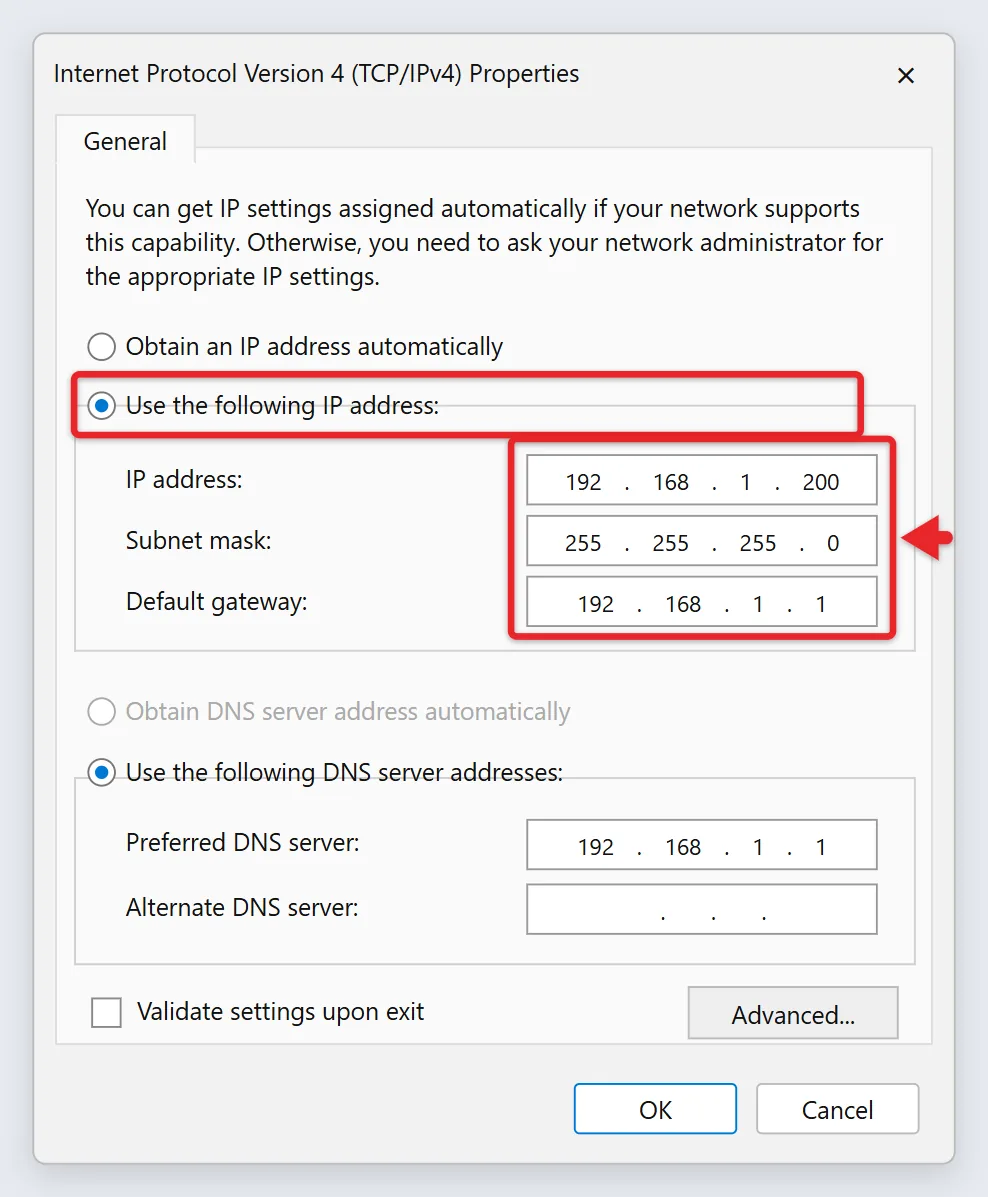
- Choose Use the following DNS server addresses, enter the Preferred DNS server and an Alternate DNS server if you have one, and select OK.
- Select Close in the adapter’s properties window.
To return to automatic, reopen the same dialog and choose Obtain an IP address automatically and Obtain DNS server address automatically.
Change the Address From the Command Line
The netsh command is handy when you set up several PCs or cannot reach Settings. Right-click Start, choose Terminal (Admin), and approve the prompt; changing settings needs administrator rights.
- Find the adapter’s exact name with
netsh interface show interface. Common names are Wi-Fi and Ethernet. - Set the address, mask, and gateway (replace the example values with yours):
netsh interface ipv4 set address name="Wi-Fi" source=static address=192.168.1.200 mask=255.255.255.0 gateway=192.168.1.1 - Set the DNS server:
netsh interface ipv4 set dnsservers name="Wi-Fi" source=static address=192.168.1.1 validate=no - Run
ipconfigto confirm the new address.
To go back to automatic, run netsh interface ipv4 set address name="Wi-Fi" source=dhcp and then netsh interface ipv4 set dnsservers name="Wi-Fi" source=dhcp. Microsoft’s netsh interface reference lists every option. Put quotes around adapter names that contain spaces.
PowerShell offers the same change with the New-NetIPAddress and Set-DnsClientServerAddress cmdlets. They use a prefix length instead of a subnet mask: 24 equals 255.255.255.0. If you are not used to PowerShell, the Settings or netsh method is easier to undo.
Change an IPv4 Address in Windows 10
Windows 10 no longer gets security updates after October 14, 2025, but the steps still work. The Control Panel method above is the most reliable path. In Windows 10 Settings, the route is Settings > Network & Internet > Wi-Fi (or Ethernet), select your network, then Edit under IP assignment. Windows 10 asks for a Subnet prefix length (24 for 255.255.255.0) instead of a subnet mask, and it has no DNS over HTTPS option.
Return to Automatic DHCP
- Open the same network in Settings > Network & internet.
- Beside IP assignment, select Edit.
- Choose Automatic (DHCP) and select Save.
The page now shows IP assignment: Automatic (DHCP), and the router gives the PC an address within a few seconds. Going back to DHCP may not give you the same address you had before. If your old setup was manual, re-enter the values you wrote down instead.
Renew a DHCP Address
Renewing asks the router for an address again. It helps when the PC shows a 169.254.x.x address, which means it could not reach the router.
- Make sure the adapter is set to Automatic (DHCP).
- Open Command Prompt and run
ipconfig /renew. To renew one adapter, add its name, such asipconfig /renew "Wi-Fi". - Run
ipconfigand check the IPv4 Address line.
Renewing often gives you the same address, because the router remembers the PC. Skip ipconfig /release unless you need it, because it drops the connection until you renew. Without an adapter name, both commands apply to every adapter.
Check That It Worked
Run ipconfig and confirm the active adapter shows the address you entered. Then load a familiar website, and open any local resource you set the address up for, such as a shared printer or folder. You can also run ping 192.168.1.1 (your gateway address) to test the link to the router.
Troubleshooting
No internet after the change. The gateway or subnet mask is usually wrong. Compare them with the values you wrote down; the gateway must be your router’s address and in the same range as the new IP. Microsoft’s addressing and subnetting explanation describes how the two work together.
Websites don’t load, but the router does. The DNS server is missing or wrong. Enter your router’s address as the Preferred DNS, or switch DNS back to automatic.
If only one site goes to the wrong address, look for an old entry when you edit the hosts file in Windows 11.
Windows reports an IP address conflict. Another device already uses that address. Pick a different one outside the DHCP range, or set up a reservation in the router instead.
The IP assignment option is missing or you are on the wrong page. You are probably looking at a network you are not using, or the main Wi-Fi page instead of the network’s own properties page. Select the network name itself. On a work or school PC, IT may lock these settings.
The address changes back. Make sure you selected Save (or OK in Control Panel). VPN apps and network management software can override adapter settings, and a different saved Wi-Fi network has its own settings.
Nothing restores the connection. Switch back to Automatic (DHCP) first. On a home PC, a network reset in Windows 11 returns all adapters to their defaults. You don’t need to turn off the firewall to assign an IP address.
How to Change Your Public IP Address
The address websites see is your router’s public address, and your internet provider assigns it. Nothing in Windows Settings changes it, and ipconfig /release and /renew don’t either.
- Search the web for “what is my IP” and note the public address.
- Turn off the modem and router, wait a few minutes, and turn them back on.
- Check the public address again once you are back online.
Many providers assign a new public address after a restart, but some keep the same one for days or give the account a fixed address. Your provider can tell you which kind you have. A VPN service also shows websites a different public address while it is connected, and your provider’s own address returns when you disconnect.
Frequently Asked Questions
Does changing my IP address make my internet faster?
No. A local address change does not affect speed, which depends on your internet plan, router, and signal.
Can Wi-Fi and Ethernet have different IP addresses?
Yes. Each adapter has its own settings, and each saved Wi-Fi network has its own too. A PC connected by both gets two local addresses.
Will changing the IP address disconnect me?
Briefly. The connection drops for a few seconds when you save, so downloads or video calls can be interrupted.
Do I need a static IP address?
Only if another device must find this PC at the same address every time, such as for Remote Desktop, a shared folder, or port forwarding. Otherwise, leave it on Automatic (DHCP).
What is the difference between a subnet mask and a prefix length?
They describe the same thing in two formats. 255.255.255.0 is the same as a prefix length of 24. Windows 11 Settings asks for the mask; Windows 10 Settings and PowerShell ask for the prefix length.
If you set the address so other PCs can reach this one, the next step is to turn on network discovery in Windows 11.

Matthew Burleigh is the founder, head writer, and editor of Solve Your Tech, which he launched in 2012. He has written technology tutorials since 2008 and worked in IT since 2003, including small-business support, IT management, and consulting. He holds Bachelor’s and Master’s degrees in Computer Science from Arizona State University.
Matthew writes practical guides for Windows, iPhone and iPad, Microsoft Office, Outlook, Google apps, and Android. Solve Your Tech’s guides are checked step by step against the device or app maker’s own documentation and tested on his own devices whenever he has the hardware or software, with clear steps, sources, and update dates.
Read more about Matthew and how Solve Your Tech writes and updates its guides, or report a correction.