To enable Gmail keyboard shortcuts on a computer, open Settings > See all settings > General, select Keyboard shortcuts on, and click Save Changes. Return to your inbox and press ? to open Gmail’s shortcut reference.
Start with a few navigation shortcuts before using actions that archive, delete, or send messages. The key you press, the item selected, and whether you are typing in a text field all affect what happens.
Enable the Shortcuts in Gmail on the Web
- Open Gmail in your computer’s browser.
- Check that you are using the account where you want shortcuts enabled.
- Click the Settings gear near the top right.
- Click See all settings.
- Open the General tab.
- Scroll down to Keyboard shortcuts.
- Select Keyboard shortcuts on.
- Scroll to the bottom and click Save Changes.
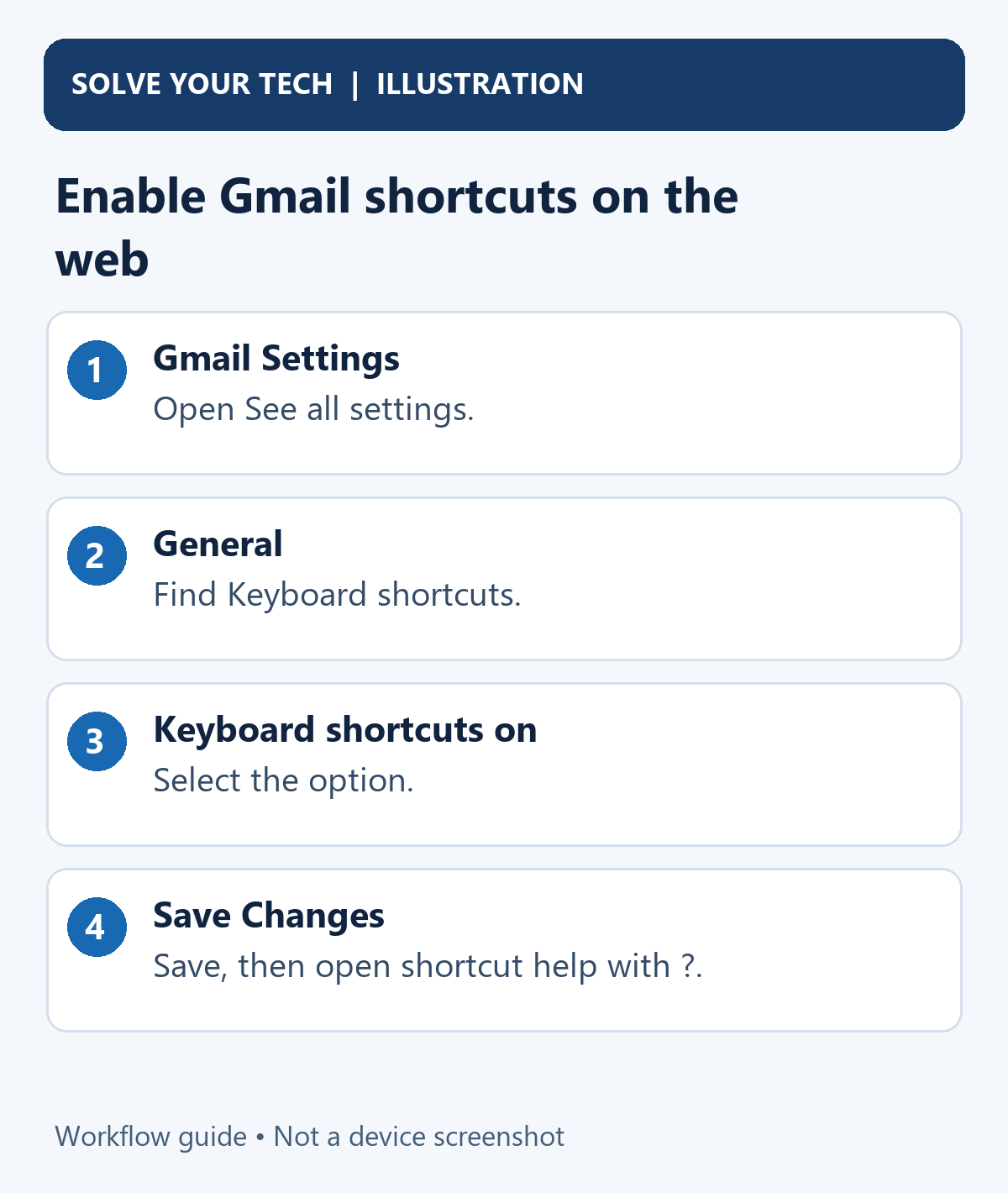
The last step matters. Selecting the option and leaving the page without saving may leave the previous setting in place. Once Gmail returns to the inbox, you can check the setting again through General if you are unsure whether the change saved.
Google’s keyboard-shortcut reference documents this setting and warns that shortcuts are not supported by every language or keyboard. These instructions describe the Gmail website; mobile apps have separate support and controls.
Open Gmail’s Shortcut Help
With Gmail active, press ?. On a US keyboard, that usually means holding Shift while pressing the slash key. Use the key combination that produces a question mark on your keyboard layout.
The help panel lists Gmail’s shortcuts and their categories. Google also documents an enabling route through this dialog: press Tab to reach its Enable link, then Enter. If you cannot open the dialog while shortcuts are off, use the General settings route above.
Google’s help page describes the dialog as an enabling route, while its Application table labels shortcut help as requiring shortcuts to be on. The settings route avoids depending on that inconsistency. Do not assume that every single-letter shortcut works before you enable the setting.
Keep the reference close while learning. It is more reliable than memorizing a list from an old guide, particularly if you have changed your shortcut mappings or use a different keyboard.
- Return to the Gmail inbox after saving the setting.
- Click a non-editable part of the mail list so you are not typing into the search box or a draft.
- Press j or k to move through conversations.
- Press o or Enter to open the focused conversation.
- Press u to return to the conversation list.
This checks useful navigation without sending or deleting anything. Be aware that opening an unread message can mark it as read. Choose a message that is already read if you want to minimize changes during your check.
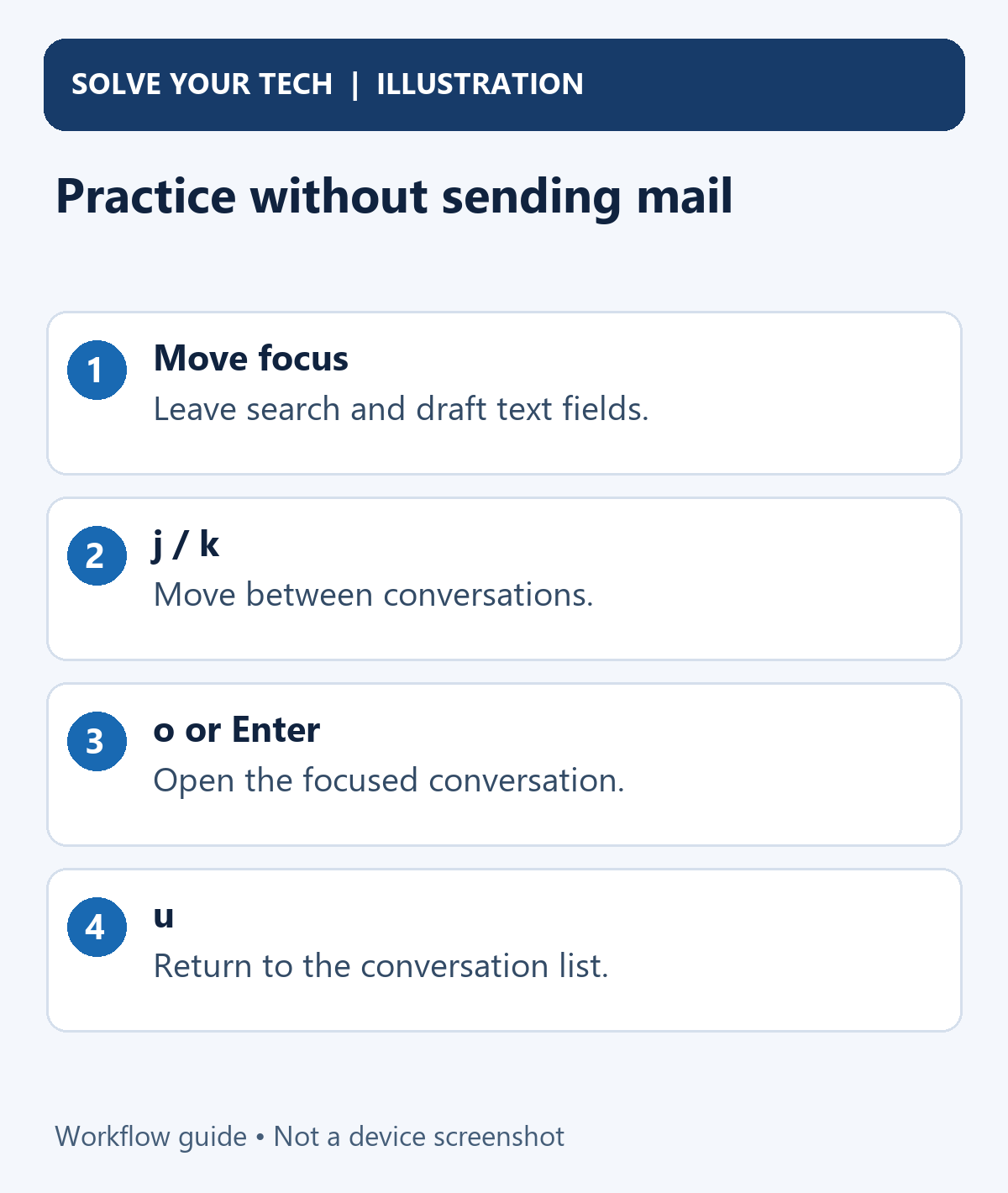
If the letters appear in the search box or email body, the text field has focus. Move focus out of the field before trying a navigation action again. The shortcut setting does not stop ordinary typing from working in a message.
Useful Shortcuts to Learn First
| Key | Action in Gmail on the web |
|---|---|
| j / k | Move to an older / newer conversation |
| o or Enter | Open the focused conversation |
| u | Return to the conversation list |
| g, then i | Go to Inbox |
| c | Open a new message draft |
| r | Reply to the open message |
| a | Reply all |
| f | Forward |
| x | Select a conversation |
| e | Archive the selected conversation |
| / | Focus the mail search field |
| ? | Open shortcut help |
Choose the commands that match the work you do most often. For example, j, k, o, and u form a small navigation set. You can learn that set before adding reply and archive actions. If you would rather use keys than the icons that appear when you point at a message, you can also disable hover actions in Gmail.
j/k move between conversations. n/p move between messages within an open conversation. This distinction matters when a thread contains several replies and you want to inspect a particular message rather than jump to a different thread.
Understand Sequences, Combinations, and Capitalization
g, then i is a sequence: press g, release it, then press i. It is not the same as holding both keys down together. Gmail also documents sequences such as g, then t for Sent and g, then d for Drafts.
Ctrl + Enter is a combination: hold Ctrl while pressing Enter. On a Mac, Gmail commonly uses Command for compose and formatting combinations that use Ctrl on Windows. Single-letter navigation commands such as j and k use the same letters on both platforms.
Where a shortcut specifies Shift, include it. r and Shift + r, for example, are different reply actions. A symbol such as # may itself require Shift on your keyboard layout. Do not confuse producing a symbol with pressing the unshifted key beneath it.
Select Messages Before Applying an Action
Some actions operate on the selected conversation rather than simply the one nearest your pointer. Press x to select a conversation, and check the visible selection before archiving or applying another action.
Gmail documents *, then a to select all conversations in the current view and *, then n to deselect them. Start with one message when learning; selecting many items makes a mistaken action affect more of your mailbox.
e archives mail, # deletes it, and ! reports it as spam. These actions have different consequences. Do not use deletion or spam reporting as a shortcut test. Archiving removes a conversation from the inbox without being the same as deleting it.
Google lists z for undoing the last action. When an Undo notice appears, use it promptly if you acted on the wrong item. Undoing a mailbox action is separate from canceling a sent message.
Reply, Format, and Send Carefully
Pressing r, a, or f starts a reply, Reply-all draft, or forward. Review the actual recipients before sending, especially after pressing a for a group reply. Our Gmail Reply-all guide explains how default reply behavior and one-message choices work.
In a draft, Gmail supports formatting combinations such as Ctrl/Command + b for bold, Ctrl/Command + i for italic, and Ctrl/Command + k for inserting a link. These are different from the single-letter inbox commands and need the appropriate text or cursor context.
Ctrl/Command + Enter sends a message. Avoid that shortcut while experimenting with a draft. Review the recipient line, subject, attachments, and message first. If you send too soon, Undo Send in Gmail only helps during its short cancellation window; it does not recall mail indefinitely.
Customize the Keys
Enabling normal shortcuts and enabling custom mappings are separate steps:
- Open Settings > See all settings > Advanced.
- Find Custom keyboard shortcuts and choose Enable.
- Click Save Changes.
- Reopen settings and select the Keyboard Shortcuts tab that appears.
- Change the key assigned to the action you want to customize.
- Click Save Changes again.
Google states that one key can refer to only one action. Change a small number of mappings and note the original keys so you can restore them. Then test the revised command on a harmless item before using it during important email work.
A custom mapping changes what a key does in Gmail. It does not remap your whole keyboard or change another app’s shortcuts. If a letter stops producing the action shown in a standard cheat sheet, check this tab for an existing customization.
If Shortcuts Are Not Working
Check the saved setting: Confirm Keyboard shortcuts on in General and save. Review the signed-in account too, especially if you switch between personal and work inboxes.
Check focus: Make Gmail’s browser tab active and move focus out of search, a draft, or another text box for inbox commands. A key typed into an email body is ordinary text, not a failed navigation command.
Check the key sequence: Release the first key in a sequence before pressing the next. Include required modifiers and produce the correct symbol for your keyboard layout.
Check custom mappings: A previous customization can make the documented default letter behave differently. Inspect the Keyboard Shortcuts tab if it is enabled.
Check keyboard and browser conflicts: Test whether the key works normally in another text field. If a browser extension or another app captures the combination, try Gmail in another supported browser or a clean browser context. Avoid resetting the entire browser as your first troubleshooting step.
Gmail on iPad, iPhone, and Android
Google documents Gmail app shortcuts for an iPad with a connected keyboard. In the iPad app, open Menu > Settings and turn on Enable keyboard shortcuts. Holding Command can show descriptions for supported commands.
Google states that keyboard shortcuts are not currently supported in the Gmail app for iPhone. It also documents shortcuts for Android with an external keyboard. Use the platform-specific list, rather than assuming all desktop combinations work on a phone or tablet.
Turn Shortcuts Off Again
Return to Settings > See all settings > General, choose Keyboard shortcuts off, and click Save Changes. This turns off the optional shortcut actions controlled by that setting; ordinary browser keys and text-editing combinations may still work.
For a more comfortable inbox while learning, you can also change Gmail’s display density. The goal is a few reliable commands that fit your routine, not using every shortcut in the reference at once.

Matthew Burleigh is the founder, head writer, and editor of Solve Your Tech, which he launched in 2012. He has written technology tutorials since 2008 and worked in IT since 2003, including small-business support, IT management, and consulting. He holds Bachelor’s and Master’s degrees in Computer Science from Arizona State University.
Matthew writes practical guides for Windows, iPhone and iPad, Microsoft Office, Outlook, Google apps, and Android. Solve Your Tech’s guides are tested on current devices or checked against official product documentation, with clear steps, sources, and update dates.
Read more about Matthew and how Solve Your Tech writes and updates its guides, or report a correction.