A DVD backup is a second copy of a disc’s contents, stored somewhere other than the disc itself. For a DVD you made yourself, such as a home movie, the shortest reliable route is to copy the disc’s VIDEO_TS folder to your computer with File Explorer on Windows or the Finder on a Mac. On a Mac you can also save the whole disc as one disc image file with Disk Utility by choosing File > New Image.
This guide covers home-made discs and data discs that have no copy protection. It uses only tools that come with Windows and macOS, so there is nothing to buy or download. If you also want a playable MP4 copy, a short HandBrake section near the end covers that.
What You Can and Cannot Back Up This Way
Before you start, work out what kind of disc you have. The answer decides whether the methods here will work.
- Home-made video DVDs. Discs you created from camcorder footage, phone videos, or a transfer service usually have no copy protection. These are the discs this guide is for.
- Data DVDs. Discs that hold ordinary files such as photos, documents, or video files. These copy like any other folder.
- Store-bought movies and TV shows. Most commercial DVDs are copy-protected. The built-in tools in Windows and macOS do not remove that protection, and this guide does not cover getting around it.
Apple states the limit plainly in its DVD Player guide: you cannot copy and play video folders from DVD discs with copy protection. In the United States, federal law also restricts bypassing copy protection, even for a disc you own. Laws differ by country, and this article is not legal advice. If you want a digital version of a commercial movie, check whether your disc came with a digital code or buy the title from a digital store.
What You Need
- A DVD drive. Many current laptops and desktops do not have one built in. An external USB DVD drive works on both Windows and Mac. Apple’s USB SuperDrive connects to a USB-A port, so a Mac with only USB-C or Thunderbolt ports needs an adapter.
- Free storage space. A single-layer DVD holds about 4.7 GB. A dual-layer disc holds roughly twice that. Leave more free space than the disc’s size.
- A clean disc. Wipe fingerprints and dust off with a soft, lint-free cloth, moving from the center straight out to the edge.
- Time. Reading a full disc can take a while, and older or worn discs read more slowly.
Choose a Backup Type: Folder Copy or Disc Image
There are two common ways to store a DVD’s contents on a computer. A folder copy is the disc’s files and folders copied as they are. A disc image is a single file that holds a copy of the entire disc.
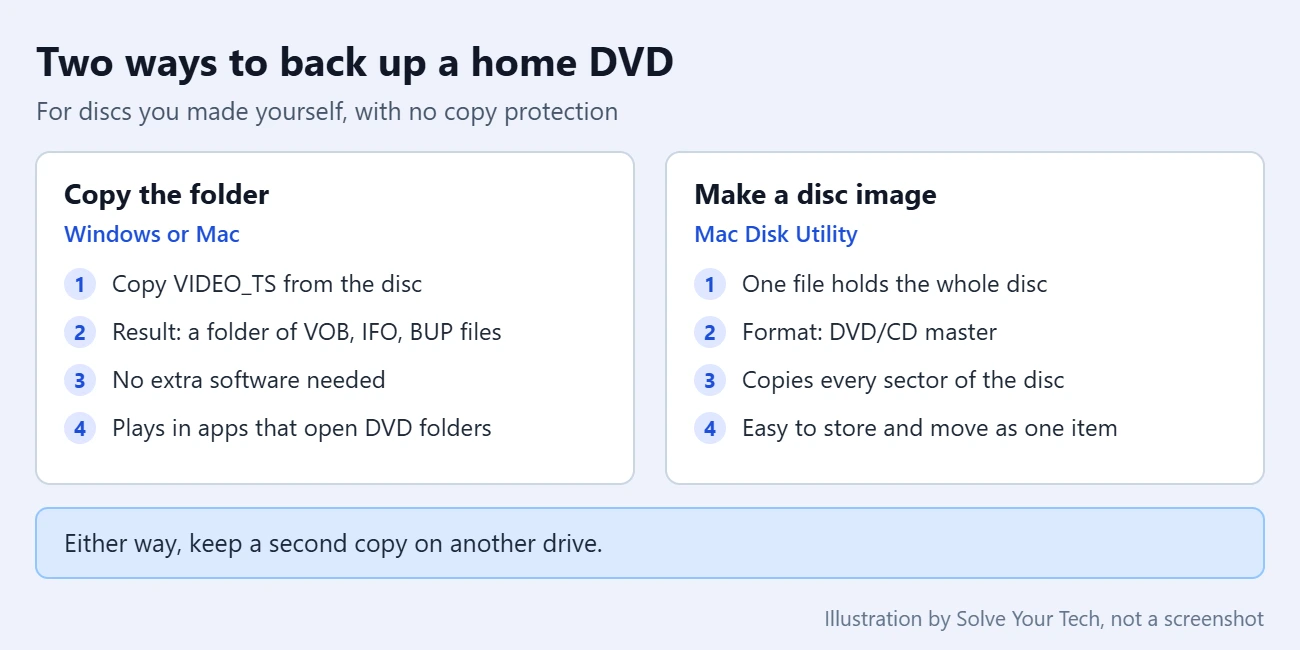
A video DVD stores its movie inside a folder named VIDEO_TS. The files inside it work together, so the folder has to stay complete. Some discs also have an AUDIO_TS folder, which is often empty.
| Question | Folder copy | Disc image |
|---|---|---|
| What you end up with | A folder containing VIDEO_TS | One file for the whole disc |
| Built-in tool on Windows | File Explorer | None. Windows has no built-in tool for making a disc image. |
| Built-in tool on Mac | Finder | Disk Utility |
| Best for | A quick, simple copy you can browse | An exact copy that is easy to move as one item |
If you are unsure, make a folder copy. It works on both systems and needs no settings.
How to Back Up a Home DVD on Windows 11 or Windows 10
These steps copy the disc’s contents to a folder on your PC. They work the same way in Windows 11 and Windows 10.
- Insert the DVD. Put the disc in your DVD drive. If a notification or an AutoPlay window appears, you can close it.
- Open File Explorer. Press Windows key + E, then select This PC in the left pane. Your DVD drive appears under the list of devices and drives, usually with the disc’s name.
- Open the disc. Right-click the DVD drive and choose Open. Double-clicking may start a player instead of showing the files. You should see a VIDEO_TS folder on a video DVD, or your own files on a data DVD.
- Create a destination folder. In a second File Explorer window, go to the place where you want the backup, such as your Videos folder or an external drive. Create a new folder and give it a clear name, for example the event and the year.
- Copy everything. In the disc window, press Ctrl + A to select all items, then Ctrl + C to copy. Switch to the destination folder and press Ctrl + V. A progress window shows the copy.
- Wait for the copy to finish. Do not eject the disc or put the PC to sleep while it runs. When the progress window closes without an error, the copy is done.
Copy the whole VIDEO_TS folder, not single files from inside it. A video DVD depends on all of those files being together, with their original names.
If Windows reports that a file cannot be read, stop and see the troubleshooting section before you rely on the copy.
Playing the copy on Windows
Windows does not include DVD movie playback by default. Microsoft’s support page for Windows Media Player Legacy says that DVD playback is not included in Windows 10 or Windows 11. That means you may need a separate player app to watch the folder you copied, just as you would to watch the disc. There are a few ways to play a DVD on Windows 11.
How to Back Up a Home DVD on a Mac by Copying the Folder
This is the Mac version of the folder copy. It uses the Finder only.
- Connect your optical drive and insert the DVD. If the DVD Player app opens and starts playing, quit it by choosing DVD Player > Quit DVD Player.
- Open the disc in the Finder. Click the Finder icon in the Dock, then select the disc in the sidebar. You should see the VIDEO_TS folder.
- Create a destination folder. In another Finder window, open the location for the backup, such as your Movies folder or an external drive. Choose File > New Folder and name it.
- Drag the contents across. Drag VIDEO_TS, and AUDIO_TS if it is there, from the disc window into the new folder. Because the disc is a separate volume, dragging makes a copy and leaves the disc unchanged.
- Wait, then eject. When the copy finishes, select the disc in the Finder and choose File > Eject.
If the disc stays stuck in an Apple USB SuperDrive, follow the steps for ejecting a disc from a SuperDrive on a MacBook Air.
Playing the copy on a Mac
You can also play a DVD folder stored on your Mac. In the DVD Player app, choose File > Open DVD Media, navigate to the VIDEO_TS folder, then click Open. The steps are in Apple’s guide to playing a DVD or DVD movie file in DVD Player on Mac. Apple also notes that DVD Player does not play Blu-ray discs.
How to Save a Home DVD as a Disc Image on a Mac
A disc image keeps the whole disc in one file. Disk Utility, which is part of macOS, can create one from a connected disc.
Warning before you start: Don’t create a disk image of a disk you believe is failing or that contains corrupted information, because the image may not serve as a reliable backup. If the disc already skips or freezes, try the folder copy first so you can see which files read correctly.
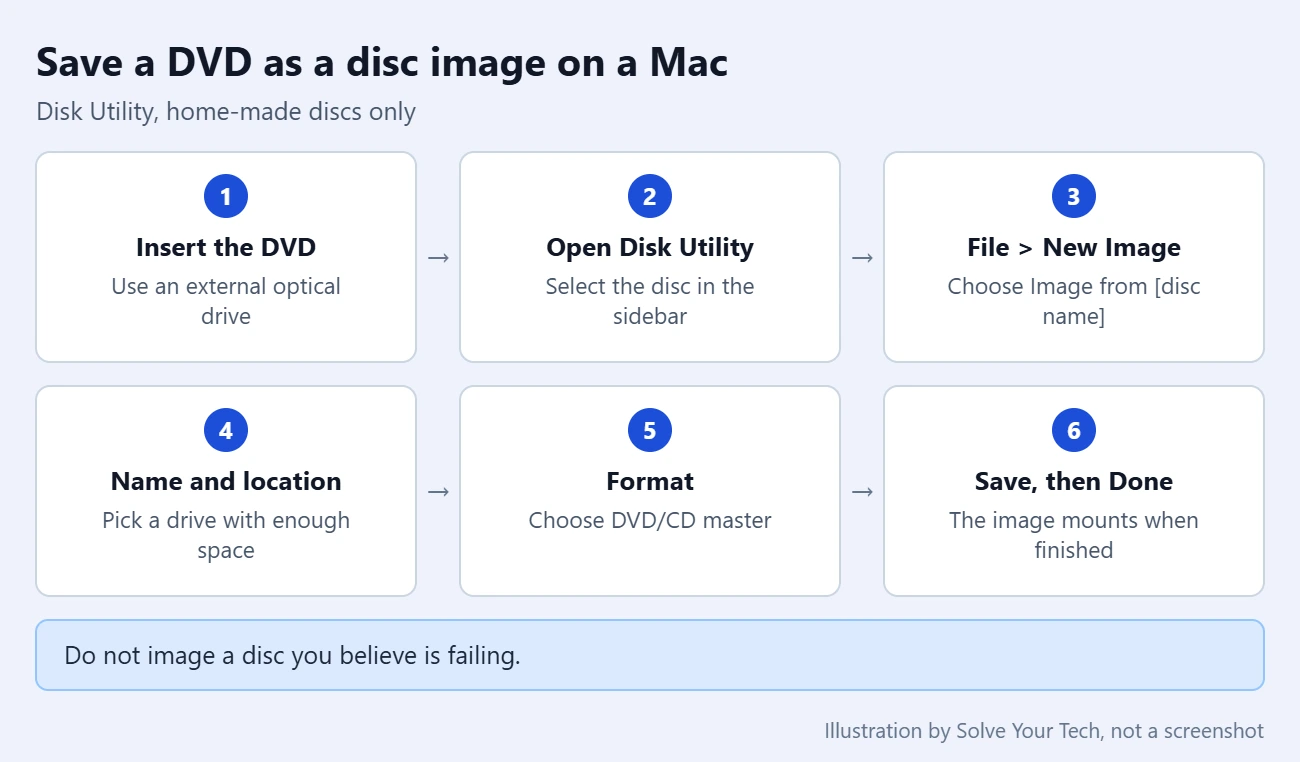
- Insert the DVD and quit DVD Player if it opens.
- Open Disk Utility. You can find it with Spotlight, or in the Utilities folder inside Applications.
- Select the disc. Click the DVD in the Disk Utility sidebar.
- Start a new image. Choose File > New Image, then choose the option that reads Image from followed by the name of your disc.
- Name and place the file. Enter a filename and choose where to save it. Pick a drive with more free space than the size of the disc.
- Choose a format. Click the Format pop-up menu. DVD/CD master includes a copy of all sectors and copies all data exactly when used to create other discs. A read-only format is the other reasonable choice if you only want to open the image on a Mac.
- Leave encryption off unless you need it. The Encryption pop-up menu is optional. If you turn it on, you will need the password every time you open the image, so store that password safely.
- Click Save, then Done. Disk Utility creates the image file in the location you chose and mounts it, so it appears in the Finder sidebar like a disc.
The format names in this menu have changed between macOS versions. If your Mac shows slightly different wording, check Apple’s instructions for your version in Create a disk image using Disk Utility on Mac. The page has a version selector at the top.
To use the image later, double-click the file. It mounts as if you had inserted the disc, and you can open its VIDEO_TS folder from DVD Player with File > Open DVD Media.
How to Confirm the Backup Worked
No error message doesn’t mean the copy is good. Check it before you put the disc away.
- Compare sizes. On Windows, right-click the DVD drive and choose Properties, then do the same for your backup folder. On a Mac, select each one and choose File > Get Info. The used space on the disc and the size of the backup should be close.
- Count the files. The backup’s VIDEO_TS folder should contain the same number of items as the one on the disc.
- Play from the backup, not the disc. Eject the DVD first. Then open the backup in a player and skip to the beginning, the middle, and the end of the video. Check that the picture and sound both work at each point.
- Open the image. If you made a disc image on a Mac, double-click it and check that it mounts and shows the disc’s folders.
Only delete other copies of the footage after the backup passes these checks, and ideally not even then.
Keep a Second Copy of the Backup
A backup on the same computer protects you from a damaged disc, but not from a failed hard drive. Put a second copy on an external drive. On Windows, File History backs up your Videos folder automatically. On a Mac, Time Machine includes your Movies folder.
You can also copy the backup folder or image file to an external drive by hand and store it away from the original disc. Backing up the whole computer is covered in backing up Windows to an external hard drive.
On a Mac, you can show external drives on your desktop so the backup drive is easy to spot when you plug it in.
Burning a Replacement Disc From Your Backup
A backup on a drive is enough for safekeeping. If you also want a spare physical disc, burn the files to a blank DVD. On a Mac, drag the files onto a blank disc in the Finder and choose File > Burn to Disc. On Windows, use the Burn tab in Windows Media Player. A disc burned as plain data may not play in a living-room DVD player. If you want several spares, you can burn multiple disc copies for free.
Troubleshooting a DVD Backup
The disc does not show up
Check that the drive has power and the cable is firmly connected. Plug an external drive directly into the computer instead of a hub. Apple gives the same advice for its SuperDrive when it does not respond through a hub or display. Then try a different disc. If other discs work, the problem is the disc and not the drive.
The copy stops with a read error
A read error usually means the drive could not read part of the disc. Eject it, clean it, and try again. If it fails at the same point, try a different DVD drive, because drives differ in how well they read marginal discs. If one file still will not copy, copy the remaining files so you at least keep what is readable, and label that backup as incomplete.
The files copy but will not play
First make sure you copied the complete VIDEO_TS folder and did not rename anything inside it. On Windows, remember that DVD playback is not built in, so the issue may be the lack of a player and not the backup. If the disc is a commercial title, the copy will not play because of copy protection, and that is expected.
There is no VIDEO_TS folder
The disc is probably a data DVD or uses a different recording format. Some camcorders and DVD recorders write discs in their own layout. Copy whatever files and folders are on the disc, keeping the structure intact. Apple also notes that DVD Player does not recognize video content burned onto certain types of DVD-RW discs.
The disc looks empty on a computer but plays in a DVD recorder
Discs made in a set-top DVD recorder or camcorder sometimes have to be finalized in that device before a computer can read them. Put the disc back in the recorder that made it and look for a Finalize option in its disc menu or manual.
There is not enough space
Free up room or choose an external drive as the destination. A full dual-layer disc needs more than 8 GB, plus working room.
Convert an Unprotected Home DVD to MP4
For your own unprotected home DVD, install HandBrake from its official site, insert the disc, and choose Open Source to select the DVD drive or an already copied VIDEO_TS folder. Let it scan, then choose the Title whose duration matches your recording. Use Preview and check chapters, audio and subtitles so you do not encode only a menu or the wrong clip. HandBrake’s quick start guide explains source selection, titles and presets. This workflow does not remove copy protection.
Choose a preset such as General > Fast 1080p30 and confirm the Format is MP4. Click Browse to pick a save location and file name, then click Start. When it finishes, play the MP4 to check the picture and sound. Keep your VIDEO_TS copy as the real backup, since an MP4 does not keep the disc menus or extras.
Frequently Asked Questions
Is a DVD a good long-term backup?
A DVD is fine as one copy, but it should not be the only one. Discs can be scratched, lost, or become unreadable with age, and fewer computers ship with a drive that can read them. Keep the content on at least one hard drive or other storage device as well.
Can I back up a store-bought movie DVD with these steps?
No. Most commercial DVDs are copy-protected, and the built-in tools in Windows and macOS do not remove that protection. You cannot copy and play video folders from copy-protected discs in DVD Player. This guide is for discs you made yourself.
What is the VIDEO_TS folder?
VIDEO_TS is the folder on a video DVD that holds the movie, its menus, and the information a player needs to navigate the disc. To back up a video DVD as files, copy this folder in full and keep the file names unchanged.
What is a disc image?
A disc image is a single file that contains a copy of an entire disc. On a Mac, Disk Utility can create one from a DVD, and double-clicking the file mounts it like a real disc. ISO is another common disc image format you may see on Windows.
Does backing up a DVD reduce the video quality?
Copying the folder or making a disc image does not change the video. Both methods copy the existing data as it is. Quality only changes if you later convert the video to a different format with other software.
How much space does a DVD backup need?
Plan for up to about 4.7 GB for a single-layer disc and roughly twice that for a dual-layer disc. A disc image in the DVD/CD master format includes every sector of the disc, so it can be as large as the disc’s full capacity even if the disc is not full.
Can I turn the backup into an MP4 file?
The built-in folder and disc-image tools preserve existing DVD files rather than convert them. For an unprotected home recording, follow Convert an Unprotected Home DVD to MP4 in this guide with HandBrake. That produces a new, re-encoded viewing file. Keep the untouched folder copy or disc image as your backup even if you also make an MP4.
Next Step
Pick the one home-made DVD you would least want to lose and back it up today using the folder copy. Check that it plays from the copy, then put a second copy on an external drive. Once that works, repeat the process for the rest of your discs. To write a disc image back to a blank disc on a PC later, burn the ISO file to a disc.

Matthew Burleigh is the founder, head writer, and editor of Solve Your Tech, which he launched in 2012. He has written technology tutorials since 2008 and worked in IT since 2003, including small-business support, IT management, and consulting. He holds Bachelor’s and Master’s degrees in Computer Science from Arizona State University.
Matthew writes practical guides for Windows, iPhone and iPad, Microsoft Office, Outlook, Google apps, and Android. Solve Your Tech’s guides are checked step by step against the device or app maker’s own documentation and tested on his own devices whenever he has the hardware or software, with clear steps, sources, and update dates.
Read more about Matthew and how Solve Your Tech writes and updates its guides, or report a correction.