To change the date format on an iPhone, open Settings, tap General, tap Language & Region, tap Date Format, and pick the format you want, such as month/day/year or day/month/year. The same screen also has the Temperature and Measurement System settings if you want Celsius or metric units.
These steps are for iPhones running iOS 16 or later, including iOS 27. Apple added the separate Date Format control in iOS 16. Apple covers the screen in its guide to changing the language and region on iPhone.
What the Date Format Setting Changes
Date Format controls how short numeric dates are written, for example 10/13/26 versus 13/10/26. You’ll see the difference in places like the message list in Messages, email dates in Mail, and other apps that follow the system format.
It doesn’t change the actual date or time on the phone, and it doesn’t move any Calendar events. It also doesn’t affect spelled-out dates like “Tuesday, October 13” on the Lock Screen. If your iPhone shows the wrong date or time, you need a different setting for changing the date, time, and time zone on iPhone.
Why it matters: a date like 03/04/26 means March 4 in the United States and April 3 in most of Europe. Picking the format you read naturally avoids missed appointments and confusing receipts.
Change the Date Format
- Open the Settings app.
- Tap General.
- Tap Language & Region. You’ll see your languages at the top, followed by Region, Calendar, Temperature, Measurement System, First Day of Week, Date Format, and Number Format.
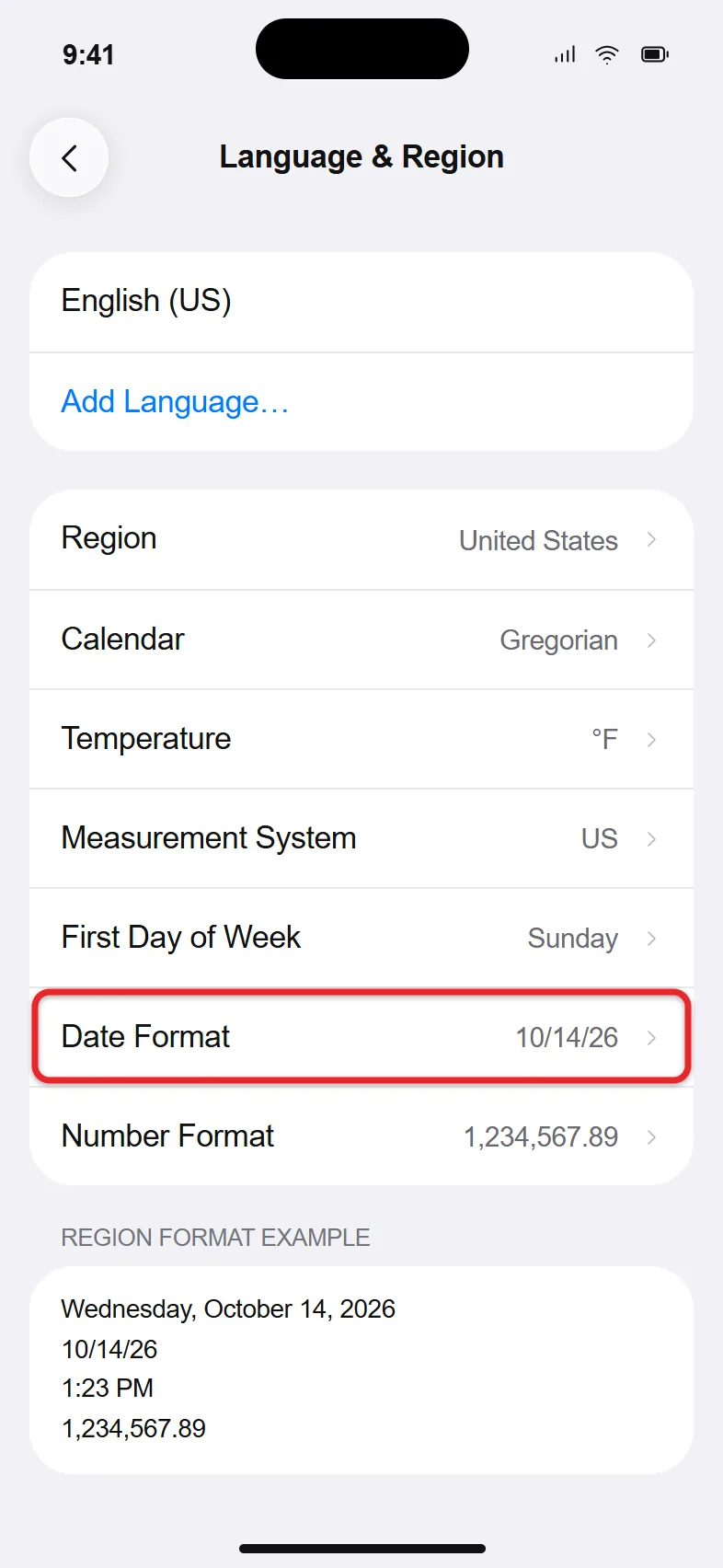
- Tap Date Format. The next screen lists each available format as a sample date, such as 8/19/26 (month/day/year), 19/8/26 (day/month/year), and 2026-08-19 (year-month-day).
- Tap the format you want. A check mark moves to it, and the change takes effect right away. There’s no Save button.
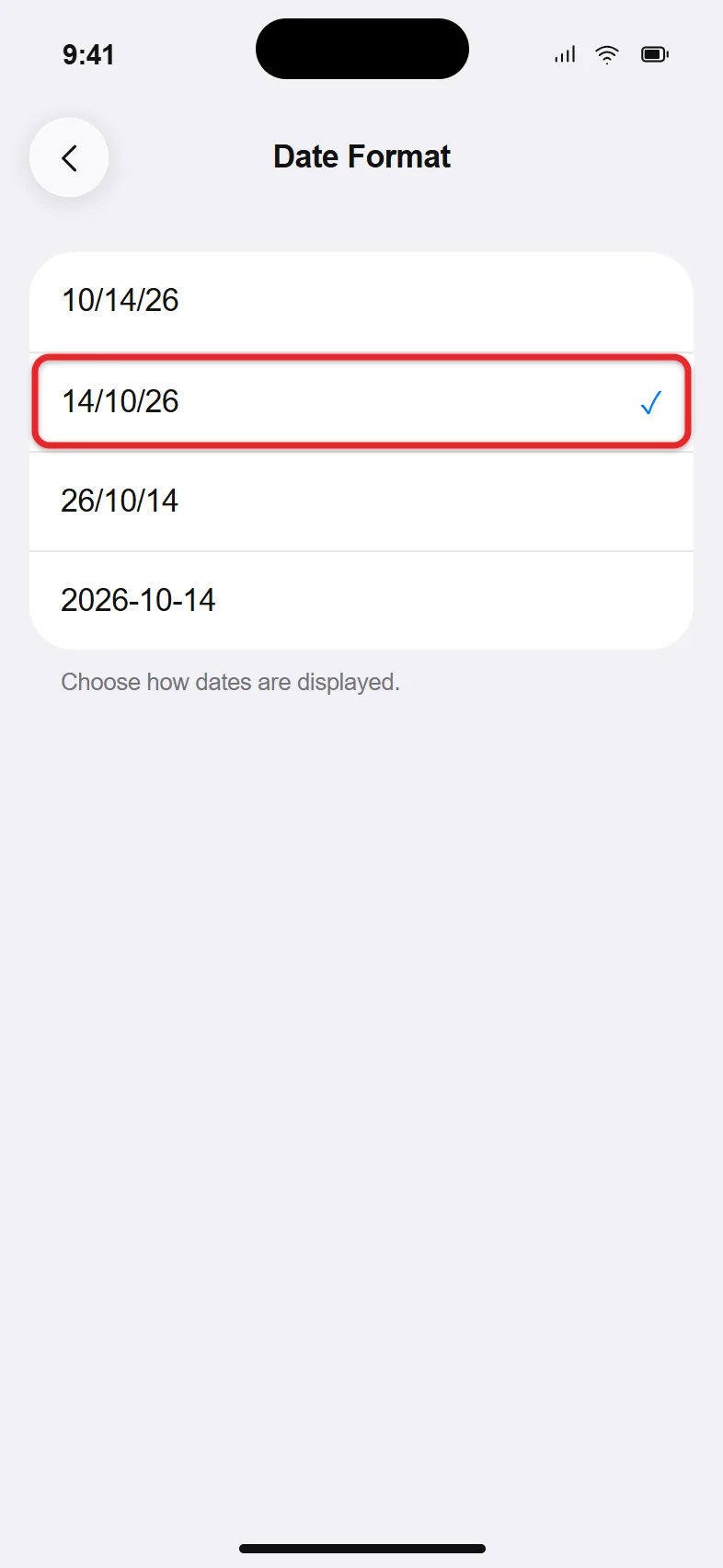
- Tap the back arrow at the top left to return to Language & Region. At the bottom of the screen, the Region Format Example box shows a sample date, time, and numbers using your new settings.
The list of formats depends on your Region. If the order you want isn’t offered, see the next section.
If the Format You Want Isn’t Listed
Each region comes with its own set of date formats. To get formats used in another country, change the region:
- Go to Settings > General > Language & Region.
- Tap Region and choose the country whose formats you want. Use the search field at the top to find it faster. For example, United Kingdom uses day/month/year.
- Confirm the change if your iPhone asks whether to switch to the new country.
- Go back and check Date Format again for the new options.
Changing the region does more than change dates. It also sets the default currency symbol, number format, units, and first day of the week, and it can change which features or App Store content are available. Check the Region Format Example afterward, and adjust Temperature or Measurement System back if you need to. To undo the whole change, set Region back to your original country.
Change Temperature and Measurement Units
These are on the same Language & Region screen, so you can switch units without touching the region.
To switch between Celsius and Fahrenheit:
- Go to Settings > General > Language & Region.
- Tap Temperature.
- Tap Celsius (°C) or Fahrenheit (°F).
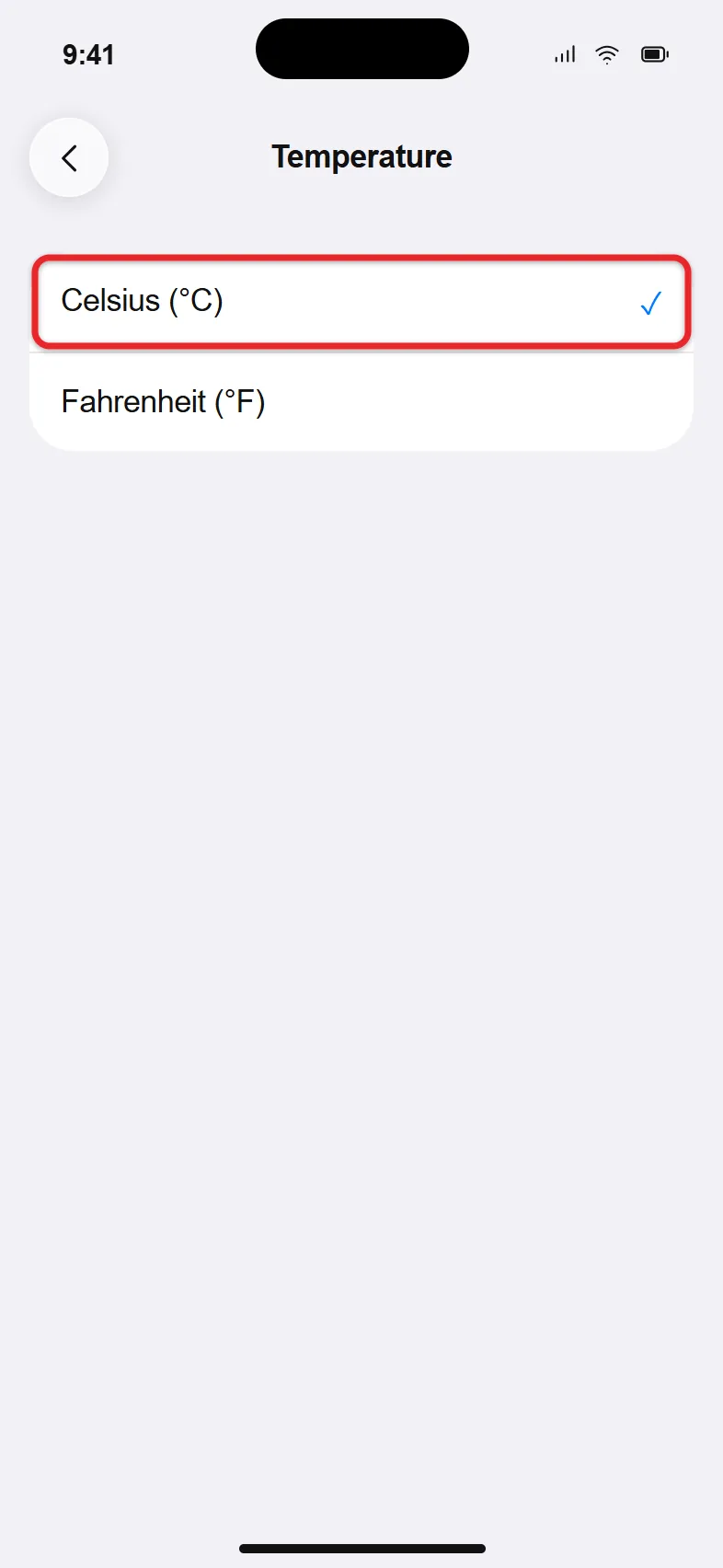
The Weather app and its widgets, along with other apps that use the system setting, show the new unit. The Weather app also has its own unit choice in its menu, so check there if it doesn’t change.
To switch between miles and kilometers (and other units):
- Go to Settings > General > Language & Region.
- Tap Measurement System.
- Tap Metric, US, or UK. Metric uses kilometers and kilograms, US uses miles and pounds, and UK uses miles for distance with metric units for most other measurements.
Other Settings on the Same Screen
- First Day of Week: Choose which day starts the week in the Calendar app’s week and month views, such as Sunday or Monday.
- Number Format: Choose how large numbers and decimals are written, such as 1,234,567.89 or 1.234.567,89.
- Calendar: Choose the calendar system, such as Gregorian, Japanese, or Buddhist. Most people should leave this on Gregorian. Change it only if you want years and months shown in a different calendar system, not to change the date order.
Where the Setting Doesn’t Apply
- Lock Screen date: The date above the clock is spelled out, and its word order follows your Region, not Date Format. A US region shows the weekday, month, and day, while a UK region puts the day before the month. Apple Community specialists confirm the Lock Screen date can’t include the year. You can change the Lock Screen font and widgets, but not the date’s format.
- Some built-in screens: Users report that parts of Photos and the Files browser still use long-form or region-based dates.
- Third-party apps: Banking, calendar, and work apps may use their own setting or your account preferences on their website.
Use a Custom Format in Shortcuts
iOS doesn’t let you type your own system date format. If you need a specific pattern, such as 2026.10.17 in a note or file name, the Shortcuts app can create it. Add the Format Date action, choose Custom, and enter a format string. Apple’s custom date formats guide lists the codes: yyyy is the four-digit year, MM the month, and dd the day. This only changes the shortcut’s output, not the date format everywhere on the phone.
If an App Shows the Old Format
- One app still shows the old format. Close the app completely and open it again. If it still doesn’t change, the app likely has its own date or region setting, or it formats dates from your account settings on its website.
- There’s no Date Format option. Your iPhone is on iOS 15 or earlier. Update it in Settings > General > Software Update, or change the Region instead, since older versions tie the date format to the region.
- You wanted 24-hour time. That’s a separate switch in Settings > General > Date & Time > 24-Hour Time. An Apple Watch has its own setting; here’s how to use 24-hour time on Apple Watch.
On an iPad, you can also add or remove AM/PM next to the time without switching to 24-hour time.
iPhone Date Format Questions
How do I change the date to DD/MM/YYYY on my iPhone?
Go to Settings > General > Language & Region > Date Format and tap the day/month/year option. If it isn’t listed for your region, change Region to a country that uses day/month/year, such as the United Kingdom.
Does changing the date format change the date on my iPhone?
No. It only changes how dates are displayed. The actual date, time, and time zone are set in Settings > General > Date & Time.
Will changing the date format affect my Calendar events?
No. Your events keep the same dates and times. Only the way the dates are written changes.
Does my iPhone change the date format when I travel?
No. With Set Automatically turned on in Date & Time, the time zone updates when you travel, but Date Format, Temperature, and Measurement System stay as you set them until you change them.
Can I show the full year, like 2026 instead of 26?
The short numeric format usually uses a two-digit year, and iOS doesn’t let you build a custom system format. The year-month-day option, where your region offers it, shows the full four-digit year.

Matthew Burleigh is the founder, head writer, and editor of Solve Your Tech, which he launched in 2012. He has written technology tutorials since 2008 and worked in IT since 2003, including small-business support, IT management, and consulting. He holds Bachelor’s and Master’s degrees in Computer Science from Arizona State University.
Matthew writes practical guides for Windows, iPhone and iPad, Microsoft Office, Outlook, Google apps, and Android. Solve Your Tech’s guides are checked step by step against the device or app maker’s own documentation and tested on his own devices whenever he has the hardware or software, with clear steps, sources, and update dates.
Read more about Matthew and how Solve Your Tech writes and updates its guides, or report a correction.