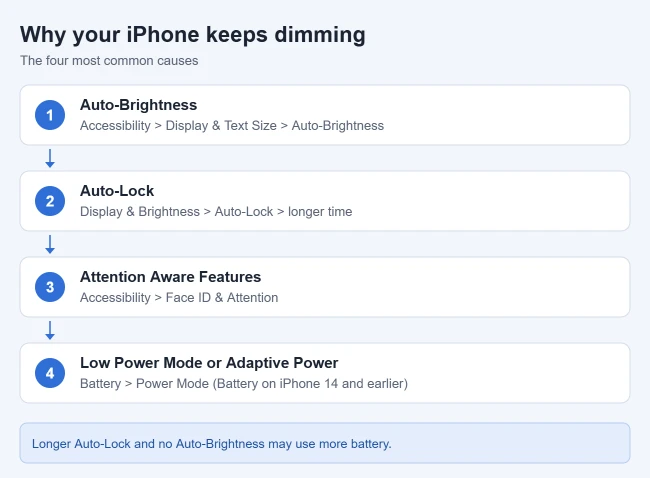
Your iPhone usually keeps dimming for one of two reasons. Auto-Brightness changes the screen to match the light around you, and Auto-Lock dims and then locks the screen when you stop using it. Turn off Auto-Brightness in Settings > Accessibility > Display & Text Size, and set a longer time in Settings > Display & Brightness > Auto-Lock.
If that doesn’t fix it, Low Power Mode, Adaptive Power, Attention Aware Features, heat or a color setting could be the cause. This guide goes through each one, based on Apple’s brightness and color guide, display timeout guide and related Apple support articles. Menu names can vary slightly by iOS version.
In this article:
- Turn off Auto-Brightness
- Stop the screen from turning off so fast
- Check Attention Aware Features
- Check Low Power Mode and Adaptive Power
- Other reasons the screen looks dim
- Make the screen brighter
- Frequently asked questions
Turn Off Auto-Brightness
Apple says iPhone uses its ambient light sensor to adjust brightness for the current light. That’s why the screen gets dimmer in a dark room.
- Open the Settings app.
- Tap Accessibility, then tap Display & Text Size.
- Turn off Auto-Brightness.
Result: The screen stays at the brightness you set until you change it. Apple notes that turning off Auto-Brightness may increase power consumption.
How to Stop the Screen From Turning Off So Fast
Apple says the display stays on while you’re looking at it, but it dims and then locks when you look away for a while. To give yourself more time:
- Go to Settings > Display & Brightness.
- Tap Auto-Lock.
- Choose a longer time.
Result: The screen waits longer before it dims and locks. Delaying Auto-Lock may also use more battery. If you can’t change Auto-Lock, check whether Low Power Mode is on (see below), because Apple says it sets Auto-Lock to 30 seconds.
Check Attention Aware Features
On iPhone models with Face ID, Apple says Attention Aware Features check whether you’re looking at the screen before dimming the display, expanding a notification on the Lock Screen, or lowering the volume of some alerts.
- Go to Settings > Accessibility > Face ID & Attention.
- Turn Attention Aware Features on or off.
Result: With the feature on, the screen should stay lit while you’re reading. If the screen still dims while you’re looking at it, try turning the feature off to see whether that stops it.
Check Low Power Mode and Adaptive Power
According to Apple, Low Power Mode reduces display brightness, sets Auto-Lock to 30 seconds and turns off some visual effects.
- On iPhone 15 and later, go to Settings > Battery > Power Mode and turn off Low Power Mode.
- On iPhone 14 and earlier, go to Settings > Battery and turn off Low Power Mode.
- You can also tap the battery icon in Control Center.
On iPhone 15 Pro and later, Adaptive Power is on by default. Apple says it can lower screen brightness, limit background activity and make performance changes when your battery use is higher than usual. It can also turn on Low Power Mode when the battery reaches 20%. To turn it off, go to Settings > Battery > Power Mode and turn off Adaptive Power.
Result: With both turned off, the iPhone stops lowering brightness to save power.
Other Reasons the Screen Looks Dim
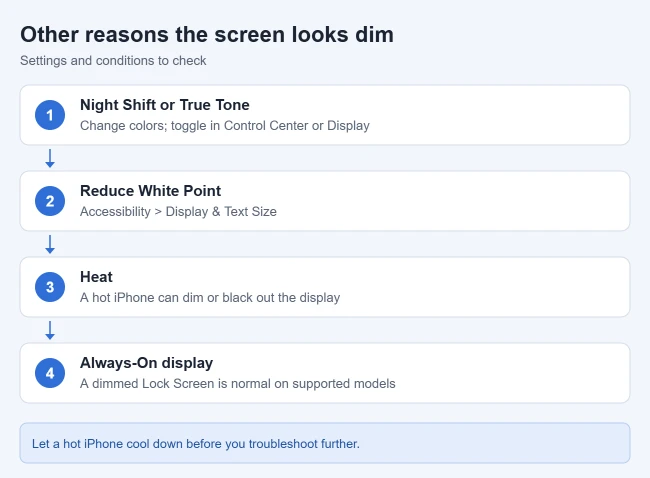
- Night Shift and True Tone: Night Shift shifts the display colors warmer, and True Tone adapts color and intensity to the light around you. Both can make the screen look dimmer or yellower. Our guide to Night Shift settings on iPhone shows how to change its schedule. Touch and hold the brightness control in Control Center to toggle them, or turn them off in Settings > Display & Brightness. A warm tint can also explain an orange hue on an iPhone.
- Reduce White Point: this accessibility setting tones down the intensity of bright colors. Check Settings > Accessibility > Display & Text Size and turn it off if you don’t need it.
- Heat: Apple says that if the iPhone gets too hot, the display can dim or go black while the phone protects itself. This is more likely in a hot car, in direct sunlight, or during navigation, gaming or long camera use. Let it cool down before you troubleshoot further.
- Always-On display: on supported models, a dimmed Lock Screen stays visible after the phone locks. That’s normal. To turn it off, go to Settings > Display & Brightness and turn off Always On Display.
If dimming also comes with unusually short battery life or unexpected shutdowns, check your iPhone battery health. A brightness change alone doesn’t mean the battery is worn.
How to Make the Screen Brighter
- Open Control Center and drag the brightness slider up.
- Or go to Settings > Display & Brightness and drag the slider.
Apple notes that a dimmer screen extends battery life, so you may want to lower brightness again when you don’t need it. To make the screen easier to read without making it brighter, see how to make text bigger on iPhone or turn on Dark Mode.
Frequently Asked Questions
Why does my iPhone dim even with Auto-Brightness off?
Check Low Power Mode, Adaptive Power, Attention Aware Features and heat. Apple documents that each of these can lower brightness or dim the display on its own.
Why does my screen dim when I’m watching a video?
If Attention Aware Features is on and the iPhone can’t tell you’re looking at it, the display may dim. Low Power Mode and heat can also reduce brightness during long videos.
Will turning off these features drain my battery faster?
It can. Apple warns that turning off Auto-Brightness and delaying Auto-Lock may increase power consumption.
More iPhone Guides
- How to make text bigger on iPhone
- How to turn on Dark Mode on iPhone
- Why is there an orange hue on my iPhone?
- Can you charge an iPhone from another iPhone?

Matthew Burleigh is the founder, head writer, and editor of Solve Your Tech, which he launched in 2012. He has written technology tutorials since 2008 and worked in IT since 2003, including small-business support, IT management, and consulting. He holds Bachelor’s and Master’s degrees in Computer Science from Arizona State University.
Matthew writes practical guides for Windows, iPhone and iPad, Microsoft Office, Outlook, Google apps, and Android. Solve Your Tech’s guides are tested on current devices or checked against official product documentation, with clear steps, sources, and update dates.
Read more about Matthew and how Solve Your Tech writes and updates its guides, or report a correction.