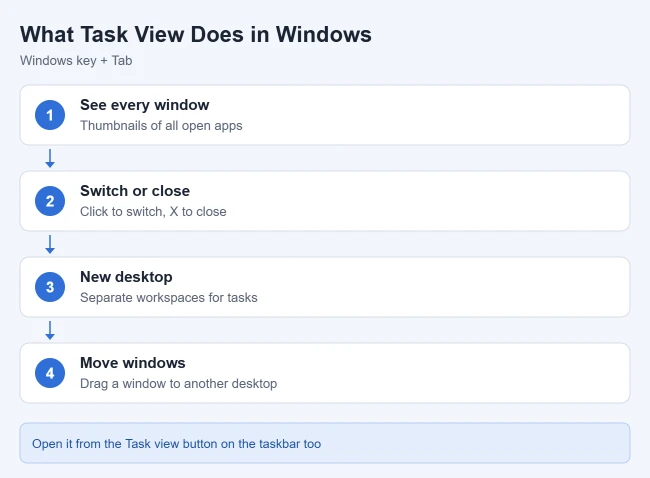
Task View shows all of your open windows at once so you can switch between them, and it lets you create and use multiple virtual desktops. Open it by selecting the Task view button on the taskbar or pressing Windows key + Tab.
This guide explains what Task View does, how to open it, how to create, rename and switch desktops, how to move windows between them, the keyboard shortcuts, and how to hide the button. It applies to Windows 11 and Windows 10 and follows Microsoft’s Configure multiple desktops in Windows article.
What Task View Does
- Shows every open window as a thumbnail, so you can click the one you want instead of hunting through the taskbar.
- Closes windows you no longer need, right from the thumbnails.
- Manages virtual desktops, which Microsoft describes as separate workspaces for different groups of apps, such as work and personal, or one desktop per project.
How to Open Task View
- Select the Task view button on the taskbar. In Windows 11, Microsoft says you can also hover over it to see your desktops.
- Press Windows key + Tab.
Result: Your open windows appear as thumbnails, with your desktops shown along the bottom or top of the screen.
How to Create and Name a New Desktop
- Open Task View.
- Select New desktop.
- Select the new desktop’s name and type a new one, such as Work or School.
- Open the apps you want on that desktop.
Result: You have a separate workspace. Apps you open there stay on that desktop until you move or close them.
Give each desktop its own background
In Task View, right-click a desktop, select Choose background, and pick a picture. Microsoft notes that per-desktop backgrounds only work with a picture, not a slideshow or solid color.
How to Switch, Move and Close Desktops
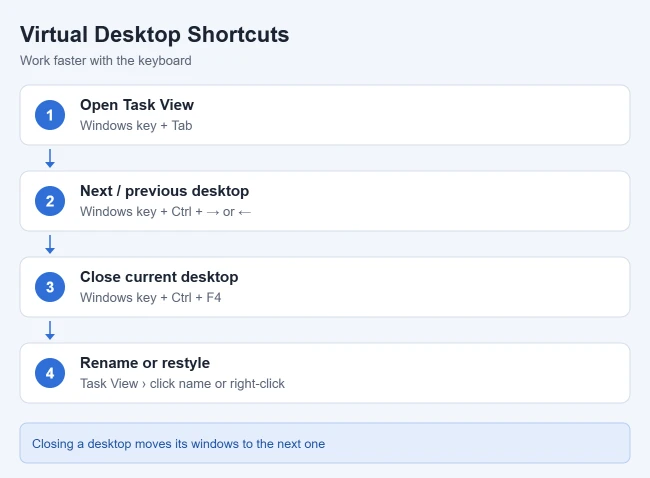
- Switch: open Task View and click a desktop, or press Windows key + Ctrl + Right arrow or Left arrow.
- Move a window: in Task View, drag a window’s thumbnail onto another desktop.
- Close a desktop: hover over it in Task View and click the X, or press Windows key + Ctrl + F4. Any apps on a closed desktop move to an adjacent desktop automatically.
How to Change Multitasking Settings
- Open Settings › System › Multitasking.
- Expand Desktops.
- Under On the taskbar, show all the open windows, choose Only on the desktop I’m using or On all desktops.
- Under Show all open windows when I press Alt+Tab, make the same choice for Alt+Tab.
Result: Microsoft says “Only on the desktop I’m using” keeps the taskbar focused on the current desktop, while “On all desktops” shows every open window no matter where you are.
How to Hide the Task View Button
Right-click the taskbar, select Taskbar settings, and turn off Task view under Taskbar items. Microsoft covers this in its Customize the taskbar article. You can still open Task View with Windows key + Tab.
When Is Task View Useful?
- Separating work and personal apps so notifications and windows don’t mix.
- Keeping a desktop ready for a meeting or presentation.
- Finding a window quickly when you have a dozen open.
Frequently Asked Questions
Does closing a desktop close my apps?
No. The apps move to the next desktop instead of closing.
Is Task View the same as Alt+Tab?
Alt+Tab is a quick switcher you hold down. Task View stays open so you can manage windows and desktops.
More Windows Guides

Matthew Burleigh is the founder, head writer, and editor of Solve Your Tech, which he launched in 2012. He has written technology tutorials since 2008 and worked in IT since 2003, including small-business support, IT management, and consulting. He holds Bachelor’s and Master’s degrees in Computer Science from Arizona State University.
Matthew writes practical guides for Windows, iPhone and iPad, Microsoft Office, Outlook, Google apps, and Android. Solve Your Tech’s guides are tested on current devices or checked against official product documentation, with clear steps, sources, and update dates.
Read more about Matthew and how Solve Your Tech writes and updates its guides, or report a correction.