To play the same sound through two HDMI or DisplayPort monitors in Windows 11, first check that each monitor plays audio independently, then use an audio mixer that can send one stream to both outputs. Voicemeeter Standard provides two hardware outputs for this purpose. Selecting a second Windows output alone changes the destination; it does not duplicate the stream.
For different apps on different speakers, use Windows Volume mixer instead. For compatible Bluetooth LE Audio accessories, Shared audio is another option. Stereo Mix can work in a suitable sound-card setup, but it is not a universal solution for two digital monitors.
Check Both Monitors Before Changing Audio Routing
Check the specifications for speakers or an audio output connected to external speakers. A monitor appearing in Windows does not establish that it has built-in speakers. HDMI and DisplayPort can carry sound; a VGA/DVI conversion can remove the audio path. Consult your monitor’s manual for its ports and supported connections.
- Open Settings > System > Sound. Under Output, select the first monitor, then play a short audio clip at low volume.
- Use the monitor’s own menu to check its volume, mute setting, and audio source. The selected source should match the connection you use.
- Select the second monitor in Windows and play the same clip. Confirm that it works by itself before trying simultaneous playback.
Microsoft’s audio troubleshooting guide covers output selection and disabled devices. ASUS’s monitor sound guidance explains speaker, cable, and on-screen-menu checks. Apply the settings appropriate to your own model.
Play the Same Audio Through Both Monitors
Voicemeeter is an optional third-party mixer that adds virtual audio devices. Use VB-Audio’s official Voicemeeter Standard download, rather than a driver-download site. Installation needs administrator access and a restart. Save your work first, and note your current Windows output so you can restore it.
- Install Voicemeeter Standard using its setup program, restart Windows, and open Voicemeeter. Its virtual playback device should now be available.
- In Voicemeeter’s Hardware Out area, select A1 and choose the first monitor’s audio device. Start with its WDM entry when available.
- Select A2 and choose the second monitor’s audio device. Choose two distinct monitor outputs, rather than the same device twice.
- In Windows Settings > System > Sound, select Voicemeeter Input (VB-Audio Voicemeeter VAIO), or the corresponding Voicemeeter VAIO playback entry, as the output. Despite its name, this is the playback endpoint that feeds the mixer.
- On the Voicemeeter VAIO virtual-input strip, enable routing to A. Keep the strip and hardware bus unmuted, with modest volume. Restart playback in your app if it was already open.
- Play a short clip and check both monitors. The virtual-input meter should move; audio routed to the hardware bus is sent to the selected A1 and A2 devices. Keep Voicemeeter running while you use this route.
These controls follow VB-Audio’s two-output startup guide and Standard user manual. Banana and Potato editions have different routing controls; the steps here describe Standard. Independent outputs may have different delays, so simultaneous playback does not guarantee perfect synchronization.
When Stereo Mix Is Appropriate
Stereo Mix is a recording input provided by an audio-device driver. It captures playback from that sound device; it does not combine arbitrary monitor outputs. The Audacity Manual explains that built-in sound-card Stereo Mix cannot capture playback sent through a separate HDMI, USB, or wireless device.
If your source is a supported sound-card output, the following listening route can copy that captured audio to another playback device. It should not be assumed to capture two separate HDMI monitors.
- Open Settings > System > Sound > More sound settings. On Playback, identify the output belonging to the sound device that supplies Stereo Mix, and play your app through that output. If you cannot find the link, see how to open the Sound control panel in Windows 11.
- On Recording, right-click empty space and select Show Disabled Devices. If Stereo Mix appears, enable it. If it is absent, this route is unavailable with the current driver.
- Open Stereo Mix > Properties > Listen. Check Listen to this device, choose the second output under Playback through this device, and apply the change.
- Test a short clip. If Stereo Mix receives no signal, stop and check the source device rather than assuming the second monitor is broken. To stop the copy, clear Listen to this device.
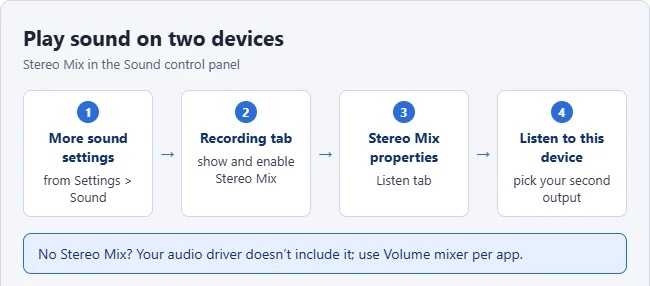
Illustration: the Stereo Mix listening route. It applies only when the source sound device supplies and captures the playback signal. Our Stereo Mix guide explains missing inputs and the distinction from loopback recording.
Send Different Apps to Different Outputs
- Open the apps you want to route and start their audio.
- Go to Settings > System > Sound > Volume mixer.
- Under Apps, expand an app’s controls if needed and select its Output device. Choose the first monitor for one app and the second for another.
- Check each app’s volume and restart playback if the destination has not changed. Also check an app’s own speaker setting if it offers one.
Microsoft documents per-app output selection. For example, a music app can use one monitor while a browser uses the other. This assigns each app a destination; it does not send one app to both. Our Volume mixer guide covers access and volume controls.
Microsoft’s Shared audio announcement describes a separate Bluetooth LE Audio feature. Your PC and both accessories must support the required broadcast capability, and the feature must be available on the PC. This is not a two-HDMI-monitor setting.
- Pair and connect two compatible LE Audio accessories.
- Open taskbar Quick Settings and select Shared audio when available.
- Choose the two listed accessories and select Share. Use their volume controls in the sharing menu.
During sharing, other Bluetooth audio inputs and outputs are unavailable. Use an integrated or wired microphone for calls. Stop the sharing session to return to normal Bluetooth operation. If the tile or accessories are missing, check the documented hardware requirements rather than assuming a Windows version alone guarantees support.
Fix Silence, Echo, or a Missing Output
- No mixer meter activity: check that the app feeds Voicemeeter’s virtual playback endpoint. An app explicitly assigned to a physical monitor can bypass that route.
- A meter moves but one monitor is silent: check the selected A1/A2 devices, routing, mute controls, and the monitor’s volume. Retest that monitor directly in Windows.
- Audio stopped after reconnecting a display: reselect its output in Voicemeeter or use Menu > Restart Audio Engine. The vendor manual documents restarting after audio-device changes.
- Echo or uneven timing: the vendor documents delays between independent outputs. Use one output if synchronization is more important than hearing both; copying stereo sound is not the same as creating surround sound.
If a monitor fails even when selected directly, fix that connection first. See our Windows 11 sound troubleshooting guide. Avoid changing multiple drivers and routing options at once; retest after each relevant change.
Return to Your Original Audio Setup
Select your original physical output in Windows Sound settings and return per-app output choices to Default or their previous devices. Clear Stereo Mix’s listening checkbox if you enabled it, or stop Shared audio if you used that method. Then close Voicemeeter and retest ordinary playback. If you later uninstall Voicemeeter, follow the vendor’s instructions and restart afterward.

Matthew Burleigh is the founder, head writer, and editor of Solve Your Tech, which he launched in 2012. He has written technology tutorials since 2008 and worked in IT since 2003, including small-business support, IT management, and consulting. He holds Bachelor’s and Master’s degrees in Computer Science from Arizona State University.
Matthew writes practical guides for Windows, iPhone and iPad, Microsoft Office, Outlook, Google apps, and Android. Solve Your Tech’s guides are tested on current devices or checked against official product documentation, with clear steps, sources, and update dates.
Read more about Matthew and how Solve Your Tech writes and updates its guides, or report a correction.