To unlink a Facebook Page from your personal account, remove your Page access rather than deleting your personal account. On a computer, switch into the Page and open Settings & privacy > Settings > Page setup > Page access. Review your access there; if removal is unavailable for your account, ask someone with full control to remove it.
Before leaving: make sure another trusted person has accepted Facebook access with full control and can manage the Page. Meta says a Page with nobody holding full control is automatically deactivated and scheduled for deletion. A pending invitation or task-only access is not a completed handover.
What Does “Unlink” Mean?
A Page does not have a standalone personal-account password that you can detach and hand over. People manage it through their own accounts and assigned permissions. If you want to stop managing it, remove those permissions. If you simply want to post as yourself, switch back to your personal profile without removing access.
Removing Page access does not erase your personal profile or automatically erase content already published on the Page. It also does not make your previous involvement anonymous. Review any public contact information you need changed with the remaining manager before leaving. If you manage more than one Page, you can find the Facebook Page ID to confirm which Page you are leaving.
If you are still deciding between a personal profile and a separate Page, our guide to creating a Page while keeping your profile explains their different purposes.
Check Your Access and Complete the Handover
Meta’s Page access explanation distinguishes Facebook access with partial or full control from task access. Facebook access lets a person switch into the Page. Full control also includes managing access and deleting the Page. Task access is used in management tools such as Meta Business Suite; it does not let that person switch into the Page on Facebook.
- Open the correct Page’s Page access settings using the steps below. Check who currently has full control.
- If a replacement is needed, a person with full control can use Add New beside People with Facebook access. Choose the trusted person’s own account, review the full-control setting and complete the confirmation prompts.
- Have that person accept the invitation and verify that they can switch into the Page and open its access settings. Do not treat sending the invitation as acceptance.
- Agree who will handle messages, scheduled content and any remaining work, then arrange removal of your own access.
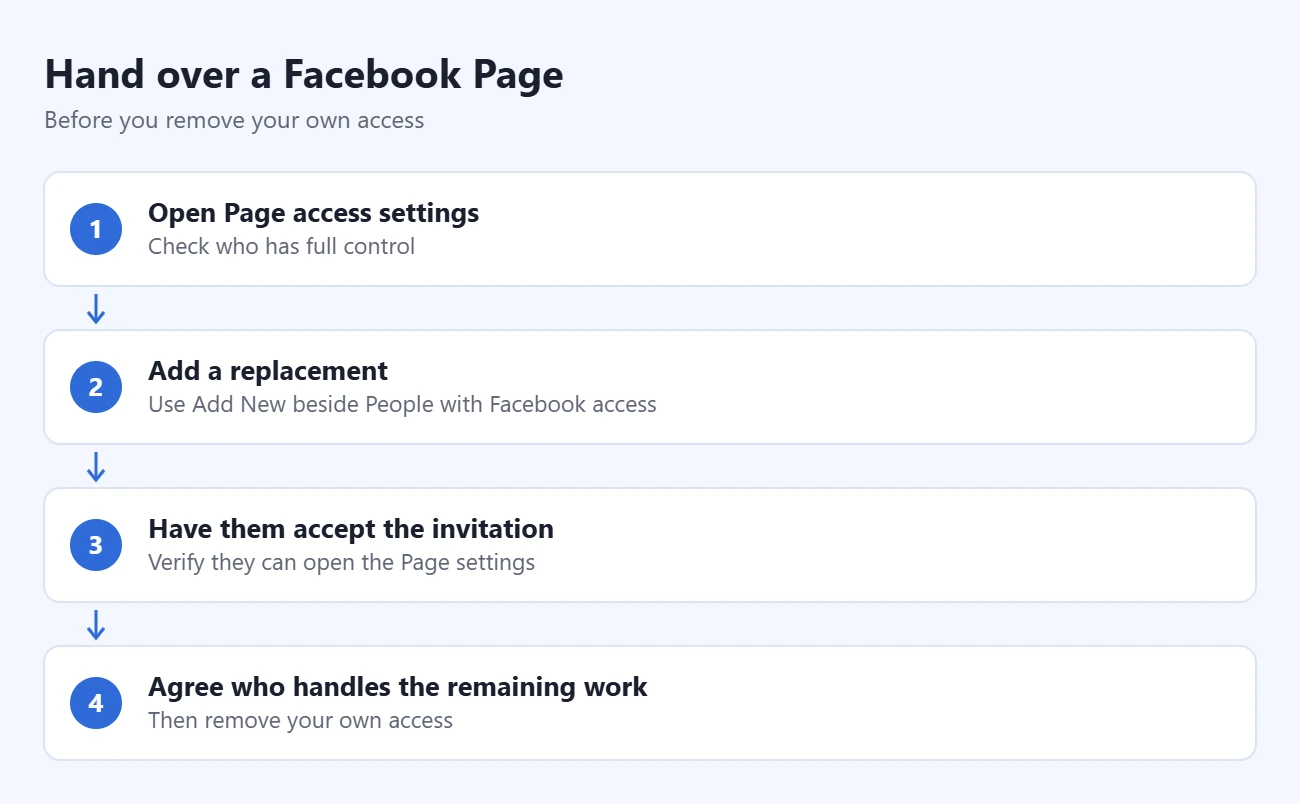
Granting full control lets that person remove other managers, including you, and delete the Page. Use an appropriate trusted account, not a shared password. If you are the only person with full control and want the Page to stay active, finish this handover before leaving.
Remove Your Facebook Page Access on a Computer
- Sign into the Facebook account that currently manages the Page. Select your profile picture, then See all profiles.
- Select the intended Page to switch into it. Check its name and picture so you do not change a different Page.
- Open the Page’s profile-picture menu, then Settings & privacy > Settings.
- Select Page setup > Page access. Meta places Page setup under Audience and Visibility in its removal instructions.
- Find your account in the access list and inspect its options. Where available, choose Remove access, read the confirmation and complete the prompts.
- If your account has no removal control, ask another person with full control to open the same list, select the options beside your name and choose Remove access. Partial or task access does not authorize managing other people’s permissions.
These settings follow Meta’s current access-management instructions. They describe removal of someone’s access and the full-control requirement; do not assume every access level offers a self-removal button.
Meta says the removed person receives an email. Removal of another administrator may require that person’s approval, so read any request status instead of assuming it took effect immediately.
Use the Facebook App on iPhone or Android
- Open Menu > Pages, select the Page and tap Switch.
- Open Menu > Settings and privacy > Settings while acting as that Page.
- Open Page setup > Page access and review your account’s access.
- Use the account’s options and Remove access if offered. Otherwise, have a person with full control remove your access using those settings.
Menu placement can vary with the app version. The important check is that you switched into the correct Page before opening its settings.
If the Page Belongs to a Business Portfolio
A business portfolio groups assets and people in Meta’s business tools. Its permissions can differ from a Page managed directly on Facebook. See Meta’s business-portfolio Page access guide before assuming a Facebook-menu change removes every assignment.
For a person with full control, Meta documents this Page removal route in Meta Business Suite: Settings > Accounts > Pages, select the Page, open People, find the person, choose Manage > Remove access. Ask the appropriate manager to remove your Page assignment if you lack the necessary control.
Leaving an entire business portfolio is broader than removing access to one Page. Meta warns that removing your own portfolio access loses your permissions to manage its Page. Review the scope before confirming; do not leave an organization merely to change one Page assignment.
Removing your personal access also differs from releasing the Page’s business ownership. Meta has a separate ownership-release request process. Use that only when the intended change is who owns the Page, rather than whether you personally manage it.
Verify the Result and Handle Missing Controls
After removal, return to your personal profile and check your managed Pages. Ask the remaining full-control manager to confirm that your access is absent and theirs still works. Being able to visit the Page as a member of the public does not prove you still have management permissions.
If you cannot find Page access, verify the account and Page identity first. Meta’s access-inspection guide gives the current route. The old Page Roles > Edit > Remove instructions describe an older interface; a missing Page Roles menu alone is not evidence of a fault.
Task-only users should contact the person who manages access in the relevant business tool. If the only manager cannot sign in, resolve that access problem before trying to hand over the Page.
Common Questions
Will this delete my personal account or the Page?
Access removal is separate from account or Page deletion. However, the Page needs someone with full control to remain active. Keep a confirmed replacement in place rather than relying on an automatic warning to protect it.
Can I manage the Page again later?
You need an appropriate new invitation from someone authorized to manage access and must accept it. Your old permissions do not return just because you visit or follow the Page.
Can I reduce my responsibility without leaving?
Discuss a suitable smaller permission set with the person managing access. Decide which work you still need to do; avoid relying on old Editor or Moderator role names when the current interface uses access levels.
Finish the handover, remove the intended permissions and have the remaining manager verify the Page still works.

Matthew Burleigh is the founder, head writer, and editor of Solve Your Tech, which he launched in 2012. He has written technology tutorials since 2008 and worked in IT since 2003, including small-business support, IT management, and consulting. He holds Bachelor’s and Master’s degrees in Computer Science from Arizona State University.
Matthew writes practical guides for Windows, iPhone and iPad, Microsoft Office, Outlook, Google apps, and Android. Solve Your Tech’s guides are tested on current devices or checked against official product documentation, with clear steps, sources, and update dates.
Read more about Matthew and how Solve Your Tech writes and updates its guides, or report a correction.