To stop showing as active, turn off Active Status in each Facebook and Messenger app or website you use. Turning it off in the Facebook app does not necessarily turn it off in Messenger, so if you use both, change both. This hides your green dot and recently-active time; it does not sign you out or stop messages. Meta covers the same steps in its Facebook Active Status help and Messenger Active Status help.
Turn off Active Status in the Facebook app
- Open Facebook and tap Menu.
- Tap Settings & privacy, then Settings.
- Under Audience and visibility, tap Active Status.
- Turn off Show when you’re active and confirm if prompted.
- If you switch between profiles, check that you changed the right one. Repeat the change in Messenger if you use it.
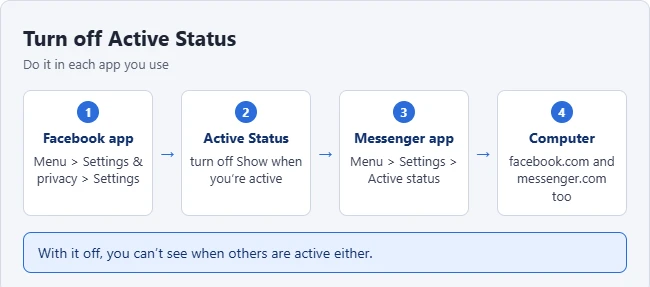
Turn it off in Messenger on iPhone or Android
- Open Messenger and tap Menu, then Settings.
- Tap Active status.
- Turn off Show when you’re active.
- Tap Turn off if Messenger asks you to confirm.
Turn it off in a mobile browser
The app setting may not cover the browser, so change both if you use both.
- In your phone browser, open Facebook and tap Menu.
- Tap Settings & privacy > Settings > Active Status.
- Turn off Show when you’re active and confirm if asked.
Turn it off on a computer
On facebook.com:
- Click Messenger at the top right.
- Beside Chats, click Options.
- Select Active Status: ON, turn the switch off, and click Save.
On messenger.com:
- Click your profile picture at the bottom left.
- Choose Preferences.
- Open Active status: On, turn it off, and click Save.
What turning it off does and does not do
Friends who could see your green dot or “Active” time no longer see it in the apps where you turned it off. According to Meta’s explanation of Active Status, you also can’t see other people’s Active Status while yours is off. Messaging still works. This setting does not hide posts, comments, stories or read receipts; those have separate controls.
You do not need to deactivate or delete your Facebook account to hide the green dot. Those actions affect much more than your activity indicator.
If someone still sees you as active
Ask whether they see you as active in Facebook or Messenger, then check that app’s switch. Also check other phones, tablets and browsers where you’re signed in, and make sure you changed the right profile. The indicator can take a little while to update, and Meta notes that you can still appear active in any app where the setting is still on.
If you compare from a second account, check the same profile in the same app after refreshing. A Facebook Page indicator can reflect Page activity or response history rather than your personal Active Status.
Common questions
Does turning off Facebook Active Status also turn it off in Messenger?
Not necessarily. Meta advises turning it off wherever you use Facebook or Messenger.
Will I still receive messages?
Yes. This setting changes visibility of your activity indicator, not your ability to receive messages.
Can I still see who is online?
Meta says no: if your Active Status is off, you cannot see other people’s Active Status.
How do I turn it back on?
Return to the same Active Status control in each app or website where you turned it off, then switch it on and save or confirm as prompted.
Active Status shows when you’re online, but Facebook never shows who looks at your profile. See can you see who views your Facebook profile?
More Facebook settings: how to edit your name on Facebook and how to reset your Facebook feed.
Looking for a chat that disappeared? See how to find deleted and archived messages in Messenger.

Matthew Burleigh is the founder, head writer, and editor of Solve Your Tech, which he launched in 2012. He has written technology tutorials since 2008 and worked in IT since 2003, including small-business support, IT management, and consulting. He holds Bachelor’s and Master’s degrees in Computer Science from Arizona State University.
Matthew writes practical guides for Windows, iPhone and iPad, Microsoft Office, Outlook, Google apps, and Android. Solve Your Tech’s guides are checked step by step against the device or app maker’s own documentation and tested on his own devices whenever he has the hardware or software, with clear steps, sources, and update dates.
Read more about Matthew and how Solve Your Tech writes and updates its guides, or report a correction.