Windows 11 doesn’t have a built-in scrolling screenshot tool. To capture a whole webpage, open it in Microsoft Edge, press Ctrl + Shift + S, and choose Capture full page. Microsoft describes the feature on its Edge screenshot tool page.
These steps work the same on Windows 11 and Windows 10 with current versions of Edge, Chrome, and Firefox. Snipping Tool and Windows key + Shift + S only capture what’s on screen, so for long windows in other apps you need a third-party tool such as ShareX.
Which Method Should You Use?
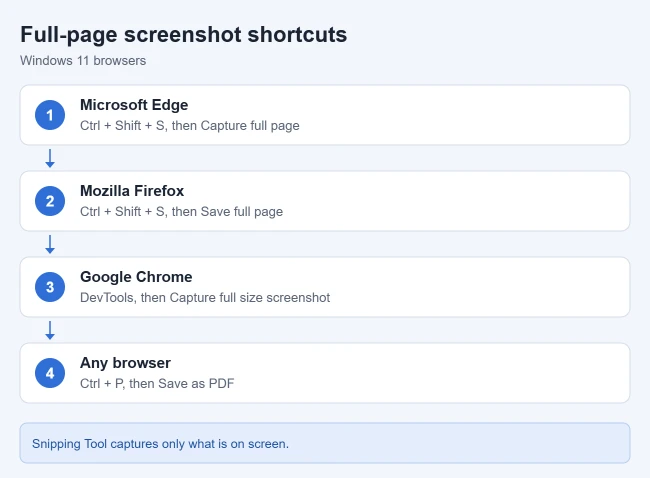
| What you want to capture | Best method | Install needed? |
|---|---|---|
| A webpage in Edge | Edge Capture full page | No |
| A webpage in Chrome | DevTools Capture full size screenshot | No |
| A webpage in Firefox | Take Screenshot > Save full page | No |
| A long article, receipt, or form you want to search later | Save as PDF | No |
| A Word document or PDF | Export or print to PDF | No |
| A chat window, settings page, or other app | ShareX scrolling capture | Yes |
Take a Scrolling Screenshot in Microsoft Edge
Edge comes with Windows 11, so this is the quickest option for most people. Microsoft walks through the same tool in its Edge screenshot guide.
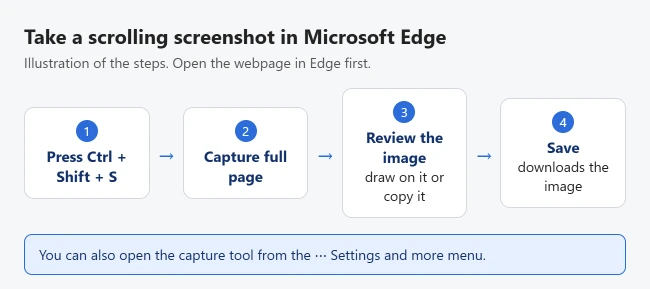
- Open the page you want to capture in Microsoft Edge.
- Press Ctrl + Shift + S. You can also right-click the page, or select the three-dot Settings and more menu in the top-right corner, and choose Screenshot.
- Select Capture full page. Edge captures the whole page, including the parts you’d have to scroll to see.
- Review the image in the editor that opens. You can draw on it before you save, or select Copy to paste it into Word, Outlook, or another app.
- Select Save to download the image.
Older versions of Edge call the Screenshot option Web capture. Need only part of a long page? Choose Capture area instead and drag over the section you want.
Take a Scrolling Screenshot in Google Chrome
Chrome’s full-page capture is in its developer tools, but you don’t need to know any code to use it.
- Open the page you want to capture in Chrome.
- Press Ctrl + Shift + I to open DevTools. You can also right-click the page and choose Inspect.
- Press Ctrl + Shift + P to open the Command Menu. If the shortcut does nothing, select the three-dot Customize and control DevTools button and choose Run command.
- Type screenshot.
- Select Capture full size screenshot.
Chrome saves the whole page as a PNG file in your Downloads folder. Press Ctrl + Shift + I again to close DevTools. The same menu has Capture area screenshot for part of a page.
If you want those files saved somewhere else, you can change the default download location in Windows 11.
If a saved screenshot seems to have gone missing, you can search your whole PC for photos and images from File Explorer.
Full-page screenshot extensions in the Chrome Web Store add a toolbar button for this. Before you install one, check its publisher and permissions, because a screenshot extension can see every page you capture.
Take a Scrolling Screenshot in Firefox
These steps follow Mozilla’s Firefox screenshots guide.
- Right-click an empty part of the page.
- Select Take Screenshot.
- Select Save full page in the top-right corner. (Save visible captures only what’s on screen.)
- Select Download, or Copy to put the image on your clipboard.
Shortcut: press Ctrl + Shift + S in Firefox to open the screenshot tool directly. Firefox saves a PNG named with the date, time, and page title in your Downloads folder.
Save a Whole Webpage as a PDF Instead
A PDF keeps text sharp and searchable, and it works in every browser. It’s often better than a very long image for receipts, articles, and forms.
- Open the page in your browser.
- Press Ctrl + P.
- Under Printer or Destination, choose Save as PDF or Microsoft Print to PDF.
- Select Save or Print, then choose a name and location.
The PDF splits the page into letter-size sheets and can drop some background images, so it won’t look exactly like the screen. All the text is included.
The browser methods only work on webpages. For a long chat, settings page, or document in another app, ShareX is a free, open-source tool for Windows 10 and 11. Download it from the ShareX website or Microsoft Store, not from a download mirror.
- Open the app you want to capture and scroll to the top of the content.
- In ShareX, select Capture > Scrolling capture. You can also right-click the ShareX icon in the taskbar notification area and choose the same command.
- Hold the left mouse button and drag over the part of the window that scrolls. Leave out fixed headers, footers, sidebars, and animated areas.
- Let go. ShareX starts scrolling and capturing on its own, then shows the finished image.
- Check the indicator in the top-right corner. Green means the pieces matched, yellow means some matched only partly, and red means the first two captures couldn’t be combined and ShareX stopped.
ShareX’s scrolling screenshot guide explains the indicators and suggests moving the pointer to the top of the scroll bar so hover effects don’t change the page during capture. To start and stop with a key instead of the menu, add a Start/Stop scrolling capture hotkey in ShareX’s hotkey settings.
Use ShareX’s After capture tasks menu and turn on Save image to file to keep the image on your PC. Uploading is a separate task, so check which tasks are on before you capture anything private. Open the saved image and check its top, middle, and bottom.
If you’d rather not install anything, take several screenshots instead. Press Windows key + Shift + S, capture one screen, scroll, and capture again. Every shortcut is listed in taking a screenshot on Windows 11, and Snipping Tool’s capture modes and save options are explained in using Snipping Tool on Windows 11.
Fix Common Scrolling Screenshot Problems
- Parts of the image are blank. Some pages load pictures only as you scroll. Scroll to the bottom and back to the top, wait a second, then capture.
- Only one screen was captured. Sites like webmail and dashboards scroll inside a panel, not the page itself, and browser full-page tools can’t unroll that panel. Use ShareX and select just the panel, or save the page as a PDF.
- A header or menu repeats down the image. Stitching tools capture sticky headers on every frame. Leave the header out of your ShareX selection, or use a browser method, which renders the page itself.
- Lines are missing or doubled in ShareX. A yellow or red indicator means the pieces didn’t line up. Close any pop-ups, keep the pointer still, and try again.
- The capture fails on a very long page. Very tall images are huge files and can hit the browser’s limits. Capture the page in sections with Capture area, or save it as a PDF.
- The image is wider than expected. Display scaling above 100% adds extra pixels. The picture is fine; shrink it when you share it.
Before you share any long capture, look through the whole thing for names, email addresses, or account details in sidebars and chat threads.
Frequently Asked Questions
How do I turn on scrolling capture in Windows 11?
There isn’t a setting for it. Windows 11 has no built-in scrolling capture, so use a browser’s full-page screenshot for webpages or a tool like ShareX for other apps. Shortcuts such as Ctrl + Alt + Print Screen belong to third-party tools, not Windows.
Can the Snipping Tool take a scrolling screenshot?
No. The Windows 11 Snipping Tool captures a rectangle, a window, a free-form shape, or the full screen, but only what you can see. It can record a video of you scrolling with Windows key + Shift + R, but that gives you a video file, not one tall image. Here’s how to open the Snipping Tool for regular captures.
Does this work the same on Windows 10?
Yes. The Edge, Chrome, Firefox, PDF, and ShareX steps are the same on Windows 10. Windows 10 support ended on October 14, 2025, but the browsers still run on it.
Where does a full-page screenshot save?
Chrome and Firefox save it to your Downloads folder by default. Edge opens the capture first and lets you choose Save or Copy.
Can I capture a page that needs a login?
Yes. Browser tools capture what you see while signed in. Online “screenshot this URL” services can’t, because they don’t have your login.

Matthew Burleigh is the founder, head writer, and editor of Solve Your Tech, which he launched in 2012. He has written technology tutorials since 2008 and worked in IT since 2003, including small-business support, IT management, and consulting. He holds Bachelor’s and Master’s degrees in Computer Science from Arizona State University.
Matthew writes practical guides for Windows, iPhone and iPad, Microsoft Office, Outlook, Google apps, and Android. Solve Your Tech’s guides are checked step by step against the device or app maker’s own documentation and tested on his own devices whenever he has the hardware or software, with clear steps, sources, and update dates.
Read more about Matthew and how Solve Your Tech writes and updates its guides, or report a correction.