There is no setting that locks the iPhone Home Screen layout. Icons move for a few specific reasons: an accidental touch and hold that starts edit mode, new apps being added to the Home Screen, a Home Screen layout reset, a Focus showing a different page, or a display size change. Each has its own fix below.
You spent time arranging your Home Screen, and later the apps have shuffled, jumped to another page, or vanished into the App Library.
The Honest Answer: There Is No Layout Lock
Apple’s iPhone User Guide explains how to move apps and widgets on the Home Screen, hide pages and reset the layout, but it does not describe any switch that freezes icons in place. Older advice that says Settings, Display & Brightness, View, Standard “locks” your icons is wrong: that setting changes how large things look on screen, and it doesn’t stop anything from being moved.
Apps and tweaks that claim to lock the Home Screen fall into two groups: jailbreak add-ons, which require modifying iOS and aren’t supported by Apple, and App Store “locker” apps, which Apple doesn’t document as able to lock the Home Screen. Skip both. The real controls are the ones below, matched to the cause.
| What you see | Likely cause | Where to fix it |
|---|---|---|
| Icons dragged to new spots or another page | Edit mode started by a long press | Exit edit mode; drag them back |
| New apps fill your pages | New downloads go to the Home Screen | Settings, Home Screen & App Library |
| Apps missing from pages | App Library Only, hidden pages, or a removed icon | App Library and page editing |
| Folders gone, apps alphabetical | Reset Home Screen Layout | Rebuild, or restore from a backup |
| A different page appears at certain times | A Focus with its own Home Screen page | Settings, Focus |
| Fewer icons fit, layout reflows | Display Zoom or Large icons | Display Zoom or Customize |
Stop Accidental Moves in Edit Mode
The most common cause is edit mode, often called jiggle mode. Apple’s guide says you start it by touching and holding the Home Screen background until the items begin to jiggle. A long press on an app icon may also open a menu with an option to edit the Home Screen. While icons jiggle, any drag moves them, and dragging toward the edge of the screen pushes an app onto another page.
This happens easily when the phone is in a pocket, when a child is holding it, or when you rest a thumb on the screen while scrolling. To get out cleanly and put things back:
- If icons are jiggling, stop and don’t drag anything else.
- Finish editing. On an iPhone with Face ID, tap the Home Screen background. On an iPhone with a Home button, press the Home button. On some versions you may see a Done button at the top of the screen instead.
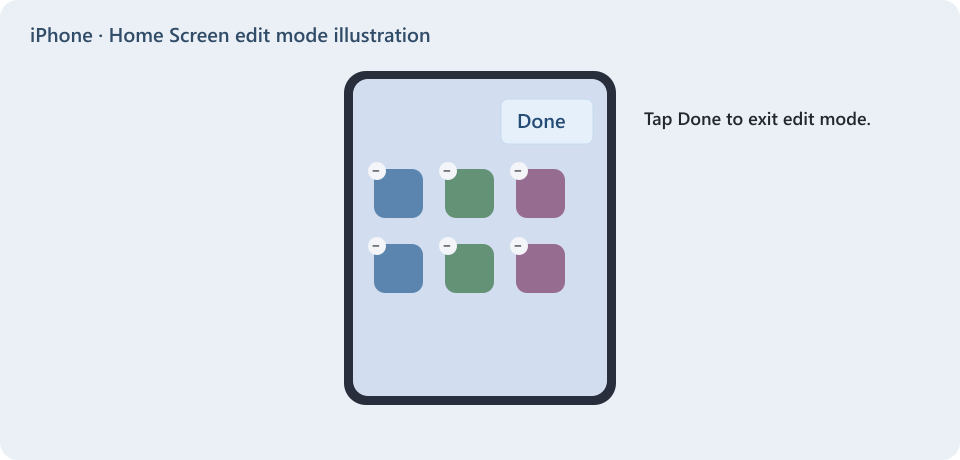
- To move an app back, touch and hold the background until icons jiggle, then drag the app to its old spot. Drag it to the right edge to reach another page, and wait a moment for the page to change.
- Finish editing again when it looks right.
Apple’s guide says apps and widgets can go anywhere on the Home Screen, including the top, bottom or sides, and each page can have its own layout. If you are tidying up after an accident, moving apps between pages on an iPhone covers the dragging itself.
To make accidents easier to undo, keep your most-used apps in the Dock and group the rest into folders. A folder moves as one item, so a stray drag affects one folder instead of a dozen icons. Some people also take a screenshot of each page as a reference for putting things back.
Control Where New Apps Go
When a new app lands on your Home Screen, it can take the next open spot and push your pages around. Apple’s App Library guide documents the setting that controls this:
- Open the Settings app.
- Tap Home Screen & App Library.
- Choose App Library Only to keep new downloads off your Home Screen, or Add to Home Screen if you want them placed there.
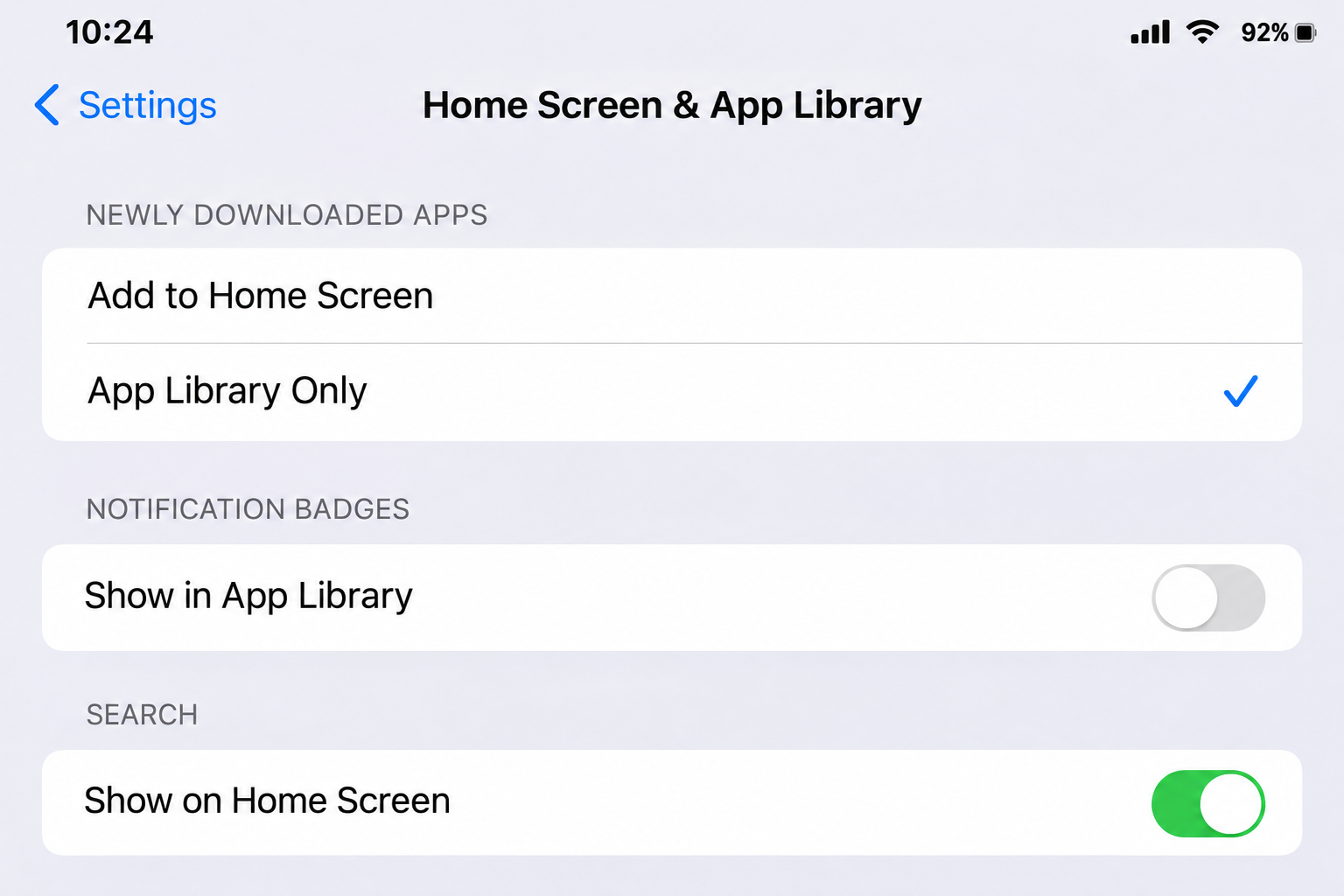
With App Library Only, your arranged pages stay as they are when you install something. You’ll find new apps in the App Library (swipe left past your last Home Screen page), where Apple sorts them into categories automatically. On the same settings screen, Apple says you can turn on Show in App Library if you want notification badges to appear there.
To place an app on a page later, touch and hold it in the App Library until the icons jiggle, and it moves to the Home Screen. Apps you add yourself, such as a Google Keep icon on the Home Screen, then sit wherever you drag them.
When Apps Seem to Vanish
An app that disappeared from your page usually hasn’t been deleted. Check these in order:
- App Library. Swipe left past your last page and search at the top. If the app is there, it was removed from the Home Screen or never added, which is what App Library Only does with new downloads.
- Hidden pages. Touch and hold the background until icons jiggle, then tap the dots near the bottom of the screen. Thumbnails of every page appear, and pages with a checkmark are shown. Tap a thumbnail’s checkmark circle to show a hidden page again. Apple notes that when pages are hidden, new apps may go to the App Library instead of the Home Screen.
- A folder. A drag that drops one app onto another creates a folder. Open folders near where the app used to be.
- A hidden or locked app. In iOS 18 and later, Apple lets you hide apps, and they move to a Hidden folder in the App Library that opens with Face ID, Touch ID or your passcode. Apple’s missing-app checklist covers where to look. How hiding and locking apps works explains how to bring one back.
Know What Reset Home Screen Layout Does
If your folders are gone and apps are suddenly in alphabetical order, the layout was probably reset. Apple’s guide describes exactly that result: any folders you created are removed, and apps you downloaded are arranged alphabetically after the apps that came with your iPhone.
Warning: only use this if you want to start over, because there is no undo. The path is Settings, General, Transfer or Reset iPhone, Reset, Reset Home Screen Layout, then Reset Home Screen. It sits next to other reset choices, so read the labels carefully; what each iPhone reset option does lays them out.
Restoring an iPhone from a backup or setting up a new phone from one can also bring back an older arrangement, so a layout may look different after either. Apple’s Home Screen pages don’t describe this, so treat it as something to check rather than a rule.
A Focus Can Switch Your Home Screen Page
If your icons look rearranged only at certain times (during work hours or at bedtime, for example), a Focus may be showing a different Home Screen page. Apple’s guide suggests putting the apps for a Focus on one page and showing that page while the Focus is on.
- Open Settings and tap Focus.
- Tap the Focus that is on when the layout looks wrong.
- Look at the Home Screen option and change or remove the page it shows.
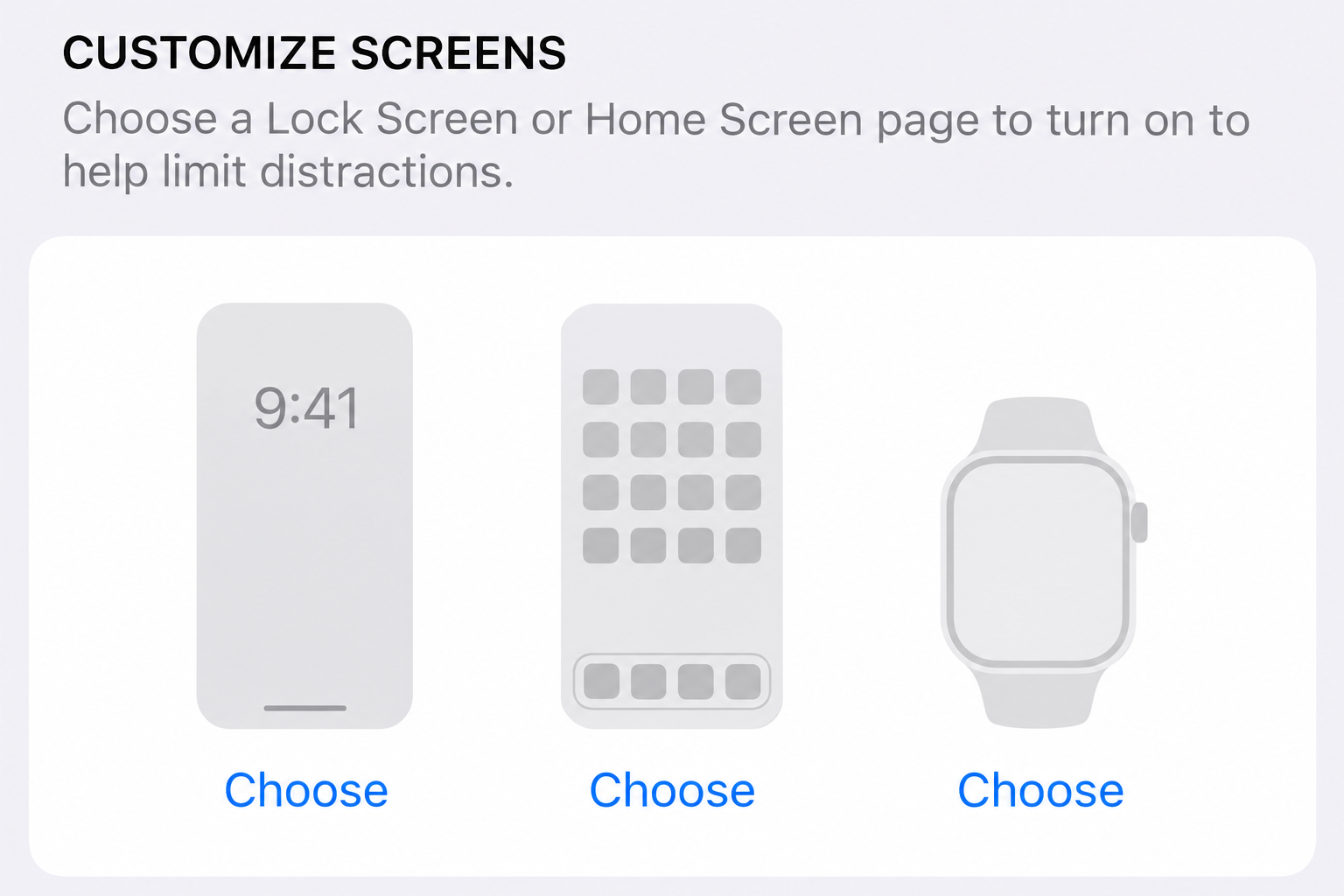
Your normal pages come back when the Focus turns off. Nothing was rearranged; you were simply looking at a different page.
Display Zoom and Icon Size Change the Grid
Display Zoom makes text and controls larger, which can mean fewer icons fit on each page, so your layout may reflow. It doesn’t lock anything in place. Apple’s display and text settings guide places it in different menus depending on the iOS version:
- iOS 26: Settings, Display & Brightness, Display Zoom, then choose a view such as Larger Text and tap Use Zoomed to confirm.
- iOS 27: Apple’s guide lists Settings, Appearance, Display Zoom, with the same choices.
If your layout changed right after someone adjusted the screen, switch Display Zoom back to its previous choice and check the pages again.
Icon appearance is a separate control. Touch and hold the background until icons jiggle, tap Edit, then tap Customize to choose options such as Large, Dark, Clear or Tinted. Apple says names disappear with Large icons. If an app seems to have “moved” but its name is just missing, check this setting. Widgets also take up space on the grid, so adding a large widget may push nearby apps to other spots.
Home Screen Layout Questions
Can I stop my child from moving apps around?
Apple doesn’t document a Screen Time or parental setting that blocks Home Screen editing. Folders and the App Library Only setting limit how much a stray drag can change, and Reset Home Screen Layout is not a fix because it erases your arrangement.
Why did my apps move after an update?
Apple’s pages don’t say that updates rearrange apps. Check the causes in the table above, especially a Focus page, hidden pages, App Library Only and Display Zoom, which can all make a layout look different after a restart.
Can I move apps between App Library categories?
No. Apple says App Library categories are organized automatically. You control the Home Screen pages, not the categories.
How do I get my old layout back?
There’s no undo button. Rebuild it by dragging in edit mode. Reset Home Screen Layout only returns the default arrangement, not your previous one.
Start with Settings, Home Screen & App Library, set new apps to App Library Only, and then fix your pages once. After that, most changes you see will come from a long press, which you can spot and undo right away.

Matthew Burleigh is the founder, head writer, and editor of Solve Your Tech, which he launched in 2012. He has written technology tutorials since 2008 and worked in IT since 2003, including small-business support, IT management, and consulting. He holds Bachelor’s and Master’s degrees in Computer Science from Arizona State University.
Matthew writes practical guides for Windows, iPhone and iPad, Microsoft Office, Outlook, Google apps, and Android. Solve Your Tech’s guides are checked step by step against the device or app maker’s own documentation and tested on his own devices whenever he has the hardware or software, with clear steps, sources, and update dates.
Read more about Matthew and how Solve Your Tech writes and updates its guides, or report a correction.