To make your Facebook account more private, open Settings & privacy → Settings → Audience and visibility. Set future posts to Friends, review older posts, restrict who can find and contact you, and check what strangers can still see with View As.
Facebook does not have one universal switch that hides everything. Your name and some profile information remain public, which is also why Facebook cannot be used with an anonymous account, while posts, stories, contact details, and discovery settings have separate controls. The steps below are for a personal profile; settings may differ for other profile types.
If You Mean a Business or Creator Page
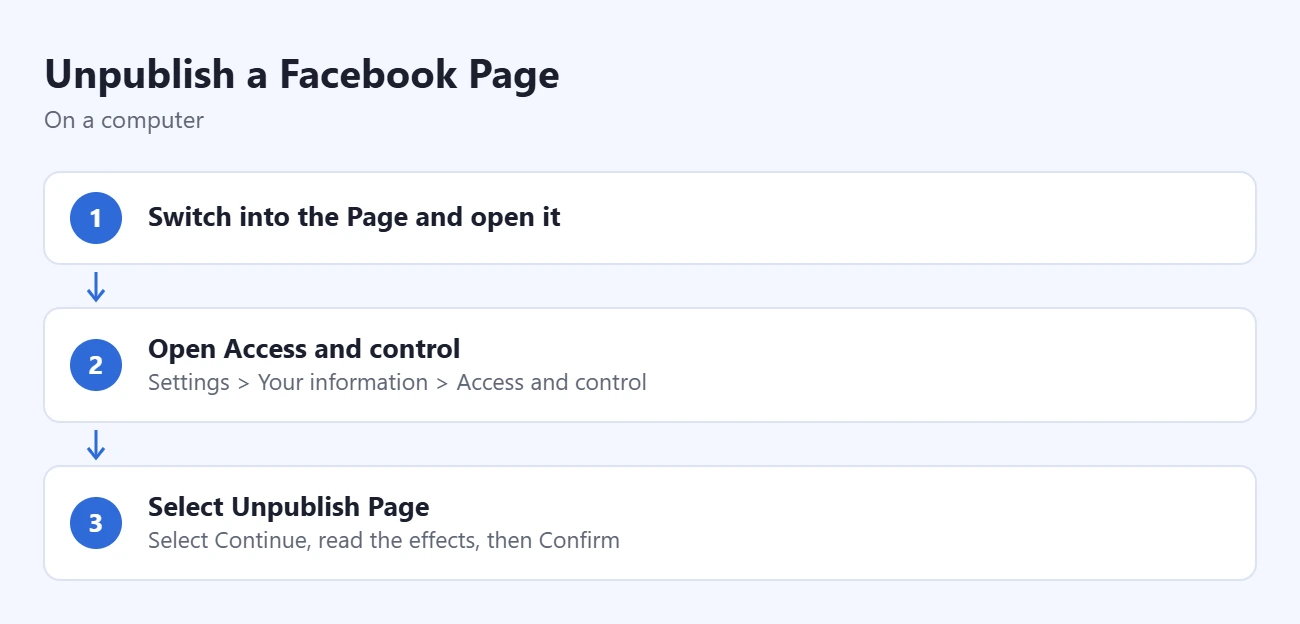
A Facebook Page has separate visibility controls from your personal profile. To hide a Page while continuing to edit it, use Unpublish Page. Meta says this requires Facebook access to the Page. Followers and other visitors without that access will no longer see or find it.
- On a computer, switch into the Page, click its profile picture at the top right, and open the Page.
- Under Manage Page, select Settings. Open Your information > Access and control.
- Select Unpublish Page > Continue, read the effects, then choose Confirm if you want to proceed.
Unpublishing pauses existing ad campaigns and prevents Page interactions such as sending messages. Associated child Pages are also unpublished. To bring it back, return to Access and control and choose Publish Page, then complete the confirmations. These steps follow Meta’s unpublishing guide.
Deactivation is another option: it hides the Page but also prevents edits until reactivation, and requires Facebook access with full control. Switch into the Page, open Settings & privacy > Settings > Access and control, and choose Deactivate Page. Follow the prompts. Meta documents deactivation and reactivation separately. Neither option deletes the Page. For a personal profile instead, use the audience controls below.
1. Open your Facebook privacy settings
- On a computer: Click your profile picture at the top right, then select Settings & privacy and Settings.
- On iPhone or Android: Open the Facebook app’s Menu, then Settings & privacy and Settings. The Menu button’s location can vary with the layout.
- Find Audience and visibility and open the setting you want to change.
The current route uses Audience and visibility, rather than an old standalone Privacy page. Meta’s privacy settings instructions list the available sections.
For a guided review on the desktop website, open Settings & privacy → Privacy Checkup. Choose Who can see what you share and review the information and audiences it shows. Some Checkup settings require your main profile, so switch to that profile if necessary. See Meta’s Privacy Checkup guide.
2. Restrict future posts
- Under Audience and visibility, open Posts.
- Select Who can see your future posts?
- Choose Friends for ordinary sharing with your friends, or a more restrictive audience that fits the post.
- Click Done if that confirmation appears.
This sets the default for future posts; it does not rewrite the audience of posts you already published. Meta documents the default-audience control here.
Check the audience underneath your name when composing a post. You can override it for that particular post with the audience selector. For example, set a personal update to Friends and a private reminder to Only Me, without assuming the reminder changed your future default.
Stories and reels have separate audience controls. Open their sections under Audience and visibility and review them too. A Friends default for ordinary posts does not replace those checks. Meta’s post-audience guide explains these distinctions and warns that tagging can expand an audience.
Make One Facebook Post Public for Sharing
For an ordinary post on your own profile that you want other people to share, choose Public for that post’s audience. When composing it, use the audience selector beneath your name. For an existing post, open the post on your profile and use its audience control beside the date or time, then select Public and finish any confirmation shown. Meta’s post-audience guide covers both new and existing posts.
Public makes the content visible more widely, including beyond your friends. Review the text and photos before choosing it. You can make one suitable announcement public while keeping your usual future-post default at Friends; the single-post choice does not change that default. Confirm the saved audience is Public and check the post’s sharing options.
Changing your own profile settings cannot make someone else’s restricted post, or a post inside a private group, publicly shareable. Stories, reels, and Page posts use their own controls, and a locked profile restricts sharing choices. Public is an audience setting, not a guarantee that every kind of content exposes the same Share button. Use the appropriate content-specific settings rather than making your whole account public.
Limit Sharing by Restricting a Post’s Audience
Facebook does not offer one universal switch that prevents every kind of sharing. For an ordinary post on your own profile, open its audience control beside the date or time and choose Friends, Friends except, or Only Me, as appropriate. Only Me keeps that post visible to you. Meta’s post-audience instructions explain how to change an individual post.
Use the future-post default above for new posts and review older posts separately below. These controls limit the audience; they cannot stop a permitted reader from taking a screenshot or copying the information. Friends except excludes selected people from the audience, rather than giving those people a special prohibition on resharing. Check tagging and the saved audience before relying on a restriction.
Stories, reels, Page posts and group posts have their own controls. Check the reel’s audience and remix options separately; changing your ordinary-post default is not a substitute. Use View As below to inspect your public profile, and review the actual post’s audience too.
3. Review past posts before limiting them
For an individual old post, open your profile, find the post, and select the audience icon beside its date or time. Choose the audience you want.
For a broader change, open Settings → Posts → Limit who can see past posts → Limit Past Posts, then read the confirmation before applying it. The bulk action changes older posts shared more broadly than Friends to Friends.
There is no single-click undo for the bulk change. To restore different audiences afterward, edit the posts individually. Existing custom audiences are not changed by this tool, tagged people can still affect the audience, and it does not change somebody else’s posts. Meta describes these limits in its past-post privacy instructions.
4. Limit discovery, friend requests, and your friends list
Open Audience and visibility → How people find and contact you. Check each control separately rather than trying to set every option to the same audience.
- Who can send you friend requests? Choose Friends of Friends if you want to narrow requests. This control offers Everyone or Friends of Friends, not Only Me.
- Who can see your friends list? Choose Only Me if you want to hide your full list on your own profile. Other profiles can still reveal a friendship, and visitors may see mutual friends. See Meta’s friends-list guidance.
- People with your email address / People with your phone number: Open View beside each setting and choose No one if you do not want that contact detail used to suggest your profile. These are suggestion controls, not a guarantee that nobody can find you by name or through other information. Meta explains email and phone-based suggestions.
- Search engines outside Facebook: If the external-search linking setting is available, turn it off to restrict that linking. Existing search results can take time to update; this does not erase every public mention of you elsewhere.
Meta’s privacy troubleshooting page documents the friend-request choices and cached-search limitation.
For the complete procedure, our Facebook friends-list privacy guide shows the desktop and app steps, how to verify the saved audience, and why mutual friends may still be visible.
5. Review contact information and tagging
On your desktop profile, open About → Contact and Basic Info. Use the audience selector beside each contact detail to choose who can see it. Hiding a phone number from your profile is separate from restricting suggestions based on that number.
Then open Settings → Profile and tagging. Enable Review posts you’re tagged in before the post appears on your profile? if you want to approve their appearance there.
That review setting controls your profile, not the original post’s audience. The same tagged post can still appear in Feed, search, or other places. Meta’s profile-review instructions explain the limit.
6. Check the public view and profile-lock option
On the desktop website, go to your profile, select its options button below your name, and choose View As. Inspect the information visible to non-friends. Select Exit View As in the banner when finished. Meta documents this public-view check.
If Lock Profile is available in your country, you can also apply Facebook’s bundled profile restrictions. Our Facebook profile-lock guide explains how to enable it, what it changes, and what to do when the option is missing.
Turn Off Facebook Professional Mode
On the desktop website, open your main profile by clicking your profile picture, then your name. Select Options below the cover photo, choose Turn off pro mode, then Continue > Turn off after reading the effects. This changes the existing profile; it does not delete it or deactivate a separate Page. Meta’s current pro-mode instructions provide device-specific tabs if you use the app.
Read the consequences before confirming. Meta currently says Who can follow me changes to Friends and followers who are not friends are lost. Existing friends and profile content remain, but content and audience insights are unavailable, professional tools are removed, and future monetization bonuses and payouts are paused. Eligible pending payouts are still received. Turning the mode off is therefore more than an appearance change.
Afterward, check that the profile offers the option to turn pro mode on again and review the post audiences using this guide. Switching the mode off does not make every previously public post private. You can enable pro mode again, but do not assume switching it back restores lost followers or every prior professional feature.
Delete a Facebook Dating Profile Separately
Facebook Dating has its own profile. Making Facebook posts private does not remove that Dating profile. In the Facebook app for Android or iPhone, open Menu > Dating, open the menu at the top right and choose Settings. Under Account, select Delete Profile, then read the confirmation and select Delete Profile if you want to proceed. Menu positions can vary by app version; use Meta’s current Dating deletion instructions if your screen differs.
Deleting Dating removes your Dating profile, answers, likes, matches and conversations from your profile. It does not delete your Facebook account, and it cannot remove messages already in someone else’s inbox. Meta says you must wait 7 days before creating another Dating profile. Review anything you need to keep before confirming. Removing a shortcut, uninstalling the app or changing your regular Facebook audience settings is not the same as deleting Dating.
Frequently asked questions
Can I make my current profile picture completely private?
Your current profile picture and cover photo are normally public. You can adjust privacy for photos previously used in those roles. Where profile locking is available, non-friends receive a limited view, including restrictions on full-resolution photos. See Meta’s profile-photo explanation.
Will these settings hide my comments in public groups?
No. Public group and Page posts and comments remain public according to their context. Your profile-post default does not make those contributions private. Meta’s public-information guide explains what others can see.
Can I change my mind later?
You can revisit an individual setting and select a different audience. Remember that Limit Past Posts requires individual post edits to reverse its bulk audience changes. After any change, check an important post’s audience and the public profile view instead of assuming one setting handled everything.

Matthew Burleigh is the founder, head writer, and editor of Solve Your Tech, which he launched in 2012. He has written technology tutorials since 2008 and worked in IT since 2003, including small-business support, IT management, and consulting. He holds Bachelor’s and Master’s degrees in Computer Science from Arizona State University.
Matthew writes practical guides for Windows, iPhone and iPad, Microsoft Office, Outlook, Google apps, and Android. Solve Your Tech’s guides are tested on current devices or checked against official product documentation, with clear steps, sources, and update dates.
Read more about Matthew and how Solve Your Tech writes and updates its guides, or report a correction.