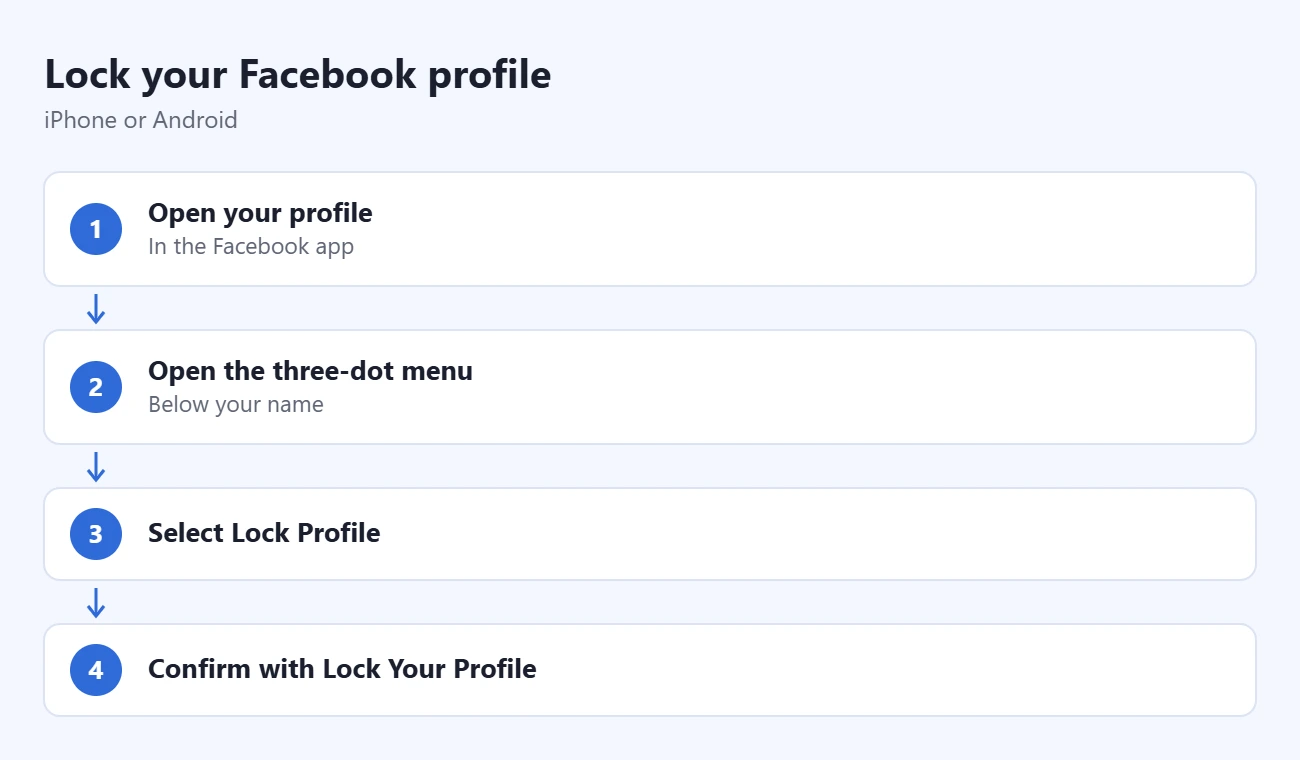
To lock your Facebook profile, open your own profile, tap the three-dot options menu, choose Lock Profile, and confirm with Lock Your Profile. This option is available only in certain countries. If it is missing, use the individual privacy settings described below to get most of the same protection.
These steps cover personal profiles in the Facebook app and on facebook.com, not Facebook Pages.
A profile lock limits what non-friends see. It doesn’t make you anonymous (see whether you can create an anonymous Facebook account) and differs from a security lock, covered in the locked Facebook account recovery guide.
How to lock your Facebook profile on iPhone or Android
The steps are the same in both apps. Only the position of the Menu button differs: it’s usually at the bottom right on iPhone and at the top right on Android.
- Open Facebook and go to your profile. Tap your profile picture, or tap Menu and then your name. Your profile page opens with your cover photo at the top.
- Open the three-dot options menu. It’s the … button next to Edit profile, below your name. Use this menu, not the three dots on an individual post. A list of profile options opens.
- Select Lock Profile. Facebook shows a screen explaining what will change. Nothing is locked yet.
- Tap Lock Your Profile. A confirmation message tells you that you locked your profile. Tap OK to return to your profile.
Meta’s profile-lock Help Center page explains where the feature is available and which privacy settings it changes.
Check your profile for the locked-profile indicator. Opening the explanation screen doesn’t apply the lock. If you closed that screen without confirming, return to the profile menu: it shows Unlock Profile when the lock is on and Lock Profile when it’s off.
How to lock your profile on a computer
If you’re signed in at facebook.com in a desktop browser, you can lock the same profile there.
- Click your profile picture at the top right, then click your name. Your profile opens.
- Click the … button below your cover photo, to the right of Edit profile.
- Click Lock profile. If you don’t see it, the feature isn’t offered for your account.
- Click Lock your profile, then click OK in the confirmation box.
You only need to do this once. The lock belongs to your profile, so it shows in the app, in a phone browser, and on a computer.
What changes when you lock a profile?
- People who are not your friends see a limited version of your profile.
- Your profile’s photos and posts, full-resolution profile and cover photos, and stories are restricted to friends.
- New photos and posts you share are restricted to friends, and older profile posts shared with Public change to Friends.
- Profile review and tag review are enabled, so posts you’re tagged in need your approval before they show on your profile.
- Only a portion of your About information is visible outside your friends list.
The same limit applies when you make a reel on Facebook, so check its audience before you share it.
Nothing changes for your friends. They can still see anything your audience settings allow them to see, so review your friends list and remove anyone you no longer want to share with. On Instagram there’s no profile lock, but you can hide posts and stories from someone on Instagram with Close Friends, archiving, or a private account.
Events have their own audience setting, which you choose when you create a Facebook event, and it can’t be changed after the event is published.
What a profile lock doesn’t do
A lock is a visibility setting, not a way to disappear. After you lock your profile:
- People can still find you in Facebook search. Your name and a small version of your profile picture still appear. A lock also leaves reaction counts alone; to turn those off, use the reaction count settings.
- People outside your friends list can still send you a friend request or a message. Messenger has its own privacy controls.
- You may still show up in suggestions such as People You May Know.
- Posts, photos and comments you share in groups, on Pages, or on a friend’s profile follow the audience of that place, not your lock.
- Your friends can still take screenshots or share what they can see.
- It doesn’t hide when you’re online. To do that, turn off your Active Status on Facebook.
Lock profile or another privacy setting?
Different settings solve different problems. Use this to pick the right one:
| Your goal | Use this |
|---|---|
| Hide your posts, photos and stories from everyone who isn’t a friend | Lock Profile, or the manual settings below |
| Hide old public posts but leave everything else as it is | Limit Past Posts |
| Keep someone as a friend but show them less | Add them to your Restricted list |
| Stop one person from seeing or contacting you | Block them |
| Hide who your friends are | Who can see your friends list? set to Only me |
| Take a break from Facebook entirely | Deactivate your account |
Why is Lock Profile missing?
Meta offers profile locking only in certain countries and doesn’t publish a full list. If Lock Profile isn’t in your profile’s three-dot menu, the feature isn’t available for your account, and updating the app won’t add it.
Also make sure you opened your own personal profile, not a Page or someone else’s profile. If you manage more than one profile, check the name at the top of the screen before you look for the option.
Get the same protection with manual settings
If Lock Profile isn’t offered, you can match most of what it does in Menu > Settings & privacy > Settings. On a computer, click your profile picture and choose Settings & privacy > Settings.
- Under Audience and visibility, tap Posts and set Who can see your future posts? to Friends.
- On the same screen, tap Limit who can see past posts and confirm with Limit Past Posts. Public posts on your profile change to Friends. You can’t undo this in one step, so you’d have to change any post you want public again one at a time.
- Go back and tap Stories, then set your story privacy to Friends.
- Tap Profile and tagging and turn on Review posts you’re tagged in before the post appears on your profile?.
- Tap How people find and contact you and set Who can see your friends list? to Friends or Only me. On the same screen, you can turn off the option that lets search engines outside of Facebook link to your profile.
- Tap Followers and public content and set Who can follow me to Friends, so people who aren’t your friends can’t follow your public posts. The people who follow you without being friends appear in a separate list, covered in finding your followers on Facebook.
For more detail, including how to limit discovery and check older posts one at a time, read the Facebook privacy settings guide. To hide only your friends list, make your Facebook friends list private.
Your profile picture and cover photo stay public with the manual method. Choose pictures you’re comfortable with anyone seeing. Meta also describes items in a profile’s Featured section as public, and this Facebook highlights walkthrough shows how to remove photos or stories from it.
Check what remains visible
On the desktop website, open your profile, select its options menu below your name, and choose View As. Your profile appears the way the public sees it. Scroll through it, then choose Exit View As. Meta’s View As instructions explain this check.
Visitors who aren’t signed in see no more than the public view. For more on that, read how to view Facebook without an account.
Profile review controls whether a tagged post appears on your profile. It does not erase the original post or stop its audience from seeing it elsewhere. If somebody else posted a photo, their audience settings still matter; see Meta’s profile-review explanation.
How to unlock your Facebook profile
- Open your profile in the app or on facebook.com.
- Select the three-dot menu below your name.
- Choose Unlock Profile, then confirm with Unlock.
Unlocking doesn’t make every post and photo public again. Posts that changed to Friends when you locked your profile keep that audience, so check the audience of any post you want to share more widely. Also check Profile and tagging in Settings if you no longer want to approve tags.
Facebook Profile Lock Questions
Does locking my profile hide every trace of my account?
No. A limited profile is still a profile, and your name and small profile picture still show in search. Do not treat the feature as protection against every way somebody could identify you or copy information they are allowed to see.
Do I need to lock it again on each device?
No. The lock applies to your Facebook profile everywhere, in the app and on the website.
Can friends of friends see a locked profile?
No, unless they’re also your friends. The lock limits your profile content to Friends, so friends of friends see the same limited version as everyone else.
Can a current profile picture be completely private?
Facebook normally treats current profile and cover photos as public information. Profile locking limits access to the full-resolution versions where the feature is available, but it does not make your entire identity disappear. Meta explains the distinction in its profile and cover photo guidance. Changing your cover can also create an update post, and you can change your Facebook cover photo without announcing it by limiting that post to Only Me.
Can I lock a Facebook Page?
No. Profile locking is for personal profiles. A Page is designed to be public, and its visibility is managed through the Page’s own settings.
After you lock your profile, open View As on a computer once to make sure the public view shows only what you expect.

Matthew Burleigh is the founder, head writer, and editor of Solve Your Tech, which he launched in 2012. He has written technology tutorials since 2008 and worked in IT since 2003, including small-business support, IT management, and consulting. He holds Bachelor’s and Master’s degrees in Computer Science from Arizona State University.
Matthew writes practical guides for Windows, iPhone and iPad, Microsoft Office, Outlook, Google apps, and Android. Solve Your Tech’s guides are checked step by step against the device or app maker’s own documentation and tested on his own devices whenever he has the hardware or software, with clear steps, sources, and update dates.
Read more about Matthew and how Solve Your Tech writes and updates its guides, or report a correction.